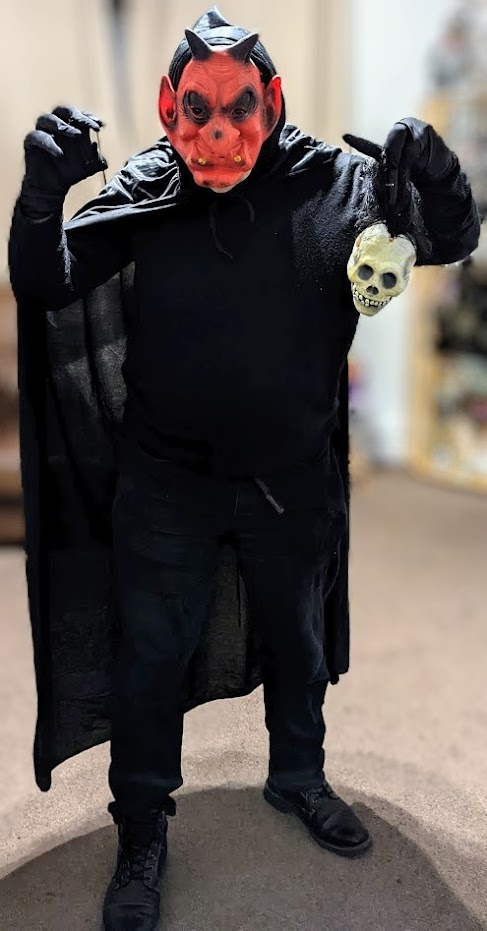
My YouTube Channel Playlists: Pets

Pets YouTube Logo
Image © YouTube via Wikipedia and edited by Frank Parker

YouTube began in 2005, and most of you reading this are aware of it and have used it, or do use it often, unless you live on another planet!

I created my YouTube channel in 2006 and, sadly, I haven’t done much on it due to many personal and health reasons, mainly because of struggling with my Mental Health I planned to do more, I planned to get better confidence wise and content wise and then my life got in the way and shit happened and often, but now, in 2026, I am trying hard to rectify all that.  I can’t change the past, and I am not looking into the future, but right now, I am doing the best I can to make the present a better place to live in for my state of mind.  I take every day as it comes and working on My YouTube Channel and website are an important part of that for me.

The original videos I put up were about my favourite Football team Birmingham City, my beloved, and sadly missed, pets, Rocky and Rosie, a Black Country L.P. that was my Dad’s and one about fire! 

Since then, I added short videos to update the channel with more short and long website related content to come.

Below are all links to my History playlist and other playlists, blog posts, etc. 

To all my original subscribers, if you are still around THANK YOU so much for sticking with me, and if you are new, then THANK YOU equally as much for joining.

I hope you enjoy looking at my videos and if you do please like them, share them and subscribe. This means a lot to me and helps me grow my channel, which will only boost my confidence further.

Pets 

These videos are dedicated to the family pets that I have had the fortune of having in my life, or other family members pets they have owned and have crossed the rainbow bridge and are no longer with us now.  These videos cover anything to do with mine and my family’s pets.

Pets Playlist

Click here to directly see the list of videos in my Pets playlist via my YouTube channel.

The latest video from it is showing below. 

You can also view the full list of videos on this playlist by clicking on the three lines symbol showing in the top right of the video.  You can also see other options to click on at the bottom as well.

When you are there PLEASE SUBSCRIBE, PRESS THE BELL to be notified when a new video comes out and LIKE and SHARE this video.  It would mean a lot to me, and THANK YOU in advance if you do any/all of the above.

The Latest Video In This Playlist

Blog Posts

Links

The image shown at the top is the copyright of YouTube and edited by Frank Parker.

YouTube on Facebook.

YouTube on X.

YouTube on Instagram.

My YouTube Channel Playlists: Inspiration

Inspiration YouTube Logo
Image © YouTube via Wikipedia and edited by Frank Parker

YouTube began in 2005, and most of you reading this are aware of it and have used it, or do use it often, unless you live on another planet!

I created my YouTube channel in 2006 and, sadly, I haven’t done much on it due to many personal and health reasons, mainly because of struggling with my Mental Health I planned to do more, I planned to get better confidence wise and content wise and then my life got in the way and shit happened and often, but now, in 2026, I am trying hard to rectify all that.  I can’t change the past, and I am not looking into the future, but right now, I am doing the best I can to make the present a better place to live in for my state of mind.  I take every day as it comes and working on My YouTube Channel and website are an important part of that for me.

The original videos I put up were about my favourite Football team Birmingham City, my beloved, and sadly missed, pets, Rocky and Rosie, a Black Country L.P. that was my Dad’s and one about fire! 

Since then, I added short videos to update the channel with more short and long website related content to come.

Below are all links to my History playlist and other playlists, blog posts, etc. 

To all my original subscribers, if you are still around THANK YOU so much for sticking with me, and if you are new, then THANK YOU equally as much for joining.

I hope you enjoy looking at my videos and if you do please like them, share them and subscribe. This means a lot to me and helps me grow my channel, which will only boost my confidence further.

Inspiration 

On this page is anything related to Inspiration.  Hopefully, they will inspire you or just help in any way possible.  The videos that are in its playlist below appear in other playlists and cover anything to do with inspiration. 

Inspiration Playlist

Click here to directly see the list of videos in my Inspiration playlist via my YouTube channel.

The latest video from it is showing below. 

You can also view the full list of videos on this playlist by clicking on the three lines symbol showing in the top right of the video.  You can also see other options to click on at the bottom as well.

When you are there PLEASE SUBSCRIBE, PRESS THE BELL to be notified when a new video comes out and LIKE and SHARE this video.  It would mean a lot to me and THANK YOU in advance if you do any/all of the above.

The Latest Video In This Playlist

To find out more information about the video above, and to comment if you’d like to, then click on where it says YOUTUBE in the bottom right and that will take you directly to my YouTube channel.

PLEASE SUBSCRIBE, PRESS THE BELL to be notified when a new video comes out and LIKE and SHARE this video.  It would mean a lot to me and THANK YOU in advance if you do any/all of the above.

Blog Posts

Links

The image shown at the top is the copyright of YouTube and edited by Frank Parker.

YouTube on Facebook.

YouTube on X.

YouTube on Instagram.

My YouTube Channel Playlists: Music

Music YouTube Logo
Image © YouTube and edited by Frank Parker

YouTube began in 2005, and most of you reading this are aware of it and have used it, or do use it often, unless you live on another planet!

I created my YouTube channel in 2006 and, sadly, I haven’t done much on it due to many personal and health reasons, mainly because of struggling with my Mental Health I planned to do more, I planned to get better confidence wise and content wise and then my life got in the way and shit happened and often, but now, in 2026, I am trying hard to rectify all that.  I can’t change the past, and I am not looking into the future, but right now, I am doing the best I can to make the present a better place to live in for my state of mind.  I take every day as it comes and working on My YouTube Channel and website are an important part of that for me.

The original videos I put up were about my favourite Football team Birmingham City, my beloved, and sadly missed, pets, Rocky and Rosie, a Black Country L.P. that was my Dad’s and one about fire! 

Since then, I added short videos to update the channel with more short and long website related content to come.

Below are all links to my History playlist and other playlists, blog posts, etc. 

To all my original subscribers, if you are still around THANK YOU so much for sticking with me, and if you are new, then THANK YOU equally as much for joining.

I hope you enjoy looking at my videos and if you do please like them, share them and subscribe. This means a lot to me and helps me grow my channel, which will only boost my confidence further.

Music

I love music.  I have since I was little.  It is my drug, my therapy, my life, my everything. It keeps me alive every day. On this page is anything related to Music. The videos that are in its playlist below appear in other playlists and cover anything to do with Music.

Music Playlist

Click here to directly see the list of videos in my Music playlist via my YouTube channel.

The latest video from it is showing below. 

You can also view the full list of videos on this playlist by clicking on the three lines symbol showing in the top right of the video.  You can also see other options to click on at the bottom as well.

When you are there PLEASE SUBSCRIBE, PRESS THE BELL to be notified when a new video comes out and LIKE and SHARE this video.  It would mean a lot to me and THANK YOU in advance if you do any/all of the above.

The Latest Video In This Playlist

To find out more information about the video above, and to comment if you’d like to, then click on where it says YOUTUBE in the bottom right and that will take you directly to my YouTube channel.

PLEASE SUBSCRIBE, PRESS THE BELL to be notified when a new video comes out and LIKE and SHARE this video.  It would mean a lot to me and THANK YOU in advance if you do any/all of the above. 

Blog Posts

Links

The image shown at the top is the copyright of YouTube and edited by Frank Parker.

YouTube on Facebook.

YouTube on X.

YouTube on Instagram.

My YouTube Channel Playlists: Sports

Sports YouTube Logo
Image © YouTube via Wikipedia and edited by Frank Parker

YouTube began in 2005, and most of you reading this are aware of it and have used it, or do use it often, unless you live on another planet!

I created my YouTube channel in 2006 and, sadly, I haven’t done much on it due to many personal and health reasons, mainly because of struggling with my Mental Health I planned to do more, I planned to get better confidence wise and content wise and then my life got in the way and shit happened and often, but now, in 2026, I am trying hard to rectify all that.  I can’t change the past, and I am not looking into the future, but right now, I am doing the best I can to make the present a better place to live in for my state of mind.  I take every day as it comes and working on My YouTube Channel and website are an important part of that for me.

The original videos I put up were about my favourite Football team Birmingham City, my beloved, and sadly missed, pets, Rocky and Rosie, a Black Country L.P. that was my Dad’s and one about fire! 

Since then, I added short videos to update the channel with more short and long website related content to come.

Below are all links to my History playlist and other playlists, blog posts, etc. 

To all my original subscribers, if you are still around THANK YOU so much for sticking with me, and if you are new, then THANK YOU equally as much for joining.

I hope you enjoy looking at my videos and if you do please like them, share them and subscribe. This means a lot to me and helps me grow my channel, which will only boost my confidence further.

Sports 

These videos are about sports that I like to watch and/or have participated in.  They appear in other playlists and cover anything to do with sports.  

Sports Playlist

Click here to directly see the list of videos in my Sports playlist via my YouTube channel.

The latest video from it is shown below. 

You can also view the full list of videos on this playlist by clicking on the three lines symbol showing in the top right of the video.  You can also see other options to click on at the bottom as well.

When you are there PLEASE SUBSCRIBE, PRESS THE BELL to be notified when a new video comes out and LIKE and SHARE this video.  It would mean a lot to me, and THANK YOU in advance if you do any/all of the above.

The Latest Video In This Playlist

Blog Posts

Links

The image shown at the top is the copyright of YouTube and edited by Frank Parker.

YouTube on Facebook.

YouTube on X.

YouTube on Instagram.

My YouTube Channel Playlists: Animals

Animals YouTube Logo
Image © YouTube and edited by Frank Parker

YouTube began in 2005, and most of you reading this are aware of it and have used it, or do use it often, unless you live on another planet!

I created My YouTube Channel in 2006 and, sadly, I haven’t done much on it due to many personal and health reasons, mainly because of struggling with my Mental Health. I planned to do more, I planned to get better confidence wise and content wise and then my life got in the way and shit happened and often, but now, in 2026, I am trying hard to rectify all that.  I can’t change the past, and I am not looking into the future, but right now, I am doing the best I can to make the present a better place to live in for my state of mind.  I take every day as it comes and working on my YouTube channel and website are an important part of that for me.

The original videos I put up were about my favourite Football team Birmingham City, my beloved, and sadly missed, pets, Rocky and Rosie, a Black Country L.P. that was my Dad’s and one about fire! 

Since then, I added short videos to update the channel with more short and long website related content to come.

To all my original subscribers, if you are still around THANK YOU so much for sticking with me, and if you are new, then THANK YOU equally as much for joining.

I hope you enjoy looking at my videos and if you do please like them, share them and subscribe. This means a lot to me and helps me grow my channel, which will only boost my confidence further.

Animals 

On this page is anything related to Animals. The videos that are in its playlist below appear in other playlists and cover anything to do with Animals. 

Animals Playlist

Click here to directly see the list of videos in my Animals playlist via my YouTube channel.

The latest video from it is showing below. 

You can also view the full list of videos on this playlist by clicking on the three lines symbol showing in the top right of the video.  You can also see other options to click on at the bottom as well.

When you are there PLEASE SUBSCRIBE, PRESS THE BELL to be notified when a new video comes out and LIKE and SHARE this video.  It would mean a lot to me and THANK YOU in advance if you do any/all of the above.

The Latest Video In This Playlist

To find out more information about the video above, and to comment if you’d like to, then click on where it says YOUTUBE in the bottom right and that will take you directly to my YouTube channel.

PLEASE SUBSCRIBE, PRESS THE BELL to be notified when a new video comes out and LIKE and SHARE this video.  It would mean a lot to me and THANK YOU in advance if you do any/all of the above.

Blog Posts

Links

The image shown at the top is the copyright of YouTube and edited by Frank Parker.

YouTube on Facebook.

YouTube on X.

YouTube on Instagram.

Birmingham City: Keep Right On To The End Of The Road

B.C.F.C. Badge
Image © of B.C.F.C.

There is only one team in Birmingham worth supporting with true passion and Birmingham City is it.  I have been supporting them since 1978 when Jim Smith was the manager.  He is my favourite manager to date.   I am a blue nose ’til I die.
You can read lots more about Blues by clicking here

The following article is all about Blues current situation in the Championship as of March the 13th, 2024. 

It also appears (slightly edited) on Blues Focus.   It is my first article for them.  Click here to view.

How Are We Doing?  

You can see all our results from this season so far here.

As of the time of writing this on March the 13th, 2024 Blues are uncomfortably lying in 21st place,  just one point from the bottom three.  We have only drawn one game in the last five.  Our last game was our game in hand against Middlesbrough which was a must-win and we didn’t.

Is It Time To Worry?  

Worry! Yes and No! Be very anxious, most definitely!

Being worried for me depends if we can get a much-needed three points against Watford in our next game and it depends if we drop into the bottom three and stay there by the middle of April. 

We have eight games to play after Watford and I am not going to lie, it is now at the squeaky bum time of the season but we have escaped relegation before.  Will our luck run out finally and we go down to League One? We will know that for sure come our last game on the 4th of May but until it is mathematically proven we are down then the season isn’t over yet despite a majority of so-called fans on social media throwing the towel in already.

I am trying hard to keep the faith.  I’ll be honest, it’s been harder than other times we have been in this situation but I always try to take the positives out of every game and I always have hope, not just in football but in life itself.  It’s what keeps me going.  I will always back the team and most of all the badge, which will always come first for me regardless of who is playing, what manager is in charge, who owns the club or what league we are in.

Make no bones about it, April is going to be tough for us but it’s not like we haven’t been in a relegation fight before.  Blues do what we do best and that is fight until the end.  Now is not the time to point fingers and blame so and so but a time for players and fans to stay strong, TOGETHER.

Will Tony Mowbray Be Back In Charge For The Q.P.R. Game?  

It was rumoured today on social media that the Blues boss Tony Mowbray would be back after being away since the 19th of February for the home game against Queen’s Park Rangers on March the 29th.

I take rumours online with a pinch of salt but I do hope it is true, all Blues fans will feel the same I am sure, but I only want that if he is truly well enough for the task of the tough days ahead until the end of the season.  We need him now, more than ever.  

Do We Get A Temporary Manager In If Mowbray Doesn’t  Return Soon?

Some “fans” have suggested on social media that Chairman Of The Board Tom Wagner should bring in another temporary manager to take over from current temporary manager Mark Venus because he isn’t cutting the mustard.  These comments are ridiculous.  This would not only be disrespectful to Venus, but it would be especially disrespectful to Mowbray and undermine his authority.  If it were to happen he would resign for sure, as would Venus and the rest of the staff and then the temporary manager may stay, he may not and then we have to get yet another new manager and staff and hope they will be successful.  It would be total madness and have the club moving backwards, not forward and I can’t see Wagner wanting that to happen.
What If?

What if the worst comes to the worst and Blues do get relegated to League One? Then what? We keep supporting them regardless that’s what, it’s what a true, loyal Blues fan does.  Of course, it would be heartbreaking but it would not be the end of the world.

We dropped down to the old third division in 1989 for the first time in our history and it wasn’t until 2002 that we were in the Premiership (established in 1992).  Under the shrewd ownership of Knighthead Co-Founder and Co-C.E.O. Tom Wagner and the experience of manager Tony Mowbray, it won’t take as long to get back to the glory days, I am sure of that.  

Will Wagner And Knighthead Capital Depart If We Get Relegated?

Some “fans” on social media believe this will happen, but I don’t.  Wagner doesn’t look like someone who is a quitter.  He and Knighthead have invested too much time and money into Birmingham City and financially it wouldn’t make sense for them to move on without making a profit on their investment.  Wagner said it was a long-term plan to get Birmingham City back into the Premiership and, as a man of integrity,  I do not believe he would go back on his word and do that to the Blues fans.  

And Finally

Albeit we stay up or go down, win, lose or draw, everyone has a right to an opinion and to get angry, sad or whatever emotion the joys and sorrows of being a Blues fan entails but being aggressive and abusive to your own supporters,  players, manager or owners online or to their faces can’t be condoned.  I think it is better not to comment at all as things get said that shouldn’t be in the heat of the moment.  Even if what you say is meant in good faith, your words easily get misconstrued and twisted on social media and get used against you.

I am an empathetic and passionate bloke and have supported Blues since the late 70’s.  Since my teens, I have battled with depression and anxiety and at the moment,  I just can’t watch them play lately.  It does not help my mental health at all.  My anxiety and stress levels have been too high for my comfort lately. 

It’s like watching a family member or your pet suffer.  It’s heartbreaking.  However, that doesn’t make me not care what’s going on, I just currently can’t take the stress.  It genuinely makes me feel ill.

I always say, for me, supporting Blues is like having a girlfriend or wife that pisses me off or makes me sad, I love her and I forgive her but at times I need my own space, ha ha, but as the header says above, true Blues fans will always KEEP RIGHT ON TO THE END OF THE ROAD.

Blog Posts

Notes And Links

The Birmingham City Club logo shown at the top of this page is the copyright of Birmingham City F.C. and has come from Blues social media pages and website. 

Birmingham City F.C. – Official website.  

Birmingham City on Facebook  – This is their official Facebook page.

Birmingham City on Twitter – This is their official Twitter page.

Birmingham City on YouTube – This is their official YouTube page.

Blues Store Online – Birmingham City’s official club store online.

Blues Focus – Official website.  Bringing you closer to Birmingham City Football Club.

Blues Focus on Facebook – This is their official Facebook page.

Blues Focus on Twitter – This is their official Twitter page.

Blues Focus on Instagram – This is their official Instagram page.

Blues Focus on YouTube – This is their official YouTube channel.

Christmas

Image © of Liliboas via iStock

I have many happy memories over the decades, especially family ones from when I was younger in the 70’s and ’80s and when my kids were younger.  Sadly my mental health suffered in my adult years, especially in the 2010’s right up to the start of the 2020’s and it was difficult to enjoy them and love them like I used to but thankfully I can start to LOVE CHRISTMAS again.

For me, Christmas is about being with family and friends.  It is enjoying good company and eating, drinking and being merry.  It is reminiscing about the happy Christmases of old and remembering people and animals that shared those precious times with us but are no longer here with us.  It is about wonderful Christmas trees and the giving and recieving of presents.  It is about the beautiful colours that come with it.  It is about traditions.  It is about listening to Christmas music and watching Christmas films and programmes. It is about the spirit of Christmas and the feeling of peace.  It is not just a holiday, it is a state of mind.  

Living in the mostly Christian country of England when I was younger (not so much now) and being a former Christian myself I always celebrated Christmas regarding the birth of Jesus Christ.

The older I got, as an atheist, I came to realise the bible just contradicts itself and is full of fictional stories.  The date of that birth itself, December the 25th, can’t be agreed upon or proved throughout the centuries (and I’m not bothering to cover all that below) but to be honest I don’t care about the date or what did or didn’t happen on it or if anyone involved with it is real but that is not here or there.

I am someone who tries hard to avoid talking about religion, royalty and politics but it would be impossible to talk about Christmas and not refer to religion regarding what is written below, however, it is written respectfully.  As I have always said about religion, as long as it doesn’t involve harm or hatred and is peaceful, I will respect your right to believe whatever you like as long as you respect my right not to believe.  Royalty and politics are briefly mentioned as it is hard to avoid them when it is part of Christmas history but mainly I wanted to keep this page interesting and informative about Christmas.

If you are reading this in December then have a very HAPPY CHRISTMAS!

Image © of Crumpled Fire via Wikipedia

A Nativity Scene made with Christmas lights.

About Christmas

Christmas is an annual festival commemorating the birth of Jesus Christ, primarily observed on December the 25th as a religious and cultural celebration among billions of people around the world.  A feast central to the Christian liturgical year, it follows the season of Advent (which begins four Sundays before) or the Nativity Fast, and initiates the season of Christmastide, which historically in the West lasts twelve days and culminates on Twelfth Night.  Christmas Day is a public holiday in many countries, is celebrated religiously by a majority of Christians, as well as culturally by many non-Christians, and forms an integral part of the holiday season organised around it.

The traditional Christmas narrative recounted in the New Testament, known as the Nativity of Jesus, says that Jesus was born in Bethlehem, under messianic prophecies.  When Joseph and Mary arrived in the city, the inn had no room so they were offered a stable where the Christ Child was soon born, with angels proclaiming this news to shepherds who then spread the word.

There are different hypotheses regarding the date of Jesus’ birth and in the early fourth century, the church fixed the date as December the 25th.  This corresponds to the traditional date of the winter solstice on the Roman calendar.  It is exactly nine months after the Annunciation on March the 25th, also the date of the spring equinox.  Most Christians celebrate on December the 25th in the Gregorian calendar, which has been adopted almost universally in the civil calendars used in countries worldwide.  However, some of the Eastern Christian Churches celebrate Christmas on December the 25th of the older Julian calendar, which currently corresponds to January the 7th in the Gregorian calendar.  For Christians, believing that God came into the world in the form of man to atone for the sins of humanity, rather than knowing Jesus’ exact birth date, is considered to be the primary purpose of celebrating Christmas.

The celebratory customs associated in various countries with Christmas have a mix of pre-Christian, Christian, and secular themes and origins.  Popular modern customs of the holiday include gift giving, completing an Advent calendar or Advent wreath, Christmas music and caroling, watching Christmas movies, viewing a Nativity play, an exchange of Christmas cards, church services, a special meal, and the display of various Christmas decorations, including Christmas trees, Christmas lights, nativity scenes, garlands, wreaths, mistletoe, and holly. In addition, several closely related and often interchangeable figures, known as Father Christmas, Santa Claus,  Saint Nicholas, and the Christkind, are associated with bringing gifts to children during Christmas and have their own body of traditions and lore.  Because gift-giving and many other aspects of the Christmas festival involve heightened economic activity, the holiday has become a significant event and a key sales period for retailers and businesses.   Over the past few centuries, Christmas has had a steadily growing economic effect in many regions of the world. 

Etymology

Other Names 

In addition to Christmas, the holiday has had various other English names throughout its history.  The Anglo-Saxons referred to the feast as midwinter, or, more rarely, as Nātiuiteð, which comes from the Latin nātīvitās.  Nativity, meaning birth, is also from the Latin nātīvitāsIn Old English, Gēola (Yule) referred to the period corresponding to December and January, which was eventually equated with Christian Christmas.  Noel (also Nowel or Nowell, as in The First Nowell) entered English in the late 14th century and is from the Old French noël or naël, itself ultimately from the Latin nātālis (diēs) meaning birth (day).

Koleda is the traditional Slavic name for Christmas and the period from Christmas to Epiphany or, more generally, to Slavic Christmas-related rituals, some dating to pre-Christian times.

The History Of Christmas

In the 2nd century, the earliest church records indicate that Christians were remembering and celebrating the birth of Jesus, an observance that sprang up organically from the authentic devotion of ordinary believers although a set date was not agreed on.  Though Christmas did not appear on the lists of festivals given by the early Christian writers Irenaeus and Tertullian, the early Church Fathers John Chrysostom, Augustine of Hippo, and Jerome attested to December the 25th as the date of Christmas toward the end of the fourth century.  A passage in Commentary on the Prophet Daniel (AD 204) by Hippolytus of Rome identifies December the 25th as Jesus’s birth date, but this passage is considered a later interpolation.

In the East, the birth of Jesus was celebrated in connection with the Epiphany on January the 6th.  This holiday was not primarily about Christ’s birth, but rather his baptism.  Christmas was promoted in the East as part of the revival of Orthodox Christianity that followed the death of the pro-Arian Emperor Valens at the Battle of Adrianople in 378.  The feast was introduced in Constantinople in 379, in Antioch by John Chrysostom towards the end of the fourth century, probably in 388, and in Alexandria in the following century.  The Georgian Iadgari demonstrates that Christmas was celebrated in Jerusalem by the sixth century.

Post-Classical History

Christmas played a role in the Arian controversy of the fourth century.   After this controversy ran its course, the prominence of the holiday declined for a few centuries.

In the Early Middle Ages, Christmas Day was overshadowed by Epiphany, which in Western Christianity focused on the visit of the magi.  However, the medieval calendar was dominated by Christmas-related holidays.  The forty days before Christmas became the forty days of St. Martin (which began on November the 11th, the feast of St. Martin of Tours), now known as Advent.  In Italy, former Saturnalian traditions were attached to Advent.  Around the 12th century, these traditions transferred again to the Twelve Days of Christmas (December the 25th to January the 5th).  This is a time that appears in the liturgical calendars as Christmastide or Twelve Holy Days.

In 567, the Council of Tours put in place the season of Christmastide, proclaiming the twelve days from Christmas to Epiphany as a sacred and festive season, and established the duty of Advent fasting in preparation for the feast.  This was done to solve the administrative problem for the Roman Empire as it tried to coordinate the solar Julian calendar with the lunar calendars of its provinces in the east.

The prominence of Christmas Day increased gradually after Charlemagne was crowned Emperor on Christmas Day in 800.  King Edmund the Martyr was anointed on Christmas in 855 and King William I of England was crowned on Christmas Day 1066.

By the High Middle Ages, the holiday had become so prominent that chroniclers routinely noted where various magnates celebrated Christmas.  King Richard II of England hosted a Christmas feast in 1377 at which 28 oxen and 300 sheep were eaten.  The Yule boar was a common feature of medieval Christmas feasts.  Carolling also became popular and was originally performed by a group of dancers who sang.  The group was composed of a lead singer and a ring of dancers that provided the chorus.  Various writers of the time condemned carolling as lewd, indicating that the unruly traditions of Saturnalia and Yule may have continued in this form.  Misrule (drunkenness, promiscuity, gambling) was also an important aspect of the festival.  In England, gifts were exchanged on New Year’s Day, and there was a special Christmas ale.

Christmas during the Middle Ages was a public festival that incorporated ivy, holly, and other evergreens. Christmas gift-giving during the Middle Ages was usually between people with legal relationships, such as tenants and landlords.  The annual indulgence in eating, dancing, singing, sporting, and card playing escalated in England, and by the 17th century, the Christmas season featured lavish dinners, elaborate masques, and pageants.  In 1607, King James I insisted that a play be acted on Christmas night and that the court indulge in games.  It was during the Reformation in 16th – 17th-century Europe that many Protestants changed the gift bringer to the Christ Child or Christkindl, and the date of giving gifts changed from December the 6th to Christmas Eve.

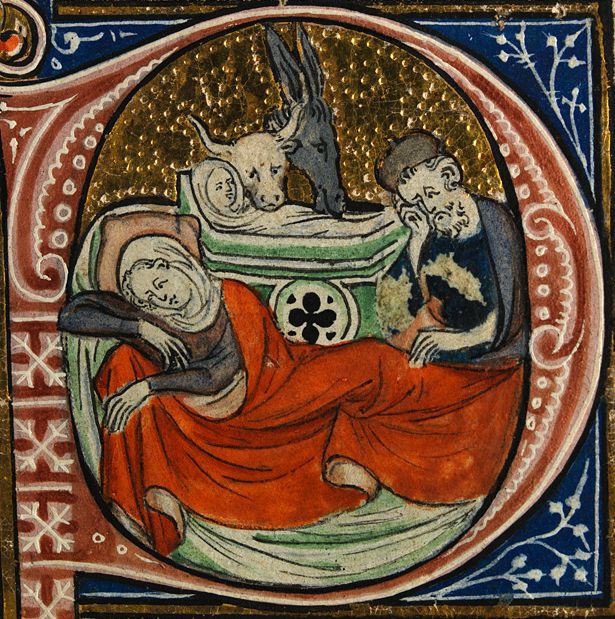
Image is by unknown via Wikipedia and is in the public domain

The Nativity by unknown.

This beautiful image comes from a 14th-century Missal.  It is made from parchment and originates from East Anglia.   It is considered a very important manuscript as it is one of the earliest examples of a Missal of an English source. 

Sarum Missals were books produced by the Church during the Middle Ages for celebrating Mass throughout the year

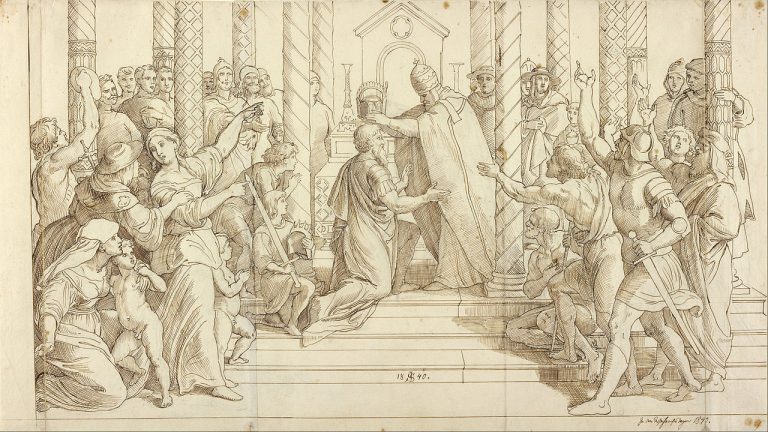
Image is by Julius Schnorr von Carolsfeld via Wikipedia and is in the public domain

The Coronation of Charlemagne on Christmas of 800 by Julius Schnorr von Carolsfeld.

Modern History

17th And 18th Centuries

Following the Protestant Reformation, many of the new denominations, including the Anglican Church and Lutheran Church, continued to celebrate Christmas.  In 1629, the Anglican poet John Milton penned On the Morning of Christ’s Nativity, a poem that has since been read by many during Christmastide.  Donald Heinz, a professor at California State University, states that Martin Luther inaugurated a period in which Germany would produce a unique culture of Christmas, much copied in North America.  Among the congregations of the Dutch Reformed Church, Christmas was celebrated as one of the principal evangelical feasts.

However, in 17th century England, some groups such as the Puritans strongly condemned the celebration of Christmas, considering it a Catholic invention and the trappings of popery or the rags of the Beast.  In contrast, the established Anglican Church pressed for a more elaborate observance of feasts, penitential seasons, and saints’ days.  The calendar reform became a major point of tension between the Anglican party and the Puritan party.  The Catholic Church also responded, promoting the festival in a more religiously oriented form.  King Charles I of England directed his noblemen and gentry to return to their landed estates in midwinter to keep up their old-style Christmas generosity.  Following the Parliamentarian victory over Charles I during the English Civil War, England’s Puritan rulers banned Christmas in 1647.

Protests followed as pro-Christmas rioting broke out in several cities and for weeks Canterbury was controlled by the rioters, who decorated doorways with holly and shouted royalist slogans.  Football, among the sports the Puritans banned on a Sunday, was also used as a rebellious force.  When Puritans outlawed Christmas in England in December 1647 the crowd brought out footballs as a symbol of festive misrule.  The book, The Vindication of Christmas (London, 1652), argued against the Puritans and makes note of Old English Christmas traditions, dinner, roast apples on the fire, card playing, dances with plow-boys and maidservants, old Father Christmas and carol singing.  During the ban, semi-clandestine religious services marking Christ’s birth continued to be held, and people sang carols in secret.

It was restored as a legal holiday in England with the Restoration of King Charles II in 1660 when Puritan legislation was declared null and void, with Christmas again freely celebrated in England.  Many Calvinist clergymen disapproved of Christmas celebrations.  As such, in Scotland, the Presbyterian Church of Scotland discouraged the observance of Christmas, and though James VI commanded its celebration in 1618, church attendance was scant.  The Parliament of Scotland officially abolished the observance of Christmas in 1640, claiming that the church had been purged of all superstitious observation of days.  Whereas in England, Wales and Ireland Christmas Day is a common law holiday, having been a customary holiday since time immemorial, it was not until 1871 that it was designated a bank holiday in Scotland.  The diary of James Woodforde, from the latter half of the 18th century, details the observance of Christmas and celebrations associated with the season over several years.

As in England, Puritans in Colonial America staunchly opposed the observation of Christmas.  The Pilgrims of New England pointedly spent their first 25th of December in the New World working normally.  Puritans such as Cotton Mather condemned Christmas both because scripture did not mention its observance and because Christmas celebrations of the day often involved boisterous behaviour.  Many non-Puritans in New England deplored the loss of the holidays enjoyed by the labouring classes in England.  Christmas observance was outlawed in Boston in 1659.  The ban on Christmas observance was revoked in 1681 by English governor Edmund Andros, but it was not until the mid-19th century that celebrating Christmas became fashionable in the Boston region.

At the same time, Christian residents of Virginia and New York observed the holiday freely.  Pennsylvania Dutch settlers, predominantly Moravian settlers of Bethlehem, Nazareth, and Lititz in Pennsylvania and the Wachovia settlements in North Carolina, were enthusiastic celebrators of Christmas.  The Moravians in Bethlehem had the first Christmas trees in America as well as the first Nativity Scenes.  Christmas fell out of favour in the United States after the American Revolution, when it was considered an English custom.  George Washington attacked Hessian (German) mercenaries on the day after Christmas during the Battle of Trenton on December the 26th, 1776.  Christmas was much more popular in Germany than in America at this time.

With the atheistic Cult of Reason in power during the era of Revolutionary France, Christian Christmas religious services were banned and the Three Kings cake was renamed the equality cake under anticlerical government policies.

Image is by Josiah King via Wikipedia and is in the public domain

The Examination and Tryal of Old Father Christmas by Josiah King.

This was published after Christmas and reinstated as a holy day in England.  It shows the frontispiece to King’s pamphlet The Examination and Tryal of Old Father Christmas, published in 1687. He had previously published a pamphlet with a very similar title The Examination and Tryall of Old Father Christmas in 1658 using the same image as the frontispiece.

19th Century

In the early 19th century, Christmas festivities and services became widespread with the rise of the Oxford Movement in the Church of England that emphasised the centrality of Christmas in Christianity and charity to the poor, along with Charles Dickens, Washington Irving, and other authors emphasising family, children, kind-heartedness, gift-giving, and Father Christmas (for Dickens) or Santa Claus (for Irving).

In the early-19th century, writers imagined Tudor-period Christmas as a time of heartfelt celebration. In 1843, Charles Dickens wrote the novel A Christmas Carol, which helped revive the spirit of Christmas and seasonal merriment.  Its instant popularity played a major role in portraying Christmas as a holiday emphasising family, goodwill, and compassion.

Dickens sought to construct Christmas as a family-centred festival of generosity, linking worship and feasting, within a context of social reconciliation.  Superimposing his humanitarian vision of the holiday, in what has been termed Carol Philosophy, Dickens influenced many aspects of Christmas that are celebrated today in Western culture, such as family gatherings, seasonal food and drink, dancing, games, and a festive generosity of spirit.  A prominent phrase from the tale, Merry Christmas, was popularised following the appearance of the story.  This coincided with the appearance of the Oxford Movement and the growth of Anglo-Catholicism, which led to a revival in traditional rituals and religious observances.

In 1822, Clement Clarke Moore wrote the poem A Visit From St. Nicholas (popularly known by its first line Twas the Night Before Christmas).  The poem helped popularise the tradition of exchanging gifts, and seasonal Christmas shopping began to assume economic importance.  This also started the cultural conflict between the holiday’s spiritual significance and its associated commercialism which some see as corrupting the holiday.  In her 1850 book The First Christmas in New England, Harriet Beecher Stowe includes a character who complains that the true meaning of Christmas was lost in a shopping spree.

While the celebration of Christmas was not yet customary in some regions in the U.S., Henry Wadsworth Longfellow detected a transition state about Christmas in New England in 1856.  He stated that the old Puritan feeling prevented it from being a cheerful, hearty holiday, though every year made it more so.  In Reading, Pennsylvania, a newspaper remarked in 1861, that “even our Presbyterian friends who have hitherto steadfastly ignored Christmas threw open their church doors and assembled in force to celebrate the anniversary of the Savior’s birth.”

The First Congregational Church of Rockford, Illinois, (although of genuine Puritan stock) was preparing for a grand Christmas jubilee, a news correspondent reported in 1864.  By 1860, fourteen states including several from New England had adopted Christmas as a legal holiday.  In 1875, Louis Prang introduced the Christmas card to Americans.  He has been called the father of the American Christmas card.  On June the 28th, 1870, Christmas was formally declared a United States federal holiday.

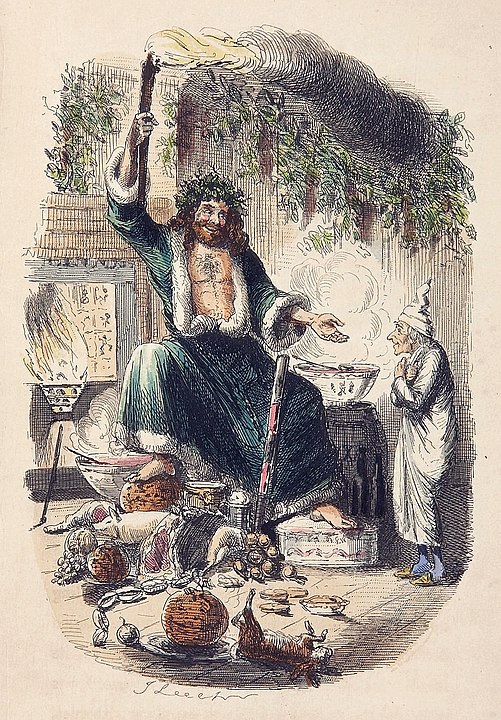
Image by John Leech via Wikipedia and is in the public domain

Scrooge’s Third Visitor by John Leech.

This image is from Charles Dickens’ A Christmas Carol published in 1843.  It is from one of four hand-coloured etchings included in the first edition.  There were also four black and white engravings.

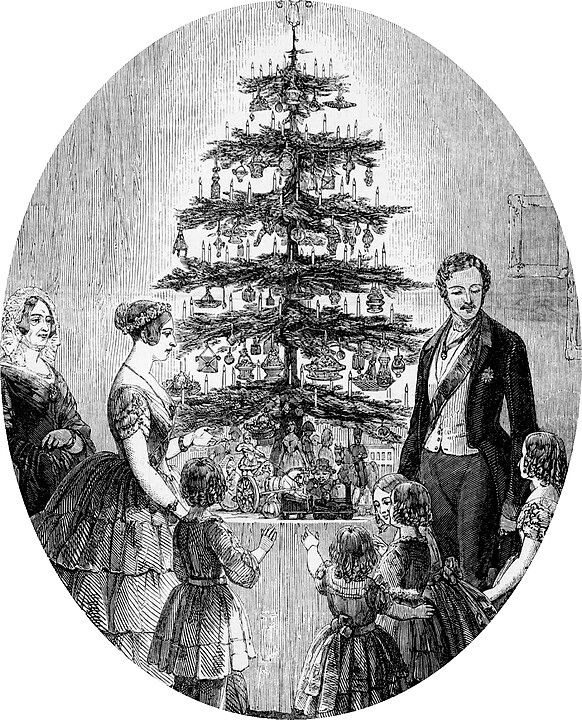
Image by Joseph Lionel Williams via Wikipedia and is in the public domain

The Queen’s Christmas Tree at Windsor Castle by Joseph Lionel Williams.

This wood engraving print was made for The Illustrated London News, Christmas Number 1848.

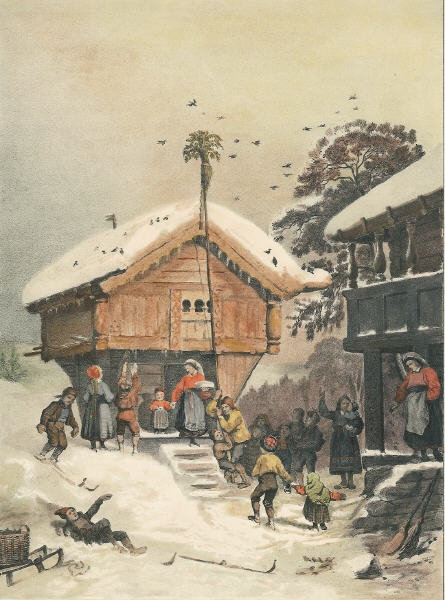
Image by Adolph Tidemand via Wikipedia and is in the public domain

A Norwegian Christmas by Adolph Tidemand.

This painting is from 1846.

20th Century

During the First World War and particularly (but not exclusively) in 1914, a series of informal truces took place for Christmas between opposing armies.  The truces, which were organised spontaneously by fighting men, ranged from promises not to shoot (shouted at a distance to ease the pressure of war for the day) to friendly socialising, gift-giving and even sport between enemies.  These incidents became a well-known and semi-mythologised part of popular memory.  They have been described as a symbol of common humanity even in the darkest of situations and used to demonstrate to children the ideals of Christmas.

Up to the 1950’s in the United Kingdom, many Christmas customs were restricted to the upper and middle classes.   Most of the population had not yet adopted many Christmas rituals that later became popular, including Christmas trees.  Christmas dinner would normally include beef or goose, not turkey as would later be common.  Children would get fruit and sweets in their stockings rather than elaborate gifts.  The full celebration of a family Christmas with all the trimmings only became widespread with increased prosperity from the 1950’s.  National papers were published on Christmas Day until 1912.  Post was still delivered on Christmas Day until 1961.  League football matches continued in Scotland until the 1970’s while in England they ceased at the end of the 1950’s.

Image by unknown via Wikipedia and is in the public domain

The Christmas Visit by unknown.

This postcard is from circa 1910. 

Nativity

The gospels of Luke and Matthew describe Jesus as being born in Bethlehem to the Virgin Mary.   In the Gospel of Luke, Joseph and Mary travel from Nazareth to Bethlehem to be counted for a census, and Jesus is born there and placed in a manger. Angels proclaim him a saviour for all people, and three shepherds come to adore him.  In the Gospel of Matthew, by contrast, three magi follow a star to Bethlehem to bring gifts to Jesus, born the king of the Jews.  King Herod orders the massacre of all the boys less than two years old in Bethlehem, but the family flees to Egypt and later returns to Nazareth.

Read more about The Nativity here.

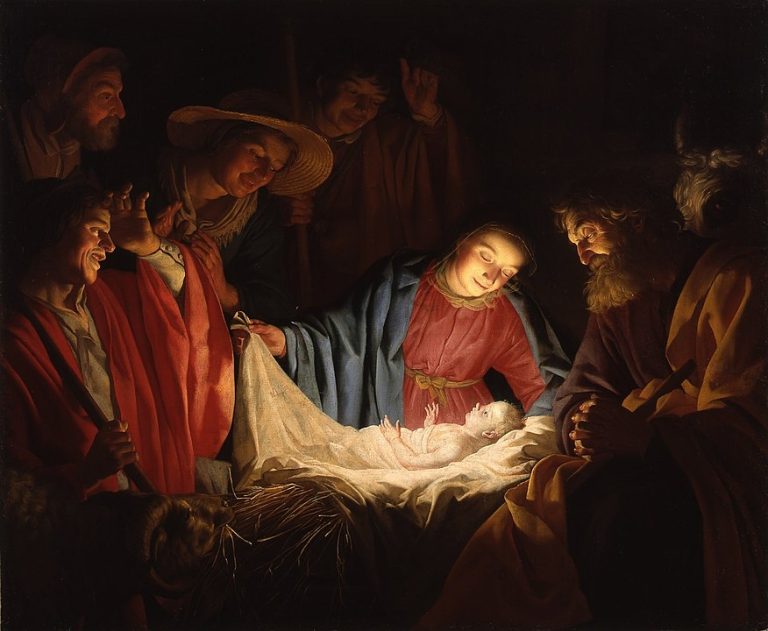
Image is by Gerard van Honthorst via Wikipedia and is in the public domain

Adoration of the Shepherds by Gerard van Honthorst.

This painting of Mary, Jesus and the shepherds was created in 1622.

Relation To Concurrent Celebrations

Many popular customs associated with Christmas developed independently of the commemoration of Jesus’ birth, with some claiming that certain elements are Christianised and have origins in pre-Christian festivals that were celebrated by pagan populations who were later converted to Christianity.  Other scholars reject these claims and affirm that Christmas customs largely developed in a Christian context.  The prevailing atmosphere of Christmas has also continually evolved since the holiday’s inception, ranging from a sometimes raucous, drunken, carnival-like state in the Middle Ages, to a tamer family-oriented and children-centered theme introduced in a 19th-century transformation.  The celebration of Christmas was banned on more than one occasion within certain groups, such as the Puritans and Jehovah’s Witnesses (who do not celebrate birthdays in general), due to concerns that it was too unbiblical.

Prior to and through the early Christian centuries, winter festivals were the most popular of the year in many European pagan cultures.  Reasons included the fact that less agricultural work needed to be done during the winter, as well as an expectation of better weather as spring approached.  Celtic winter herbs such as mistletoe and ivy, and the custom of kissing under a mistletoe, are common in modern Christmas celebrations in the English-speaking countries.

The pre-Christian Germanic peoples (including the Anglo-Saxons and the Norse) celebrated a winter festival called Yule, held in the late December to early January period, yielding modern English yule, today used as a synonym for Christmas.  In Germanic language-speaking areas, numerous elements of modern Christmas folk custom and iconography may have originated from Yule, including the Yule log, Yule boar, and the Yule goat.  Often leading a ghostly procession through the sky (the Wild Hunt), the long-bearded god Odin is referred to as the Yule one and Yule father in Old Norse texts, while other gods are referred to as Yule beings.  On the other hand, as there are no reliable existing references to a Christmas log prior to the 16th century, the burning of the Christmas block may have been an early modern invention by Christians unrelated to the pagan practice.

In eastern Europe also, pre-Christian traditions were incorporated into Christmas celebrations there, an example being the Koleda, which shares parallels with the Christmas carol.

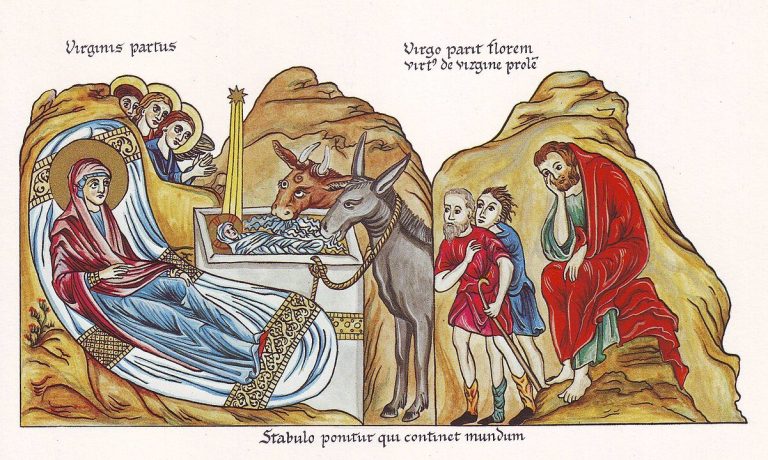
Image is by Herrad of Landsberg via Wikipedia and is in the public domain

The Nativity of Christ by Herrad of Landsberg.

This 12th-century, medieval illustration is from the Hortus deliciarum.

Observance And Traditions

Christmas Day is celebrated as a major festival and public holiday in countries around the world, including many whose populations are mostly non-Christian. In some non-Christian areas, periods of former colonial rule introduced the celebration (e.g. Hong Kong); in others, Christian minorities or foreign cultural influences have led populations to observe the holiday. Countries such as Japan, where Christmas is popular despite there being only a small number of Christians, have adopted many of the cultural aspects of Christmas, such as gift-giving, decorations, and Christmas trees. A similar example is in Turkey, being Muslim-majority and with a small number of Christians, where Christmas trees and decorations tend to line public streets during the festival.

Among countries with a strong Christian tradition, a variety of Christmas celebrations have developed that incorporate regional and local cultures.

Read more about Observance And Traditions here and here.

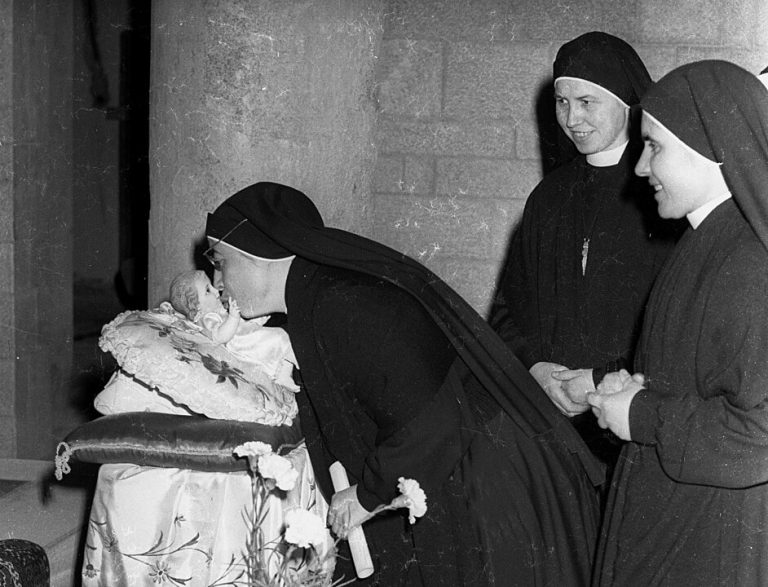
Image © Israel Press and Photo Agency via Wikipedia

Christmas at the Annunciation Church in Nazareth.

This photo by Dan Hadani, from his collection Collection at the National Library of Israel, was taken on Christmas Eve, 1965.

Decorations

Nativity scenes are known from 10th-century Rome. They were popularised by Saint Francis of Assisi from 1223, quickly spreading across Europe.  Different types of decorations developed across the Christian world, dependent on local tradition and available resources, and can vary from simple representations of the crib to far more elaborate sets.  Renowned manger scene traditions include the colourful Krakow szopka in Poland, which imitate Krakow’s historical buildings as settings, the elaborate Italian presepi (Neapolitan, Genoese and Bolognese), or the Provencal creches in southern France, using hand-painted terracotta figurines called santons.  In certain parts of the world, notably Sicily, living nativity scenes following the tradition of Saint Francis are a popular alternative to static creches.  The first commercially produced decorations appeared in Germany in the 1860’s, inspired by paper chains made by children.  In countries where a representation of the Nativity scene is very popular, people are encouraged to compete and create the most original or realistic ones.  Within some families, the pieces used to make the representation are considered a valuable family heirloom.

The traditional colours of Christmas decorations are red, green, and gold.  Red symbolises the blood of Jesus, which was shed in his crucifixion, green symbolises eternal life, and in particular the evergreen tree, which does not lose its leaves in the winter and gold is the first colour associated with Christmas, as one of the three gifts of the Magi, symbolising royalty.

The Christmas tree was first used by German Lutherans in the 16th century, with records indicating that a Christmas tree was placed in the Cathedral of Strassburg in 1539, under the leadership of the Protestant Reformer, Martin Bucer.  In the United States, these German Lutherans brought the decorated Christmas tree with them.  The Moravians put lighted candles on the trees.  When decorating the Christmas tree, many individuals place a star at the top of the tree symbolising the Star of Bethlehem, a fact recorded by The School Journal in 1897.  Professor David Albert Jones of Oxford University wrote that in the 19th century, it became popular for people to also use an angel to top the Christmas tree in order to symbolise the angels mentioned in the accounts of the Nativity of Jesus.   Aditionally, in the context of a Christian celebration of Christmas, the Christmas tree, being evergreen in colour, is symbolic of Christ, who offers eternal life and the candles or lights on the tree represent the Light of the World.  Christian services for family use and public worship have been published for the blessing of a Christmas tree, after it has been erected.  The Christmas tree is considered by some as Christianisation of pagan tradition and ritual surrounding the Winter Solstice, which included the use of evergreen boughs, and an adaptation of pagan tree worship.  According to eighth-century biographer Æddi Stephanus, Saint Boniface (634 – 709), who was a missionary in Germany, took an ax to an oak tree dedicated to Thor and pointed out a fir tree, which he stated was a more fitting object of reverence because it pointed to heaven and it had a triangular shape, which he said was symbolic of the Trinity.  The English language phrase Christmas tree is first recorded in 1835 and represents an importation from the German language.

Since the 16th century, the poinsettia, a native plant from Mexico, has been associated with Christmas carrying the Christian symbolism of the Star of Bethlehem; in that country it is known in Spanish as the Flower of the Holy Night. Other popular holiday plants include holly, mistletoe, red amaryllis, and Christmas cactus.

Other traditional decorations include bells, candles, candy canes, stockings, wreaths, and angels.  Both the displaying of wreaths and candles in each window are a more traditional Christmas display.  The concentric assortment of leaves, usually from an evergreen, make up Christmas wreaths and are designed to prepare Christians for the Advent season.  Candles in each window are meant to demonstrate the fact that Christians believe that Jesus Christ is the ultimate light of the world.

Christmas lights and banners may be hung along streets, music played from speakers, and Christmas trees placed in prominent places.  It is common in many parts of the world for town squares and consumer shopping areas to sponsor and display decorations.  Rolls of brightly coloured paper with secular or religious Christmas motifs are manufactured to wrap gifts.  In some countries, Christmas decorations are traditionally taken down on the Twelfth Night.

Read more about Decorations here and here.

Image by unknown is from the Diocesan Museum of Sacred Art via Wikipedia

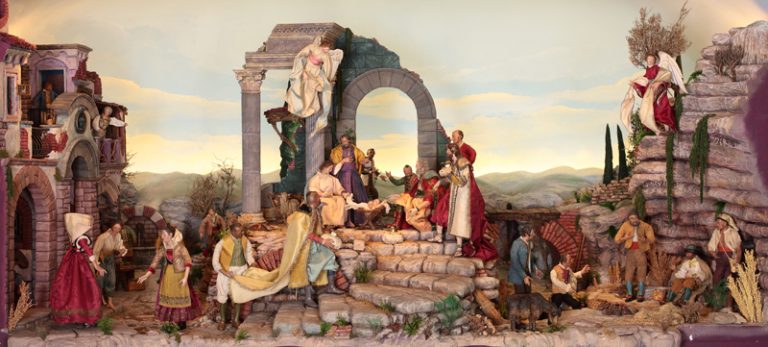
A typical Neapolitan Nativity scene by unknown.

This Eighteenth-century nativity scene painting is also known as a presepe or presepio and can be found at the Diocesan Museum of Sacred Art in Bilbao, Spain.  

Local creches are renowned for their ornate decorations and symbolic figurines, often mirroring daily life.

Image © of TaniaLuz via iStock

A Christmas tree and presents.

Image by Robert Knudsen is from the Kennedy Library via Wikipedia and is in the public domain

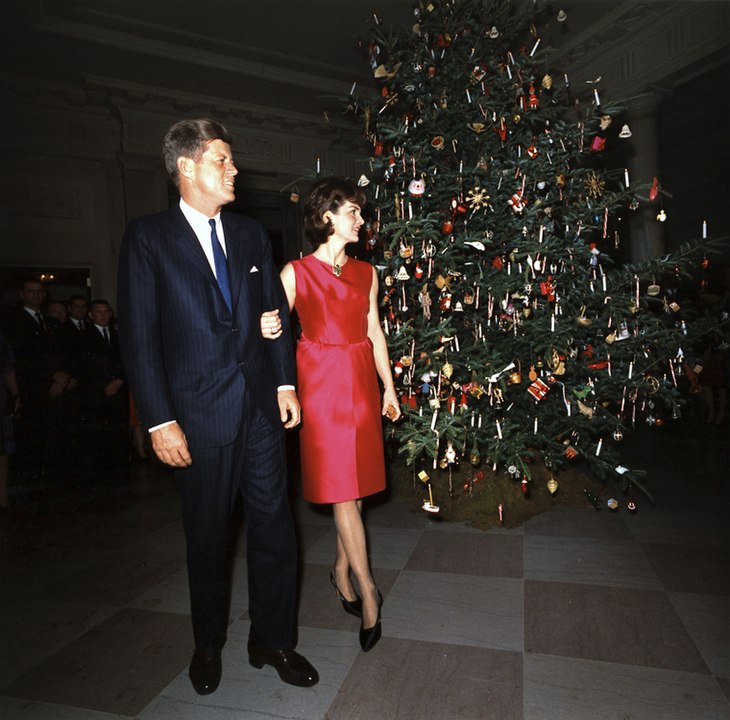
The official White House Christmas tree for 1962 by Robert Knudsen.

The official White House Christmas tree above is in the entrance hall.  It is usually located in the Blue Room, this was one of a few instances since 1961 where the tree has been displayed here.

It was presented by President John F. Kennedy and First Lady Jacqueline Kennedy at the Christmas Reception on the 12th of December, 1962 at the White House, U.S.A. 

Image © of PFAStudent via Wikipedia

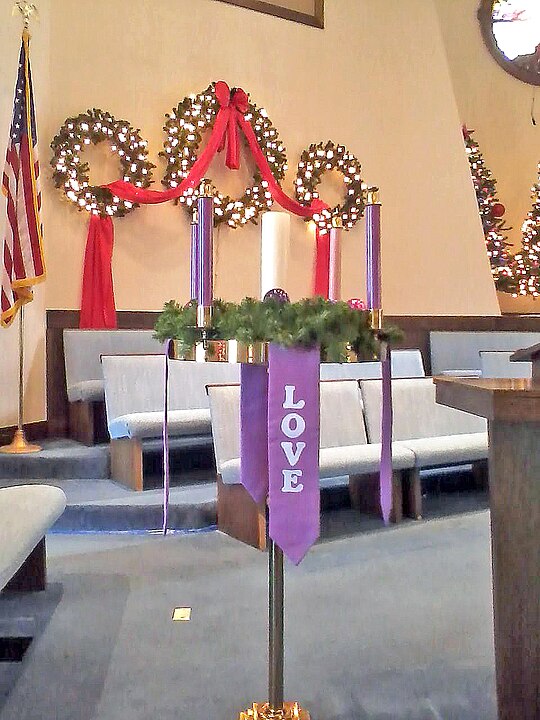
The Christ Candle in the centre of an Advent wreath.

This is traditionally lit in many church services.  This one is in the chancel of Broadway United Methodist Church, located in New Philadelphia, U.S.A.

The Advent wreath consists of four coloured candles of the same size, arranged around a larger white Christ candle.

Nativity Play

For the Christian celebration of Christmas, the viewing of the Nativity play is one of the oldest Christmastime traditions, with the first reenactment of the Nativity of Jesus taking place in 1223 A.D.  In that year, Francis of Assisi assembled a Nativity scene outside of his church in Italy and children sung Christmas carols celebrating the birth of Jesus.  Each year, this grew larger and people travelled from afar to see Francis’ depiction of the Nativity of Jesus that came to feature drama and music.  Nativity plays eventually spread throughout all of Europe, where they remain popular.  Christmas Eve and Christmas Day church services often came to feature Nativity plays, as did schools and theatres.  In France, Germany, Mexico and Spain, Nativity plays are often reenacted outdoors in the streets.

Read more about Nativity Play here.

Image © of Wesley Fryer via Wikipedia

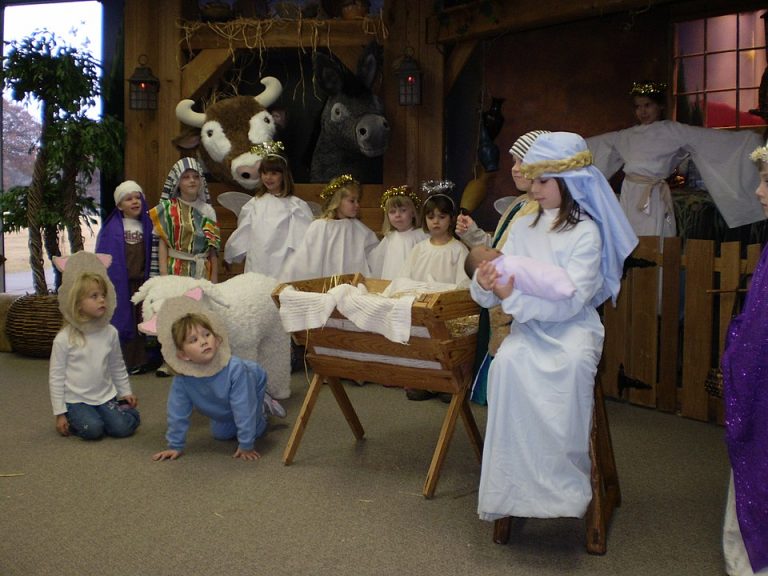
Children in Oklahoma reenact a Nativity play.

These children are performing their nativity play in 2007 at the First Presbyterian Church in Edmond, Oklahoma, U.S.A.

Music And Carols

The earliest extant specifically Christmas hymns appear in fourth-century Rome.  Latin hymns such as Veni redemptor gentium, written by Ambrose, Archbishop of Milan, were austere statements of the theological doctrine of the Incarnation in opposition to Arianism.  Corde natus ex Parentis (Of the Father’s love begotten) by the Spanish poet Prudentius (died 413) is still sung in some churches today.  In the 9th and 10th centuries, the Christmas Sequence or Prose was introduced in North European monasteries, developing under Bernard of Clairvaux into a sequence of rhymed stanzas. In the 12th century the Parisian monk Adam of St. Victor began to derive music from popular songs, introducing something closer to the traditional Christmas carol.  Christmas carols in English appear in a 1426 work of John Awdlay who lists twenty-five “caroles of Cristemas”, probably sung by groups of wassailers, who went from house to house.

Read more about Music And Carols here.

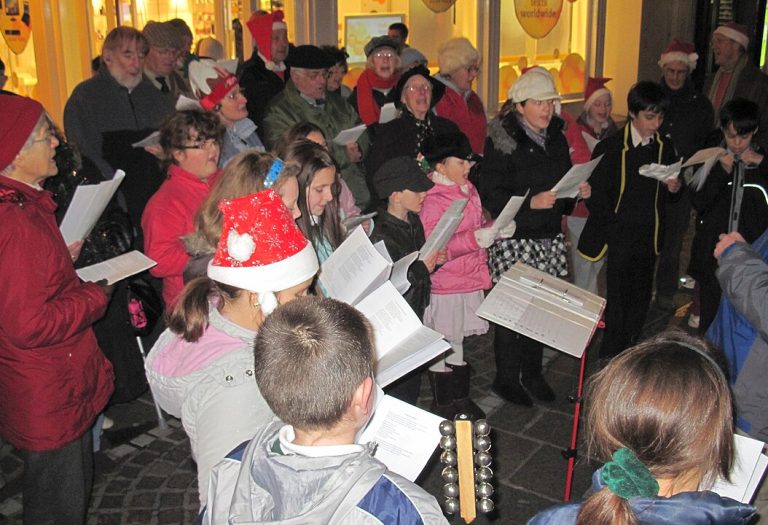
Christmas carolers in Jersey.

Image © of Man vyi via Wikipedia and is in the public domain
Image by unknown is via Wikipedia and is in the public domain

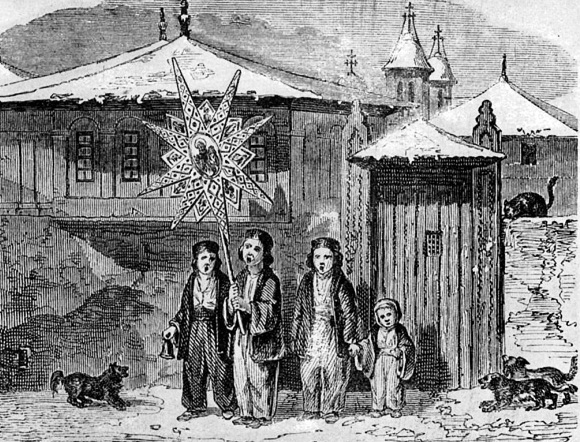
Child singers in Bucharest by unknown.

This picture is from 1842 and depicts the singers carrying a star with an icon of a saint on it.

Christmas Food

A special Christmas family meal is traditionally an important part of the holiday celebration, and the food that is served varies greatly from country to country.  Some regions have special meals for Christmas Eve, such as Sicily, where 12 kinds of fish are served.  In the United Kingdom and countries influenced by its traditions, a standard Christmas meal usually includes turkey, goose or other large bird, gravy, potatoes, vegetables, sometimes bread, cider or some other alcoholic drink for the adults.  Special desserts are also prepared, such as Christmas pudding, mince pies, Christmas cake, Panettone and a Yule log cake.  A traditional Christmas meal in Central Europe features fried carp or other fish.

Read more about Christmas Food here.

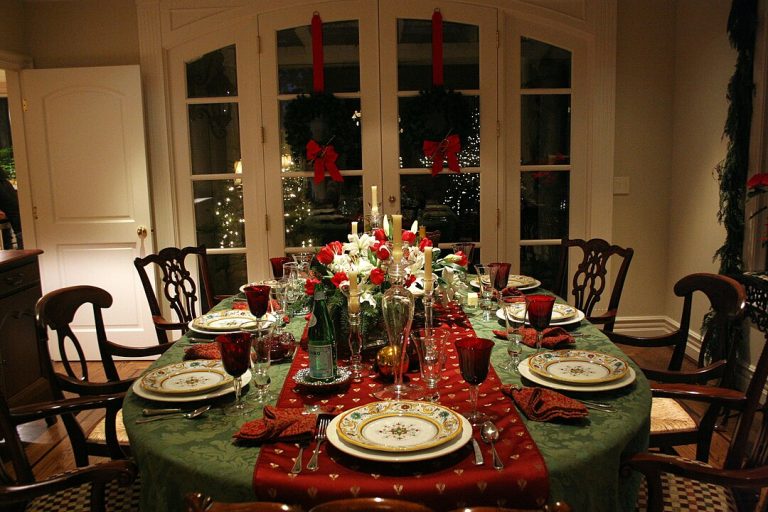
Image © of Austin McGee via Wikipedia

A Christmas dinner setting.

Christmas Cards

Christmas cards are illustrated messages of greeting exchanged between friends and family members during the weeks preceding Christmas Day.  The traditional greeting reads wishing you a Merry Christmas and a Happy New Year, much like that of the first commercial Christmas card, produced by Sir Henry Cole in London in 1843.  The custom of sending them has become popular among a wide cross-section of people with the emergence of the modern trend towards exchanging E-cards.

Christmas cards are purchased in considerable quantities and feature artwork, is commercially designed and relevant to the season.  The content of the design might relate directly to the Christmas narrative, with depictions of the Nativity of Jesus, or Christian symbols such as the Star of Bethlehem, or a white dove, which can represent both the Holy Spirit and Peace on Earth.  Other Christmas cards are more secular and can depict Christmas traditions, mythical figures such as Father Christmas, objects directly associated with Christmas such as candles, holly, and baubles, or a variety of images associated with the season, such as Christmastide activities, snow scenes, and the wildlife of the northern winter.

Some prefer cards with a poem, prayer, or Biblical verse, while others distance themselves from religion with an all-inclusive Season’s greetings.

Read more about Christmas Cards here.

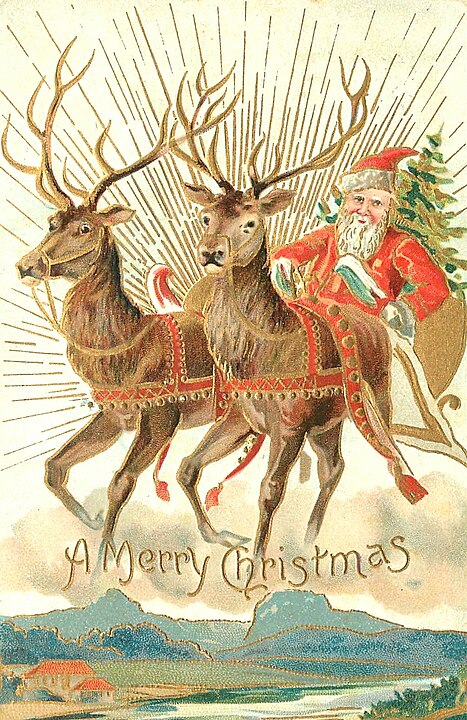
Image by unknown is from the Souvenir Post Card Company via Wikipedia and is in the public domain

A Christmas postcard with Father Christmas and some of his reindeer by unknown.

This card was published by the Souvenir Post Card Company in New York, U.S.A. in 1907. 

Christmas Stamps

A number of nations have issued commemorative stamps at Christmastide.  Postal customers will often use these stamps to mail Christmas cards, and they are popular with philatelists.  These stamps are regular postage stamps, unlike Christmas seals, and are valid for postage year-round.  They usually go on sale sometime between early October and early December and are printed in considerable quantities.

Read more about Christmas Stamps here.

Christmas Gifts

The exchanging of gifts is one of the core aspects of the modern Christmas celebration, making it the most profitable time of year for retailers and businesses throughout the world.  On Christmas, people exchange gifts based on the Christian tradition associated with Saint Nicholas, and the gifts of gold, frankincense, and myrrh which were given to the baby Jesus by the Magi.  The practice of gift giving in the Roman celebration of Saturnalia may have influenced Christian customs, but on the other hand the Christian core dogma of the Incarnation, however, solidly established the giving and receiving of gifts as the structural principle of that recurrent yet unique event, because it was the Biblical Magi, together with all their fellow men, who received the gift of God through man’s renewed participation in the divine life. However, Thomas J. Talley holds that the Roman Emperor Aurelian placed the alternate festival on December the 25th in order to compete with the growing rate of the Christian Church, which had already been celebrating Christmas on that date first.

Read more about Christmas Gifts here.

Image © of Kelvin Kay via Wikipedia

Christmas gifts under a Christmas tree.

Gift-Bearing Figures

Several figures are associated with Christmas and the seasonal giving of gifts. Among these, the best known of these figures today is the red-dressed  Father Christmas (more well-known in the United Kingdom although the American term Santa Claus is becoming more popular.  Amongst many names around the world, he is known as  Pere Noel,  Joulupukki, Babbo Natale, Ded Moroz and tomte.  The Scandinavian tomte (also called nisse) is sometimes depicted as a gnome instead of Santa Claus.   

The name Santa Claus can be traced back to the Dutch Sinterklaas (Saint Nicholas). Nicholas was a 4th-century Greek bishop of Myra, a city in the Roman province of Lycia, whose ruins are 3 kilometres (1.9 mi) from modern Demre in southwest Turkey.  Among other saintly attributes, he was noted for the care of children, generosity, and the giving of gifts.  His feast day, December the 6th, came to be celebrated in many countries with the giving of gifts.

Saint Nicholas traditionally appeared in bishop’s attire, accompanied by helpers, inquiring about the behaviour of children during the past year before deciding whether they deserved a gift or not.  By the 13th century, Saint Nicholas was well known in the Netherlands, and the practice of gift-giving in his name spread to other parts of central and southern Europe.  At the Reformation in 16th- and 17th-century Europe, many Protestants changed the gift bringer to the Christ Child or Christkindl, corrupted in English to Kris Kringle, and the date of giving gifts changed from December the 6th to Christmas Eve.

The modern popular image of Father Christmas, however, was created in the United States, and in particular in New York.  The transformation was accomplished with the aid of notable contributors including Washington Irving and the German-American cartoonist Thomas Nast (1840 – 1902).  Following the American Revolutionary War, some of the inhabitants of New York City sought out symbols of the city’s non-English past.  New York had originally been established as the Dutch colonial town of New Amsterdam and the Dutch Sinterklaas tradition was reinvented as Saint Nicholas.

Current tradition in several Latin American countries (such as Venezuela and Colombia) holds that while Father Christmas makes the toys, he then gives them to Baby Jesus, who is the one who delivers them to the children’s homes, a reconciliation between traditional religious beliefs and the iconography of Santa Claus imported from the United States.

In South Tyrol (Italy), Austria, Czech Republic, Southern Germany, Hungary, Liechtenstein, Slovakia, and Switzerland, the Christkind (Jezisek in Czech, Jezuska in Hungarian and Jezisko in Slovak) brings the presents.  Greek children get their presents from Saint Basil on New Year’s Eve, the eve of that saint’s liturgical feast.  The German St. Nikolaus is not identical to the Weihnachtsmann (who is the German version of Father Christmas).  St. Nikolaus wears a bishop’s dress and still brings small gifts (usually candies, nuts, and fruits) on December the 6th and is accompanied by Knecht Ruprecht.  Although many parents around the world routinely teach their children about Father Christmas and other gift bringers, some have come to reject this practice, considering it deceptive.

Multiple gift-giver figures exist in Poland, varying between regions and individual families. St Nicholas (Swiety Mikolaj) dominates Central and North-East areas, the Starman (Gwiazdor) is most common in Greater Poland, Baby Jesus (Dzieciątko) is unique to Upper Silesia, with the Little Star (Gwiazdka) and the Little Angel (Aniołek) being common in the South and the South-East.  Grandfather Frost (Dziadek Mroz) is less commonly accepted in some areas of Eastern Poland.  It is worth noting that across all of Poland, St Nicholas is the gift giver on Saint Nicholas Day on December the 6th.

You can read a well-known poem about St. Nicholas here.

Read more about Gift-Bearing Figures here.

Image © of CrazyPhunk via Wikipedia

Saint Nicholas.

See Also

Christmas in July – Second Christmas celebration.

Christmas Peace – Finnish tradition.

Christmas Sunday – Sunday after Christmas.

List of Christmas films.

List of Christmas novels – Christmas as depicted in literature.

Little Christmas – Alternative title for 6 January.

NochebuenaEvening or entire day before Christmas Day.

Mithraism in comparison with other belief systems.

Christmas by medium – Christmas represented in different media.

You can see notes, references, further reading and external links to the above articles here.  The above was sourced from a page on Wikipedia and is subject to change. 

Blog Posts

Links

Liliboas on iStock.  The image shown at the top of this page of a Christmas tree and presents is the copyright of Liliboas.  You can find more great work from the photographer Lili and lots more free stock photos at iStock.

The image above of a nativity scene made with Christmas lights is the copyright of Wikipedia user Crumpled Fire.  It comes with a Creative Commons licence (CC BY-SA 2.0).

The image above of the Nativity by unknown comes via Wikipedia and is in the public domain.

The image above of the Coronation of Charlemagne on Christmas of 800 by Julius Schnorr von Carolsfeld comes via Wikipedia and is in the public domain.

The image above of the Examination and Tryal of Old Father Christmas by Josiah King comes via Wikipedia and is in the public domain.

The image above of the Queen’s Christmas Tree at Windsor Castle by Joseph Lionel Williams comes via Wikipedia and is in the public domain.

The image above of a Norwegian Christmas by Adolph Tidemand comes via Wikipedia and is in the public domain.

The image above of the Christmas visit by unknown comes via Wikipedia and is in the public domain.

The image above of Adoration of the Shepherds by Gerard van Honthorst comes via Wikipedia and is in the public domain.

The image above of the  Nativity of Christ by Herrad of Landsberg comes via Wikipedia and is in the public domain.

The image above of Christmas at the Annunciation Church in Nazareth is the copyright of Wikipedia user Israel Press and Photo Agency.  It comes with a Creative Commons licence (CC BY-SA 4.0)

The image above of a typical Neapolitan Nativity scene by unknown comes from the Diocesan Museum of Sacred Art.  It comes with a Creative Commons licence (CC BY-SA 4.0)

The image above of the official White House Christmas tree for 1962 by Robert Knudsen comes from the Kennedy Library via Wikipedia and is in the public domain.

The image above of the Christ Candle in the centre of an Advent wreath is the copyright of Wikipedia user PFAStudent.  It comes with a Creative Commons licence (CC BY-SA 3.0).

The image above of children in Oklahoma reenact a Nativity play is the copyright of Wikipedia user Wesley Fryer.  It comes with a Creative Commons licence (CC BY-SA 2.0).

The image above of Christmas carolers in Jersey is copyright of Wikipedia user Man vyi and is in the public domain.

The image above of a Christmas dinner setting is the copyright of Wikipedia user Austin McGee.  It comes with a Creative Commons licence (CC BY-SA 2.0).

The image above of a Christmas postcard with Father Christmas and some of his reindeer by unknown comes via Wikipedia and is in the public domain.

The image above of  Christmas gifts under a Christmas tree is the copyright of Wikipedia user Kelvin Kay.  It comes with a Creative Commons licence (CC BY-SA 2.0).

The image above of Saint Nicholas is the copyright of Wikipedia user CrazyPhunk.  It comes with a Creative Commons licence (CC BY-SA 3.0).

Birmingham City: Blues History

B.C.F.C. Badge
Image © of B.C.F.C.

There is only one team in Birmingham worth supporting with true passion and Birmingham City is it.  I have been supporting them since 1978 when Jim Smith was the manager.  He is my favourite manager to date.   I am a blue nose ’til I die.

You can read lots more about Blues by clicking here

Below is a series of videos from Birmingham City which looks back on its history via interviews with ex-players and how it affected them as they celebrate their time playing for the club.

To read more history of Birmingham City click here.

Noel Blake

Noel Blake discusses his time at Blues, that Villa game, and his successes as a coach with England.

Read more about Blake here.

Ricky Otto

Ricky Otto discusses everything from his early life in Hackney, ending up in prison for armed robbery, and becoming Blues’ record signing.

Read more about Otto here.

Clayton Donaldson discusses his rise up the football leagues, his special relationship with fans at St. Andrew’s and becoming a player-manager.

Read more about Donaldson here.

Blog Posts

Notes And Links

The image shown at the top of this page is copyright of Birmingham City F.C.  

The videos shown above are via YouTube.

Birmingham City F.C. – Official website.  

Birmingham City on Facebook  – This is their official Facebook page.

Birmingham City on Twitter – This is their official Twitter page.

Birmingham City on YouTube – This is their official YouTube page.

Blues Store Online – Birmingham City’s official club store online.

Halloween Photos (Part 4)

Image ©Toby Ord via Wikipedia

Growing up in England from a child to a teenager in the 1960’s, 1970’s and 1980’s, Halloween was an American thing you saw on the telly.  There was no dressing up and trick-or-treating, not in my family home anyway.  Even when my kids were younger I never really bothered much about Halloween.  It was just all too American for me and just liked the English traditions I was brought up with.  They had fun wearing masks, bobbing for apples etc. but we never went out dressed up knocking on people’s doors, in fact, I don’t recall ever seeing anyone else do it either. 

Nowadays all of the above is a common sight.  I am no killjoy and I don’t knock anyone who really enjoys it.  I admit it’s a fun thing for kids to do and a good excuse for a party for the adults which I have enjoyed going to in the past few years.  When you have suffered from depression and anxiety for as long as I have, just to be included can be a lifesaver.

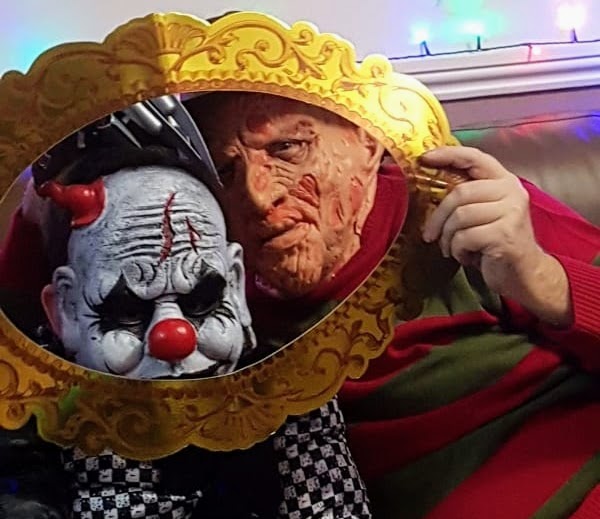
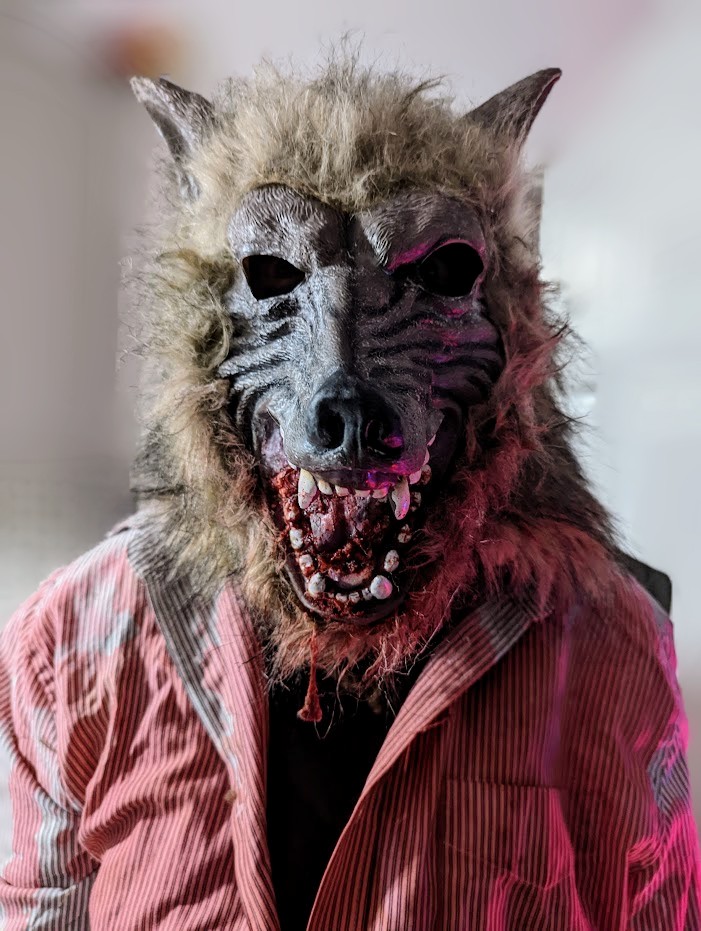
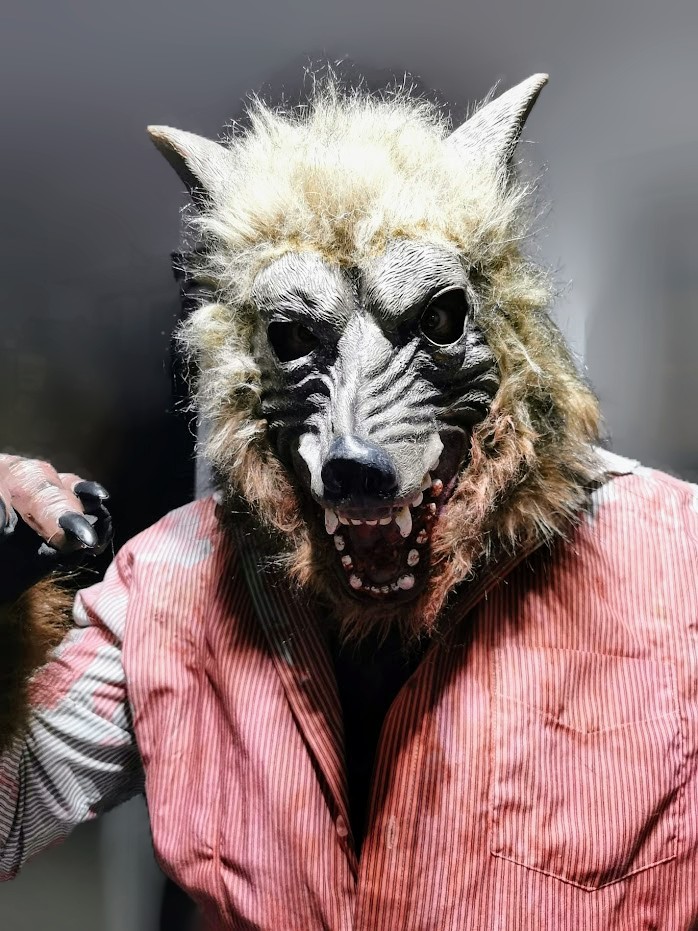
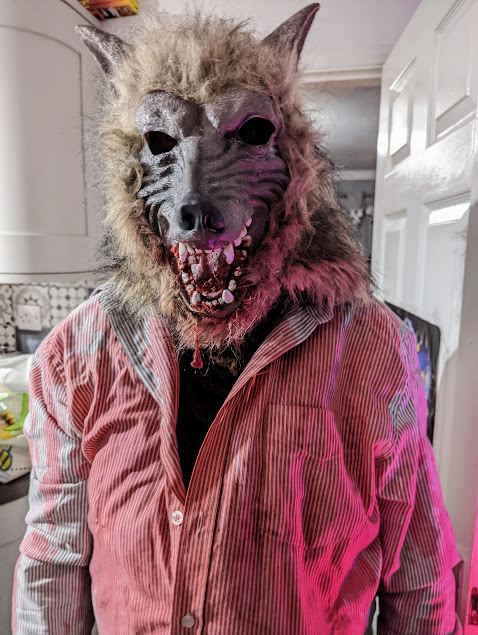
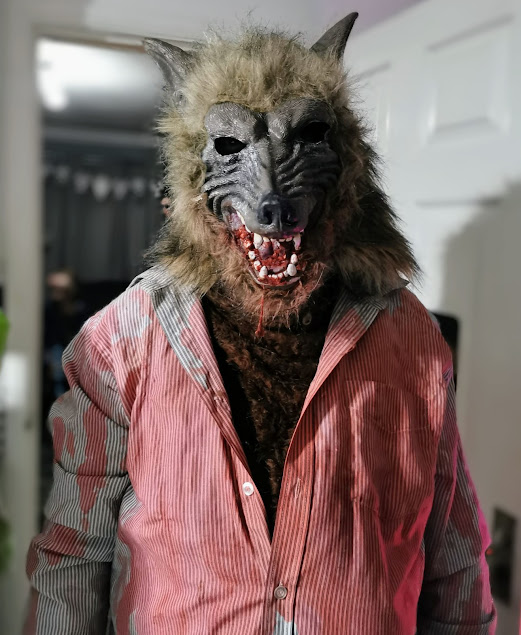
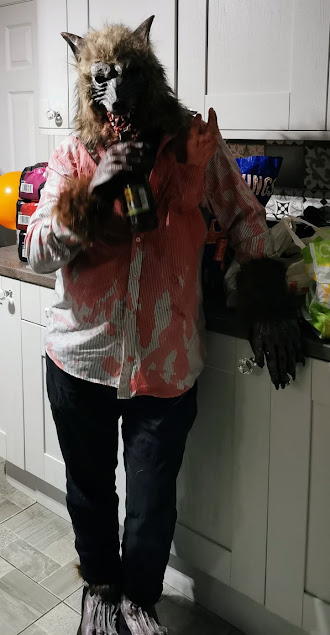
The main thing I like about Halloween is dressing up and the Horror theme to it.  I have never celebrated  Halloween in my life in the past because, since I was a kid, I have loved horror.  Every day is Halloween for me, ha ha.

Below are photos of Halloween celebrations of me and my family over the years. 

The quality of some of these photos is not the greatest due to poor-quality camera equipment.  I have tried to enhance them the best I can but they are worth reminiscing about on here regardless.

2022  (Continued)  

Click here for 2022 details.

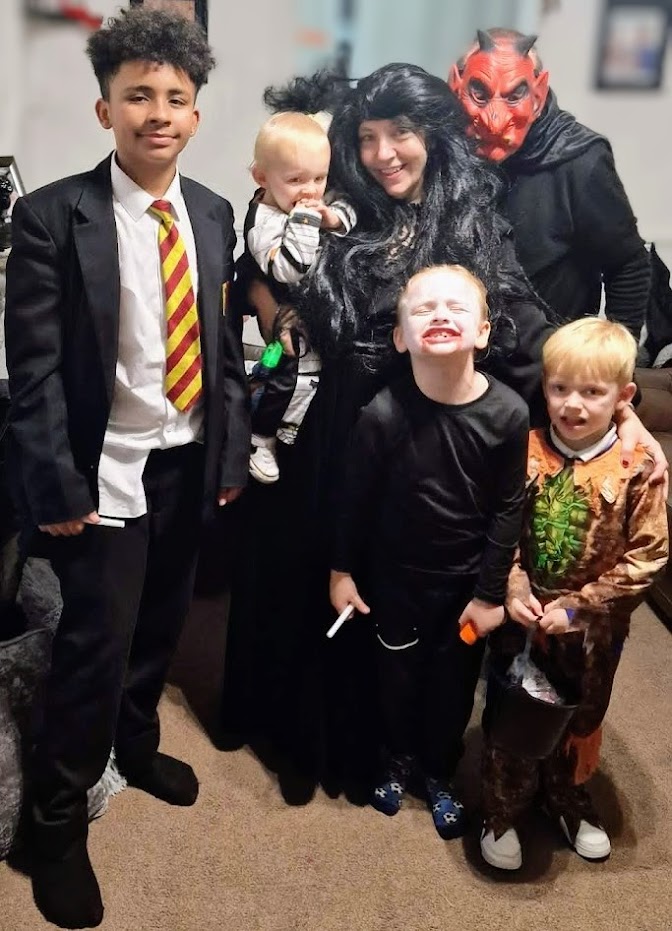
Image © Joanne Wheeler

A small Halloween holiday family get-together.

Me, my sister Julie and great nephews Archie, Harley, Kenny and Oscar.

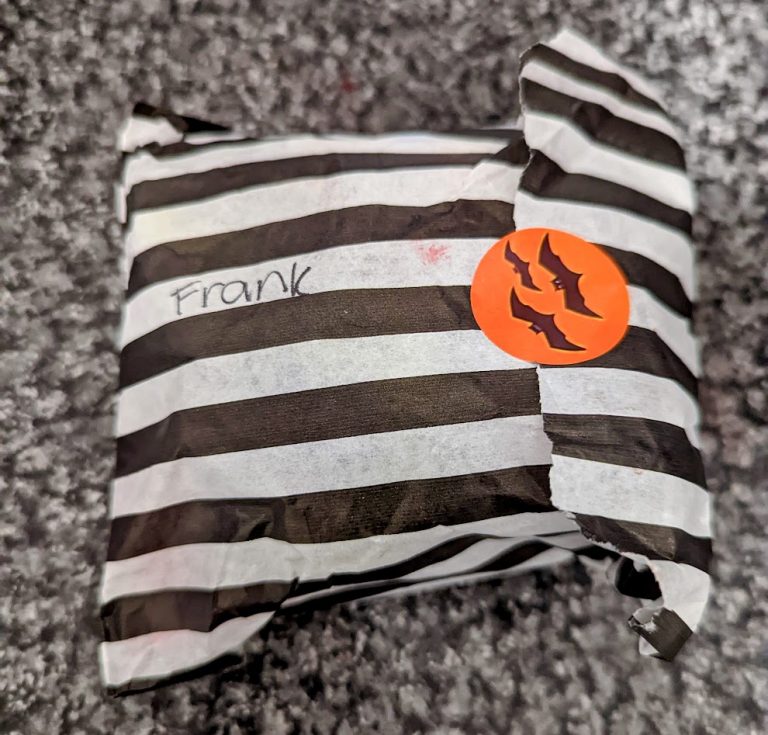
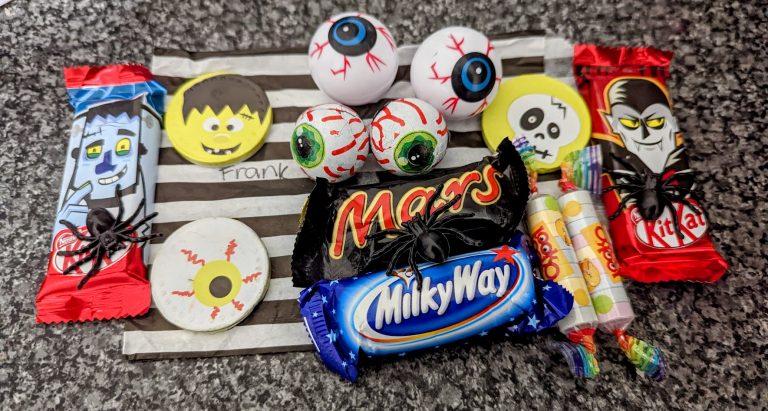
Image © Frank Parker

My goody bag from the kid’s get-together.

I wasn’t expecting this treat from my niece Joanne so it was nice to be included as one of the kids, ha ha and I thank her for it.

2023

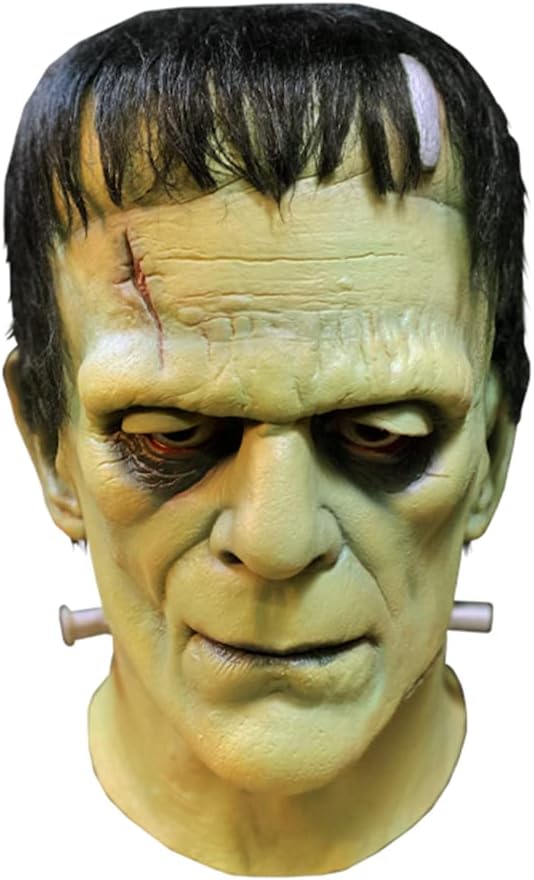
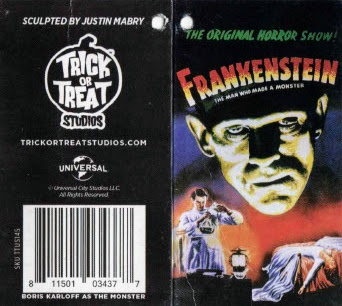
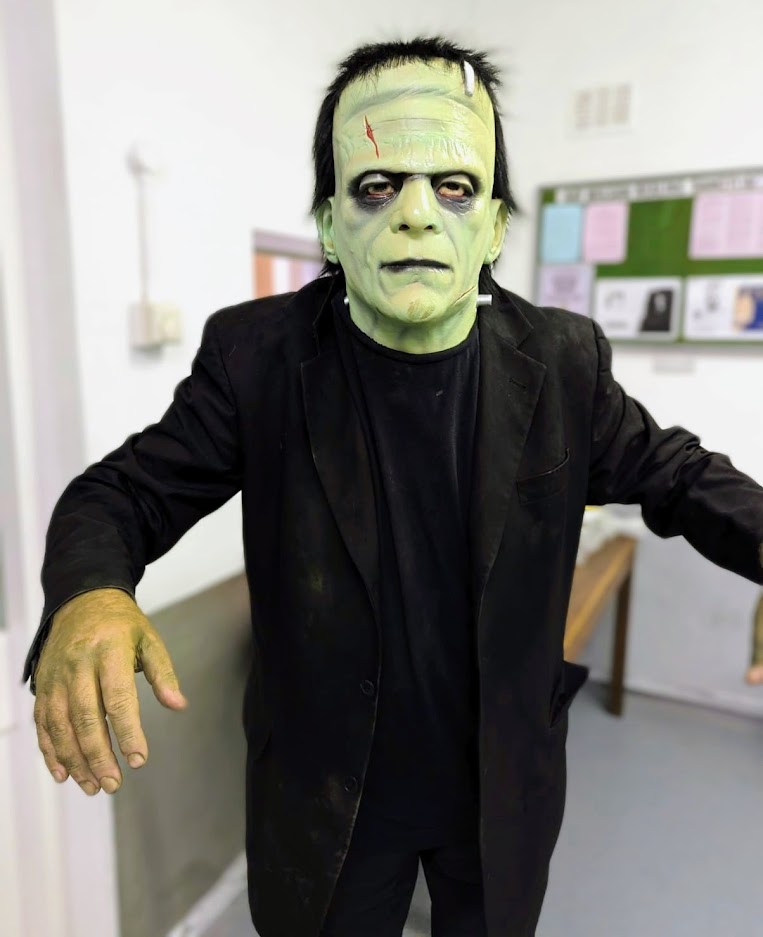
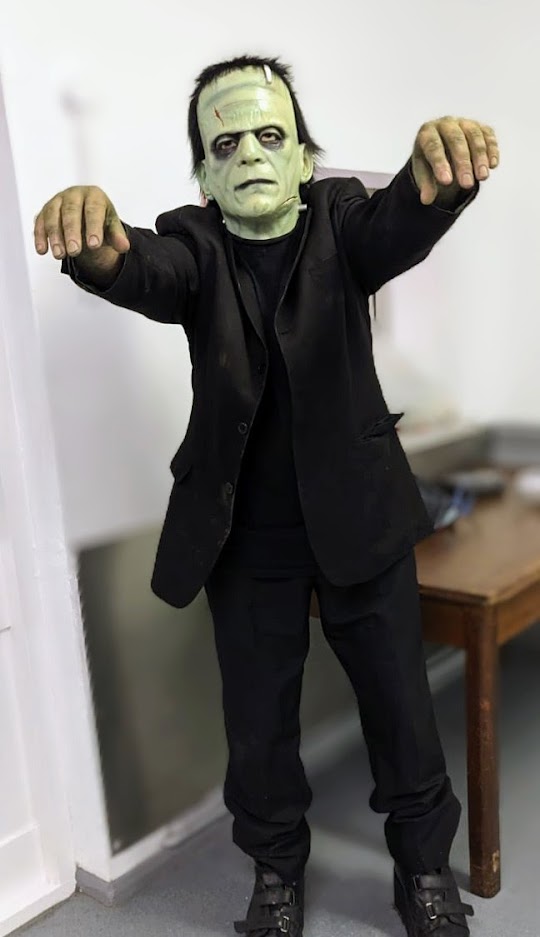
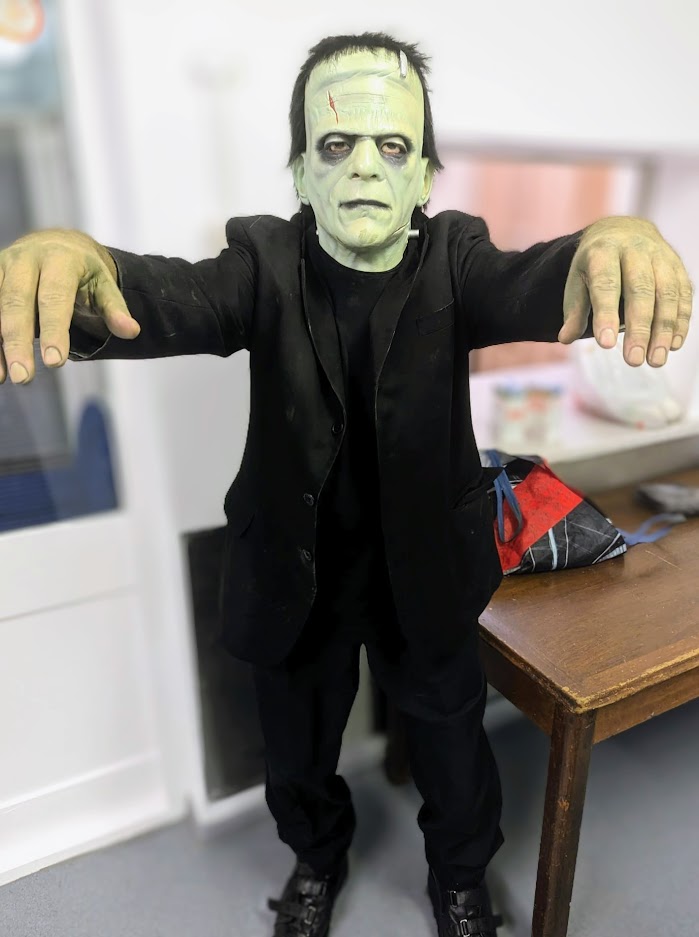
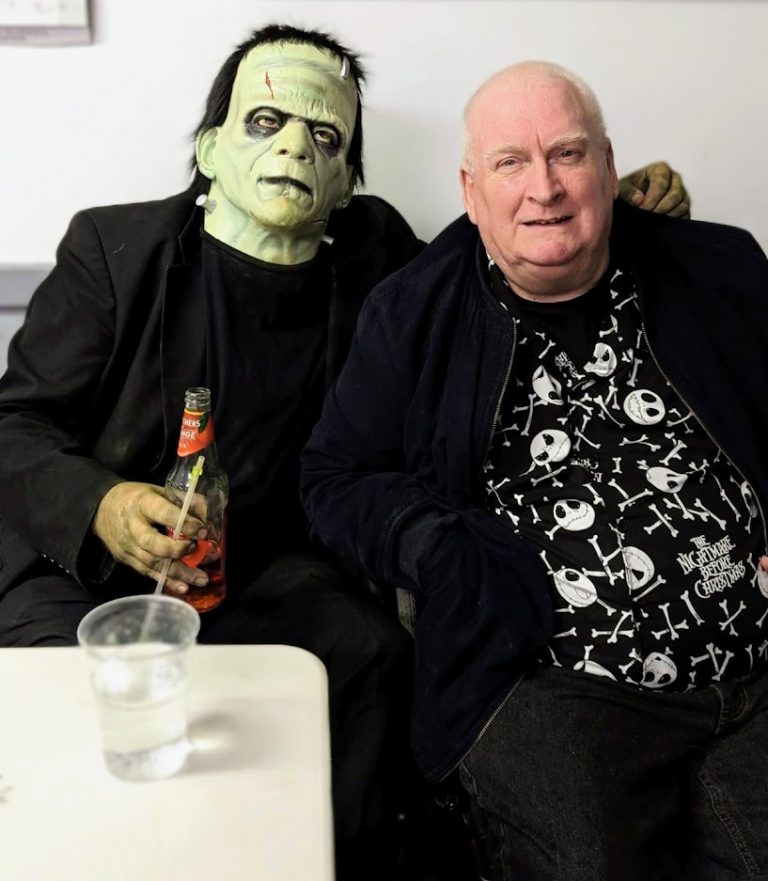
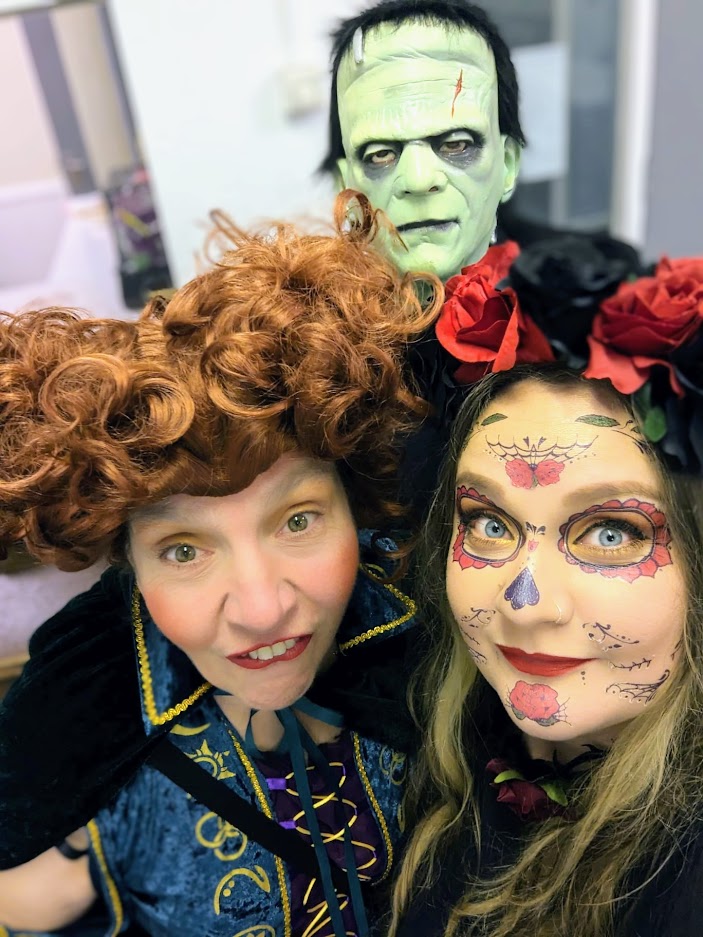
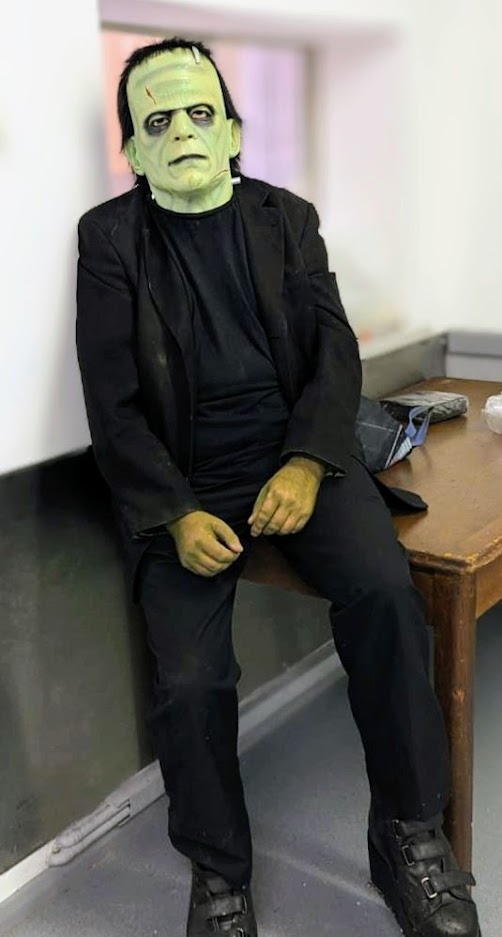
This was my sixth Halloween party and I wore a Frankenstein costume complete with my very cool mask.  This realistic full overhead, latex mask with added hair (designed in the U.S.A. and made in Mexico) is officially licenced by Universal Studios and made for Trick Or Treat Studios and, for a very pleasant change, the quality of it was exactly like in the photo from the place I ordered it from (but I knew it would be after reading very good reviews).   It has been my most expensive mask to date at £68 but that old saying you get what you pay for rings very true here.  It was worth every penny and I can’t wait to put it on display in my bungalow one day. Regardless of the price, I was very happy about it and I enjoyed wearing it (it’s just a shame one or both of the electrodes were hidden a lot in the photos of me wearing it.  This is because I pulled my t-shirt up too far without realising it).   It has now become my favourite Halloween costume since I started wearing Halloween costumes, more so the mask element of it, the rest was a disaster!

I wore a black suit, black T-shirt and big black boots to try and get the full Frankenstein look from the first film which starred Boris Karloff as Frankenstein’s monster.

It has a slit in the back to help get it on so I didn’t have to cut one in which was good.  The mask is hard to get on and off but it isn’t too tight when it is on.  However, there are two moulded bits by the eyes inside that are a bit uncomfortable as they dig into the bridge of my nose a bit but I’m sure these could be softened somehow.  The eye holes are not that big to see through and I had to tilt my head up a bit to see better which is hard anyway with no glasses on like most overhead masks I can’t.  I also couldn’t wear my hearing aids meaning I couldn’t hear that great either.  Both these things are always annoying but it is what it is. 

As I mentioned above this costume was a disaster for me.  I had purchased four army green make-up pots (the closest colour I could get to match the mask and there were two for each arm) as I wasn’t sure how well they would spread.  It turned out I only needed one and, despite using make-up primer, it smudged on my fingers and palms.  It didn’t help I left it too late to do and wasn’t fully dry.  On top of that, I got it on my T-shirt and suit which meant I had to use a wet cloth to get it off but all it did was smudge in my clothes.  Every time I tried to get it off my clothes because the cloth was wet, my hands would be partly washed which meant adding more paint! This did give it a muddy clothes look so I suppose it looked OK but I was very annoyed it happened. 

I also brought FX modelling wax pot, fake blood, spirit gum glue and black cotton to achieve a scarred, sewn-on look around the wrists.  There wouldn’t have been enough wax to use so I didn’t bother with it, therefore there was no point using the cotton.  Anyway, I tried to cut a load of little threads and it was too thin and fiddly so I wouldn’t have been able to do it even if I wanted to with time flying by until I had to go out.

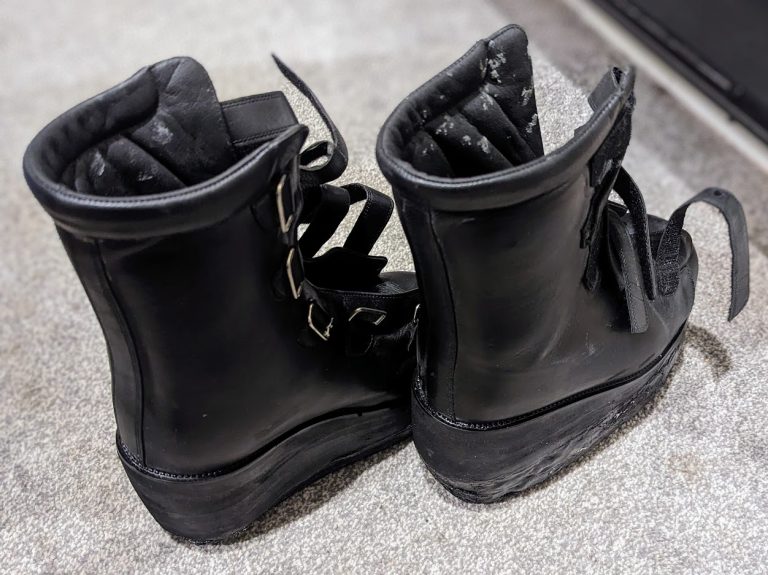
My boots were the biggest failure of the whole costume.  They were disability boots my brother-in-law Ken gave me and one was lower than the other meaning that less than a week before the party I had to build the one up to make them even looking.  I used about 1-inch polystyrene sheets for that, on one boot (to give it a bit more height) and more on the other to build it up to the same as the other one.  I used normal glue which dissolved the polystyrene sheets so I used no nails glue hoping it would dry in time for the party, IT DID NOT.  I used cardboard on them and super-glued a bit cut from tarpaulin to make souls and stop the polystyrene wrecking.  That made no difference because all my weight just squashed everything down, glue and all and it went everywhere, eventually losing the soles altogether.  The boots looked so crap and because of this I have cropped them off in the photos but you may see the odd bit of white.  I am a perfectionist when it comes to a lot of things I do including ideas I have and when they don’t turn out like it was in my head (they rarely do) I do get disheartened when these things happen but I try not to let them bring me down too much and I get on with it, that is how my life is.

The photos below were taken at Ayelsford Hall in Shard End.  I got ready at home and got a lift there from my Brother-In-Law Ken which was good because there was no way I was going to walk!

My sister Julie had to lock the door for me when we left mine and help put my phone and keys in my jacket pocket as my hands were painted green and I didn’t want them to smudge, ha ha.

The photos were taken on the 28th of October, 2023.

Image © Universal via Universal Studios and Trick Or Treat Studios

The EXCELLENT Frankenstein mask from Trick Or Treat Studios.

This version of Frankenstein’s monster is the original one played by Boris Karloff and the likeness is spot on.

Image © Universal via Universal Studios and Trick Or Treat Studios

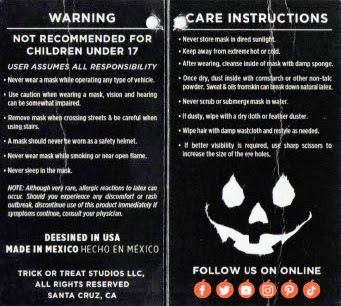
The Frankenstein mask tag that came with it.

Image © Julie Shingler

My very cool Frankenstein mask.

Image © Julie Shingler
Image © Faye Libby
Image © Julie Shingler

Frankenstein’s monster.

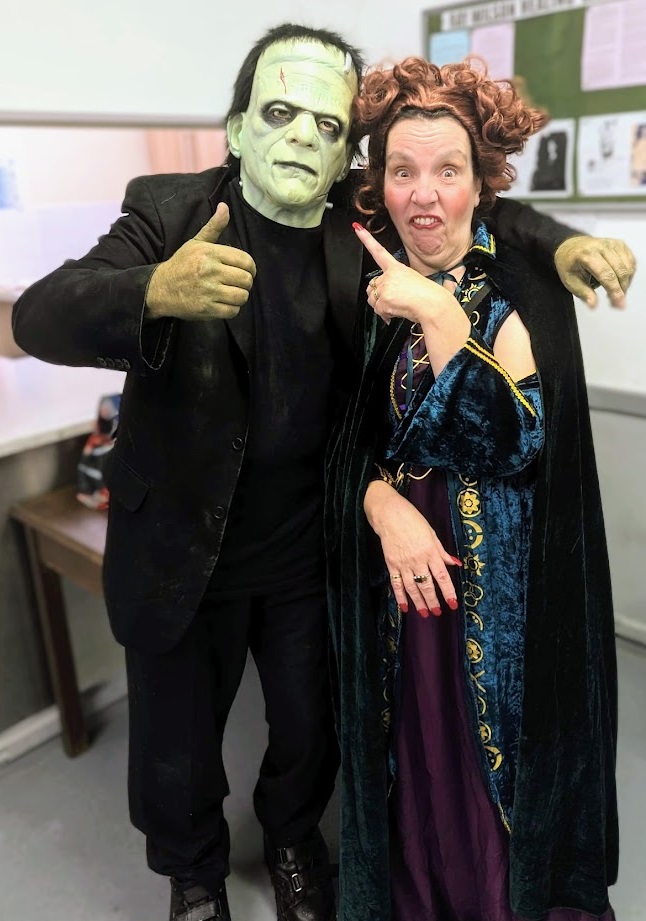
Various poses of me in my Frankenstein costume.

Image © Julie Shingler

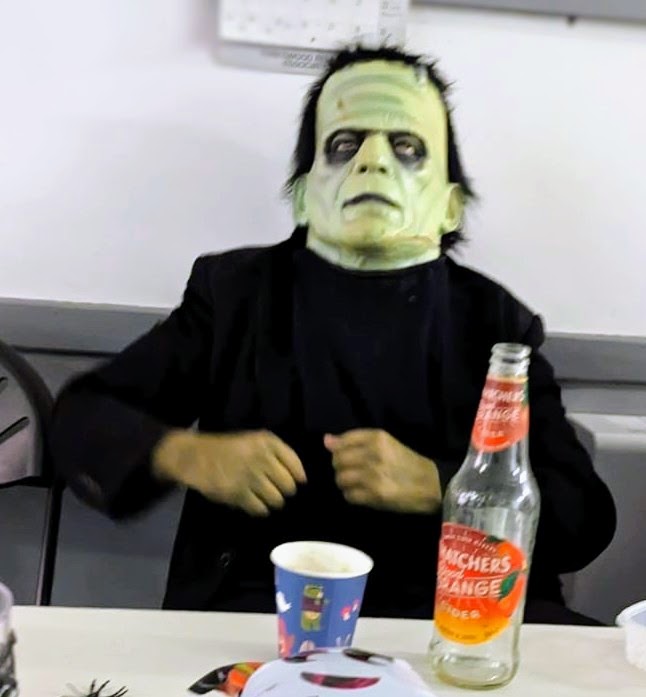
Frankenstein’s monster dancing.

Julie took a photo of me dancing, ha ha.

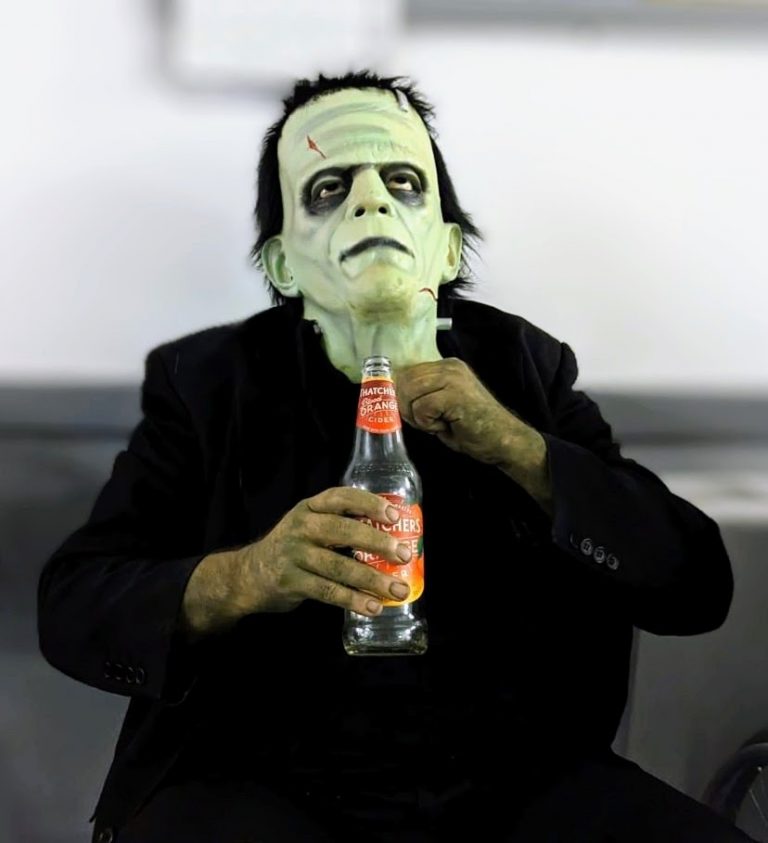
Image © Julie Shingler

Frankenstein’s monster drinking.

It is thirsty work being chased by a flame-wielding mob, ha ha.

This is me attempting to have a drink with my Frankenstein mask on.  I had to lift it up a bit making it look like I was drinking out my neck!

The mask doesn’t have a mouthpiece and I could have cut a little slit in it for using a straw but I didn’t want to spoil and risk (and possibly ruin) an expensive mask like this so I left it as it was.

Image © Faye Libby

Me and my sister Julie. 

Image © Julie Shingler

Me and my brother-in-law Ken.

Image © Faye Libby

Me, my sister Julie and niece Faye.

Image © Frank Parker

My Frankenstein boots.

It was a messy process modifying these boots (hence the glue inside them from my hands).  Here you can see my final effort of changing their look slightly BEFORE I wore them and they became ruined.

Blog Posts

Notes And Links

This page contains links that send you to Wikipedia and other websites and are subject to change. 

The image shown above of a carved pumpkin is the copyright of Wikipedia user Toby Ord.  It comes with a Creative Commons licence (CC BY-SA 2.5) 

The images above are copyright of Frank Parker unless stated. 

The Frankenstein mask and tag photos at the top of the page are copyright of Universal via Universal Studios and Trick Or Treat Studios.

The photos above of me in my Frankenstein mask and costume, me with my sister Julie and brother-in-law Ken are copyright of Julie Shingler.

The photos above of me and my sister Julie, me, my sister Julie and niece Faye and one of me as Frankenstein’s monster are copyright of Faye Libby.

Creative Commons – Official website.  They offer better sharing, advancing universal access to knowledge and culture, and fostering creativity, innovation, and collaboration.

Universal Pictures – U.K. official website.

Universal Pictures on YouTube.

Universal Pictures on Facebook.

Universal Pictures on Twitter.

Universal Studios – Official website.

Universal Studios on YouTube.

Universal Studios on Facebook.

Universal Studios on Twitter.

Trick Or Treat Studios – Official website.

Trick Or Treat Studios on YouTube.

Trick Or Treat Studios on Facebook.

Trick Or Treat Studios on Twitter.

Trick Or Treat Studios on Instagram.

Trick Or Treat Studios on TikTok.

Wikipedia – Official website.  Wikipedia is a free online encyclopedia that anyone can edit in good faith. Its purpose is to benefit readers by containing information on all branches of knowledge.  Hosted by the Wikimedia Foundation, it consists of freely editable content, whose articles also have numerous links to guide readers to more information.  

Halloween Photos (Part 3)

Image ©Toby Ord via Wikipedia

Growing up in England from a child to a teenager in the 1960’s, 1970’s and 1980’s, Halloween was an American thing you saw on the telly.  There was no dressing up and trick-or-treating, not in my family home anyway.  Even when my kids were younger I never really bothered much about Halloween.  It was just all too American for me and just liked the English traditions I was brought up with.  They had fun wearing masks, bobbing for apples etc. but we never went out dressed up knocking on people’s doors, in fact, I don’t recall ever seeing anyone else do it either. 

Nowadays all of the above is a common sight.  I am no killjoy and I don’t knock anyone who really enjoys it.  I admit it’s a fun thing for kids to do and a good excuse for a party for the adults which I have enjoyed going to in the past few years.  When you have suffered from depression and anxiety for as long as I have, just to be included can be a lifesaver.

The main thing I like about Halloween is dressing up and the Horror theme to it.  I have never celebrated  Halloween in my life in the past because, since I was a kid, I have loved horror.  Every day is Halloween for me, ha ha.

Below are photos of Halloween celebrations of me and my family over the years. 

The quality of some of these photos is not the greatest but I have tried to enhance them the best I can but they are worth reminiscing about on here regardless.

2021  (Continued) 

Click here for 2021 details.

Image © Frank Parker

Me and my sister Julie.  

Image © Julie Shingler

Me and my great nephew Billy.

Image © Frank Parker

My cool Freddy Krueger Halloween costume.

I won the Best Costume award for this.  Thank you to my niece Faye for that and the bottle of Bucks Fizz and the cool cover it was in that she crocheted herself.

Image © Frank Parker

Hey You Guys!

The day after the Halloween party I tried on the mask my sister Yvonne gave me what she wore of Sloth from The Goonies.

It doesn’t exactly look like him and I can guarantee it did in the stock photo from where it was purchased from.

I happily had it to add to my mask collection as Yvonne was just going to throw it away!  It is another mask that is not full over the head so my glasses can be worn underneath it if I decide to wear it again which I doubt but I am always happy to receive anything free regarding horror, masks and Halloween costumes.  They are all appreciated.  

2022 

This was my fifth Halloween party and I wore my cool Werewolf costume.  Like the previous years, the quality of the mask was nothing like in the photo from the place I ordered it from but I wasn’t unhappy about it because it was very close and I enjoyed wearing it.  It was my fourth favourite Halloween costume since I started wearing Halloween costumes.

I ordered myself some slip-on werewolf feet, and werewolf gloves and, just like most masks in stock photos that you buy, these were not as good quality as them and I didn’t like how the feet slipped on over your shoes but it was the best I could find.  I wore a blooded shirt with it.  I got some fake fur to stick to my chest using titty tape, ha ha.  I made my own meaty blood and that was a laugh (see below) and I used a severed hand prop (which I rubbed in dirt and sprayed fake blood on it) to complete the scary look to it all.

This wasn’t the werewolf I wanted to go as originally.  I wanted to go as the Universal Classic Monsters The Wolf Man version from 1941, starring Lon Chaney Jnr.  However, there wasn’t a mask available for him so I thought I would try and get a look similar to my favourite werewolf film ever, An American Werewolf In London.  I saw a very cool mask that would have been cool but after reading a lot of reviews and seeing you really get a PATHETIC version of it, (no surprise there), I decided to go for a generic werewolf look.  It bothered me that everything I wore didn’t match the same shade of brown but regardless it was a costume I enjoyed wearing.  

Picture this scene.  I had recently been attacked and bitten by a werewolf but I managed to get away somehow.  The next night there was a full moon and I changed into a wolf man.  I run around outside to find someone to kill. A bloke sees me, panics and runs into some nearby muddy woods.  I attack him and he falls to the ground.  I grab his legs and drag him.  Screaming, he grabs any fallen trees and branches he can to stop himself from going any further.  Desperately clawing the ground, his dirty hands could not save him now).  I  pounce on him, bite his throat and chew on it, causing blood to soak my shirt.  I bite one of his dirty hands off before running off with it in my hand to find my next victim.  This was the inspiration for the look I wanted to achieve for this Halloween party. I have always had a great imagination since I was little! 

This was another tight mask meaning I couldn’t wear my glasses underneath making it hard to see (especially in the dark) but I could wear my hearing aids which is always good at noisy parties.  However, it was not as tight as three years ago and I didn’t have to cut a slit in the back of it like I did with that one but I still had trouble getting it on and off.  Out of all my masks, this was the one I sweated the most in.  I was very hot wearing this.  I did put baby talcum powder in it but it made no difference.

As mentioned above, the meaty blood I made (the night before) was a laugh because, oh boy, did it smell! 

I used fake blood in a jug and added ripped-up cotton balls, green and red food colouring and washing-up liquid to get the colour and constancy of blood-stained chewed-up meat.  I just couldn’t get it how I pictured it in my head. 

I added more cotton wool and put it in the microwave (not shown) thinking the heat would help thicken it but that was a disaster.  The whole lot overflowed and made my microwave look like a horror scene from a film!

I was either getting too light, or too dark by adding a bit of red and brown sauce to it, too watery or too thick, by adding shredded tissue to it.  I added sweet pickle so the chunks in it would make it look like chunks of flesh.  Eventually, I was sort of happy with what I had (and you can see in the photos of it in my mouth and hanging from it, it looked realistic) but as you can imagine it smelled very tangy indeed and it sure did make the car stink on the journey there and it was noticed by people at the party too.  Still, it made the whole experience very memorable, ha ha.

The photos below were taken at my sister Julie’s house where I got ready and at my nephew Wayne’s house on the 30th of October, 2022.

Image © Frank Parker

My cool werewolf Halloween costume.

Complete with meat in my mouth and hanging from my fur.

Image © Frank Parker

My cool werewolf Halloween costume.

I had just got ready at Julie’s ready for the Halloween party.

Image © Julie Shingler

My cool werewolf Halloween costume.

Image © Julie Shingler

My cool werewolf Halloween costume.

It is thirsty work being a werewolf and killing people, ha ha.

Image © Julie Shingler

Me and my sister Julie. 

Image © Julie Shingler

Me and my great nephew Harley. 

Image © Frank Parker

Making fake bloodied meat. 

Image © Frank Parker

My cool werewolf Halloween mask.

The day after the Halloween party I washed my shirt and mask for keepsakes.  The wolf looks like he has had a stroke, ha ha.

Later that day I went to a kid’s get-together.  It wasn’t a Halloween party as such so I haven’t classed it as one. 

Anyway, I wasn’t sure what to wear so I cobbled an outfit together. I went as a devil.  I have had this mask for a long time.  my gloves were from my 2017 outfit and my cloak from the 2019 one. I already had the shrunken head (again from a long time ago as part of my horror collection).  This devil liked to shrink people’s heads, chop them off and keep them as souvenirs.

There’s that great imagination again!

The photos below were taken at my sister Julie’s house where I got ready on the 31st of October, 2022.

Image © Frank Parker

My devil Halloween costume.

Blog Posts

Notes And Links

This page contains links that send you to Wikipedia and is subject to change.

The image shown above of a carved pumpkin is the copyright of Wikipedia user Toby Ord.  It comes with a Creative Commons licence (CC BY-SA 2.5)

The images above are copyright of Frank Parker unless stated.

The images above of me and my great nephew Billy, my cool werewolf Halloween costume and my sister Julie, and my great nephew Harley are copyright of Julie Shingler.

Creative Commons – Official website.  They offer better sharing, advancing universal access to knowledge and culture, and fostering creativity, innovation, and collaboration. 

Wikipedia – Official website.  Wikipedia is a free online encyclopedia that anyone can edit in good faith. Its purpose is to benefit readers by containing information on all branches of knowledge.  Hosted by the Wikimedia Foundation, it consists of freely editable content, whose articles also have numerous links to guide readers to more information.