YouTube

YouTube Logo
Image © YouTube via Wikipedia

YouTube began in 2005, and most of you reading this are aware of it and have used it, or do use it often, unless you live on another planet!

I created my YouTube channel in 2006 and, sadly, I haven’t done much on it due to many personal and health reasons, mainly because of struggling with my Mental Health. I planned to do more, I planned to get better confidence wise and content wise and then my life got in the way and shit happened and often, but now, in 2026, I am trying hard to rectify all that.  I can’t change the past, and I am not looking into the future, but right now, I am doing the best I can to make the present a better place to live in for my state of mind.  I take every day as it comes, and working on My YouTube Channel and website is an important part of that for me.

The original videos I put up were about my favourite Football team Birmingham City, my beloved, and sadly missed, pets, Rocky and Rosie, a Black Country L.P. that was my Dad’s and one about fire! 

I added some short videos more recently and plan to add more related content that tie in with my website a.s.ap.   You can see my channel here.  However, on this page, you can read all about the history of YouTube. 

About YouTube 

YouTube is an American online video sharing platform owned by Google and is headquartered in San Bruno, California, U.S.A.  YouTube was founded on February the 14th, 2005 and is the second-most-visited website in the world, after Google itself.  In January 2024, YouTube had more than 2.7 billion monthly active users, who collectively consumed more than one billion hours of video content every day.  As of May 2019, videos were being uploaded to the platform at a rate of more than 500 hours of content per minute, and as of mid-2024, there were approximately 14.8 billion videos in total.

On November, the 13th, 2006, YouTube was purchased by Google for 1.65 billion dollars (equivalent to 2.44 billion dollars in 2025).  Google expanded YouTube’s business model from generating revenue through advertisements alone to offering paid content such as movies and exclusive content explicitly produced for YouTube.  It also offers YouTube Premium, a paid subscription option for watching content without ads.  YouTube incorporated the Google AdSense program, generating more revenue for both YouTube and approved content creators.  In 2023, YouTube’s advertising revenue totalled $31.7 billion, a 2% increase from the $31.1 billion reported in 2022.  From financial quarter 4 2023 to financial quarter 2024, YouTube’s combined revenue from advertising and subscriptions exceeded $50 billion.

Since its purchase by Google, YouTube has expanded beyond the core website, creating mobile apps, network television, games, and the ability to link with other platforms.  Video categories on YouTube include music videos, video clips, news, short and feature films, songs, documentaries, movie trailers, teasers, TV spots, live streams, vlogs, and more.  Most content is generated by individuals, including collaborations between YouTubers and corporate sponsors.  Established media, news, and entertainment corporations have also created and expanded their visibility on YouTube channels to reach bigger audiences.

YouTube has had unprecedented social impact, influencing popular culture, internet trends, and creating multimillionaire celebrities.  Despite its growth and success, the platform has been criticised for its facilitation of the spread of misinformation and copyrighted content, routinely violating its users’ privacy, excessive censorship, endangering the safety of children and their well-being, and for its inconsistent implementation of platform guidelines.

YouTube Logo Used Since 2025
Image © YouTube via Wikipedia

YouTube’s logo, used since June 2024.

The YouTube logo was introduced in June 2024, using a custom font based on YouTube New typeface.  It is similar to the 2017 logo except that the font is thinner and the play button symbol uses a more pinky shade of red.  As of February 2026, this logo has almost rolled out completely.  The 2017 logo is still used in a few instances.

The History Of YouTube

Founding And Initial Growth (2005 – 2006)

YouTube was founded by Chad Hurley, Steve Chen and Jawed Karim.  They were former employees of PayPal.  They had become wealthy after Google’s acquisition of the company on November the 13th, 2006.   It was purchased for 1.65 billion dollars (equivalent to 2.44 billion dollars in 2025).  Hurley had studied design at the Indiana University of Pennsylvania, and Chen and Karim studied computer science together at the University of Illinois Urbana-Champaign.

According to a story that has often been repeated in the media, Hurley and Chen developed the idea for YouTube during the early months of 2005, after they had experienced difficulty sharing videos that had been shot at a dinner party at Chen’s flat in San Francisco.  Karim did not attend the party and denied that it had occurred, but Chen remarked that the idea that YouTube was founded after a dinner party that was probably very strengthened by marketing ideas around creating a very digestible story.

Karim said the inspiration for YouTube came from the Super Bowl XXXVIII half-time show controversy when Janet Jackson’s breast was briefly exposed by Justin Timberlake during the half-time show.  Karim could not easily find video clips of the incident and the 2004 Indian Ocean tsunami online, which led to the idea of a video-sharing site.  Hurley and Chen said that the original idea for YouTube was a video version of an online dating service and had been influenced by the website Hot or Not.  They created posts on Craigslist asking attractive women to upload videos of themselves to YouTube in exchange for a $100 reward.  Difficulty in finding enough dating videos led to a change of plans, with the site’s founders deciding to accept uploads of any video.

YouTube began as a venture capital–funded technology startup. Between November 2005 and April 2006, the company raised money from various investors, with Sequoia Capital and Artis Capital Management being the largest two.  YouTube’s early headquarters were situated above a pizzeria and a Japanese restaurant in San Mateo, California.  In February 2005, the company registered www.youtube.com. The first video was uploaded on April the 23rd, 2005.  Titled Me at the zoo, it shows co-founder Jawed Karim at the San Diego Zoo and can still be viewed on the site.  The same day, the company launched a public beta and by November, a Nike ad featuring Ronaldinho became the first video to reach one million total views.  The site exited beta in December 2005, by which time the site was receiving 8 million views a day.  Clips at the time were limited to 100 megabytes, as little as 30 seconds of footage.

YouTube was not the first video-sharing site on the Internet, there was also Vimeo.  That was founded in November 2004, though that site remained a side project of its developers from CollegeHumor.  On December, the 17th, 2005, the same week YouTube exited beta, NBCUniversal Saturday Night Live ran a sketch called Lazy Sunday by The Lonely Island.  Besides helping to bolster ratings and long-term viewership for Saturday Night Live, the video‘s status as an early viral video helped establish YouTube as an important website.  Unofficial uploads of the skit to YouTube drew in more than five million collective views by February 2006 before they were removed when NBCUniversal requested it two months later based on copyright concerns.  Despite eventually being taken down, these duplicate uploads of the skit helped popularise YouTube’s reach and led to the upload of more third-party content.  The site grew rapidly.  In July 2006, the company announced that more than 65,000 new videos were being uploaded every day and that the site was receiving 100 million video views per day.

The choice of the name youtube.com led to problems for a similarly named website, utube.com.  That site’s owner, Universal Tube & Rollform Equipment (Universal Tube), filed a lawsuit against YouTube in November 2006, after being regularly overloaded by people looking for YouTube.  Universal Tube subsequently changed its website to www.utubeonline.com. 

Chad Hurley
Image © The Bui Brothers via Wikipedia

Chad Hurley.

Steve Chen
Image © TaiwanPlus via Wikipedia

Steve Chen.

Jawed Karim
Image © Robin Brown via Wikipedia and is in the public domain

Jawed Karim.

Original YouTube Logo Used Until 2007
Image © YouTube via Wikipedia and is in the public domain

The YouTube logo used from its launch until 2007.

It returned in 2008 before being removed again in 2010. Another version without “Broadcast Yourself” was used until 2011.

Broadcast Yourself Era (2006 – 2013)

On October the 9th, 2006, Google announced that they had acquired YouTube for 1.65 billion dollars in Google stock.  The deal was finalised on November the 13th, 2006.  Google’s acquisition launched newfound interest in video-sharing sites IAC, which now owned Vimeo, focused on supporting the content creators to distinguish itself from YouTube.  It was at this time that YouTube adopted the slogan Broadcast Yourself.  The company experienced rapid growth. The Daily Telegraph wrote that in 2007, YouTube consumed as much bandwidth as the entire Internet in 2000.  By 2010, the company had reached a market share of around 43% and more than 14 billion views of videos, according to comScore.  That year, the company simplified its interface to increase the time users would spend on the site.

In 2011, more than three billion videos were being watched each day with 48 hours of new videos uploaded every minute.  Most of these views came from a relatively small number of videos, according to a software engineer at that time, 30% of videos accounted for 99% of views on the site.  That year, the company again changed its interface and at the same time, introduced a new logo with a darker shade of red.  A subsequent interface change, designed to unify the experience across desktop, T.V., and mobile, was rolled out in 2013.  By that point, more than 100 hours were being uploaded every minute, increasing to 300 hours by November 2014.

During that time, the company also went through some organisational changes.  In October 2006, YouTube moved to a new office in San Bruno, California.  Hurley announced that he would be stepping down as chief executive officer of YouTube to take an advisory role and that Salar Kamangar would take over as head of the company in October 2010.  In April 2009, YouTube partnered with Vevo.  In April 2010, Lady Gaga’s Bad Romance became the most-viewed video, becoming the first video to reach 200 million views on May the 9th, 2010.

YouTube faced a major lawsuit by Viacom International in 2011 that nearly resulted in the discontinuation of the website.  The lawsuit was filed due to alleged copyright infringement of Viacom’s material by YouTube.  However, the United States Court of Appeals for the Second Circuit ruled that YouTube was not liable, and thus, YouTube won the case in 2012.

901 Cherry Avenue, San Bruno, California
Image © Coolcaesar via Wikipedia and is in the public domain

YouTube’s headquarters at 901 Cherry Avenue, San Bruno, California in April 2017.

Susan Wojcicki’s Leadership (2014 – 2023)

Susan Wojcicki was appointed C.E.O. of YouTube in February 2014.  In January 2016, YouTube expanded its headquarters in San Bruno by purchasing an office park for $215 million.  The complex has 51,468 square metres (554,000 square feet) of space and can house up to 2,800 employees.  YouTube officially launched the polymer redesign of its user interfaces based on Material Design language as its default, as well as a redesigned logo that is built around the service’s play button emblem in August 2017.

Through this period, YouTube tried several new ways to generate revenue beyond advertisements.  In 2013, YouTube launched a pilot program for content providers to offer premium, subscription-based channels.  This effort was discontinued in January 2018 and relaunched in June, with $4.99 channel subscriptions.  These channel subscriptions complemented the existing Super Chat ability, launched in 2017, which allows viewers to donate between $1 and $500 to have their comment highlighted.  In 2014, YouTube announced a subscription service known as Music Key, which bundled ad-free streaming of music content on YouTube with the existing Google Play Music service.  The service continued to evolve in 2015 when YouTube announced YouTube Red, a new premium service that would offer ad-free access to all content on the platform (succeeding the Music Key service released the previous year), premium original series, and films produced by YouTube personalities, as well as background playback of content on mobile devices.  YouTube also released YouTube Music, a third app oriented towards streaming and discovering the music content hosted on the YouTube platform.

The company also attempted to create products appealing to specific viewers.  YouTube released a mobile app known as YouTube Kids in 2015, which was designed to provide an experience optimised for children.  It features a simplified user interface, curated selections of channels featuring age-appropriate content, and parental control features.  Also in 2015, YouTube launched YouTube Gaming.  This is a video gaming-oriented vertical and app for videos and live-streaming, intended to compete with the Amazon.com owned Twitch.  In April 2018, a shooting occurred at YouTube’s headquarters in San Bruno, California, which wounded four and resulted in the death of the shooter.

By February 2017, one billion hours of YouTube videos were being watched every day, and 400 hours worth of videos were uploaded every minute.  Two years later, the uploads had risen to more than 500 hours per minute.  During COVID, when most of the world was under stay-at-home orders, usage of services like YouTube significantly increased.  Forbes estimated that YouTube accounted for 16% of all internet traffic, as of 2024, up from 11% in 2018, before COVID.  In response to E.U. officials requesting that such services reduce bandwidth to make sure medical entities had sufficient bandwidth to share information, YouTube and Netflix said they would reduce streaming quality for at least thirty days as to cut bandwidth use of their services by 25% to comply with the E.U.’s request.  YouTube later announced that they would continue with this move worldwide saying “We continue to work closely with governments and network operators around the globe to do our part to minimise stress on the system during this unprecedented situation.”

After a 2018 complaint alleging violations of the Children’s Online Privacy Protection Act (C.O.P.P.A.), the company was fined $170 million by the FTC for collecting personal information from minors under the age of 13.  YouTube was also ordered to create systems to increase children’s privacy.  Following criticisms of its implementation of those systems, YouTube started treating all videos designated as made for kids as liable under C.O.P.P.A. on January the 6th, 2020.  Joining the YouTube Kids app, the company created a supervised mode, designed more for tweens, in 2021.  Additionally, to compete with TikTok and Instagram Reels, YouTube released YouTube Shorts, a short-form video platform.  During that period, YouTube entered disputes with other tech companies.  For over a year, in 2018/ 19, no YouTube app was available for Amazon Fire products.  In 2020, Roku removed the YouTube TV app from its streaming store after the two companies were unable to reach an agreement.

After testing earlier in 2021, YouTube removed public display of dislike counts on videos in November 2021, claiming the reason for the removal was, based on its internal research, that users often used the dislike feature as a form of cyberbullying and brigading.  While some users praised the move as a way to discourage trolls, others felt that hiding dislikes would make it harder for viewers to recognise clickbait or unhelpful videos and that other features already existed for creators to limit bullying.  YouTube co-founder Jawed Karim referred to the update as a stupid idea and said that the real reason behind the change was not a good one, and not one that will be publicly disclosed.  He felt that users’ ability on a social platform to identify harmful content was essential, saying that the process works, and there’s a name for it –  the wisdom of the crowds.  He said the process breaks when the platform interferes with it and then, the platform invariably declines.  Shortly after the announcement, software developer Dmitry Selivanov created Return YouTube Dislike, an open-source, third-party browser extension for Chrome and Firefox that allows users to see a video’s number of dislikes.  In a letter published on January the 25th, 2022, by then YouTube C.E.O. Susan Wojcicki, acknowledged that removing public dislike counts was a controversial decision, but reiterated that she stands by this decision, claiming that it reduced dislike attacks.

In 2022, YouTube launched an experiment where the company would show users who watched longer videos on T,V,’s a long chain of short unskippable adverts, intending to consolidate all ads into the beginning of a video.  Following public outrage over the unprecedented amount of unskippable ads, YouTube ended the experiment on September the 19th of the same year.  In October, YouTube announced that they would be rolling out customisable user handles in addition to channel names, which would also become channel U.R.L’s.

YouTube Logo Used Since 2025
Image © YouTube via Wikipedia and is in the public domain

YouTube’s logo from 2015 until 2017.

Neal Mohan’s Leadership (2023 – Present)

On February the 16th, 2023, Wojcicki announced that she would step down as C.E.O., with Neal Mohan named as her successor.  Wojcicki took on an advisory role for Google and parent company Alphabet.  Wojcicki died a year and a half later from non-small-cell lung cancer, on August the 9th, 2024.  In late October 2023, YouTube began cracking down on the use of ad blockers on the platform.  Users of ad blockers may be given a pop-up warning saying “Video player will be blocked after 3 videos.” Users of ad blockers are shown a message asking them to allow ads or inviting them to subscribe to the ad-free YouTube Premium subscription plan.  YouTube says that the use of ad blockers violates its terms of service.  In April 2024, YouTube announced it would be strengthening their enforcement on third-party apps that violate YouTube’s Terms of Service, specifically ad-blocking apps.  Starting in June 2024, Google Chrome announced that it would be replacing Manifest V2 in favour of Manifest V3, effectively killing support for most ad-blockers.  Around the same time, YouTube started using server-side ad injection, which allows the platform to inject the ads directly into the video, instead of having the ad as a separate file which can be blocked.

In September 2023, YouTube announced an in-app gaming platform called Playables.  It was made accessible to all users in May 2024, expanding from an initial offering limited to premium subscribers.  In December 2024, YouTube began testing a new multiplayer feature for that service, supporting multiplayer functionality across desktop and mobile devices.  As of December 2024, the Playables catalogue has over 130 games in various genres, including trivia, action, and sports.  In December 2024, YouTube introduced new guidelines prohibiting videos with clickbait titles to enhance content quality and combat misinformation.  The platform aims to penalise creators using misleading or sensationalised titles, with potential actions including video removal or channel suspension.  According to YouTube, this guideline will gradually roll out in India first, but will expand to more countries in the coming months.

On February, the 14th, 2025, YouTube celebrated 20 years since its founding.  On July 30, 2025, amid the implementation of the Online Safety Act 2023 in the United Kingdom, Google announced that it would begin to enforce age assurance policies for selected users in the United States as a trial.  Machine learning will be used to determine the age of the user (regardless of any account information indicating their age) and restrict access to certain content and features across all Google properties, including YouTube (including, in particular, disabling personalised advertising and enabling certain digital wellbeing limits), if they are assumed to be under 18.  On YouTube, this will be based on factors such as searches and video history, and the age of the account.  The user must go through age verification via payment, scanned ID, or selfie to access all features if they are detected to be a minor.  On April, the 9th, 2025, YouTube expressed support for the NO FAKES Act of 2025, introduced by Senator Chris Coons (D-DE) and Senator Marsha Blackburn (R-TN), and announced an expansion of its pilot program that is designed to identify content generated by A.I.

YouTube's Logo From August 2017 Until February 2025
Image © YouTube via Wikipedia and is in the public domain

YouTube’s logo from August 2017 until February 2025.

YouTube Features

YouTube offers different features based on user verification, such as standard or basic features like uploading videos, creating playlists, and using YouTube Music, with limits based on daily activity (verification via phone number or channel history increases feature availability and daily usage limits), intermediate or additional features like longer videos (over 15 minutes), live-streaming, custom thumbnails, and creating podcasts, advanced features like content I.D. appeals, embedding live streams, applying for monetisation, clickable links, adding chapters, and pinning comments on videos or posts.

Read more here.

YouTube Videos

In January 2012, it was estimated that visitors to YouTube spent an average of 15 minutes a day on the site, in contrast to the four or five hours a day spent by a typical U.S. citizen watching television.  In 2017, viewers on average watched YouTube on mobile devices for more than an hour every day.  In December 2012, two billion views were removed from the view counts of Universal and Sony Music videos on YouTube, prompting a claim by The Daily Dot that the views had been deleted due to a violation of the site’s terms of service, which ban the use of automated processes to inflate view counts.  That was disputed by Billboard, which said that the two billion views had been moved to Vevo, since the videos were no longer active on YouTube.

On August, the 5th, 2015, YouTube patched the formerly notorious behaviour, which caused a video’s view count to freeze at 301 (later 301+) until the actual count was verified to prevent view count fraud.  YouTube view counts again began updating in real time.  Since September 2019, subscriber counts are abbreviated.  Only three leading digits of channels’ subscriber counts are indicated publicly, compromising the function of third-party real-time indicators such as Social Blade.  Exact counts remain available to channel operators inside YouTube Studio.

On November, the 11th, 2021, after testing out this change in March of the same year, YouTube announced it would start hiding dislike counts on videos, making them invisible to viewers.  The company stated the decision was in response to experiments which confirmed that smaller YouTube creators were more likely to be targeted in dislike brigading and harassment.  Creators will still be able to see the number of likes and dislikes in the YouTube Studio dashboard tool, according to YouTube.  YouTube has an estimated 14.8 billion videos with about 4% of those never having a view.  Just over 85% have fewer than 1,000 views.

Read more here.

Copyright Issues

YouTube has faced numerous challenges and criticisms in its attempts to deal with copyright, including the site’s first viral video, Lazy Sunday, which had to be taken down due to copyright concerns.  At the time of uploading a video, YouTube users are shown a message asking them not to violate copyright laws.  Despite this advice, many unauthorised clips of copyrighted material remain on YouTube.  YouTube does not view videos before they are posted online, and it is left to copyright holders to issue a D.M.C.A. takedown notice pursuant to the terms of the Online Copyright Infringement Liability Limitation Act.  Any successful complaint about copyright infringement results in a YouTube copyright strike.  Three successful complaints for copyright infringement against a user account will result in the account and all of its uploaded videos being deleted.   From 2007 to 2009 organisations including Viacom, Mediaset, and the English Premier League have filed lawsuits against YouTube, claiming that it has done too little to prevent the uploading of copyrighted material.

In August 2008, a U.S. court ruled in Lenz v. Universal Music Corp. that copyright holders cannot order the removal of an online file without first determining whether the posting reflected fair use of the material.  YouTube’s owner Google announced in November 2015 that they would help cover the legal cost in select cases where they believe fair use defences apply.  In the 2011 case of Smith v. Summit Entertainment LLC, professional singer Matt Smith sued Summit Entertainment for the wrongful use of copyright takedown notices on YouTube.  He asserted seven causes of action, and four were ruled in Smith’s favour.  In April 2012, a court in Hamburg ruled that YouTube could be held responsible for copyrighted material posted by its users.  On November, the 1st, 2016, the dispute with G.E.M.A. was resolved, with Google content I.D. being used to allow advertisements to be added to videos with content protected by G.E.M.A.

In April 2013, it was reported that Universal Music Group and YouTube have a contractual agreement that prevents content blocked on YouTube by a request from U.M.G. from being restored, even if the uploader of the video files a D.M.C.A. counter-notice.  As part of YouTube Music, Universal and YouTube signed an agreement in 2017, which was followed by separate agreements other major labels, which gave the company the right to advertising revenue when its music was played on YouTube.  By 2019, creators were having videos taken down or demonetised when Content I.D. identified even short segments of copyrighted music within a much longer video, with different levels of enforcement depending on the record label.  Experts noted that some of these clips said qualified for fair use.

Read more here and here.

Content I.D.

In June 2007, YouTube began trials of a system for automatic detection of uploaded videos that infringe copyright.  Google C.E.O. Eric Schmidt regarded this system as necessary for resolving lawsuits such as the one from Viacom, which alleged that YouTube profited from content that it did not have the right to distribute.  The system, which was initially called Video Identification and later became known as Content I.D., creates an I.D. File for copyrighted audio and video material, and stores it in a database.  When a video is uploaded, it is checked against the database, and flags the video as a copyright violation if a match is found.  When this occurs, the content owner has the choice of blocking the video to make it unviewable, tracking the viewing statistics of the video, or adding advertisements to the video.

An independent test in 2009 uploaded multiple versions of the same song to YouTube and concluded that while the system was surprisingly resilient in finding copyright violations in the audio tracks of videos, it was not infallible.  The use of Content I.D. to remove material automatically has led to controversy in some cases, as the videos have not been checked by a human for fair use.  If a YouTube user disagrees with a decision by Content I.D., it is possible to fill in a form disputing the decision.  Before 2016, videos were not monetised until the dispute was resolved.  Since April 2016, videos continue to be monetised while the dispute is in progress, and the money goes to whoever won the dispute.  Should the uploader want to monetise the video again, they may remove the disputed audio in the Video Manager.  YouTube has cited the effectiveness of Content I.D. as one of the reasons why the site’s rules were modified in December 2010 to allow some users to upload videos of unlimited length.

Read more here.

Russia

In 2021, two accounts linked to RT DE, the German channel of the Russian state-owned RT network, were removed for breaching YouTube’s policies relating to COVID.  Russia threatened to ban YouTube after the platform deleted two German RT channels in September 2021.  Shortly after the Russian invasion of Ukraine in 2022, YouTube removed all channels funded by the Russian state.  YouTube expanded the removal of Russian content from its site to include channels described as pro-Russian.  In June 2022, the War Gonzo channel run by Russian military blogger and journalist Semyon Pegov was deleted.

In July 2023, YouTube removed the channel of British journalist Graham Phillips, active in covering the war in Donbas from 2014.  In August 2023, a Moscow court fined Google 3 million rubles, around $35,000, for not deleting what it said was fake news about the war in Ukraine.  In October 2024, a Russian court fined Google 2 undecillion rubles (equivalent to $20 decillion) for restricting Russian state media channels on YouTube.  State news agency TASS reported that Google is allowed to return to the Russian market only if it complies with the court’s decision.  Kremlin spokesperson Dmitry Peskov labelled the court decision as symbolic and warned Google that it should not be restricting the actions of their broadcasters on its platform.

April Fools Gags

YouTube featured an April Fools’ prank on the site on April the 1st of every year from 2008 to 2016.  In 2008, all links to videos on the main page were redirected to Rick Astley’s music video Never Gonna Give You Up, a prank known as rick rolling.  The next year, when clicking on a video on the main page, the whole page turned upside down, which YouTube claimed was a new layout.  In 2010, YouTube temporarily released a TEXTp mode which rendered video imagery into A.S.C.I.I. art letters in order to reduce bandwidth costs by $1 per second.

The next year, the site celebrated its 100th anniversary with a range of sepia-toned silent, early 1900’s style films, including a parody of Keyboard Cat.  In 2012, clicking on the image of a D.V.D. next to the site logo led to a video about a purported option to order every YouTube video for home delivery on D.V.D.   In 2013, YouTube teamed up with satirical newspaper company The Onion to claim in an uploaded video that the video-sharing website was launched as a contest which had finally come to an end, and would shut down for ten years before being re-launched in 2023, featuring only the winning video.  The video starred several YouTube celebrities, including Antoine Dodson.  A video of two presenters announcing the nominated videos streamed live for 12 hours.

In 2014, YouTube announced that it was responsible for the creation of all viral video trends, and revealed previews of upcoming trends, such as Clocking, Kissing Dad, and Glub Glub Water Dance.  The next year, YouTube added a music button to the video bar that played samples from Sandstorm by Darude.  In 2016, YouTube introduced an option to watch every video on the platform in 360-degree mode with Snoop Dogg.

Read more here

YouTube Services

YouTube Premium

YouTube Premium (formerly Music Key and YouTube Red) is YouTube’s premium subscription service.  It offers advertising-free streaming, access to original programming, and background and offline video playback on mobile devices.  YouTube Premium was originally announced on November the 12th, 2014, as Music Key, a subscription music streaming service, and was intended to integrate with and replace the existing Google Play Music All Access service.  On October, the 28th, 2015, the service was relaunched as YouTube Red, offering ad-free streaming of all videos and access to exclusive original content.  As of November 2016, the service has 1.5 million subscribers, with a further million on a free-trial basis.  As of June 2017, the first season of YouTube Originals had received 250 million views in total.

Read more here.

YouTube's Premium Logo In 2024
Image © YouTube via Wikipedia and is in the public domain

YouTube’s Premium logo in 2024.

YouTube Kids

YouTube Kids is an American children’s video app developed by YouTube, a subsidiary of Google.  The app was developed in response to parental and government scrutiny on the content available to children.  The app provides a version of the service oriented towards children, with curated selections of content, parental control features, and filtering of videos deemed inappropriate viewing for children aged under 13, 8 or 5, depending on the age grouping chosen.  First released on February the 15th, 2015, as an Android and iOS mobile app, the app has since been released for LG, Samsung, and Sony smart T.V.’s, as well as for Android TV.  On May, the 27th, 2020, it became available on Apple TV.  As of September 2019, the app is available in 69 countries, including Hong Kong and Macau, and one province.  YouTube launched a web-based version of YouTube Kids on August the 30th, 2019.

Read more here.

YouTube's Kids Logo In 2019
Image © YouTube via Wikipedia and is in the public domain

YouTube’s Kids logo in 2024.

YouTube Music

On September, the 28th, 2016, YouTube named Lyor Cohen, the co-founder of 300 Entertainment and former Warner Music Group executive, the Global Head of Music.  In early 2018, Cohen began hinting at the possible launch of YouTube’s new subscription music streaming service, a platform that would compete with other services such as Spotify and Apple Music.  On May, the 22nd, 2018, the music streaming platform named YouTube Music was launched for people who mostly listen to music on YouTube.

Read more here.

YouTube's Music Logo In 2024
Image © YouTube via Wikipedia and is in the public domain

YouTube’s Music logo in 2024.

YouTube Movies & TV

YouTube Movies & TV is a video on demand (V.O.D.) service that offers movies and television shows for purchase or rental, depending on availability, along with a selection of movies (encompassing between 100 and 500 titles overall) that are free to stream, with interspersed ad breaks.  YouTube began offering free-to-view movie titles to its users in November 2018.  Selections of new movies are added and others removed, unannounced each month.  In March 2021, Google announced plans to gradually deprecate the Google Play Movies & TV app, and eventually migrate all users to the YouTube app’s Movies & TV store to view, rent and purchase movies and T.V. shows (first affecting Roku, Samsung, LG, and Vizio smart TV users on July the 15th).  Google Play Movies & TV formally shut down on January the 17th, 2024, with the web version of that platform migrated to YouTube as an expansion of the Movies & T.V. store to desktop users.  Other functions of Google Play Movies & TV were integrated into the Google TV service.

Read more here.

YouTube Primetime Channels

On November the 1st, 2022, YouTube launched Primetime Channels, a channel store platform offering third-party subscription streaming add-ons sold a la carte through the YouTube website and app, competing with similar subscription add-on stores operated by Apple, Prime Video and Roku.  The add-ons can be purchased through the YouTube Movies & TV hub or through the official YouTube channels of the available services.  Subscribers of YouTube TV add-ons that are sold through Primetime Channels can also access their content via the YouTube app and website.  A total of 34 streaming services (including Paramount+, Showtime, Starz, MGM+, AMC+ and ViX+) were initially available for purchase.

NFL Sunday Ticket, as part of a broader residential distribution deal with Google signed in December 2022 that also made it available to YouTube TV subscribers, was added to Prime-time Channels as a standalone add-on on August the 16th, 2023.  The ad-free tier of Max was added to Prime-time Channels on December the 12th, 2023, coinciding with YouTube TV converting its separate HBO (for base plan subscribers) and HBO Max (for all subscribers) linear/V.O.D. add-ons into a single combined Max offering.

Read more here.

YouTube TV

On February, the 28th, 2017, in a press announcement held at YouTube Space Los Angeles, YouTube announced YouTube TV, an over-the-top M.V.P.D.-style subscription service that would be available for United States customers for $65 per month.  Initially launching in five major markets (New York City, Los Angeles, Chicago, Philadelphia and San Francisco) on April the 5th, 2017, the service offers live streams of programming from the five major broadcast networks (ABC, CBS, The CW, Fox and NBC, along with selected MyNetworkTV affiliates and independent stations in certain markets), as well as approximately 60 cable channels owned by companies such as The Walt Disney Company, Paramount Global, Fox Corporation, NBCUniversal, Allen Media Group and Warner Bros. Discovery (including among others Bravo, USA Network, Syfy, Disney Channel, CNN, Cartoon Network, E!, Fox Sports 1, Freeform, FX and ESPN).

Subscribers can receive premium cable channels (including HBO (via a combined Max add-on that includes in-app and log-in access to the service), Cinemax, Showtime, Starz and MGM+) and other subscription services (such as NFL Sunday Ticket, MLB.tv, NBA League Pass, Curiosity Stream and Fox Nation) as optional add-ons for an extra fee, and can access YouTube Premium original content.  In September 2022, YouTube TV began allowing customers to purchase most of its premium add-ons (excluding certain services such as NBA League Pass and AMC+) without an existing subscription to its base package.

Read more here.

YouTube's TV Logo In 2018
Image © YouTube via Wikipedia and is in the public domain

YouTube’s TV logo in 2018.

YouTube Go

In September 2016, YouTube Go was announced, as an Android app created for making YouTube easier to access on mobile devices in emerging markets.  It was distinct from the company’s main Android app and allowed videos to be downloaded and shared with other users.  It also allowed users to preview videos, share downloaded videos through Bluetooth, and offered more options for mobile data control and video resolution.

In February 2017, YouTube Go was launched in India, and expanded in November 2017 to 14 other countries, including Nigeria, Indonesia, Thailand, Malaysia, Vietnam, the Philippines, Kenya, and South Africa.  On February, the 1st, 2018, it was rolled out in 130 countries worldwide, including Brazil, Mexico, Turkey, and Iraq.  Before it shut down, the app was available to around 60% of the world’s population.  In May 2022, Google announced that they would be shutting down YouTube Go in August 2022.

YouTube's Go Logo In 2025
Image © YouTube via Wikipedia and is in the public domain

YouTube’s Go logo in 2025.

YouTube Shorts

In September 2020, YouTube announced that it would be launching a beta version of a new platform of 15-second videos, similar to TikTok, called YouTube Shorts.  The platform was tested in India and later expanded to other countries, including the United States in March 2021, with videos allowed up to 1 minute long.  The platform is not a standalone app, but is integrated into the main YouTube app. Like TikTok, it gives users access to built-in creative tools, including the possibility of adding licensed music to their videos.  The platform had its global beta launch on July the 13th, 2021.  On October, the 15th, 2024, the platform officially extended the length of shorts to 3 minutes.

Read more here.

YouTube Stories

In 2018, YouTube started testing a new feature initially called YouTube Reels.  The feature was nearly identical to Instagram Stories and Snapchat Stories.  YouTube later renamed the feature YouTube Stories.  It was only available to creators who had more than 10,000 subscribers and could only be posted/seen in the YouTube mobile app.  On May the 25th, 2023, YouTube announced that they would be shutting down this feature on June the 26th, 2023.

YouTube VR

In November 2016, YouTube released YouTube VR, a dedicated version with an interface for V.R. devices, for Google’s Daydream mobile V.R. platform on Android.  In November 2018, YouTube VR was released on the Oculus Store for the Oculus Go headset.  YouTube VR was updated since for compatibility with successive Quest devices, and was ported to Pico 4.

YouTube VR allows for access to all YouTube-hosted videos, but particularly supports headset access for 360° and 180°-degree video (both in 2D and stereoscopic 3D).  Starting with the Oculus Quest, the app was updated for compatibility with mixed-reality pass-through modes on V.R. headsets.  In April 2024, YouTube VR was updated to support 8K SDR video on Meta Quest 3.

Read more here.

Playables

In 2010, YouTube added Snake as a hidden game inside their video player.  In May 2024, YouTube introduced Playables, a set of around 75 free-to-play games that can be played on the platform.

Automatic Language Dubbing

In December 2024, YouTube added the functionality of automatic language dubbing, which uses A.I. to produce translations of videos into different languages.  However, the feature has initially been criticised for providing robotic-sounding dubs, mistranslations, and lack of an option for the user to disable auto-dubbed voices.

Criticism And Controversies

YouTube has faced various criticisms over the years, particularly regarding content moderation, offensive content, and monetisation.  YouTube has faced criticism over aspects of its operations, its recommendation algorithms perpetuating videos that promote falsehoods and hosting videos ostensibly targeting children but containing violent or sexually suggestive content involving popular characters, videos of minors attracting paedophilic activities in their comment sections, and fluctuating policies on the types of content that is eligible to be monetised with advertising.

YouTube has also been blocked by several countries.  As of 2018, public access to YouTube was blocked by countries including China, North Korea, Iran, Turkmenistan, Uzbekistan, Tajikistan, Eritrea, Sudan and South Sudan.

Read more here.

Privacy Concerns

Since its founding in 2005, YouTube has been faced with a growing number of privacy issues, including allegations that it allows users to upload unauthorised copyrighted material and allows personal information from young children to be collected without their parents’ consent.

In September 2024, the Federal Trade Commission released a report summarising 9 company responses (including from YouTube) to orders made by the agency pursuant to Section 6(b) of the Federal Trade Commission Act of 1914 to provide information about user and non-user data collection (including of children and teenagers) and data use by the companies that found that the companies’ user and non-user data practices put individuals vulnerable to identity theft, stalking, unlawful discrimination, emotional distress and mental health issues, social stigma, and reputational harm.

Read more here.

Censorship And Bans

Read more here.

State Censorship Of YouTube Content

YouTube has been censored, filtered, or banned for a variety of reasons, including:

Limiting public access and exposure to content that may ignite social or political unrest.

Preventing criticism of a ruler (e.g. in North Korea), government (e.g. in China) or its actions (e.g. in Morocco), government officials (e.g. in Turkey and Libya), or religion (e.g. in Pakistan).

Morality-based laws, e.g. in Iran.

Access to specific videos is sometimes prevented due to copyright and intellectual property protection laws (e.g. in Germany), violations of hate speech, and preventing access to videos judged inappropriate for youth, which is also done by YouTube with the YouTube Kids app and with restricted mode.  Businesses, schools, government agencies, and other private institutions often block social media sites, including YouTube, due to its bandwidth limitations and the site’s potential for distraction.

As of 2018, public access to YouTube is blocked by China, North Korea, Iran, Turkmenistan, Uzbekistan, Tajikistan, Eritrea, Sudan and South Sudan mostly due to freedom of speech laws.  In some countries, YouTube is blocked for more limited periods of time, such as during periods of unrest, the run-up to an election, or in response to upcoming political anniversaries.  In cases where the entire site is banned due to one particular video, YouTube will often agree to remove or limit access to that video to restore service.

Reports emerged that since October 2019, comments posted with Chinese characters insulting the Chinese Communist Party (共匪 communist bandit or 五毛 50 Cent Party, referring to state-sponsored commentators) were being automatically deleted within 15 seconds.  Specific incidents where YouTube has been blocked include:

Thailand blocked access in April 2007 over a video said to be insulting the Thai king.

Morocco blocked access in May 2007, possibly as a result of videos critical of Morocco’s occupation of Western Sahara.  YouTube became accessible again on May the 30th, 2007, after Maroc Telecom unofficially announced that the denied access to the website was a mere technical glitch.

Turkey blocked access between 2008 and 2010 after controversy over videos deemed insulting to Mustafa Kemal Atatürk.  In November 2010, a video of the Turkish politician Deniz Baykal caused the site to be blocked again briefly, and the site was threatened with a new shutdown if it did not remove the video.  During the two and a half-year block of YouTube, the video-sharing website remained the eighth-most-accessed site in Turkey.  In 2014, Turkey blocked the access for the second time, after a high-level intelligence leak.

Libya blocked access on January the 24th, 2010, because of videos that featured demonstrations in the city of Benghazi by families of detainees who were killed in Abu Salim prison in 1996, and videos of family members of Libyan leader Muammar Gaddafi at parties.  The blocking was criticised by Human Rights Watch.  In November 2011, after the Libyan Civil War, YouTube was once again allowed in Libya.

Social Impact

Read more here.

Private individuals, as well as large production corporations, have used YouTube to grow their audiences.  Indie creators have built grassroots followings numbering in the thousands at very little cost or effort, while mass retail and radio promotion proved problematic.  Concurrently, old media celebrities moved into the website at the invitation of a YouTube management that witnessed early content creators accruing substantial followings and perceived audience sizes potentially larger than that attainable by television.  While YouTube’s revenue-sharing Partner Program made it possible to earn a substantial living as a video producer, its top five hundred partners each earning more than $100,000 annually and its ten highest-earning channels grossing from $2.5 million to $12 million (in 2012 C.M.U. business editor), characterised YouTube as a free-to-use promotional platform for the music labels.  In 2013, Katheryn Thayer of Forbes asserted that digital-era artists’ work must not only be of high quality, but must elicit reactions on the YouTube platform and social media.  Videos of the 2.5% of artists categorized as mega, mainstream and mid-sized received 90.3% of the relevant views on YouTube and Vevo in that year.  By early 2013, Billboard had announced that it was factoring YouTube streaming data into calculation of the Billboard Hot 100 and related genre charts.

Observing that face-to-face communication of the type that online videos convey has been fine-tuned by millions of years of evolution, TED curator Chris Anderson referred to several YouTube contributors and asserted that what Gutenberg did for writing, online video can now do for face-to-face communication.  Anderson asserted that it is not far-fetched to say that online video will dramatically accelerate scientific advance, and that video contributors may be about to launch the biggest learning cycle in human history.  In education, for example, the Khan Academy grew from YouTube video tutoring sessions for founder Salman Khan’s cousin into what Forbes Michael Noer called the largest school in the world, with technology poised to disrupt how people learn.  YouTube was awarded a 2008 George Foster Peabody Award, the website being described as a Speakers’ Corner that both embodies and promotes democracy.  The Washington Post reported that a disproportionate share of YouTube’s most-subscribed channels feature minorities, contrasting with mainstream television in which the stars are largely white.  A Pew Research Center study reported the development of visual journalism, in which citizen eyewitnesses and established news organisations share in content creation.  The study also concluded that YouTube was becoming an important platform by which people acquire news.

Some YouTube videos have themselves had a direct effect on world events, such as TED curator Chris Anderson who described a phenomenon by which geographically distributed individuals in a certain field share their independently developed skills in YouTube videos, thus challenging others to strengthen their own skills, and spurring invention and evolution in that field.  Journalist Virginia Heffernan stated in The New York Times that such videos have surprising implications for the dissemination of culture and even the future of classical music. 

In response to fifteen-year-old Amanda Todd’s video My story: Struggling, bullying, suicide, self-harm, legislative action was undertaken almost immediately after her suicide to study the prevalence of bullying and form a national anti-bullying strategy.  In May 2018, after London Metropolitan Police claimed that drill music videos glamorising violence gave rise to gang violence, YouTube deleted 30 videos.

Read more here.

Jordan Hoffner
Image © Anders Krusberg via Wikipedia

YouTube’s Finances

Before 2020, Google did not provide detailed figures for YouTube’s running costs, and YouTube’s revenues in 2007 were noted as not material in a regulatory filing.  In June 2008, a Forbes magazine article projected the 2008 revenue at 200 million dollars, noting progress in advertising sales.  In 2012, YouTube’s revenue from its ads program was estimated at 3.7 billion dollars.  In 2013, it nearly doubled and estimated to hit 5.6 billion dollars according to e-Marketer, while others estimated 4.7 billion dollars.  The vast majority of videos on YouTube are free to view and supported by advertising.  In May 2013, YouTube introduced a trial scheme of 53 subscription channels with prices ranging from 99 cents to $6.99 a month.  The move was seen as an attempt to compete with other providers of online subscription services such as Netflix, Amazon Prime, and Hulu.

Google first published exact revenue numbers for YouTube in February 2020 as part of Alphabet’s 2019 financial report.  According to Google, YouTube had made 15.1 billion dollars in ad revenue in 2019, in contrast to 8.1 billion dollars in 2017 and 11.1 billion dolars in 2018.  YouTube’s revenues made up nearly 10% of the total Alphabet revenue in 2019.  These revenues accounted for approximately 20 million subscribers combined between YouTube Premium and YouTube Music subscriptions, and 2 million subscribers to YouTube TV.  YouTube had 29.2 billion dollars ads revenue in 2022, up by 398 million dollars from the prior year.  In the financial quarter 2, 2024, ad revenue rose to 8.66 billion dollars, up 13% in the financial quarter 1.

Partnership With Corporations

YouTube entered into a marketing and advertising partnership with NBC in June 2006.  In March 2007, it struck a deal with the B.B.C. for three channels with B.B.C. content, one for news and two for entertainment.  In November 2008, YouTube reached an agreement with MGM, Lions Gate Entertainment, and CBS, allowing the companies to post full-length films and television episodes on the site, accompanied by advertisements in a section for U.S. viewers called Shows.  The move was intended to create competition with websites such as Hulu, which features material from NBC, Fox, and Disney.  In November 2009, YouTube launched a version of Shows available to U.K. viewers, offering around 4,000 full-length shows from more than 60 partners.  In January 2010, YouTube introduced a film rentals service, available in many countries, and T.V. shows can be bought in several countries.  The service offers over 6,000 films.  

YouTuber Earnings

In May 2007, YouTube launched its Partner Program (Y.P.P.), a system based on AdSense which allows the uploader of the video to share the revenue produced by advertising on the site.  YouTube typically takes 45 percent of the advertising revenue from videos in the Partner Program, with 55 percent going to the uploader.  There are over two million members of the YouTube Partner Program.  According to TubeMogul, in 2013 a pre-roll advertisement on YouTube (one that is shown before the video starts) cost advertisers on average $7.60 per 1000 views.  Usually, no more than half of the eligible videos have a pre-roll advertisement, due to a lack of interested advertisers.

YouTube’s policies restrict certain forms of content from being included in videos being monetised with advertising, including videos containing violence, strong language, sexual content, controversial or sensitive subjects and events, including subjects related to war, political conflicts, natural disasters and tragedies, even if graphic imagery is not shown (unless the content is usually newsworthy or comedic and the creator intends to inform or entertain), and videos whose user comments contain inappropriate content.

In 2013, YouTube introduced an option for channels with at least a thousand subscribers to require a paid subscription for viewers to watch videos.  In April 2017, YouTube set an eligibility requirement of 10,000 lifetime views for a paid subscription.  On January, the 16th, 2018, the eligibility requirement for monetisation was changed to 4,000 hours of watch-time within the past 12 months and 1,000 subscribers.  The move was seen as an attempt to ensure that videos being monetised did not lead to controversy, but was criticised for penalising smaller YouTube channels.  YouTube Play Buttons, a part of the YouTube Creator Rewards, are a recognition by YouTube of its most popular channels.  The trophies are made of nickel-plated copper-nickel alloy, golden-plated brass, silver-plated metal, ruby, and red-tinted crystal glass.  They are given to channels with at least one hundred thousand, a million, ten million, fifty million, and one hundred million subscribers, respectively.

YouTube’s policies on advertiser-friendly content restrict what may be incorporated into videos being monetised.  This includes strong violence, language, sexual content, and controversial or sensitive subjects and events, including subjects related to war, political conflicts, natural disasters and tragedies, even if graphic imagery is not shown, unless the content is usually newsworthy or comedic and the creator’s intent is to inform or entertain.  In September 2016, after introducing an enhanced notification system to inform users of these violations, YouTube’s policies were criticised by prominent users, including Philip DeFranco and Vlogbrothers.  DeFranco argued that not being able to earn advertising revenue on such videos was censorship by a different name. A YouTube spokesperson stated that while the policy itself was not new, the service had improved the notification and their appeal process to ensure better communication to creators.   In the United States as of November 2020, and June 2021 worldwide, YouTube reserves the right to monetise any video on the platform, even if their uploader is not a member of the YouTube Partner Program.  This will occur on channels whose content is deemed advertiser-friendly, and all revenue will go directly to Google without any share given to the uploader.

Revenue To Copyright Holders

The majority of YouTube’s advertising revenue goes to the publishers and video producers who hold the rights to their videos; the company retains 45% of the ad revenue.  In 2010, it was reported that nearly a third of the videos with advertisements were uploaded without permission from the copyright holders.  YouTube gives an option for copyright holders to locate and remove their videos or to have them continue running for revenue.  In May 2013, Nintendo began enforcing its copyright ownership and claiming the advertising revenue from video creators who posted screenshots of its games.  In February 2015, Nintendo agreed to share the revenue with the video creators through the Nintendo Creators Program.  On March, the 20th, 2019, Nintendo announced on Twitter (now known as X) that the company will end the Creators program.  Operations for the program ceased on March the 20th, 2019.

See Also

Lawsuits:

Ouellette v. Viacom International Inc.

Viacom International, Inc. v. YouTube, Inc.

Lists:

Comparison of video hosting services.

List of Google Easter eggs.

List of Internet phenomena.

List of most-disliked YouTube videos.

List of most-liked YouTube videos.

List of most-subscribed YouTube channels.

List of most-viewed YouTube videos.

List of online video platforms.

List of YouTubers.

Alternative mediaMedia sources that differ from established or dominant types of media.

blip.tvAmerican media platform for web series.

BookTube YouTube book community.

BreadTube Group of left-wing YouTubers.

Criticism of Google.

Google Video – Discontinued free video hosting service.

iFilm – Defunct video sharing website.

Invidious – A free and open-source alternative frontend to YouTube.

Metacafe – Defunct Israeli video-sharing website.

Multi-channel network – Type of online media organisation.

Reply girl – Female YouTube user uploading video responses.

Revver – Former video hosting website.

VideoSift – Video aggregation website.

vMix – Multimedia mixing software for Windows.

YouTube Awards – Promotion that rewarded YouTubers with the best video on the platform.

YouTube copyright issues.

YouTube Creator Awards – Media awards.

YouTube Instant – Real-time search engine.

YouTube Music Awards.

YouTube Poop – Video genre.

YouTube Rewind – Discontinued annual event on YouTube (2010–2019).

YouTube Theater – Music and theatre venue in Inglewood, California.

The above articles were taken from Wikipedia and are subject to change.

Blog Posts

Links

The YouTube image shown at the top of this page and the ones below of YouTube’s logo used since June 2024, the YouTube logo used from its launch until 2007, YouTube’s logo from 2015 until 2017, YouTube’s logo from August 2017 until February 2025, YouTube’s Premium logo in 2024, YouTube’s Kids logo in 2019, YouTube’s Music logo in 2024 and YouTube’s TV logo in 2018 are copyright of YouTube via Wikipedia and are in the public domain.

The image above of Chad Hurley is the copyright of Wikipedia users The Bui Brothers.   It comes with a Creative Commons licence (CC BY-SA 2.0).  You can see more of their photos on Flikr here.

The image above of Steve Chen is the copyright of Wikipedia user TaiwanPlus.  It comes with a Creative Commons licence (CC BY-SA 3.0).  

The image above of Jawed Karim is the copyright of Robin Brown and is in the public domain.

The image above of YouTube’s headquarters at 901 Cherry Avenue, San Bruno, California in April 2017 is the copyright of Wikipedia user Coolcaesar and is in the public domain.  It comes with a Creative Commons licence (CC BY-SA 4.0).

The image above of Jordan Hoffner is the copyright of Robin Brown.  It comes with a Creative Commons licence (CC BY-SA 2.0). 

YouTube on Facebook.

YouTube on X.

YouTube on Instagram


My YouTube Channel: Playlists

YouTube Logo
Image © YouTube via Wikipedia

YouTube began in 2005, and most of you reading this are aware of it and have used it, or do use it often, unless you live on another planet!

I created My YouTube Channel in 2006 and, sadly, I haven’t done much on it due to many personal and health reasons, mainly because of struggling with my Mental Health.  I planned to do more, I planned to get better confidence wise and content wise and then my life got in the way and shit happened and often, but now, in 2026, I am trying hard to rectify all that.  I can’t change the past, and I am not looking into the future, but right now, I am doing the best I can to make the present a better place to live in for my state of mind.  I take every day as it comes and working on my YouTube channel and website are an important part of that for me.

The original videos I put up were about my favourite Football team Birmingham City, my beloved, and sadly missed, pets, Rocky and Rosie, a Black Country L.P. that was my Dad’s and one about fire! 

Since then, I added short videos to update the channel with more short and long website related content to come.

Below are all links to my YouTube channel playlists, blog posts, etc. 

To all my original subscribers, if you are still around THANK YOU so much for sticking with me, and if you are new, then THANK YOU equally as much for joining.

I hope you enjoy looking at my videos and if you do please like them, share them and subscribe. This means a lot to me and helps me grow my channel, which will only boost my confidence further.

Playlists

Anything Goes

Anything Goes YouTube Logo

Click here for Anything Goes related videos.

These videos are Anything Goes which basically means they are miscellaneous videos that don’t have a category/playlist of their own so get gathered on there.  They don’t appear in any other playlists.

Animals 

Animals YouTube Logo

Click here for Animals related videos.

I love animals.  These videos cover anything to do with Animals.

Birmingham 

Birmingham YouTube Logo

Click here for Birmingham related videos.

These videos cover anything to do with my hometown, Birmingham.

Birmingham City 

Birmingham City YouTube Logo

Click here for Birmingham City related videos.

These videos cover anything to do with my favourite football team, the mighty Blues.

Football 

Football YouTube Logo

Click here for Football related videos.

These videos cover anything to do with Football. I refuse to call it Soccer! 

Horror 

Horror YouTube Logo

Click here for Horror related videos.

Ever since I was younger, I have loved Horror. These videos  cover anything to do with Horror.

Humour 

Humour YouTube Logo

Click here for Humour related videos. 

The world needs humour more than anything right now and that is what these videos are about to hopefully put a smile on your face and/or make you chuckle.  These videos cover anything to do with Humour.

Mental Health 

Mental Health YouTube Logo

Click here for Mental Health related videos. 

These videos cover anything to do with Mental Health. Mental Health plays a huge part in my life and that is what these videos are about.  Hopefully, they will inspire and or motivate you or just help in any way possible.  

DON’T GIVE UP.  YOU ARE NOT ALONE

Music 

Music YouTube Logo

Click here for Music related videos.

I love music. I have since I was little. It is my drug, my therapy, my life, my everything. It keeps me alive every day. These videos cover anything to do with Music.

History  

History YouTube Logo

Click here for History related videos.

I love History.  These videos cover anything to do with History.

Inspiration 

Inspiration YouTube Logo

Click here for Inspiration related videos.

These videos cover anything to do with Inspiration. Hopefully, they will inspire you or just help in any way possible. 

Motivation

Motivation YouTube Logo

Click here for Motivation related videos.

These videos cover anything to do with Motivation. Hopefully, they will motivate you or just help in any way possible. 

Pets

Pets YouTube Logo

Click here for Pets related videos.

These videos are dedicated to the family pets that I have had the fortune of having in my life, or other family members pets they have owned and have crossed the rainbow bridge and are no longer with us now.   They cover anything to do with mine and my families pets.

Sports

Sports YouTube Logo

Click here for Sports related videos.

The videos are about sports that I like to watch and/or have participated in.  They cover anything to do with sports.

The West Midlands 

The West Midlands YouTube Logo

Click here for The West Midlands related videos. 

These videos are of anything that links to the county that I live in, The West Midlands.  They cover anything to do with The West Midlands.

Blog Posts

Links

The image shown at the top of this page and the ones below it are the copyright of YouTube and are edited by Frank Parker.

YouTube on Facebook.

YouTube on X.

YouTube on Instagram.

My YouTube Channel

Facebook And Instagram Profile Picture
Image © Frank Parker

YouTube began in 2005, and most of you reading this are aware of it and have used it, or do use it often, unless you live on another planet!

I created my YouTube channel in 2006 and, sadly, I haven’t done much on it due to many personal and health reasons, mainly because of struggling with my Mental Health.  I planned to do more, I planned to get better confidence wise and content wise and then my life got in the way and shit happened and often, but now, in 2026, I am trying hard to rectify all that.  I can’t change the past, and I am not looking into the future, but right now, I am doing the best I can to make the present a better place to live in for my state of mind.  I take every day as it comes and working on my YouTube channel and website are an important part of that for me.

The original videos I put up were about my favourite Football team Birmingham City, my beloved, and sadly missed, pets, Rocky and Rosie, a Black Country L.P. that was my Dad’s and one about fire! 

Since then, I added short videos to update the channel with more short and long website related content to come.

Below are links to all my YouTube channel playlists, blog posts, etc. 

To all my original subscribers, if you are still around THANK YOU so much for sticking with me, and if you are new, then THANK YOU equally as much for joining.

I hope you enjoy looking at my videos and if you do please like them, share them and subscribe. This means a lot to me and helps me grow my channel, which will only boost my confidence further.

Playlists

Click here to view a list of all my current playlists.

Blog Posts

Links

The image shown at the top is the copyright of Frank Parker.

YouTube on Facebook.

YouTube on X.

YouTube on Instagram.


Advance UK

Advance UK Logo Blue Background
Image © of Advance UK

On Monday the 22nd of September, 2025, I joined Advance UK.  I did this because I TRULY believe Ben Habib and his newly formed political party are our only hope of saving this country from the evil, fascist and oppressive control it is currently under.  If you value any kind of freedom of speech, are, as in my case, PROUD TO BE ENGLISH and you want to put the GREAT back in Great Britain and be able to show your pride in flying whatever flag you like without being called a racist, or this phobic or that phobic, then click here via my recruiter page (at the bottom) to join TODAY!

I myself am not religious, but there is no doubt this country is a Christian country built on Christian/Family values, and it should, under no circumstances, be allowed to be changed from that way, FOR ANYONE!

Read all about Ben and the party below.

Introducing Advance UK
Image © of Advance UK

Introducing Advance UK.

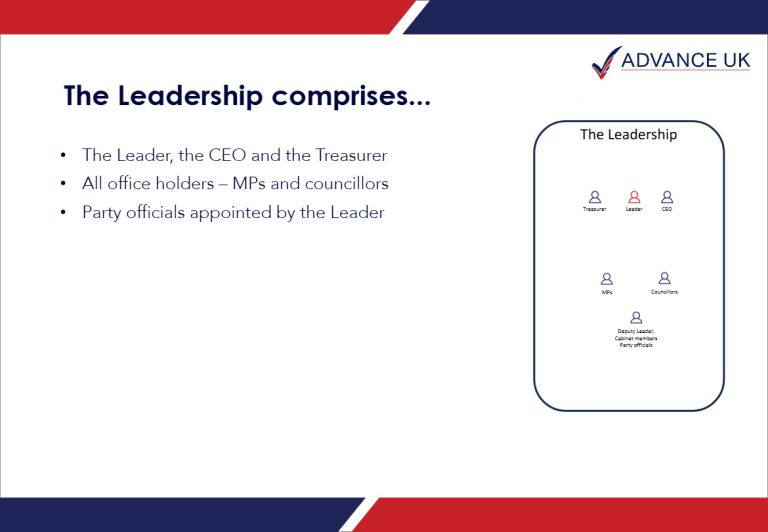
The Leadership

Explore Our Structure 5
Image © of Advance UK

The Leadership Comrises. 

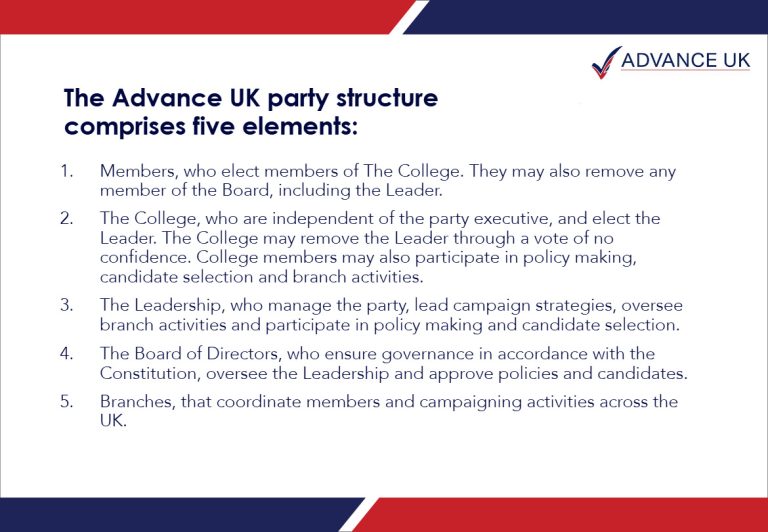
The Leadership manage the party, lead campaign strategies, oversee branch activities and participate in policy making and candidate selection.

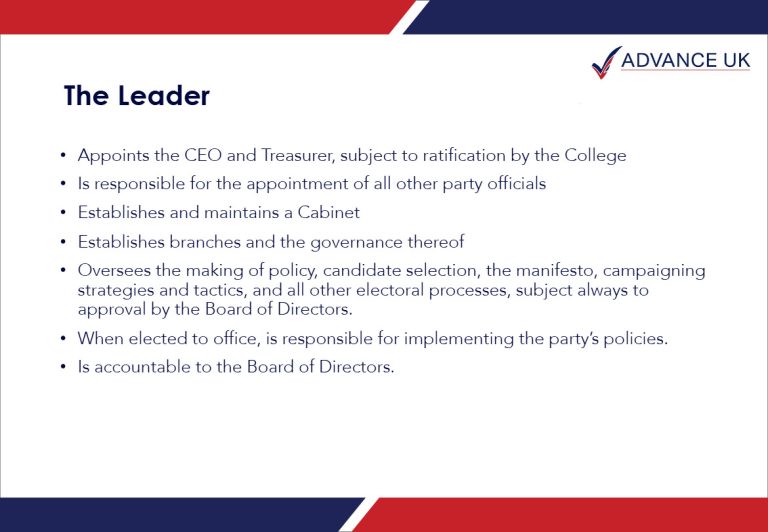
The Leader

Explore Our Structure 6
Image © of Advance UK

The Leader. 

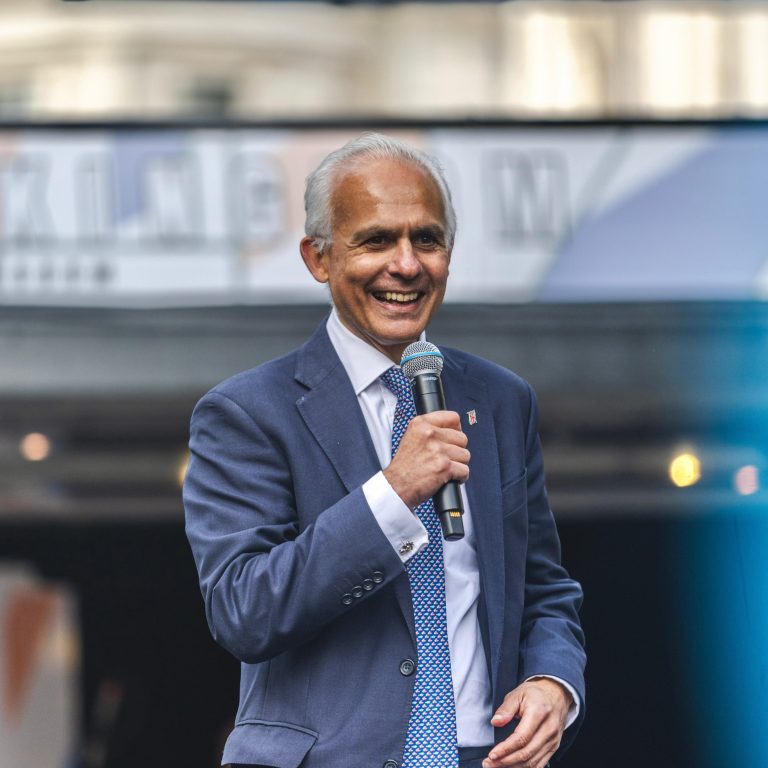
Ben Habib

Ben Habib
Image © of Advance UK
Ben Habib
Image © of Advance UK

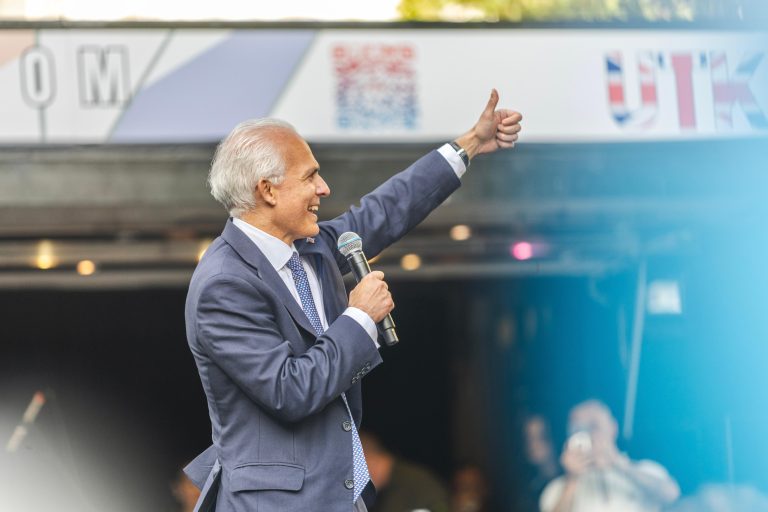
Ben Habib, Leader Of Advance UK.

A Voice For Courage And Conviction

Ben Habib is the Leader of Advance UK. A formidable businessman, seasoned politician, and steadfast advocate for Britain’s independence, prosperity, and national pride. He stands at the forefront of a movement to reclaim sovereignty and restore confidence in our democracy.

Born in Karachi to a Pakistani father and British mother, Ben moved to the UK at 13. He went on to become Head of Rugby School, before studying Natural Sciences at Cambridge University, where he also earned a Boxing Blue.

His early career was in finance in the City, before moving into private property development and investment in 1994. He went on to found First Property Group plc, an FCA-regulated and London Stock Exchange-listed fund manager, where he continues to serve as Chief Executive.

Ben entered politics in 2019, joining the Brexit Party in response to Theresa May’s failure to deliver Brexit. He was elected a Member of the European Parliament and later became Deputy Leader of Reform UK. Known for his principled opposition to the Northern Ireland Protocol, he has consistently fought to defend Britain’s sovereignty and independence.

He joined Reform UK in March 2023, becoming Deputy Leader later that year and helping take the party from 6% to 16% in the polls. He later resigned over disagreements on governance and political principles.

In June 2025, he founded Advance UK, which has grown at a remarkable pace, gaining over 30,000 members in just two months and becoming the seventh-largest party in the UK. Its growth continues.

As leader, Ben is determined to recruit the finest minds and most capable people in the country to deliver a proud, sovereign, and prosperous United Kingdom once again.

“I love my country, I love you, and I will not falter. I will deliver for you.”

Mission 

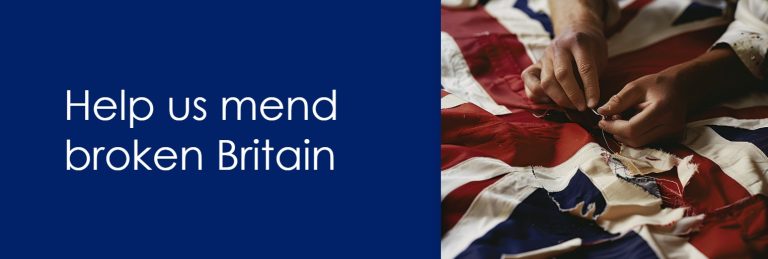
Help Us Mend Broken Britain
Image © of Advance UK

Help Us Mend Broken Britain.

We will build a proud, independent and prosperous United Kingdom.

We stand for nation, freedom, democracy and equality under the law.

Nation

Our Nation is the United Kingdom of Great Britain and Northern Ireland, in all its parts and with all its people.

The Party asserts every part of the Acts of Union which created the Nation. The Party stands against any arrangement which is not compliant with those Acts.

The Party promotes and celebrates the Nation’s Christian constitution, roots, traditions, culture, and values.

The sovereignty of the Nation stands as a bulwark against the undemocratic influence of supra-national institutions and international law.

Freedom Of Speech

A cornerstone of democracy is the freedom of speech.

All people should be free to think, speak and act according to their conscience and beliefs if they do not incite violence.

Children should be protected from ideological and political indoctrination.

There should be minimal Government intervention in people’s lives.

Democracy

The Government should serve the British people and be accountable to them.

There can be no dilution of the Government’s ability to discharge this obligation, and the people’s ability to hold them to account, by membership of international bodies, the entering into of international treaties, international law and domestic quangos.

There should be minimal Government intervention in people’s lives.

Equality Under The U.K. Law

All people living in the UK should be equal before and subject only to UK law.

All people should be able to live free from the threat of terror or violent crime and without prejudice.

There should be no discrimination based on ethnicity, sex or sexual orientation.

The British legal system must be the only legal system in the Nation and its application must be impartial and free of political influence or control.

Security of life and property are fundamental in creating a peaceful and prosperous society.

Our Mission Statement

Our Mission Statement.

Structure

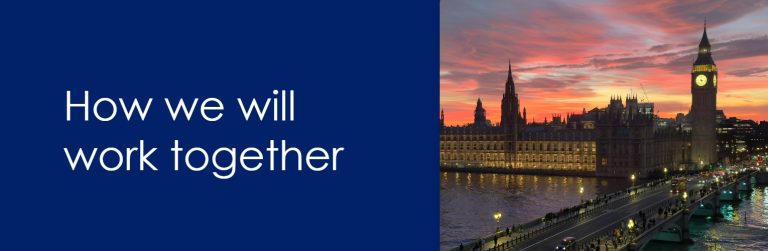
How We Will Work Together
Image © of Advance UK

How We Will Work Together.

Image © of Advance UK

Information. 

Explore Our Structure 2
Image © of Advance UK

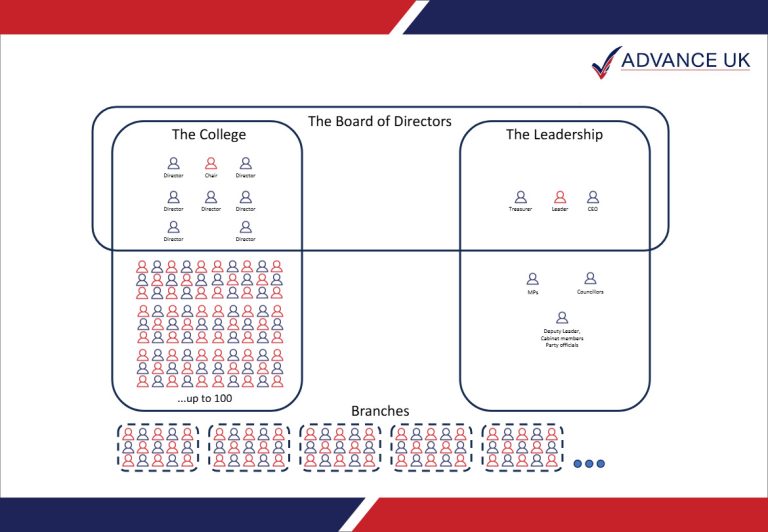
The Advance UK party structure comprises five elements.

Members

Explore Our Structure 3
Image © of Advance UK

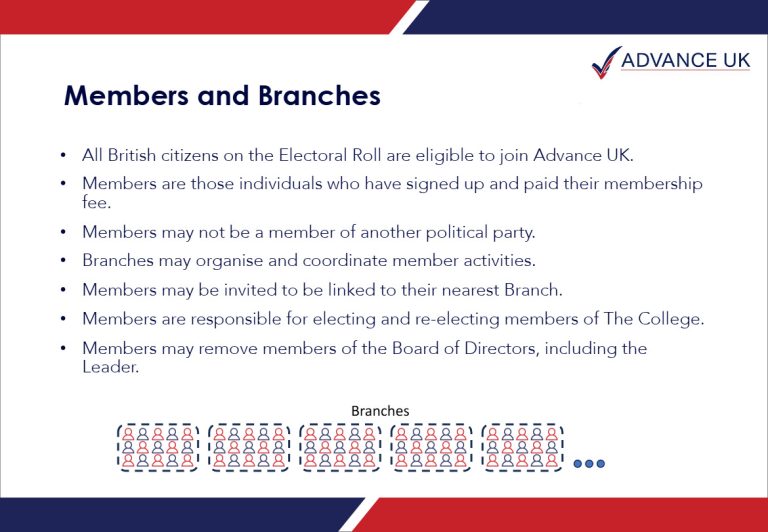
Members And Branches.

Members elect members of The College. They may also remove any member of the Board, including the Leader.

Members of the Party will, subject to due process, be eligible to:

Receive notices and communications.

Attend members’ meetings.

Stand for election to the College.

Join the Party executive.

Stand as candidates in local and national elections.

Join local associations. 

Campaign for the Party.

By a simple majority, vote in the election of College members.

By a simple majority, vote to remove directors of the Party (including the leader). 
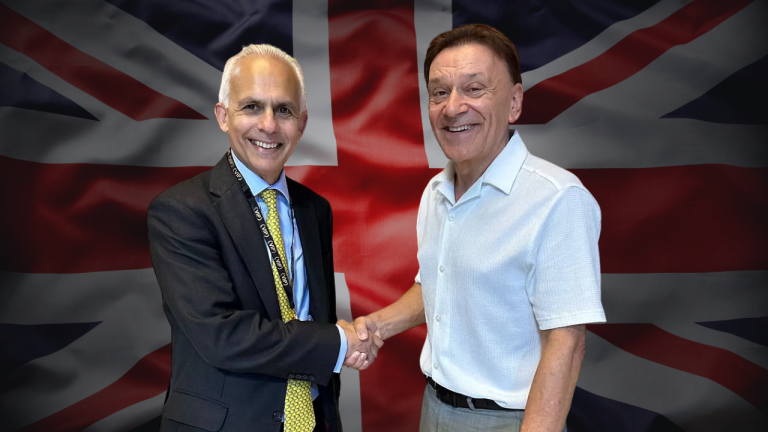
Become A Member 

You can join via my recruiter page (at the bottom) by clicking here

The College  

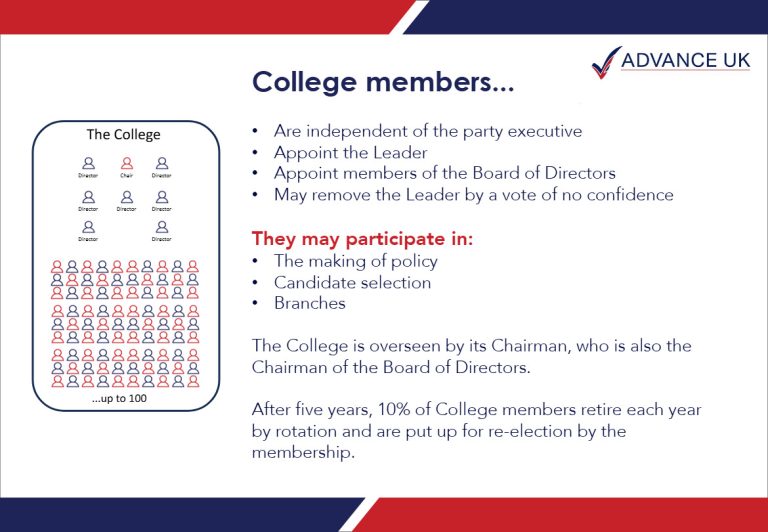
The College are independent of the party executive, and elect the Leader. The College may remove the Leader through a vote of no confidence. College members may also participate in policy making, candidate selection and branch activities.
The College is overseen by its Chairman, who is also the Chairman of the Board of Directors.  After five years, 10% of College members retire each year by rotation and are put up for re-election by the membership.

College Members

Explore Our Structure 4
Image © of Advance UK

College Members.

Craig Walton
Craig Walton
Image © of Advance UK

Craig Walton.

Read more about Craig here.   

gavin Maxwell
Gavin Maxwell
Image © of Advance UK

Gavin Maxwell.  

Read more about Gavin here.  

nick buckley
Nick Buckley
Image © of Advance UK

Nick Buckley.

Read more about Nick here.

richard thompson
Richard Thomson
Image © of Advance UK

Richard Thompson. 

Read more about Richard here.

Bepi Pezzulii
Bepi Pezzulli
Image © of Advance UK

Bepi Pezzulii.

Read more about Bepi here.

justin downes
Justin Downes
Image © of Advance UK

Justin Downes.

Read more about Justin here.

andrew cadman
Andrew Cadman
Image © of Advance UK

Andrew Cadman.

Read more about Andrew here.

paul thorpe
Paul Thorpe
Image © of Advance UK

Paul Thorpe.

Read more about Paul here.

aileen quinton
Aileen Quinton
Image © of Advance UK

Aileen Quinton.

Read more about Aileen here.

norman fenton
Norman Fenton
Image © of Advance UK

Norman Fenton.

Read more about Norman here.

howard cox
Howard Cox
Image © of Advance UK

Howard Cox.

Read more about Howard here.

paul burgess
Paul Burgess
Image © of Advance UK

Read more about Paul here.

Paul Burgess.

richie taylor
Richie Taylor
Image © of Advance UK

Richie Taylor. 

Read more about Richie here

katie waissel
Katie Waissel
Image © of Advance UK

Katie Waissel.

Read more about Katie here.

jim ferguson
Jim Ferguson
Image © of Advance UK

Jim Ferguson.

Read more about Jim here.

kathy gyngell
Kathy Gyngell
Image © of Advance UK

Read more about Kathy here

Kathy Gyngell. 

The Board Of Directors

Explore Our Structure 7
Image © of Advance UK

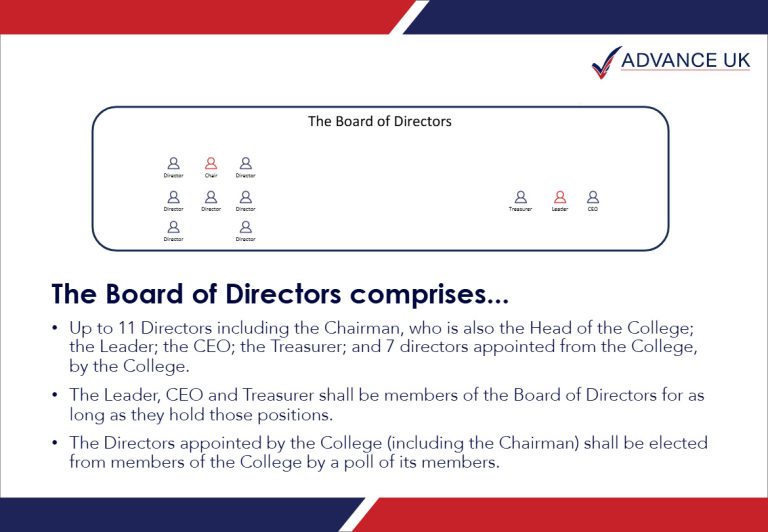
The Board Of Directors Comprises.

Explore Our Structure 8
Image © of Advance UK
Explore Our Structure 9
Image © of Advance UK

The Board Of Directors.

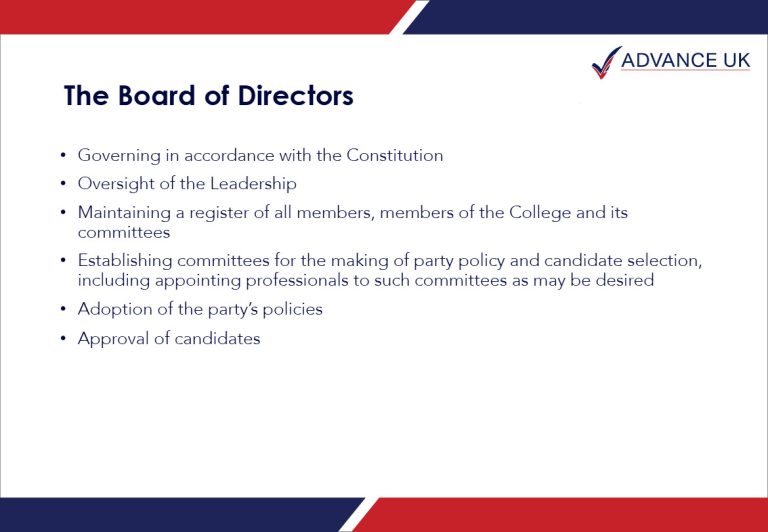
The Board of Directors ensure governance in accordance with the Constitution, oversee the Leadership and approve policies and candidates.

Branches

Branches coordinate members and campaigning activities across the U.K.

Explore Our Structure 10
Image © of Advance UK

Information.

Get In Touch With Advance UK

General Enquiries

If you are an Advance UK member or supporter, or you have questions or feedback about our work, please get in touch using the form here. You may also find the answer to your question in the Frequently Asked Question’s below.

Press Enquiries

If you are a member of the press, and you have questions about Advance UK, please email our press office by clicking here.

Frequently Asked Questions

Click here to see any F.A.Q.’s for Advance UK.

Events

To see all of Advance UK’s events, click here.

JOIN TODAY!

If you are tired of being lied to and treated like a stranger in your own country, and you want a government that will TRULY care about its citizens, then you can join Advance UK via my recruiter page (at the bottom) by clicking here and help grow our party that will become second to none.

Blog Posts

Notes And Links

The image shown at the top of this page, and subsequent photos, are the copyright of Advance UK. 

Advance UK – Official website.  

Advance UK on Facebook  – This is their official Facebook page.

Advance UK on X – This is their official X page.

Advance UK on Instagram – This is their official Instagram page.

Advance UK on YouTube – This is their official YouTube page.

Ben Habib on Facebook  – This is his official Facebook page.

Ben Habib on X – This is his official X page.

Ben Habib on Instagram – This is his official Instagram page.

Ben Habib on YouTube – This is his official YouTube page.

Books: The Allcott’s By Jeffrey Allen

Photos © via various sources

Please note this page has been slightly edited for website purposes from the original booklet and is presented to you with kind permission from Jeffery. 

The original booklet is available to download and as an e-book at the bottom of this page in the Links section and will appear slightly different to what you see here but the content is the same.

About The Allcott’s

In Jeffrey’s own words:

“The Allcott family were typical of the many thousands of people who once turned to the canals for their livelihood during the middle and latter part of the Victorian era. Times were especially hard for the poorest people in society, often moving about in order to find better employment or affordable accommodation, whilst the terrifying spectre of the workhouse loomed ever present should they fail to find both. Not surprising then that the canals should offer a viable alternative to life on land, with their boat providing a ready source of income, and a roof over their head. For most people boats were too expensive to have built, so they turned to well established canal carriers such as Pickford’s, Fellows Morton & Clayton and coal merchants such as Samuel Barlow for employment. Most of the canals by now had been absorbed by railway companies, such as the Shropshire Union Canal and the Trent & Mersey. By the time the Allcott’s entered life on the waterways, the great heyday of canal building was over, but they continued, even into the latter years of the 20th century, to play a key role in the economy of the country.” 

About Jeffrey Allen

Jeffrey is my Cousin via my Mom’s long, lost Brother and it was by chance we found each other, call it fate, call it whatever but everything happens for a reason.

On October 21st, 2021 I decided to join the Canal World forum in the hope I could find anything about the Allcott’s and the long boating history that goes with them, stretching back to the 1800’s.

On November 10th, 2021 Jeffrey messaged me believing we were related via his Dad, Oliver Allcott and, I was happy he did and to confirm that we were indeed related.  We have been in touch since.

For a long time, Mom always wondered how my Uncle Oliver was doing in life and would have loved to know all that I know now when she was alive but, sadly, that was never to be.  I did, however, get to show her family photos and documents that I came by in her final months, before me and Jeffrey first got in touch.

Jeffrey didn’t do this booklet for monetary gain, just as a family keepsake and it was never intended for publication.  I, on the other hand, think more people should see the hard work he has put into it and, hopefully, more information can subsequently come from it in the not-so-distant future.  If you think you are related to anyone mentioned in this post then please contact me here.

Regardless if you are family or not, if you are a lover of history and canal life then you will enjoy this book as much as I did.

Front cover is © Jeffrey Allen: Photos © via various sources.

The Allcott’s By Jeffrey Allen

The Allcott’s 

The Story of a Canal Boating Family from Wolverhampton.

Acknowledgements 

A special thank you to my cousins Frank Parker and Janet Terry for supplying me with all the information on the Allcott’s.  Without their kindness and love of family this booklet would not have been possible.

Dedication 

In memory of my grandfather Oliver Allcott, My grandmother Beatrice Violet Allcott, Their daughter Beatrice Mary Allcott, my aunt, And their son, Oliver Allcott, my father. 

Introduction

The Allcott family were typical of the many thousands of people who once turned to the canals for their livelihood during the middle and latter part of the Victorian era.  Times were especially hard for the poorest people in society, often moving about in order to find better employment or affordable accommodation, whilst the terrifying spectre of the workhouse loomed ever present should they fail to find both.  Not surprising then that the canals should offer a viable alternative to life on land, with their boat providing a ready source of income and a roof over their head.  For most people boats were too expensive to have built, so they turned to well-established canal carriers such as Pickford’s, Fellows Morton & Clayton and coal merchants such as Samuel Barlow for employment.  Most of the canals by now had been absorbed by railway companies, such as the Shropshire Union Canal and the Trent & Mersey.  By the time the Allcott’s entered life on the waterways, the great heyday of canal building was over, but they continued, even into the latter years of the 20th century, to play a key role in the economy of the country. 

Family History

Allcott is a surname that existed in Nuneaton, Bedworth, Atherstone and Caldecote since the 17th century.   Allcott derives from an Old English word eauld meaning old, and cot meaning a shelter or cottage; hence ‘a dweller in an old cottage.’   The name has its highest frequency in Herefordshire and the West Midlands.  In Nuneaton for example, it first appears in records of the Quarter Sessions and Indictment Books for the years 1631-96 and the Hearth Tax of 1662.  Albert Allcott was born at Hartshill, North Warwickshire, on the 17th of May 1843 to William and Sarah Allcott.  Sarah (nee Buckler) was born at Bedworth on the 1st of October 1809.  William was a labourer, whilst Sarah looked after their six children: Thomas (b. 20 March 1832), William (born June 15th 1833), David (born 1836), Hannah (born 1837), Sarah (born March 25th 1839) and Eliza (born 1841).  Hartshill is a large village and civil parish in North Warwickshire.  It borders the districts of Bedworth and Nuneaton, which is two and a half miles northwest of the village.  The combined population of Bedworth and Nuneaton by 1863 was in excess of 8,600 people, and many of those were employed in silk ribbon weaving.  Hartshill also borders Ansley to the south-west, where there was a coal mining colliery established in 1874; Mancetter to the north-west, Caldecote to the east, and the parish of Witherley in Leicestershire to the north-east.  The market town of Atherstone is three and a half miles to the northwestHartshill had good communications with the rest of Warwickshire and neighbouring counties.  There was a canal wharf on the Coventry Canal, (14 miles from the Coventry Basin), which served the Jees Granite & Brick Co. Ltd., which also had its own quarry.  William Allcott may have worked for this company as a labourer.  There was also a railway, part of the Coventry and Nuneaton branch line, with a signal box and sidings.  

© Unknown
Hartshill bridge and canal wharf circa 1900: © Unknown
Hartshill Wharf circa 1910: © Unknown

Not long after Albert’s birth, the family moved to Foleshill, where Sarah died in the later part of 1848 aged 39.  By the mid-19th century Coventry was the centre of the ribbon trade, and at one time employed an estimated 30,000 workers, using steam-powered looms as part of a large-scale manufacturing process.  William Allcott Snr. remarried two years later on the 22nd of June 1850 to Rhoda Ball from Nuneaton.  The 1851 Census shows the family still living in Foleshill.  William, and his son William Jnr., now aged 16, were both employed as coal miners, whilst Rhoda was a hand loom weaver, and Hannah, aged 11, was employed as a silk winder.  Ten years later, both Rhoda, and her step-son Albert, now aged 18, were employed as silk weavers, whilst William was working as a day labourer.  William and Rhoda had eleven children together, three boys, Henry (born June 5th 1852), Frederick (born February 28th 1858), and Joseph (born October 28th 1867); and eight girls, Emma (born September 23rd 1849), Matilda (born November 23rd 1854), Ellen (born May 8th 1856), Mary (born February 3rd 1859); all these children were born at Bedworth.  Sometime after the birth of Mary in 1859, the family moved to Nuneaton, where Rose (17th of May 1863) was born, along with Sophia (22nd of May 1872) and Rhoda (31st of July 1869).  Sadly, little Fanny Allcott (born 1861, Nuneaton), died when she was just three years old in 1864.  Rhoda passed away in 1873 aged 47, and a year later William died aged 68.  At least four of their youngest children, Rose, Sophia, Joseph and Rhoda, would not have been old enough to support themselves without their parents or older siblings. 

On the 26th of March 1877 Albert Allcott, now in his mid-thirties, married Elizabeth Franks at the parish church of St Matthew, Lower Horseley Fields, Wolverhampton.  His marriage certificate gives his occupation as a labourer.  He may have worked for the Minerva Iron & Steel Company founded in 1857 by Isaac Jenks, who owned the Beaver Works at Lower Horseley Fields.  The company exported 80% of the UK’s steel to America and had 21 puddling furnaces, 4 mills, and several forges.  At one time the canal carriers Pickford’s had a wharf directly opposite the steel works at Horseley Fields. 

But just four years later at the birth of their son, Albert Charles Allcott, (at Canal Street, in the town of Coseley, Wolverhampton), Albert Snr. is now a ‘boatman.’  Albert Charles was christened on the 8th of January 1882 at St Mary’s Church, Wolverhampton. 

Minerva Works, Horseley Fields 1876: © Unknown
Albert Allcott: © Family photo

Wolverhampton was particularly noted for its iron manufacture, consisting of locks, hinges, buckles, corkscrews and japanned ware; a type of lacquer similar to shellack polish used by furniture makers.  The technique of applying a heavy black lacquer originated from India, China and Japan, where it was used to glaze pottery, but in Europe, the technique was extended to small items of metal. 

Trade directories from the first half of the 19th century show that there were 20 firms of japanners in Wolverhampton, ranging from small family workshops attached to the proprietor’s home to larger purpose-built factories employing between 250 to 300 workers.  It is possible that Albert may have been working as a wharf labourer at Horseley Fields, where there is a junction on the Birmingham Main Line and Wyrley & Essington Canal, eventually leading to his employment as a boatman’s mate.  The main advantage for families living and working on narrowboats was that money was saved on renting a house, but living conditions could be challenging.  The typical cabin size would be around 8ft long by 6ft wide, and 5ft in height.  Space was limited to just a couple of cupboards and a fold-out table.  There was no toilet or running water aboard the vessel.  Drinking water was obtained from pumps sited along the towpath and at canal wharves.  The pay was low and only the skipper of the boat got paid.  This meant the whole family helped to get the boat to its destination as quickly as possible, with children running ahead to open and close lock gates.  The more cargo a boat could carry, the more the skipper got paid.  Typical loads were around 20 – 30 tons for a single boat, but if a second boat was worked, referred to as the ‘butty,’ which was simply pulled along by the lead boat, the skipper would earn twice as much money, as well as having the additional living space of a second cabin. 

A traditional narrowboat interior. The cupboard to the right of the picture has a hinged drop down table, behind which food items were stored. Space was used carefully, with many things, such as plates and pots being suspended overhead or on the walls of the cabin. Possessions were limited to what the family needed in order to work and live aboard the boat: © Unknown

On long hauls, a family might work anything up to 15, sometimes 18 hours a day in order to reduce the journey time.  It was also physically demanding for both men and women, with parents sometimes ‘bow-hauling’ a vessel through lock gates, or ‘legging’ a boat through the damp and murky conditions of a tunnel; literally pushing the boat along with their feet as they lay on their backs at the stern. 

Legging a fully laden canal boat through a tunnel could take several hours of arduous work: © Unknown

It was also incredibly dangerous work, especially for young children, with death by drowning all too common.  Albert Ledward aged 11 was drowned in the Bridgewater Canal in June 1876.  According to the newspaper report in the Runcorn Guardian, the family left Anderton Wharf on a Wednesday afternoon: 

 “… with a pair of narrow boats laden with salt to be discharged at Runcorn, and when near to Bate’s Bridge at Halton, the deceased [Albert Ledward], who had had his supper, got ashore from the second boat to drive the horse, while his brother, nine years old, who had been driving, got on board to have his supper.  It was then half past eleven o’clock, and dark, and as the deceased passed the first boat which he (witness) [the father] was steering, he spoke to him [Albert], and he afterwards heard him speak to the horse.  When they got to the Delf Bridge the deceased came and spoke to him, and he told him to go on and get to the horse’s head, and he did.  He [the father] heard him speak to the horse, and when it got near to the gas works it “shied” at a light, but again went all right until it got opposite the Soapery, when it turned back, and he (witness) called to it to stop, and it did so.  He then called out to the deceased [Albert], and receiving no answer got ashore to look for him.  Not seeing him, he began to feel about in the canal with a boat hook, and there being no person near but his wife, she ran for assistance, and soon brought some men and grapples, and in about half an hour the body of the deceased was found in the canal opposite to the Soapery, and near to the spot where the horse turned.  He could not tell how the deceased got into the canal, for he neither heard any splash nor a scream.”

The incident at Runcorn happened just five years prior to the birth of Albert and Elizabeth’s first child, Albert Charles.  By the time of the 1901 Census, Albert and Elizabeth Allcott had five children living at home, William, Joseph, Minnie, Sarah Jane and Frederick.  The registration took place at Calf Heath, Wolverhampton.  Calf Heath Bridge and Wharf are on the Staffordshire & Worcestershire Canal, which commences at a junction with the River Severn at Stourport, and terminates at Great Haywood by a junction with the Trent & Mersey Canal, once owned by the North Staffordshire Railway Company.  Albert Charles was now 19 years old and living away from home. At the time of the census, he was a canal boatman’s mate aboard the Fancy, moored up at Welshpool Wharf, Montgomeryshire, a Shropshire Union Canal depot.  Fancy entered service in September 1899 for the London Midland & Scottish Railway Company, and it was captained by Thomas Hyde, aged 28 from Barbridge in Cheshire.  Also on board was Thomas’ wife Mary and their baby girl, Jane.  Hyde may have been a relative of John Hyde, an iron merchant at Wrexham who supplied large quantities of pig iron via the Shropshire Union Canal Company to factories in Wolverhampton.  The Shropshire Union Railways and Canal Company (SURCCo.) was founded in 1854.  The Company owned 23½ miles of railway, which was leased to the North Western Railway Company in perpetuity for a 50% dividend of North Western’s stock.  They had offices in London, Birmingham, Albion Wharf at Wolverhampton, and Chester.  The main line of its canal navigation was the Shropshire Union Canal from Autherley Junction near Wolverhampton to Ellesmere Port near the Wirral, a total of 66½ miles consisting of 46 locks.  Thirty-eight miles into the journey from Autherley is the Nantwich Basin, the birthplace of two of Albert’s sons, William (1884) and Frederick (1895).  Both went on to become boatmen. 

On the 3rd of August 1903 at Ellesmere Port, Cheshire, Albert Charles married Mary Ann Goddard, aged 19 from Wolverhampton.  Interestingly, Mary was born at Horseley Fields, where Albert Allcott Snr., married Elizabeth Franks some 26 years earlier.  Mary’s father William was also a boatman, and it is quite possible that William Goddard and Albert Allcott had previously worked together on the same boat or stretch of canal, forming a life-long friendship between the two families, eventually leading to kinship through the marriage of their children.  William’s father, Richard Goddard (1822 – 1883), first appears in the records as a boatman in 1851 at Brook Lane Wharf, Newcastle-under-Lyme, Staffordshire.  In subsequent census’ he is to be found aboard canal boats Lincoln (1861), Emily (1871), and Birmingham (1881). The Goddard’s may have been instrumental in introducing Albert Allcott Snr. to life on the canals.  Ellesmere Port is six miles north of Chester and eleven miles south of Liverpool.  In 1905 the Wolverhampton Corrugated Iron Company built a factory at Ellesmere, employing 300 workers and their families from Wolverhampton.  The company was seeking to exploit its international trade through nearby ports of Birkenhead and Liverpool.  The community that grew up around the factory was affectionately referred to as ‘Wolverham.’  The following year Mary gave birth to their first child, Minnie Allcott, at Ellesmere Port.  Canal boat Snap was given as the family residence, and Minnie was delivered by Harriet Didsbury, midwife, living at no. 6 Porters Row, Whitley, a row of Victorian cottages built in 1833 to house canal workers and their families.  Snap was a SURCCo. boat working the Shropshire Union Canal. Albert Charles and Mary had three more children, Frederick (1905), Sarah Ann (1908) and Albert (1911).  Albert Allcott Snr. was 68 at the time of the 1911 Census.  He may have been retired from the boats as his occupation was not recorded.  Times may have been hard for the family as Elizabeth was said to be a ‘washerwoman,’ and Sarah Jane, aged 17, was a ‘presser’ for a company manufacturing iron brackets.  In those days a typical working-class family budget would have been around 22 shillings a week, with bread, flour and meat alone costing around 8s, more than a third of the household budget.  Rent could be anywhere between 3 to 5s a week.

Their youngest son Frederick was 15 at the time of the census and a boatman’s mate aboard the canal boat Jim, moored at Etruria Locks, Stoke on Trent.  The master was William Mallard aged 32 and his wife Emma and two children James and Mary.  Their niece Elizabeth Clewes aged 18 was the third mate. Jim worked the Trent & Mersey Canal navigation.  Fred’s older brother Joseph, aged 24, was a boat hand on a Shropshire Union Canal boat the Flying Fox.  Flying Fox was registered on the 13th of June 1899 at Chester, reg. 550, and entered service for the SURCCo. in August 1899 fleet no. 529.  As her name suggests, she may well have been a ‘fly-boat.’  Flyboats usually carried smaller loads of high-value merchandise, with a two-man crew working day and night.  A fly boat could travel from Ellesmere Port to Birmingham in little more than 36 hours.  In its heyday, Pickford’s specialised in the fly-boat trade, with 116 boats and 398 horses.  It was an offence enforceable by law not to give their boats right of way at lock gates.  By 1925 Joseph was working for the Midlands & Coastal Canal Carriers Ltd., transporting goods between Stoke-on-Trent and Ellesmere Port.  He is recorded as being on their boat Mermaid, originally a motor boat registered in Wolverhampton, no. 1118.  Its engines were removed in the same year, turning it into a butty.  Joseph was also on a MCCC boat called Diamond, first registered in 1922 at Wolverhampton, (no. 1088).  Since Albert Allcott Snr. was living in Wolverhampton at the time of the 1911 Census, the Albert Allcott mentioned as master of the Winconsin, must refer to his son Albert Charles.  Winconsin was moored at the Anderton Wharf, Burslem, Stoke-on-Trent, working the Trent & Mersey Canal.  His son Albert Jnr. was born at Rode Heath, Cheshire, (1911), where the Trent & Mersey runs through the middle of the village.  Four years later and Mary Ann gave birth to their fifth child, Oliver Allcott, on the 2nd of June 1915.  The family residence was given as canal boat Sutherland, moored at Hay Basin, Broad Street, Wolverhampton.  Built by Calder Valley Marine, Sutherland belonged to the Shropshire Union Railways and Canal Company, fleet no. 481, and was ‘gauged’ for the Birmingham Canal Navigations in 1896.  When war raged across Europe in 1914, Frederick Allcott enlisted in the 2nd Battalion of the South Staffordshire Regiment, at Wolverhampton.  Fred was killed in action at Delville Wood, the Somme, after a German counter attack on the 28th of July 1916.  He was just 21.  His personal effects were returned to his family on the 4th of November 1916, along with £5 6d to his father, Albert Allcott Snr.  On the 21st of October 1919, his mother Elizabeth Allcott received a further payment from the army of £9.  Fred’s name can be found on the Common Wealth War Graves Commission memorial at Thiepval, the Somme, and on the Roll of Honour of the London and North Western Railwaymen; because he had been employed as a boatman at Wolverhampton delivering coal to the railways.  Six months after the loss of his son, Albert snr., the first Allcott to have started work on the narrowboats, died on the 13th of February 1917, at no. 2 Southampton Street, Wolverhampton; Elizabeth, his dutiful wife of 40 years, was at his bedside.  By the time of the 1921 Census, held on the 19th of June, Albert Charles was skipper of the canal boat Widgeon, moored at Bunbury Locks, on the Shropshire Union Canal.  Originally built for the Chester & Liverpool Lighterage Co. Ltd., Widgeon joined the SURCCo. in March 1917, fleet no. 776.  It was registered at Chester on the 10th of April 1917, registration no. 812.   

Albert Charles Allcott: © Family photo
Canal boat Widgeon in the 1921 Census: © Unknown

Two years after the census, on the 27th of October 1923, Albert Charles’ eldest daughter Minnie, aged 19, married John Pountney, himself a boatman aged 32.  Canal boat Cardigan was given as the residence of both Minnie and John on their marriage certificate.  Cardigan was a Fellows Morton & Clayton boat, fleet no. 42, built at Uxbridge Docks (West London), and entered service in January 1906, registration no. Uxbridge 401.  

Minnie Pountney (nee Allcott): © Family photo
Location of canal boat Snap, birthplace of Minnie Allcott on the 12th of May 1904: © Unknown

Thirteen years after the death of her husband Albert, Elizabeth Allcott died at no. 9 Barker Street, Wolverhampton, on the 10th of January 1930, aged 73.  She never got to see the marriage of her son Oliver to Beatrice Violet Townsend on the 8th of April 1935.  They were married at the parish church of St Chads, Staffordshire, in the presence of Ernest Williams and Sarah Ann Williams.  Their address was given as 120, Jeffcock Road, Wolverhampton, but as Oliver was, like his father and grandfather before him, a boatman, it is likely that his boat was moored nearby on the Staffordshire & Worcestershire Canal, and that Jeffcock Road was a temporary residence used for the purposes of official registration.  On the 28th of January 1936, Beatrice gave birth to the couple’s first child, Beatrice Mary Allcott.  The address was given as no. 19, Purcel Road, Low Hill, Wolverhampton. Three years later Beatrice gave birth to a son, Oliver Allcott Jnr., this time at 177 Marsh Lane, Bushbury, Wolverhampton, on the 12th of October 1939. 

Marsh Lane Bridge, Wolverhampton, not far from Autherley Junction, a major interchange between the Shropshire Union Canal: © Roger Kidd via Wikimedia Commons and Geograph
The North, and the Birmingham Canal Navigations to the South: © Unknown
A 1938 map shows Marsh Lane adjacent to Marsh Lane Bridge and the Staffordshire & Worcestershire Canal: © Unknown

By now Oliver Snr. was seriously ill with tuberculosis, and little more than five months after the birth of his son, he passed away on the 9th of February 1940 aged just 24.  He died at 376 Wolverhampton Road, Heath Town, a pseudonymous address of the former New Cross Workhouse, which became a hospital in 1930.  Although officially a hospital, it still performed some of the services of the former workhouse.  The death certificate gives Oliver’s occupation as ‘a Wharf Labourer for Coal Merchant,’ possibly Samuel Barlow.  Two years after the death of his father, Oliver Allcott Jnr. was adopted by Frederick and Laura Allen on the 22nd of January 1942.  Laura (nee Townsend) was the older sister of Beatrice Violet Allcott, so the two-year-old Oliver was being adopted by his own aunt.  The couple were living at no. 147, Durley Dean Road, Selly Oak, Birmingham. 

Beatrice Allcott & Oliver Allcott aged two in 1942: © Family photo
Oliver Allcott's birth certificate: © General Register Office
Oliver Allcott's adoption certificate: © General Register Office

Unlike the Allcott’s, the Townsend family were involved in Birmingham’s enormous metal industry, with the family home, 37 Tower Street, not far from the famous Jewellery Quarter.  In 1921, Laura was a ‘capstan lathe’ operator, putting threads on metal items usually made of brass.  She may have worked for Young’s Ltd at their Ryland Street works, Edgbaston, where her younger brother Albert, aged 14, was employed as an errand boy. 

© Unknown
© Unknown
Adoring mother Beatrice Allcott and her four-year-old daughter Beatrice Mary Allcott. The rudder of a boat is just in view in the bottom right of the photo, probably taken on the Staffordshire & Worcestershire Canal, with Marsh Lane, Wolverhampton, in the background: © Family photo

Although the canal boating tradition had come to an end for one branch of the Allcott family, it continued for another.  During the Second World War, William Allcott, the eldest son of Albert and Elizabeth Allcott, was working for the Grand Union Canal Carrying Company, transporting cargoes such as coal, steel, timber and grain between London and the Midlands.

According to a manning list of paired boats for September 1944, William was the skipper of Arcas and Malus.  Arcas was built by Harland and Wolff Ltd on the 16th of November 1935, and registered at Brentford, West London, on the 18th of December 1935, no. 558.  She was gauged for the Grand Union Canal on the 20th of October 1936, gauge no. 12582.  Malus (the butty) was built by W. J. Yarwoods & Sons of Northwich in September 1935.  It was delivered on the 4th of October 1935, fleet no. 307 and registered at Coventry no. 535.  She was gauged on the Grand Union Canal on the 24th of October 1936, and given the gauge no. 12412.  Arcas and Malus were part of the company’s expansion program of its Southern Division during the 1930’s and 1940’s.

Malus in its British Waterways livery: © Unknown

William’s family lived near Stowe Hill Wharf, Heyford Lane, in the village of Weedon Bec, Northamptonshire, about 6 miles south of the market town of Daventry. 

Stowe Hill Wharf in the 1940's: © Unknown

The Second World War brought with it hazards all of its own, with thousands of German bombs raining down on Birmingham in Hitler’s effort to destroy Britain’s manufacturing base.  During the war, Eliza Stubbs (nee Goddard) and her husband James were working for Fellows Morton & Clayton and moored up in Birmingham.  Eliza was the sister-in-law of Albert Charles Allcott.  Albert and his future wife Mary Ann Goddard, (Eliza’s sister), were witnesses to the wedding of Eliza and James at Ellesmere Port on the 25th of May 1903. “We were in our barge during an air-raid,” recalled Eliza.  “A German bomb crashed through a warehouse roof right on to our boat.  The bomb cut the boat clean in half and we were trapped in the cabin.  Our son, Jim, with some other people, released us just in time.”  Eliza and James were one of the 622 families then living and working on the waterways, helping to transport an estimated 12 million tonnes of essential goods a year on Britain’s canals. 

© Unknown
Eliza Stubbs (nee Goddard) aboard canal boat Grace, a Fellows Morton & Clayton boat: © Family photo
Newspaper article telling the wartime experience of Eliza and James on the occasion of their golden wedding anniversary in 1953: © Unknown

A year after nationalisation took place in Britain, Albert Charles Allcott remarried in 1949 following the death of Mary Ann.  His bride was Sarah Emma Shaw (nee Stubbs), sister of James Herbert Stubbs, who was also Albert Charles’ best man at the wedding.  The reception was held at no. 3, Canal Terrace, Middlewich, Cheshire, the family home of Eliza and James. 

Albert Charles Allcott and Sarah Emma Shaw (nee Stubbs) on their wedding day: © Family photo
A Handwritten note from Albert Charles to Sarah outlining the arrangements for their forthcoming marriage: © Source unknown

The Middlewich Branch of the Shropshire Union Canal runs through the town before joining the Trent & Mersey Canal at Wardle Lock.  In 1826 authorization had been given for the section of canal at Middlewich to join with the Trent & Mersey, linking Chester with the potteries in the Midlands.  The Great Heywood Junction is 19 miles from Stoke-On-Trent, which connects to the Staffordshire & Worcestershire Canal with Wolverhampton.  Albert died on the 18th of December 1961 at 175 Marsh Lane, Wolverhampton, aged 80.  The boating tradition was carried on in the next generation of the Allcott’s.  According to an article in Narrowboat Magazine, ‘British Waterways Boating’ (Spring 2018), two boats, Purton and Capella, were worked by Joseph and Lucy Allcott in the 1950’s and 1960’s on the Grand Union Canal.  Joseph Allcott was born at Wolverhampton in 1927, the son of William Allcott (b. 1884).  Lucy Elizabeth Jackson was five years older, being born at Northampton in 1922.  They married at Brixworth, Northamptonshire on the 24th of September 1951.  Along with her father Thomas Jackson, Lucy was already employed by British Waterways, a ‘boatwoman’ in her own right. 

Lock gate No. 1 on the Northampton Arm of the Grand Union Canal: © Unknown
Purton and Capella at Buckby Bottom Lock No. 13, Whilton: © Unknown

Purton was built by W.J. Yarwoods & Sons Ltd. with a National DM2 engine and joined the GUCCCo. in September 1936 fleet no. 162.  She was registered at Rickmansworth on the 20th of October 1936, registration no. 104, and gauged for the Grand Union Canal on the 7th of  November 1936, gauge no. 12614. 

Spring issue of Narrowboat Magazine entitled ‘British Waterways Boating’ featuring Purton and Capella: ©Unknown
Purton at lock gate No. 11, with Lucy ashore rolling her sleeves up: © Family photo

Capella (the butty) was built by Harland & Wolf Ltd. and joined the GUCCCo. in December 1935, fleet no. 247.  She was registered at Brentford on the 18th of December 1935, registration no. 572, and gauged for the Grand Union Canal in December 1935, gauge no. 12549. 

Sometime during the 1960’s British Waterways gave Purton a new Lister HA2 engine, and shortened its length to approximately 56ft.  She was eventually sold off in 1987 when the transportation of goods by canal boat finally came to an end.  Joseph was the steerer of Purton from January 1951 to August 1956, but not always with Capella as the butty; others included Ruislip, Asla and Hadfield.  According to the Birmingham Public Health Department records, by March 1957 Joseph was steering a 72ft motor boat called Fulbourne, with Chesham as its buttyFulbourne was built by Harland & Wolf at Woolwich and was completed in March 1937.  She is a steel-hulled motor boat in the ‘Town Class’ of narrow boats, so named because twenty-four of them were named after British towns.  Fulbourne was registered at Rickmansworth and gauged for the Grand Union Canal, no. 12740.  She remained in the GUCCCo. fleet until nationalisation in 1947.  British Waterways fleet lists from May 1958 to January 1959 show that Joseph and Lucy were still on Fulbourne, with Halton as the butty.  During his time on Fulbourne, Joseph carried coal to Apsley, Colne Valley Sewage Works, Croxley and Nash Mill.  They delivered grain to Wellingborough on the River Nene, took spelt from Brentford to Birmingham, and lime juice from Limehouse to Boxmoor.  On one occasion they took the boat to Weston Point on the Manchester Ship Canal to unload a ship, but since the dockers were on strike at the time, they were turned away and had to pick up an alternative cargo elsewhere.  Joseph died aged 61 on the 4th of December 1988.  Lucy passed away eight years later in the June quarter of 1996. 

Fulbourne fully restored to her original GUCCCo. Livery: © Unknown
© Unknown

Postscript

Of the many newspaper reports throughout the canal network from 1881 to 1936, the Allcott’s feature in none of them.  Whilst some boaters were often in trouble with the law for theft, drunkenness, and often cruelty to their animals, (and occasionally to each other), the Allcott’s were a peaceable hardworking family.  The four main canal systems they worked, from Ellesmere Port in the north west, to London in the south east, spanned some 255 miles with a total of 207 locks, but Wolverhampton remained their home base for many years.  With a great sense of pride, it has been my privilege to learn about the Allcott family, the many relatives connected to them, and how they lived and worked on Britain’s inland waterways.  

Jeffrey Allen  

March 23rd, 2022 

© Jeffrey Allen
Albert Allcott and Elizabeth Allcott with family members, taken in the 1940's: © Family photo
Mary Ann Allcott (nee Goddard) and Albert Charles Allcott (right) with possibly Oliver Allcott (centre) with child (either Beatrice Mary Allcott or Oliver Allcott Jnr?): © Family photo
Oliver Allen (Allcott) 1939 - 1986 , whilst on National Service in Cyprus in the 1950's: © Family photo

Oliver Allen (Allcott), October 12th 1939 – July 6th 1986

This booklet has been a journey of discovery.  My father, Oliver Allen, never knew his real parents.  All that he had been told by his adoptive parents Fred and Laura, was that he was born on the 12th of October 1939 in Wolverhampton and that he had been adopted.  He thought his original surname was Parker, and that he may have had a sister.  It was not until the end of last year, 2021, that I finally, by pure chance, found a blood relative whilst searching online, my first cousin Frank Parker.  Through Frank and his sister Janet, the story of the Allcott family slowly began to emerge, and the tragic circumstances which led to my father’s adoption in 1942.  The great irony is, for all those years we lived in Daventry, he was actually surrounded by living descendants of the Allcott family.  Some were living in the town itself, whilst others were working in the neighbouring villages of Weedon Bec and Braunston.  In accordance with his wishes, my father’s ashes were scattered on Screel Hill, Dumfries and Galloway, Scotland, where we spent many a happy family holiday.  

July 6th, 2022 

Back cover is © Jeffrey Allen: Photo © Unknown

Addendum 

The following is not in the above booklet and some information and photo’s are repeated but there is further information on the Allcott’s.

Canal Boats Worked By The Allcott Family From 1881 – 1944 By Jeffrey Allen  

1877 – 1881

Albert Allcott (born 1843 died 1917) was the first family member to work the canal boats, sometime between the 26th of March 1877 and the 13th of December 1881.  His occupation at the time of the 1861 Census was ‘silk weaver,’ and by the time of his marriage to Elizabeth Franks in 1877, he was a labourer.  They were married at the Parish Church of St Matthew in Lower Horseley Fields, Wolverhampton, where there is a junction between the Birmingham Main Line and the Wyrley & Essington Canal.  It’s possible that Albert was working as a wharf labourer loading the barges before he became a boatman himself.  By the time of his first child, Albert Charles Allcott in 1881, Albert’s occupation is recorded as ‘Boatman,’ with the family residence given as Canal Street in the town of Coseley, Wolverhampton. 

Albert Allcott: © Family photo

1901

FANCY (SURCCo.)  

Shropshire Union Canal

In the 1901 Census, Albert was a mate aboard the FANCY, moored at Welshpool Wharf, a Shropshire Union Canal depot.  FANCY entered service in September 1899 for the LMS Railway, fleet no. 534. Registration no. Chester 555.  

The Shropshire Union Railways and Canal Company (SURCCo.) was founded in 1854.  The Company owned 23½ miles of railway, which was leased to the North Western Railway Company in perpetuity for a 50% dividend of North Western’s stock.  They had offices in London, Birmingham, Albion wharf at Wolverhampton, and Chester.  The main line of its canal navigation was the Shropshire Union Canal from Autherley Junction near Wolverhampton to Ellesmere Port near the Wirral, a total of 66½ miles consisting of 46 locks.  Thirty-eight miles into the journey from Autherley is the Nantwich Basin, Cheshire, the birthplace of two of Albert’s sons, William (1884) and Frederick (December 1895).  Frederick was baptised at Lilleshall, Shropshire on January the 18th 1896.  Both men went on to become boatmen. 

Frederick Allcott

1904

Frederick Allcott: © Family photo

SNAP (SURCCo.) 

Shropshire Union Canal 

Given as the family residence at Ellesmere Port, Whitley, on the birth certificate of Minnie Allcott (born 1904 died 1968).

Minnie Pountney (nee Allcott): © Family photo

1911

WINCONSIN & JIM

Trent & Mersey Canal 

In the 1911 Census, Albert was master of the WINCONSIN moored at Anderton Wharf, Burslem, Stoke-on-Trent, Staffordshire.  

At the time of the 1911 Census, Frederick Allcott was 15 years old and worked as a canal boat mate, the master was William Mallard aged 32.  The address was given as Etruria Locks, Stoke on Trent, Staffordshire.  Frederick enlisted in the 2nd Batallion, South Staffordshire Regiment, at Wolverhampton.

Rank: Private, Service No. 16384, Frederick was killed in action at the Battle of the Somme in 1916 in the Battle of Delville Wood.  You can read more about Delville Wood here.

He was commemorated on the roll of honour of the London and North Western Railwaymen.  

The Commonwealth War Graves memorial to Frederick Allcott: © The Commonwealth War Graves Commision

You can read more about Thiepval Memorial, France here.

1915

SUTHERLAND (SURCCo.) 

Shropshire Union Canal 

Built by Calder Valley Marine, SUTHERLAND belonged to the Shropshire Union Railways and Canal Company, fleet no. 481, and was gauged for the Birmingham Canal Navigations in 1896.  It was a powered motor boat 17.68 metres (58 ft) long, with a beam of 2.14 metres (7 ft) wide.  It was a long-distance cabin boat in which the steerer plus family (and/or mate) would have been resident, at least when in transit, if not as their home.  It was given as the family’s address on the birth certificate of Oliver Allcott, 2nd of June 1915, Hay Basin, Broad Street, Wolverhampton.  Albert Charles Allcott was the steerer.  Registered with the Canal & River Trust, No. 512465.  

Albert Charles Allcott: © Family photo

1923

CARDIGAN (FM&C)  

Coventry Canal   

Given as the family residence of Minnie Allcott and John Pountney on their marriage certificate, October 27th 1923.  CARDIGAN was moored near the Foleshill Road, Coventry. Possibly a boat of Fellows Morton & Clayton, a nation-wide canal carrying company, fleet no. 42, built at Uxbridge Dock (West London), entered service in January 1906. Registration no. Uxbridge 401.  

1944

ARCAS & MALUS (GUCCCo. paired boats, fleet no. 11) 

Grand Union Canal  

According to a manning list of paired boats for September 1944, William Allcott (born 1884) was working for the Grand Union Canal Carrying Company during WW2 on canal boats ARCAS and MALUS.  The family lived at Stowe Hill Wharf, Heyford Lane, in the village of Weedon Bec, Northamptonshire. (Weedon is 6 miles from the market town of Daventry, where I grew up.  We moved to Daventry in about 1969, living at 109 Hemans Road).  

ARCAS was built by Harland and Wolff Ltd and entered service in November 1935. Registration no. Brentford 558 (West London).  

MALUS (the butty) was built by W. J. Yarwoods & Sons of Northwich in September 1935 for the GUCCCo.  It was delivered on 4 October 1935, fleet no. 307. Registration no. Coventry 535.  She was gauged on the Grand Union Canal on October 24th 1936, and given the gauging number 12412.  She was used for the carriage of cargoes such as coal, steel, timber and grain from London to the Midlands.  In order to remain profitable, boatmen/boatwomen didn’t like to run between jobs without cargo.  To avoid this some on the London run would load up with cocoa or chocolate crumbs before returning to Cadbury’s in the Midlands.  

MALUS as she is today in its British Waterways colours: © Source unknown
Stowe Hill wharf, Weedon Bec, in the 1940's.  Home to William Allcott and family: © Source unknown

Blog Posts

Notes And Links

Download The Allcotts in PDF format by clicking here.

Read an online e-book version of The Allcott’s here.

Roger Kidd’s page on Geograph – The Marsh Lane image above is the copyright of Roger Kidd.  Here you will find more great work from the photographer Roger. 

Geograph  – The Geograph Britain and Ireland project offers lots of free, good-quality images and aims to collect geographically representative photographs and information for every square kilometre of Great Britain and Ireland, and you can be part of it.

Local History: Narrowboats

Image © Unknown

About Narrowboats

A narrowboat is a particular type of canal boat, built to fit the narrow locks of the United Kingdom.   The UK’s canal system provided a nationwide transport network during the Industrial Revolution, but with the advent of the railways, commercial canal traffic gradually diminished and the last regular long-distance transportation of goods had virtually disappeared by 1970.  However, some commercial traffic continued.  From the 1970’s onward narrowboats were gradually being converted into permanent residences or as holiday lettings.  Currently, about 8580 narrowboats are registered as permanent homes on Britain’s waterway system and represent a growing alternative community living on semi-permanent moorings or continuously cruising.

For any boat to enter a narrow lock, it must be under 7 feet (2.13 m) wide, so most narrowboats are nominally 6 feet 10 inches (2.08 m) wide.  A narrowboat’s maximum length is generally 72 feet (21.95 m), as anything longer will be unable to navigate much of the British canal network because the nominal maximum length of locks is 75 feet (22.86 m).  Some locks are shorter than 72 feet (21.95 m), so to access the entire canal network the maximum length is 57 feet (17.37 m).

The first narrow boats played a vital role in the economic changes of the British Industrial Revolution.  They were wooden boats drawn by a horse walking on the canal towpath led by a crew member.  Horses were gradually replaced by steam and then diesel engines.  By the end of the 19th century, it was common practice to paint roses and castles on narrowboats and their fixtures and fittings.  This tradition has continued into the 21st century, but not all narrowboats have such decorations.

Modern narrowboats are used for holidays, weekend breaks, touring, or as permanent or part-time residences.  Usually, they have steel hulls and a steel superstructure.  The hull’s flat base is usually 10mm thick, the hull sides 6mm or 8mm, the cabin sides 6mm, and the roof 4mm or 6mm.  The number of boats has been rising, with the number of licensed boats (not all of them narrowboats) on canals and rivers managed by the Canal & River Trust (CRT) estimated at about 27,000 in 2006; by 2019, this had risen to 34,367.  Although a small number of steel narrowboats dispense with the need for a rear steering deck entirely, by imitating some river cruisers in providing wheel steering from a central cockpit, most narrowboats’ steering is by a tiller on the stern.  There are three major configurations for the stern: traditional stern, cruiser stern and semi-traditional stern.

Narrowboats are Category D boats intended only for navigating rivers, canals and small lakes; but some intrepid boaters have crossed the English Channel in a narrowboat.

Image © RHaworth via Wikipedia

Terminology

The narrowboat (one word) definition in the Oxford English Dictionary is:

“A British canal boat of traditional long, narrow design, steered with a tiller; spec. one not exceeding 7 feet (approx. 2.1 metres) in width or 72 feet (approx. 21.9 metres) in length.”

Earlier quotations listed in the Oxford English Dictionary use the term “narrow boat”, with the most recent, a quotation from an advertisement in Canal Boat & Inland Waterways in 1998, uses “narrowboat”.

The single word “narrowboat” has been adopted by authorities such as the Canal and River Trust, Scottish Canals and the authoritative magazine Waterways World to refer to all boats built in the style and tradition of commercial boats that were able to fit in the narrow canal locks.

Although some narrow boats are built to a design based on river barges and many conform to the strict definition of the term, it is incorrect to refer to a narrowboat (or narrow boat) as a widebeam or as a barge, both of which are definable by their greater width. In the context of British inland waterways, a barge is usually a much wider, cargo-carrying boat or a modern boat modelled on one, certainly more than 7 feet (2.13 m) wide.

Another historic term for a narrow boat is a long boat, which has been noted in the Midlands and especially on the River Severn and connecting waterways to Birmingham.

Usage has not quite settled as regards (a) boats based on narrowboat design, but too wide for narrow canals, or (b) boats the same width as narrowboats but based on other types of boats.

Narrowboats may have ship prefix NB.

Size

The key distinguishing feature of a narrowboat is its width, which must be less than 7 feet (2.13 m) wide to navigate British narrow canals.  Some old boats are very close to this limit (often built 7 feet 1+12 inches or 2.17 metres or slightly wider), and can have trouble using certain narrow locks whose width has been reduced over time because of subsidence.  Modern boats are usually produced to a maximum of 6 feet 10 inches (2.08 m) wide to guarantee easy passage throughout the complete system.

Because of their slenderness, some narrowboats seem very long.  The maximum length is about 72 feet (21.95 m), which matches the length of the longest locks on the system.  Modern narrowboats tend to be shorter, to permit cruising anywhere on the connected network of British canals, including on canals built for wider, but shorter, boats.  The shortest lock on the main network is Salterhebble Middle Lock on the Calder and Hebble Navigation, at about 56 feet (17.07 m) long.  However, the C&H is a wide canal, so the lock is about 14 feet 2 inches (4.32 m) wide.  This makes the largest go-anywhere-on-the-network narrowboat slightly longer (about 58 feet or 17.68 metres) than the straight length of the lock because it can (with a certain amount of shoehorning) lie diagonally.  Some locks on isolated waterways are as short as 40 feet (12.19 m).  Where it was possible to avoid going through locks, narrow boats were sometimes built a little larger.  Wharf boats or more usually ‘Amptons, operated on the Wolverhampton level of the Birmingham Canal Navigations and were up to 89 feet in length and 7 foot 10.5 inches wide.

Hire fleets on British canals usually consist of narrow boats of varying lengths from 30 feet (9.14 m) upwards, to allow parties of different numbers or varying budgets to be able to hire a boat and get afloat.

The Development Of Traditional Working Boats

The first narrowboats played a key part in the economic changes of the British Industrial Revolution.  They were wooden boats drawn by a horse walking on the canal towpath led by a crew member, often a child.  Narrowboats were chiefly designed for carrying cargo, though some packet boats carried passengers, luggage, mail and parcels.

The first canals to feature locks in the now standard size were the canals designed by James Brindley and approved by Parliament in 1766, including the Staffordshire and Worcestershire Canal and Trent and Mersey Canal.  Although construction took many years, the lock size became standard for many canal-building projects.

Boatmen’s families originally lived ashore, but in the 1830’s as canals started to suffer competition from the burgeoning railway system, families (especially those of independent single boat owners/skippers) began to live on board, partly because they could no longer afford rents, partly to provide extra hands to work the boats harder, faster and further, partly to keep families together.  As late as 1858, a Household Words article states that “the Grand Junction Canal company did not allow the boatmen’s families on board.” The crew of the non-stopping flyboat in the article (skipper, two crew and a youth) is said to be typical.

The rear portion of the boat became the boatman’s cabin, familiar from picture postcards and museums, famous for its space-saving ingenuity and interior made attractive by a warm stove, a steaming kettle, gleaming brass, fancy lace, painted housewares and decorated plates.  Such descriptions rarely consider the actual comfort of a (sometimes large) family, working brutally hard and long days, sleeping in one tiny cabin.  However many shore-bound workers endured harder indoor trades in less healthy conditions and in worse accommodation, where the family was separated for long hours rather than being together all day.  The lifestyle afloat, by definition itinerant, made it impossible for children to attend school.  Most boat people were effectively illiterate and ostracised by those living on the bank, who considered themselves superior.

As steam and diesel progressively replaced the tow-horse in the early years of the 20th century, it became possible to move even more cargo with fewer hands by towing a second, un-powered boat, referred to as a butty, buttyboat or butty boat.  Although there was no longer a horse to maintain, the butty had to be steered while being towed.  So that the butty boatman could lengthen or shorten the towline as needed, the towline wasn’t tied off on the bow, instead travelled over the buttyboat through permanent running blocks on stands or retractable middle masts and managed in the stern.  On a wide canal, such as the Grand Union Canal, the pair could be roped side-to-side (breasted up) and handled as a unit through working locks.

Cargo-carrying by narrow boat diminished from 1945 and the last regular long-distance traffic disappeared in 1970.  However, some traffic continued into the 1980’s and beyond.  Two million tonnes of aggregate were carried on the Grand Union (River Soar) between 1976 and 1996, latterly using wide beam barges.  Aggregate continues to be carried between Denham and West Drayton on the (wide) Grand Union Canal and on the tidal estuary of Bow Creek (which is the eventual outflow of the Lee & Stort Navigation).

A few people are doing their best in the 21st century to keep the tradition of canal-borne cargo-carrying alive, mostly by one-off deliveries rather than regular runs, or by selling goods such as coal to other boaters.  Enthusiasts remain dedicated to restoring the remaining old narrow boats, often as members of the Historic Narrow Boat Owners Club.  There are many replicas, such as Hadar, ornately painted with traditional designs, usually of roses and castles.  Boats not horse-drawn may have a refurbished, slow-revving, vintage semi-diesel engine.  There are some steam-driven narrow boats such as the ex-Fellows Morton & Clayton steamer President.

Image © Mike Fascione via Wikipedia
Image © G-Man via Wikipedia

Painted Decoration

By the end of the 19th century, it was common practice to paint roses and castles on narrow boats and their fixtures and fittings.  Common sites include the doors to the cabin, the water can or barrel and the side of the boat along with ornate lettering giving the boat’s name and owner.  This tradition did not happen in all regions, the Chesterfield Canal being one waterway where narrow boats never bore such decorations.

The origin of the roses and castles found on canal boats is unclear.  The first written reference to them appears to be in an 1858 edition of the magazine Household Words in one of a series of articles titled “On the Canal”, showing that the art form must have existed by this date.  For some time, a popular suggestion was that it had some form of Romani origin; however, there does not appear to be a significant link between the Romani and boating communities.  Other suggestions include the transfer of styles from the clock-making industry (in particular the decoration on the face), the japanning industry or the pottery industry.  There is certainly a similarity in style and a geographical overlap, but no solid proof of a link.  There are similar styles of folk art in Scandinavia, Germany, Turkey and Bangladesh.

In the 18th century, similar Dutch Hindeloopen paintwork would only have been a sailing barge journey away from the Thames.  There is also an article in the Midland Daily Telegraph on July 22nd 1914 that credits the practice of painting of water cans, at least, to a Mr Arthur Atkins.

While the practice declined as commercial use of the canals dwindled, it has seen something of a revival in recent times with the emergence of leisure boating.  Narrowboat decorations with roses and castle themes are a common sight on today’s canals, although these may utilise cheaper printed vinyl transfers in place of the traditional craft of hand-painted designs.

Image © Laurence White via Wikipedia

Modern Narrowboats 

The number of licensed boats on canals and rivers managed by the Canal & River Trust (CRT), a charitable trust, formerly British Waterways, was estimated at about 27,000 in 2006.  By 2014 this number had risen to over 30,000.  There were perhaps another 5,000 unlicensed boats kept in private moorings or on other waterways in 2006.  Most boats on CRT waterways are steel (or occasionally, aluminium) cruisers popularly referred to as narrowboats.

Modern leisure narrowboats are used for holidays, weekend breaks, touring, and as permanent or part-time residences.  Usually, they have steel hulls and a steel superstructure, but when they were first developed for leisure use in the 1970’s glass reinforced plastic (fibre-glass) or timber was often used above gunwale height.  Newer narrowboats, say post-1990, are usually powered by modern diesel engines and may be fitted inside to a high standard.  There will be at least 6 feet (1.8 m) internal headroom and often or usually similar domestic facilities as land homes: central heating, flush toilets, shower or even bath, four-ring hobs, oven, grill, microwave oven, and refrigerator; some may have satellite television and mobile broadband, using 4G technology.  Externally, their resemblance to traditional boats can vary from a faithful imitation (false rivets, and copies of traditional paintwork) through interpretation (clean lines and simplified paintwork) through to a free-style approach which does not try to pretend in any way that this is a traditional boat.

They are owned by individuals, shared by a group of friends (or by a more formally organised syndicate), rented out by holiday firms, or used as cruising hotels.  A few boats are lived on permanently: either based in one place (though long-term moorings for residential narrowboats are currently very difficult to find) or continuously moving around the network (perhaps with a fixed location for the coldest months, when many stretches of the canal are closed by repair works or stoppages).

A support infrastructure has developed to provide services to the leisure boats, with some narrowboats being used as platforms to provide services such as engine maintenance and boat surveys; while some others are used as fuel tenders, that provide diesel, solid fuel (coal and wood) and Calor Gas.

Image © Per Palmkvist Knudsen via Wikipedia

Types

On almost all narrowboats steering is by tiller, as was the case on all working narrow boats.  The steerer stands at the stern of the boat, aft of the hatchway and/or rear doors at the top of the steps up from the cabin.  The steering area comes in three basic types, each meeting different needs of maximising internal space; having a more traditional appearance; having a big enough rear deck for everyone to enjoy summer weather or long evenings; or protection outside in bad weather.  Each type has its advocates.  However, the boundaries are not fixed, and some boats blur the categories as new designers try out different arrangements and combinations.

Traditional Stern

Many modern canal boats retain the traditional layout of a small open, unguarded counter or deck behind the rear doors from which the crew can step onto land.  It is possible to steer from the counter, but this is not very safe, with the propeller churning below only one missed step away.  The tiller extension allows the steerer to stand in safety on the top step, forward of the rear doors.  On a working boat, this step would have been over the top of the coal box.  On cold days, the steerer can even close the rear doors behind themselves, and be in relative comfort, their lower body in the warmth of the cabin, and only their upper body emerging from the hatchway and exposed to the elements.  In good weather, many trad-stern steerers sit up on the hatchway edge, a high vantage point giving good all-around visibility.  On trad boats, the bow well-deck forms the main outside viewing area, because the traditional stern is not large enough for anyone other than the steerer to stand on safely.  Internally, trads may have an engine room forward of a traditional boatman’s cabin, or an enclosed engine tucked away out of sight and the increased living space this brings.  

Image © Jongleur100 via Wikipedia

Cruiser Stern

The name for this style arises from the large open rear deck resembling that of the large rear cockpits common on glass-fibre (glass-reinforced plastic or GRP) river cruisers which in turn derives from elliptical sterns used on cruisers and larger warships in the 20th century.  At the stern, a cruiser narrowboat looks very different from traditional boats: the hatch and rear doors are considerably further forward than on a trad, creating a large open deck between the counter and rear doors, protected by a railing (perhaps with built-in seating) around back and sides.  The large rear deck provides a good al fresco dining area or social space, allowing people to congregate on the deck in good weather and the summer holiday season.

In winter (or less than perfect weather in summer) the steerer may be unprotected from the elements.  The lack of an enclosed engine room means that engine heat does not contribute to keeping the boat warm and there may be wasted space above the deck area.  A cruiser stern allows the engine to be located under the deck, rather than in the body of the boat.  Although this may make access to the engine more of a nuisance (due to weather considerations) the whole deck can usually be lifted off in whole or in sections, allowing the operative to stand inside the engine bay, the cruiser stern has a major advantage that the engine is located entirely outside the living space.  In this configuration also, it is common to find that the engine bay contains batteries, isolator switching, fuel tanks and seldom-used kit, spares and equipment. 

Image © Norman Rogers via Wikipedia

Semi-Traditional Stern

A semitraditional stern is a compromise to gain some of the social benefits of a cruiser stern while retaining a more traditional design and providing some protection for the steerer in bad weather or in cooler seasons.  As with the cruiser stern, the deck is extended back from the hatch and rear doors, but in this case, most of the deck is protected at the sides by walls which extend back from the cabin sides – giving a more sheltered area for the steerer and companions, usually with lockers to sit on.  The engine is located under the deck, much like a cruiser, again allowing a separation between the cabin and the engine bay, with the steps down to the cabin being located past the false sides of the semi-trad social area.

Image © Mark Ahsmann via Wikipedia

A Butty Stern

A butty boat is an unpowered boat traditionally with a larger rudder with (usually) a wooden tiller (known as an elum, a corruption of helm) as the steering does not benefit from the force of water generated by the propeller.  The tiller is usually removed and reversed in the rudder-post socket to get it out of the way when moored. A few butty boats have been converted into powered narrowboats like NB Sirius.  The term butty is derived from the dialect word buddy, meaning companion.

Centre Cockpit

While the vast majority of narrowboats have tiller steering at the stern, a small number of steel narrowboats dispense with the need for a rear steering deck entirely, by imitating some river cruisers in providing wheel steering from a central cockpit.  This layout has the advantage (as many Dutch barges) of enabling an aft cabin to be separate from the forward accommodation.

Image © PBS via Wikipedia

National Organisations

Blog Posts

Notes And Links

The narrowboat interior image above is unknown copyright and was taken from here.

The modern narrowboats for leisure cruising image above is the copyright of photographer Roger Haworth and you can find more great work from him by clicking here.

The historic working narrowboats image above is the copyright of photographer G-Man and you can find more great work from him by clicking here.

The Horse-drawn narrowboat image above is, as far as I know, the copyright of photographer Mike Fascione.

The narrowboat decoration image above is the copyright of photographer Laurence White.

The modern narrowboats on the Kennet and Avon Canal image above is the copyright of photographer Per Palmkvist Knudsen.

The traditional stern narrowboats image above is the copyright of photographer Jongleur100 and you can find more great work from him by clicking here.

The cruiser stern narrowboat decoration image above is the copyright of photographer Norman Rogers.

The semi-traditional stern image above is, as far as I know, the copyright of photographer Mark Ahsmann.

The narrowboat with a centre cockpit image above is the copyright of photographer PBS.

All the above images were found on Wikipedia with the exception of the Narrowboat interior one.

Sandwell

Image © unknown via Wikipedia

About Sandwell

Sandwell is a metropolitan borough of the West Midlands county in England.  The borough is named after the Sandwell Priory and spans a densely populated part of the West Midlands conurbation.  According to Sandwell Metropolitan Borough Council, the borough comprises the six amalgamated towns of Oldbury, Rowley Regis, Smethwick, Tipton, Wednesbury, and West Bromwich, although these places consist of numerous smaller settlements and localities.  Sandwell’s Strategic Town Centre is designated as West Bromwich, the largest town in the borough, while Sandwell Council House (the headquarters of the local authority) is situated in Oldbury.  In 2019 Sandwell was ranked 12th most deprived of England’s 317 boroughs.

Bordering Sandwell is the City of Birmingham to the east, the Metropolitan Borough of Dudley to the south and west, the Metropolitan Borough of Walsall to the north, and the City of Wolverhampton to the north-west.  Spanning the borough are the parliamentary constituencies of West Bromwich West, West Bromwich East, Warley, and part of Halesowen and Rowley Regis, which crosses into the Dudley borough.

At the 2011 census, the borough had a population of 309,000 and an area of 86 square kilometres (33 sq mi).

History

The Metropolitan Borough of Sandwell was formed on 1 April 1974 as an amalgamation of the county boroughs of Warley (ceremonially within Worcestershire) and West Bromwich (ceremonially within Staffordshire), under the Local Government Act 1972.  Warley had been formed in 1966 by a merger of the county borough of Smethwick with the municipal boroughs of Rowley Regis and Oldbury; at the same time, West Bromwich had absorbed the boroughs of Tipton and Wednesbury.

For its first 12 years of existence, Sandwell had a two-tier system of local government; Sandwell Council shared power with the West Midlands County Council.  In 1986 the county council was abolished, and Sandwell effectively became a unitary authority.  The borough is divided into 24 wards and is represented by 72 ward councillors on the borough council.

The borough was named after Sandwell Priory, the ruins of which are located in Sandwell Valley.  The local council has considered changing its name in the past over confusion outside the West Midlands as to the whereabouts of the borough, and in June 2002 a survey of borough residents was carried out.  Sixty-five percent of those surveyed favoured retaining the name Sandwell.

Read more here.

The above articles were taken from Wikipedia and are subject to change.

Blog Posts

Links

The image shown at the top of this page is copyright unknown and was found on Wikipedia.

Sandwell College – Official website.  Links to their social media sites are on there.

Dudley

Image © of Phil Wild via Pixabay

About Dudley

Dudley has a history dating back to Anglo-Saxon times, its name deriving from the Old English Duddan Leah, meaning Dudda’s clearing, and one of its churches being named in honour of the Anglo-Saxon King and Saint, Edmund.

Mentioned in the Domesday Book as Dudelei, in the hundred of Clent in Worcestershire, the town was listed as being a medium-sized manor in the possession of Earl Edwin of Mercia prior to the Norman Conquest, with William Fitz-Ansculf as Lord of the Manor in 1086.  Dudley Castle, constructed in 1070 by William’s father Ansculf de Picquigny after his acquisition of the town, served as the seat of the extensive Barony of Dudley, which possessed estates in eleven different counties across England.

Of historical significance, the town was attacked by King Stephen in 1138, after a failed siege of the castle following the Baron’s decision to support Empress Matilda’s claim to the throne during The Anarchy.

History

Early History

Dudley has a history dating back to Anglo-Saxon times, its name deriving from the Old English Duddan Leah, meaning Dudda’s clearing, and one of its churches being named in honour of the Anglo-Saxon King and Saint, Edmund.

Mentioned in the Domesday Book as Dudelei, in the hundred of Clent in Worcestershire, the town was listed as being a medium-sized manor in the possession of Earl Edwin of Mercia prior to the Norman Conquest, with William Fitz-Ansculf as Lord of the Manor in 1086. Dudley Castle, constructed in 1070 by William’s father Ansculf de Picquigny after his acquisition of the town, served as the seat of the extensive Barony of Dudley, which possessed estates in eleven different counties across England.

Of historical significance, the town was attacked by King Stephen in 1138, after a failed siege of the castle following the Baron’s decision to support Empress Matilda’s claim to the throne during The Anarchy.

Early Modern And Industrial Revolution

By the early 16th century the Dudley estate, now held by the Sutton family, had become severely in debt and was first mortgaged to distant relative John Dudley, Duke of Northumberland, before being sold outright in 1535.  Following Dudley’s execution in 1553, the estate returned to the Sutton family, during whose ownership the town was visited by Queen Elizabeth during a tour of England.

In 1605, conspirators of the Gunpowder Plot fled to Holbeche House in nearby Wall Heath, where they were defeated and captured by the forces of the Sheriff of Worcestershire.

During the English Civil, War Dudley served as a Royalist stronghold, with the castle besieged twice by the Parliamentarians and later partly demolished on the orders of the Government after the Royalist surrender.  It is also from around this time that the oldest excavated condoms, found in the remains of Dudley Castle, were believed to have originated.

Dudley had become an incredibly impoverished place during the 16th and 17th centuries, but the advent of the Industrial Revolution began to reverse this trend.  In the early 17th century, Dud Dudley, an illegitimate son of Edward Sutton, 5th Baron Dudley and Elizabeth Tomlinson, devised a method of smelting Iron ore using coke at his father’s works in Cradley and Pensnett Chase, though his trade was unsuccessful due to circumstances of the time.  Abraham Darby was descended from Dud Dudley’s sister, Jane, and was the first person to produce iron commercially using coke instead of charcoal at his works in Coalbrookdale, Shropshire in 1709.  Abraham Darby was born near Wrens Nest Hill near the town of Dudley and it is claimed that he may have known about Dud Dudley’s earlier work.

Dud Dudley’s discovery, together with improvements to the local road network and the construction of the Dudley Canal, made Dudley into an important industrial and commercial centre.  The first Newcomen steam engine, used to pump water from the mines of the Lord Dudley’s estates, was installed at the Conygree coal works a mile east of Dudley Castle in 1712, though this is challenged by Wolverhampton, which also claims to have been the location of the first working Newcomen engine.

Read more here.

The above articles were sourced from Wikipedia and are subject to change. 

Blog Posts

Downloads

The following Dudley Zoo & Castle leaflets are available to download in PDF format.  There is a link to a free PDF reader below if you don’t have one.

Image © of Dudley Zoo And Castle

Links

philwild on Pixabay – The image shown at the top of this page is the copyright of philwild.  You can find more great work from the photographer Phil and lots more free stock photo’s at Pixabay.

Dudley Zoo & Castle – Official websiteThe images shown above are copyright of Dudley Zoo And Castle.  They run as a not for profit charity relying on ticket sales in order to operate and care for more than 1300 animals, and has nigh on 200 species, including some of the rarest creatures on Planet Earth.  Please consider donating to them if you can as well as purchasing tickets to visit.  

Note: I am not affiliated with Dudley Zoo & Castle whatsoever.  I simply want to raise awareness to help in any way I can.

Adobe Acrobat DC Reader – This PDF reader from Adobe is the free global standard for reliably viewing, printing, and commenting on PDF documents.

Walsall

Image © of Richard Gallagher via Wikipedia

About Walsall

Walsall is a market town and administrative centre in West Midlands County, England. Historically part of Staffordshire, it is located 9 miles (14 km) north-west of Birmingham, 7 miles (11 km) east of Wolverhampton and 9 miles (14 km) from Lichfield.

Walsall is the administrative centre of the wider Metropolitan Borough of Walsall.  At the 2011 census, the town’s built-up area had a population of 67,594, with the wider borough having a population of 269,323.  Neighbouring settlements in the borough include Darlaston, Brownhills, Pelsall, Willenhall, Bloxwich and Aldridge.

History

Early Settlement

The name Walsall is derived from “Walh halh”, meaning “valley of the Welsh”, referring to the British who first lived in the area.  However, it is believed that a manor was held here by William FitzAnsculf, who held numerous manors in the Midlands.  By the first part of the 13th century, Walsall was a small market town, with the weekly market being introduced in 1220 and held on Tuesdays.  The mayor of Walsall was created as a political position in the 14th century.

The Manor of Walsall was held by the Crown and given as a reward to royal proteges.  In 1525, it was given to the King’s illegitimate son, Henry Duke of Richmond, and in 1541 to the courtier Sir John Dudley, later Duke of Northumberland.  It was seized by Queen Mary in 1553 after Northumberland had been found guilty of treason.

Queen Mary’s Grammar School was founded in 1554, and the school carries the queen’s personal badge as its emblem: the Tudor Rose and the sheaf of arrows of Mary’s mother Catherine of Aragon tied with a Staffordshire Knot.

The town was visited by Queen Elizabeth I, when it was known as ‘Walshale’.  It was also visited by Henrietta Maria in 1643.  She stayed in the town for one night at a building named the ‘White Hart’ in the area of Caldmore.

The Manor of Walsall was later sold to the Wilbrahim and Newport families and passed by inheritance to the Earls of Bradford.  On the death of the fourth Earl in 1762, the estate was transferred to his sister Diana, Countess of Mountrath and then reverted to the Earls of Bradford until the estates were sold after World War II.  The family’s connection with Walsall is reflected in local placenames, including Bridgeman Street, Bradford Lane, Bradford Street and Mountrath Street.

Industrial Revolution

The Industrial Revolution changed Walsall from a village of 2,000 people in the 16th century to a town of over 86,000 in approximately 200 years.  The town manufactured a wide range of products including saddles, chains, buckles and plated ware.  Nearby, limestone quarrying provided the town with much prosperity.

In 1824, the Walsall Corporation received an Act of Parliament to improve the town by providing lighting and gas works.  The gas works were built in 1826 at a cost of £4,000.  In 1825, the corporation built eleven tiled, brick almshouses for poor women.  They were known to the area as ‘Molesley’s Almshouses’.

The ‘Walsall Improvement and Market Act’ was passed in 1848 and amended in 1850.  The Act provided facilities for the poor, improving and extending the sewerage system and giving the commissioners the powers to construct new gas works.  On 10 October 1847, a gas explosion killed one person and destroyed the west window of St Matthew’s Church.

Walsall finally received a railway line in 1847, 48 years after canals reached the town, Bescot having been served since 1838 by the Grand Junction Railway. In 1855, Walsall’s first newspaper, the Walsall Courier and South Staffordshire Gazette was published.

The Whittimere Street drill hall was completed in 1866. 

Read more here.

The above articles were taken from Wikipedia and are subject to change.

Blog Posts

Links

The image shown at the top of this page is the copyright of Richard Gallagher and was found on Wikipedia.

The New Art Gallery Walsall – Official website.  Links to their social media sites are on there.

Wolverhampton

Image © of jorono via Pixabay

Both my mom and dad were born in Wolverhampton and I have many relatives living there.  I am just as proud of these roots as I am of my Birmingham ones.

About Wolverhampton

Wolverhampton is a city, metropolitan borough, and administrative centre in the West Midlands, England.  At the 2011 census, it had a population of 249,470.  Natives of the city are called “Wulfrunians”.

Historically part of Staffordshire, the city grew initially as a market town specialising in the wool trade.  In the Industrial Revolution, it became a major centre for coal mining, steel production, lock making, and the manufacture of cars and motorcycles.  The economy of the city is still based on engineering, including a large aerospace industry, as well as the service sector.

Toponyn

The city is named after Wulfrun, who founded the town in 985, from the Anglo-Saxon Wulfrūnehēantūn (“Wulfrūn’s high or principal enclosure or farm”).  Before the Norman Conquest, the area’s name appears only as variants of Heantune or Hamtun, the prefix Wulfrun or similar appearing in 1070 and thereafter.  Alternatively, the city may have earned its original name from Wulfereēantūn (“Wulfhere’s high or principal enclosure or farm”) after the Mercian King, who according to tradition established an abbey in 659, though no evidence of an abbey has been found.  The variation Wolveren Hampton is seen in medieval records, e.g. in 1381.

History

A local tradition states that King Wulfhere of Mercia founded an abbey of St Mary at Wolverhampton in 659.

Wolverhampton is recorded as being the site of a decisive battle between the unified Mercian Angles and West Saxons against the raiding Danes in 910, although sources are unclear as to whether the battle itself took place in Wednesfield or Tettenhall.  The Mercians and West Saxons claimed a decisive victory, and the field of Woden is recognised by numerous place names in Wednesfield.

In 985, King Ethelred the Unready granted lands at a place referred to as Heantun to Lady Wulfrun by royal charter, and hence founding the settlement.

In 994, a monastery was consecrated in Wolverhampton for which Wulfrun granted land at Upper Arley in Worcestershire, Bilston, Willenhall, Wednesfield, Pelsall, Ogley Hay near Brownhills, Hilton near Wall, Hatherton, Kinvaston, Hilton near Wolverhampton, and Featherstone.  This became the site for the current St. Peter’s Church.  A statue of Lady Wulfrun, sculpted by Sir Charles Wheeler, can be seen on the stairs outside the church.

Wolverhampton is recorded in the Domesday Book in 1086 as being in the Hundred of Seisdon and the county of Staffordshire.  The lords of the manor are listed as the canons of St Mary (the church’s dedication was changed to St Peter after this date), with the tenant-in-chief being Samson, William the Conqueror’s personal chaplain.  Wolverhampton at this date is a large settlement of fifty households.

In 1179, there is mention of a market held in the town, and in 1204 it had come to the attention of King John that the town did not possess a Royal Charter for holding a market.  This charter for a weekly market held on a Wednesday was eventually granted on 4 February 1258 by Henry III.

It is held that in the 14th and 15th centuries that Wolverhampton was one of the “staple towns” of the woollen trade, which today can be seen by the inclusion of a woolpack on the city’s coat of arms, and by the many small streets, especially in the city centre, called “Fold” (examples being Blossom’s Fold, Farmers Fold, Townwell Fold and Victoria Fold), as well as Woolpack Street and Woolpack Alley.

In 1512, Sir Stephen Jenyns, a former Lord Mayor of London and a twice Master of the Worshipful Company of Merchant Taylors, who was born in the city, founded Wolverhampton Grammar School, one of the oldest active schools in Britain.

From the 16th century onwards, Wolverhampton became home to a number of metal industries including lock and key making and iron and brass working.

Wolverhampton suffered two Great Fires: the first in April 1590, and the second in September 1696.  Both fires started in today’s Salop Street.  The first fire lasted for five days and left nearly 700 people homeless, whilst the second destroyed 60 homes in the first five hours.  This second fire led to the purchase of the first fire engine within the city in September 1703.

On 27 January 1606, two farmers, Thomas Smart and John Holyhead of Rowley Regis, were executed on High Green, now Queen Square, for sheltering two of the Gunpowder Plotters, Robert Wintour and Stephen Littleton, who had fled to the Midlands.  The pair played no part in the original plot nevertheless suffered a traitor’s death of being hanged, drawn and quartered on butcher’s blocks set up in the square a few days before the execution of Guy Fawkes and several other plotters in London.

There is also evidence that Wolverhampton may have been the location of the first working Newcomen Steam Engine in 1712.

Read more here.

The above articles were taken from Wikipedia and are subject to change.

Links

jorono on Pexels – The image shown at the top of this page is the copyright of jorono.  You can find more great work from the photographer and lots more free stock photo’s at Pixabay.