Books: Queer Visitors From The Marvelous Land Of Oz By L. Frank Baum

Image © Walt McDougall and is in the Public Domain via Wikipedia

Queer Visitors from the Marvelous Land of Oz is not a book in itself but is related to the Oz series of books which is why it is headed under Books and included here.

You can download the main fourteen fantasy books in the Oz series by L. Frank Baum via Project Gutenberg by clicking here.  

About Queer Visitors From The Marvelous Land Of Oz

Queer Visitors from the Marvelous Land of Oz was a newspaper comic strip written by L. Frank Baum and illustrated by Walt McDougall, a political cartoonist for the Philadelphia North American.  Queer Visitors appeared in the North American, the Chicago Record-Herald and other newspapers from the 28th of August 1904 to the 26th of February 1905.  The series chronicles the misadventures of the Scarecrow, the Tin Woodman, the Woggle-Bug, Jack Pumpkinhead, and the Sawhorse, as the Gump flies them to various cities in the United States.  The comic strip in turn produced its own derivation, The Woggle-Bug Book (1905).

Queer Visitors was formatted as a series of prose stories, surrounded by large illustrations, therefore not a comic strip in the modern sense.

Development

The project was designed to promote The Marvelous Land of Oz.  Coincidentally, it ran at the same time as a comic strip featuring Oz characters visiting America, that was written and drawn by W. W. Denslow.  Denslow drew the illustrations for The Wonderful Wizard of Oz and shared in its copyright.  After Baum and Denslow had a falling out, Denslow exercised his copyright through his strip, called Denslow’s Scarecrow and Tin-Man, which ran in relatively few newspapers from December 1904 to March 1905.  It was an artistic and commercial failure.

Re-Publication
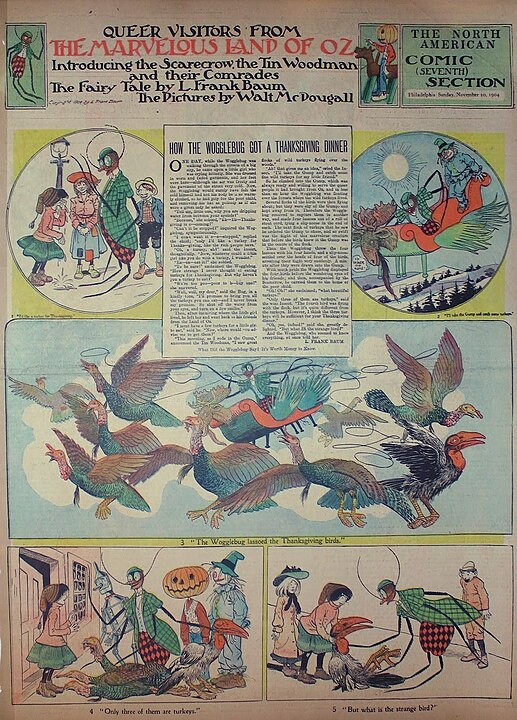
Image © Walt McDougall and is in the Public Domain via Wikipedia

How the Wogglebug got a Thanksgiving dinner from Queer Visitors from The Marvelous Land of Oz, published November 20th, 1904.  

The Visitors from Oz, published by Reilly and Lee in 1960, includes about half of Baum’s Visitors stories rewritten and illustrated by Dick Martin.

The 27 Queer Visitors stories have been republished in book form as The Third Book of Oz (1989) from Buckethead Enterprises, which was censored.  The Buckethead Edition was a reprint under a new cover of an earlier edition, and Dulabone was not aware at the time that it was censored.  The Third Book of Oz also includes another early promotion project, The Woggle-Bug Book (written by Baum and illustrated by Ike Morgan); the volume is illustrated by Eric Shanower. Hungry Tiger Press corrected the censoring from the Buckethead edition but used The Visitors from Oz as the title, like the 1960 adaptation. 

In June, 2009, Sunday Press Books released a collected edition of the newspaper strips in their original format and colouring.  The book also included W. W. Denslow’s competing strip Denslow’s Scarecrow And Tin-Man as well as other comic strips by Walt McDougall, W. W. Denslow, and John R. Neill.
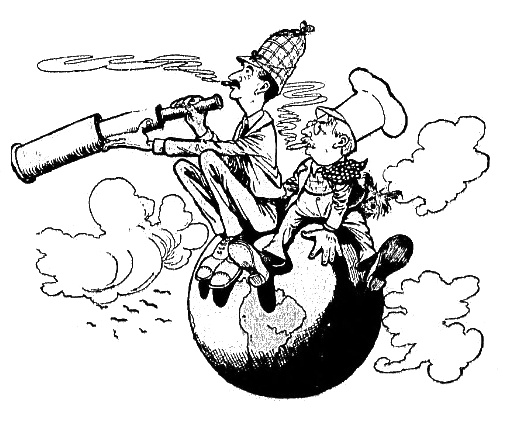
Image © unknown and is in the Public Domain via Wikipedia

A caricature of L. Frank Baum And Walt McDougall, from 1904, from a cartoon announcing the comic strip Queer Visitors from the Marvelous Land of Oz. 

Read more about Queer Visitors from The Marvelous Land of Oz here.   

Blog Posts

Notes And Links

The 1900 first edition front cover image shown at the top of this page is copyright of W. W. Denslow.

The caricature of L. Frank Baum And Walt McDougall, from 1904 image is copyright unknown.

All the above images are in the Public Domain via Wikipedia.

Project Gutenberg – Project Gutenberg is an online library of free e-books and was the first provider of free electronic books.  Michael Hart, the founder of Project Gutenberg, invented e-books in 1971 and his memory continues to inspire the creation of them and related content today.

The Wonderful Wiki of Oz – Official website.  A wonderful and welcoming encyclopedia of all things Oz that anyone can edit or contribute Oz-related information and Oz facts to enjoy.

The Oz Archive on Facebook – Archiving and celebrating the legacy of Oz.

The Oz Archive on Twitter – Archiving and celebrating the legacy of Oz.

The Oz Archive on Instagram – Archiving and celebrating the legacy of Oz.

The Oz Archive on TikTok – Archiving and celebrating the legacy of Oz.   
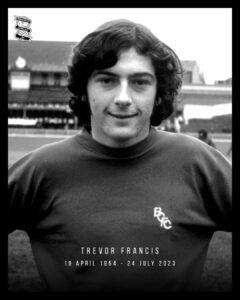
Birmingham City: A Tribute To Trevor Francis

Image © of B.C.F.C.

There is only one team in Birmingham worth supporting with true passion and Birmingham City is it.  I have been supporting them since 1979 when Jim Smith was the manager.  I was 13 at the time.  He is my favourite manager to date.   I am a blue nose ’til I die.

You can read lots more about Blues by clicking here.

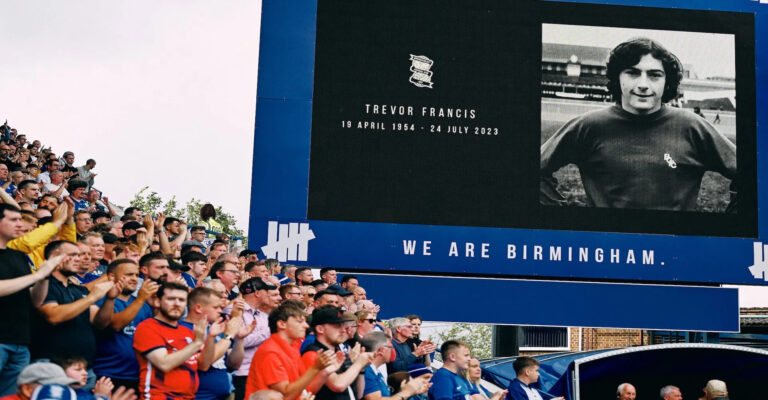
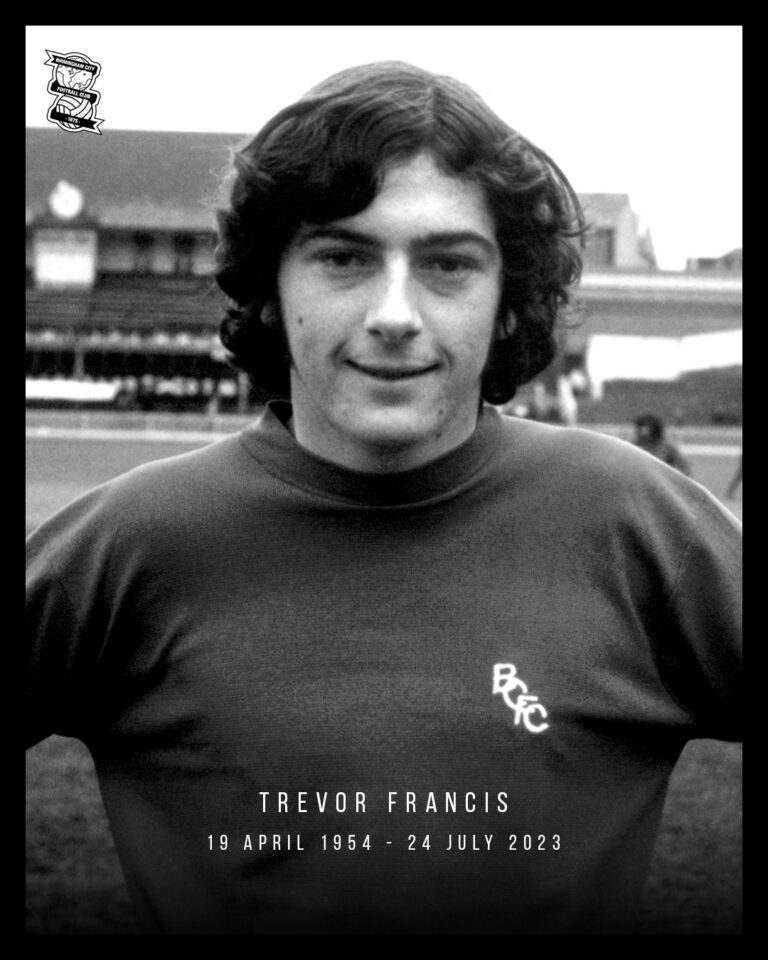
The 24th of July 2023 was a day of shock and sadness for those associated with Birmingham City Football Club, Trevor Francis had died. Trevor wore the number 10 shirt and was certainly the most well-known player for B.C.F.C. and adored by many.  You can read more about him here.

I never got to see him play in person.  I was only in my early teens when I started supporting Blues and could only dream of going to St. Andrews but I saw him on television work his magic on the pitch.  He was at the end of his Blues career when I first started following Jim Smith and the Lads.  I can’t exactly recall when it was but it was around the time he was sold to Nottingham Forest as the first million player in British history.  I continued to watch him for Forest cementing my love for them and their manager Brian Clough.  Forest automatically became my second team until Clough retired in 1993. 

R.I.P.

Tributes From The Club 

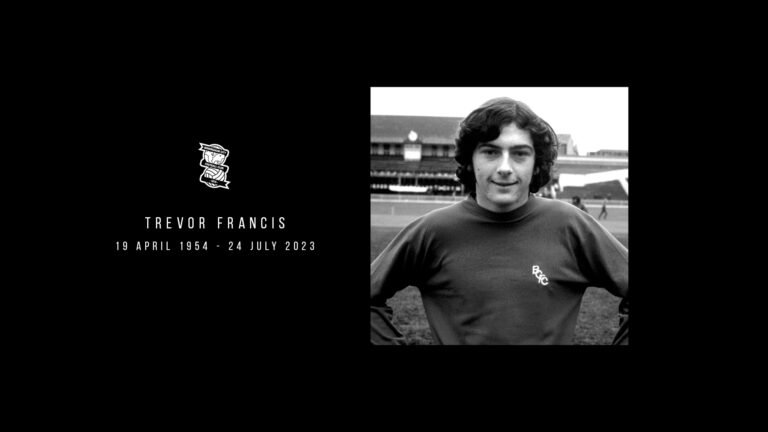
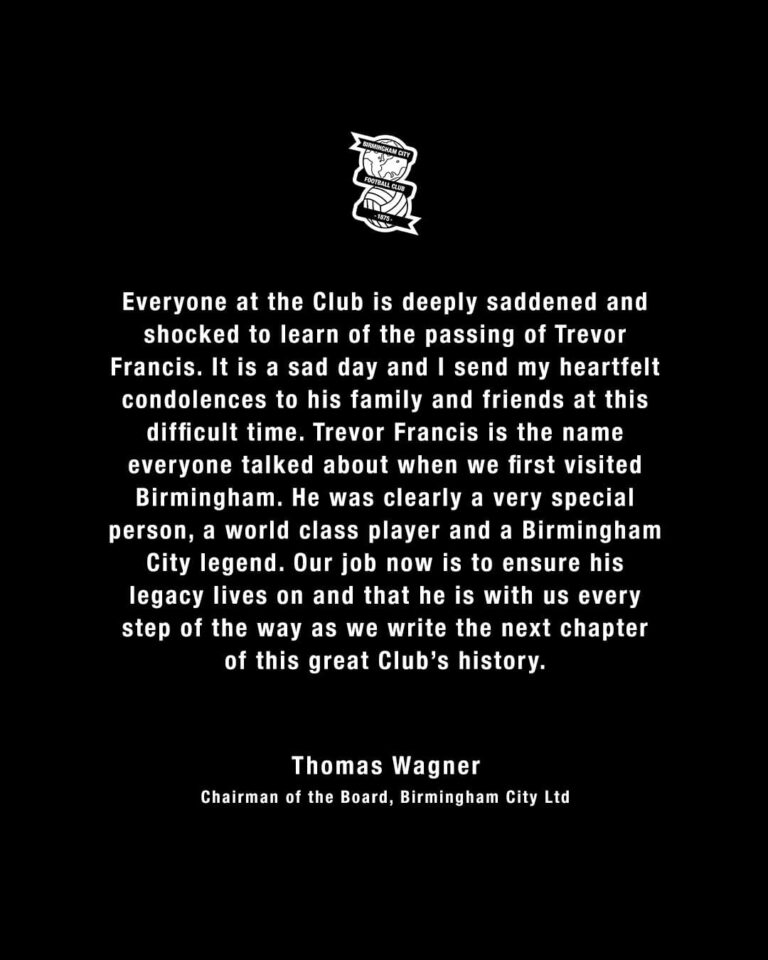
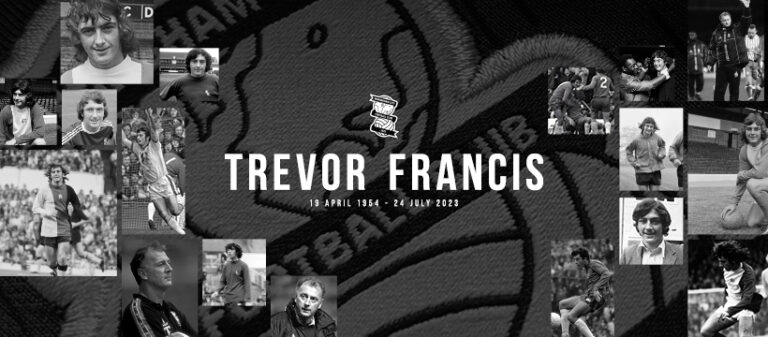
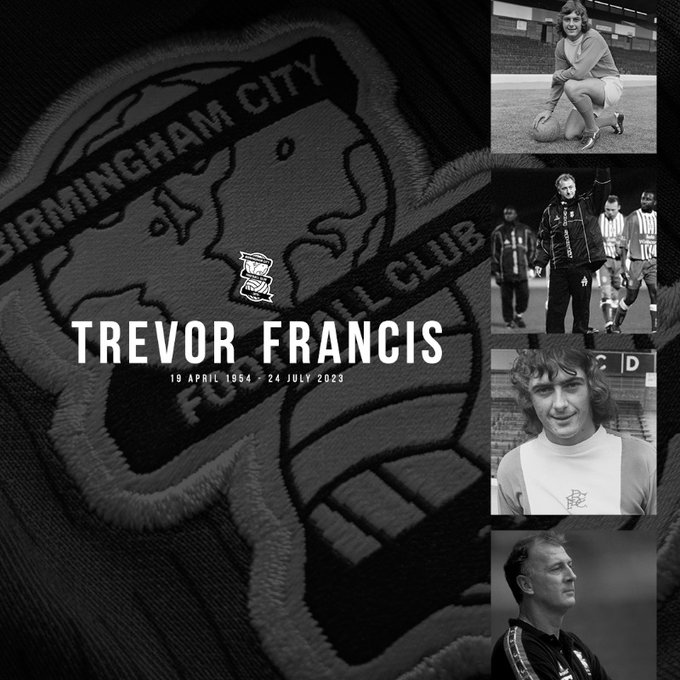
On the 24th of July 2023 there was an announcement by Birmingham City informing the passing of Trevor Francis.  The Blues badge was changed to black as a mark of respect to the great man.

Image © of B.C.F.C.
Image © of B.C.F.C.
Image © of B.C.F.C.
Image © of B.C.F.C.
Image © of B.C.F.C.
Image © of B.C.F.C.
Image © of B.C.F.C.
Image © Unknown
Image © Unknown

The above two photos were posted on Jude Bellingham’s Twitter account on 24/07/23.  This is what he  wrote:

“A very sad day for @BCFC and all of football. Beyond legendary, a trailblazer, a great and an icon of the game. The only thing that could exceed his quality and accolades on the pitch was his class off it. Thank you for all the guidance and the benchmarks you set. Rest in peace, King Trevor! “ 💙

Image © of B.C.F.C.

Players and staff from Blues Men’s and Women’s First Team paying their respects to Trevor Francis on 25/07/23.

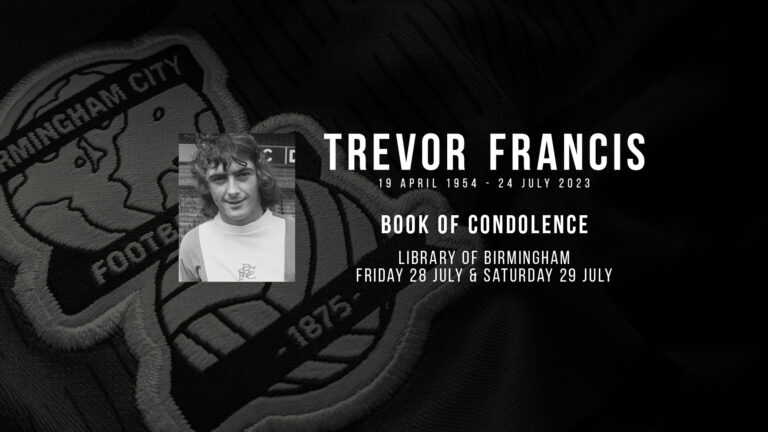
On 27/07/23 there was an announcement from Blues that there would be a Trevor Francis Book of Condolence at the Library of Birmingham on the 28th and 29th of July.  This should have been longer than two days in my opinion.

Image © of B.C.F.C.
Image © of B.C.F.C.
Image © of B.C.F.C.

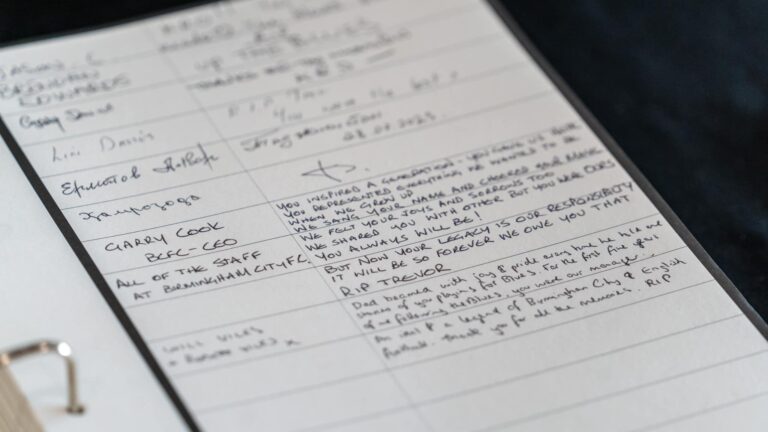
Garry Cook signs the Trevor Francis Book of Condolence at the Library of Birmingham on 29/07/23.

Image © of B.C.F.C.

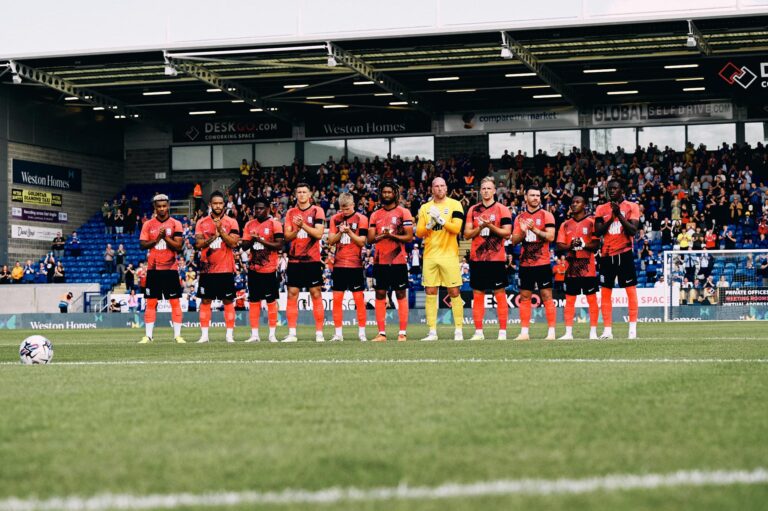
Blues players paying their respects to Trevor Francis at Peterborough United on 29/07/23.

Image © of B.C.F.C.

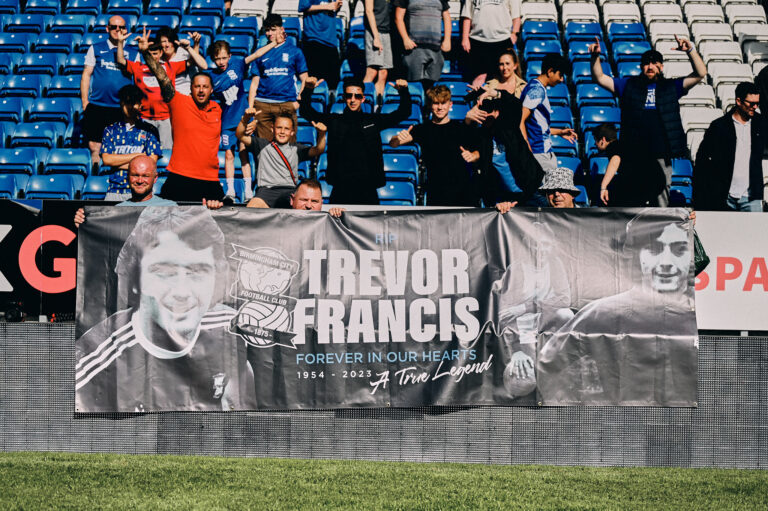
Blues fans at Peterborough United on 29/07/23.

Birmingham City Fans Tribute Area 

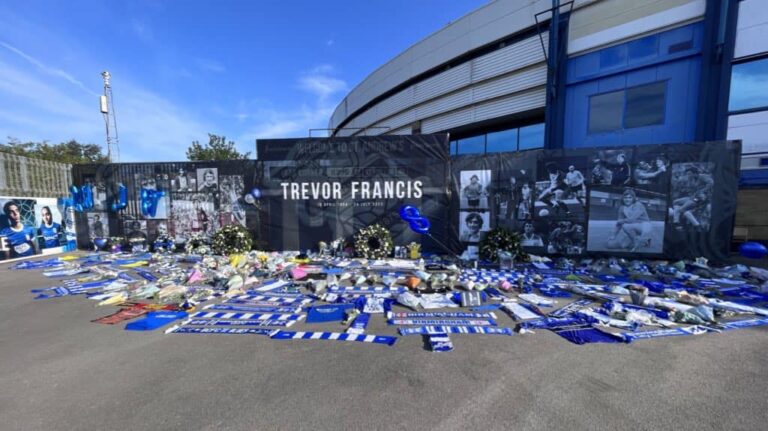
Click here to watch John Eustace and Darren Carter lay a reef in respect of Trevor Francis. This was the start of many flowers, scarves etc. that were placed in the designated area towards the Ticket Office at St. Andrew’s for fans to pay tribute to a club legend from 24/07/23 – 07/08/23.  The tributes are now safely in storage.

Image © of B.C.F.C.
Image © of B.C.F.C.
Image © of B.C.F.C.
Image © of B.C.F.C.

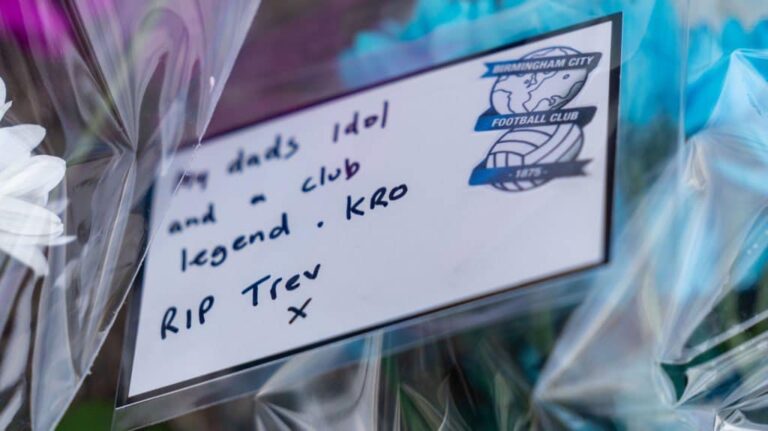
Fan tributes left for Trevor Francis at St. Andrews.

Videos From The Club 

The following videos (not including shorts) are from Birmingham City’s YouTube page and appear in order they were first shown.  There are too many videos of such a legend elsewhere to show here but search in your favourite browser and see for yourself what a great man he was.

Club Celebration 

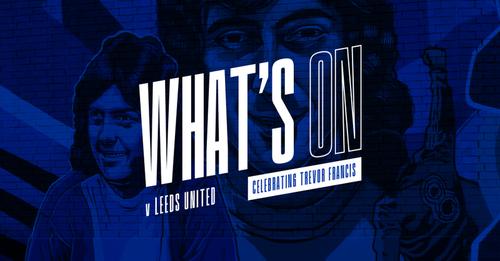
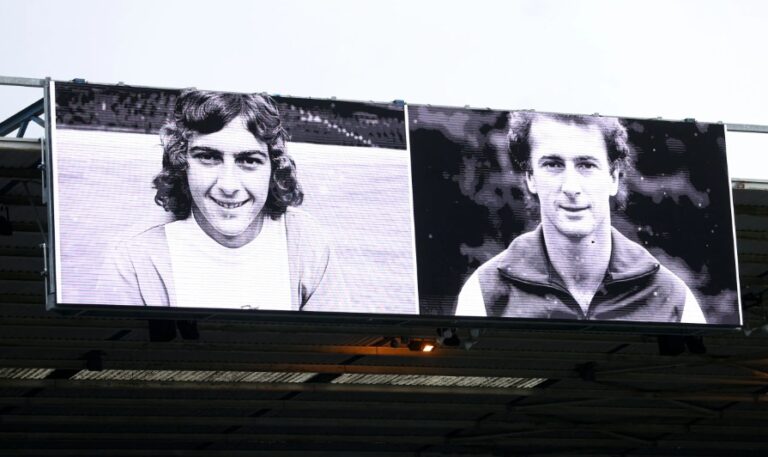
On the 11th of August, 2023, the club announced that they will be celebrating Trevor Francis’s life at the first home game of the 2023/24 season against Leeds United. 

Image © of B.C.F.C.
Image © of B.C.F.C.
Image © of B.C.F.C.
Image © of B.C.F.C.

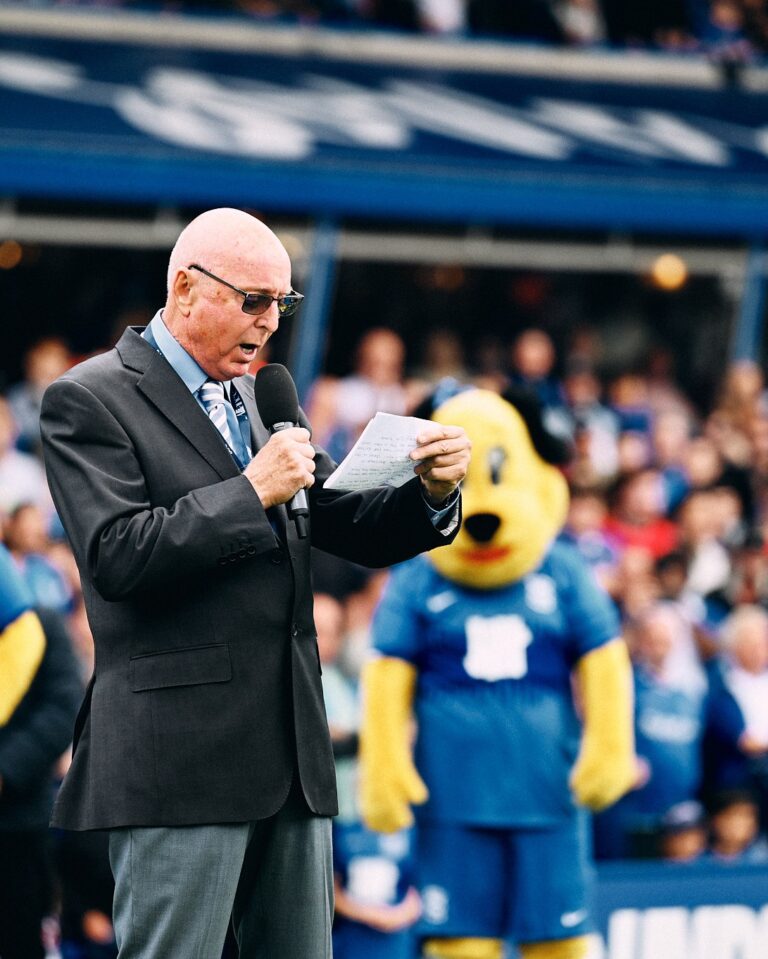
Jasper Carrott pays tribute to his good friend Trevor Francis.

Image © of B.C.F.C.
Image © of B.C.F.C.

A celebration to Trevor Francis at Blues first home game of the 2023/24 season against Leeds United.  

Trevor Francis Statue Announcement  

Trevor Francis Statue Announcement
Image © of B.C.F.C.

Trevor Francis statue announcement.

On the 24th of July, 2024,  Birmingham City made an announcement about the commission of a Trevor Francis statue by  Douglas Jennings M.R.B.S., a globally acclaimed portrait sculptor.

Read more here.

Read more about Francis here.

Read more about Jennings here.

Garry Cook Pays Tribute To The Late, Great Trevor Francis

Click here for Chief Executive Officer Garry Cook’s tribute to the late, great Trevor Francis. 

Trevor Francis Memorial Match V Rangers

On the 24th of July, 2024, one year after Trevor’s passing, Birmingham City hosted Rangers in the first Trevor Francis Memorial Match.

To read about the match, click here.

You can see photos from that match by clicking here.

For Chris Davies’s interview after the match, click here.

For Ethan Laird’s interview after the match, click here.

For match highlights, click here.

Birmingham City Legend Trevor Francis
Image © of B.C.F.C.

Birmingham City legend Trevor Francis.

Trevor Francis In His Birmingham City And Rangers Tops
Image © of B.C.F.C.

Trevor Francis in his Birmingham City and Rangers tops.

Rest In Peace Trevor and thanks for all the great memories and your service to Birmingham City.

KEEP RIGHT ON

Blog Posts

Notes And Links

The image shown at the top of this page is copyright of Birmingham City F.C.  

The images of Trevor Francis and Jude Bellingham with Trevor Francis are copyright unknown.

Birmingham City F.C. – Official website.  

Birmingham City on Facebook  – This is their official Facebook page.

Birmingham City on Twitter – This is their official Twitter page.

Birmingham City on YouTube – This is their official YouTube page.

Blues Store Online – Birmingham City’s official club store online.

Wikipedia – Official website.  Its purpose is to benefit readers by acting as a widely accessible and free encyclopedia that contains information on all branches of knowledge. Funded and hosted by the Wikimedia Foundation, Wikipedia consists of freely editable content whose articles also provide numerous links to guide readers to related pages with more information. 

Birmingham Mail – Official website.  The Birmingham Mail is a newspaper based in Birmingham, England but distributed around Birmingham, the Black Country, Solihull and parts of Warwickshire, Worcestershire and Staffordshire. 

Birmingham City: Trevor Francis

Image © of B.C.F.C.

There is only one team in Birmingham worth supporting with true passion, and Birmingham City is it.  I have been supporting them since 1979, when Jim Smith was the manager.  I was 13 at the time.  He is my favourite manager to date.   I am a blue nose ’til I die.

You can read lots more about Blues by clicking here.

The 24th of July 2023 was a day of shock and sadness for those associated with Birmingham City Football Club on the news that Trevor Francis had died. Trevor wore the number 8 shirt and was certainly the most well-known player for B.C.F.C., adored by many.  You can read my tribute post to him here.

I never got to see him play in person.  I was only in my early teens when I started supporting Blues and could only dream of going to St. Andrews, but I saw him on television work his magic on the pitch.  He was at the end of his Blues career when I first started following Jim Smith and the Lads.  I can’t exactly recall when it was, but it was around the time he was sold to Nottingham Forest as the first million-pound player in British history.  I continued to watch him for Forest, cementing my love for them and their manager, Brian Clough.  Forest automatically became my second team until Clough retired in 1993. 

R.I.P. Trevor. 

Image © of B.C.F.C.

About Trevor Francis 

Trevor Francis was an English footballer who played as a forward for a number of clubs in England, the United States, Italy, Scotland and Australia.  In 1979 he became Britain’s first £1 million player following his transfer from Birmingham City to Nottingham Forest.  He scored the winning goal for Forest in the 1979 European Cup final against Malmö.  He won the European Cup again with the club the following year.  At international level, he played for England 52 times between 1976 and 1986, scoring 12 goals, and played at the 1982 FIFA World Cup.

Between 1988 and 2003, Trevor was a football manager with Queens Park Rangers, Sheffield Wednesday, Birmingham City and Crystal Palace.

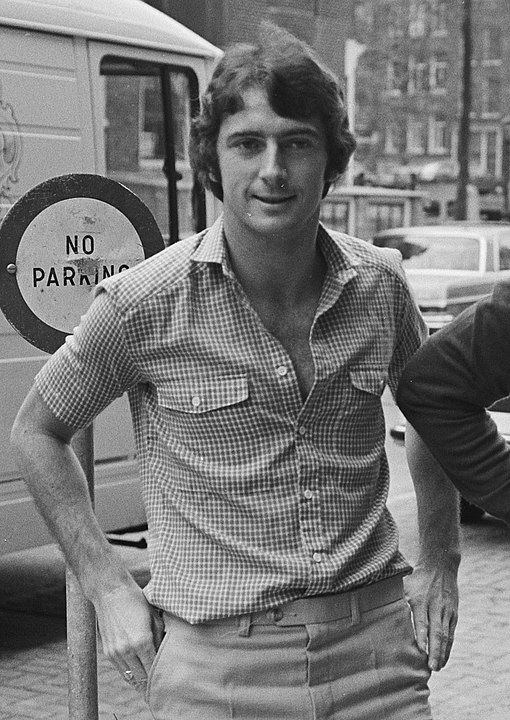
Image © of Hans van Dijk via Wikipedia

Trevor Francis in Amsterdam on the 22nd Of April 1980.  He was playing for Nottingham Forest at the time.

Early Life And Education

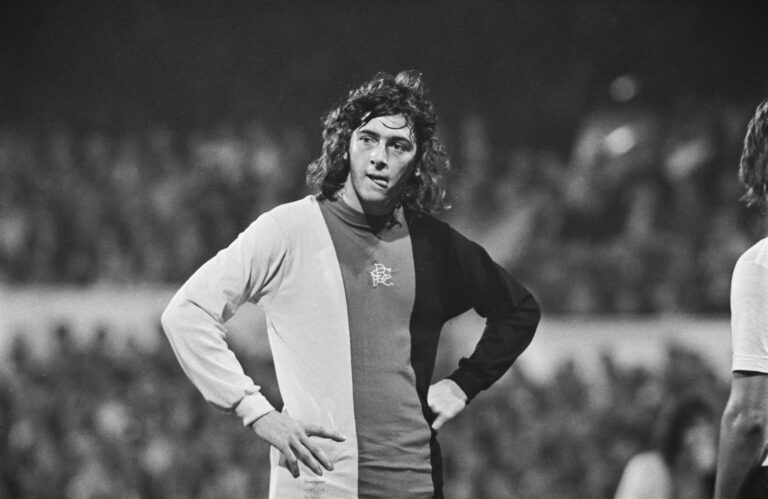
Trevor John Francis was born on the 19th of April 1954, in Plymouth, Devon, and educated at Plymouth’s Public Secondary School for Boys.  He was an agile and skilful forward and joined Birmingham City as a schoolboy.

Club Career

Birmingham City

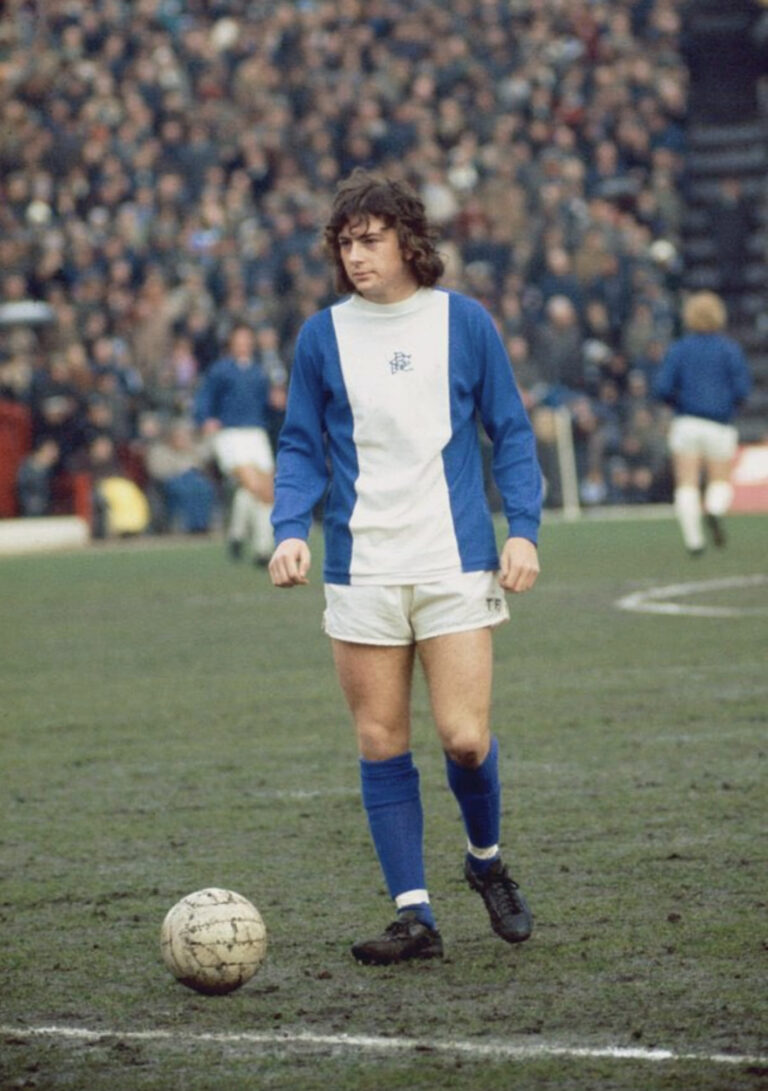
Trevor quickly rose in status, making his debut for Birmingham City’s first team in 1970, aged just 16.  His talent was noted when, before his 17th birthday, he scored four goals in a match against Bolton Wanderers.  He ended his first season with 15 goals from just 22 games.  Birmingham City manager at the time, Freddie Goodwin, compared Trevor to both Jimmy Greaves and Denis Law.

On the 30th of October 1976, he scored one of Birmingham’s most famous goals, when he turned away from the touchline and cut inside two Queens Park Rangers defenders, constantly being forced backwards before suddenly unleashing a 25-yard (23 meters) shot. 

Detroit Express

Trevor negotiated a loan from Birmingham in 1978 to play for the Detroit Express in the North American Soccer League where he scored 22 goals in 19 league matches and was named to the N.A.S.L. first XI alongside Franz Beckenbauer and Giorgio Chinaglia before returning home to the Midlands.

Nottingham Forest

Nottingham Forest, the reigning First Division champions and League Cup holders managed by Brian Clough, put in a bid for Trevor which totalled just over £1 million.  No player had ever been sold between English clubs for a seven-figure fee before, and the deal was sealed, with Trevor famously being introduced to the media by a manager impatient to play squash.  Clough was in his red gym kit and carrying a racquet as he addressed the press conference.

While recognised as the first British million-pound player, the actual transfer fee for the player was £1,150,000, including a 15% commission to the Football League.  Clough wrote in his autobiography that the fee was £999,999, as he wanted to ensure the million-pound milestone did not go to the player’s head, although Trevor says that was a tongue-in-cheek remark by Clough.

Nottingham Forest retained the League Cup shortly afterwards without the cup-tied Francis and made progress in the European Cup to the extent that they reached the semi-finals, although Francis was not eligible to play in the competition until the final.  They won their semi-final, and in May 1979 Forest took on Swedish club Malmö in the final in Munich, and a major instalment of the huge investment money was repaid just before half time.

The ball was spread to Forest’s winger John Robertson wide on the left and he took on two defenders at once to reach the byline and curl an awkward, outswinging cross towards the far post.  Francis had already begun to sprint into position, but even so, he had to increase his pace in order to reach the cross as it dropped and ended up throwing himself low at the ball.  He connected with his head and the ball diverted powerfully into the roof of the net.  Forest won the match 1–0 and footage of the goal was used in the opening titles to Match of the Day for some years afterwards.  A giant picture of Francis stooping to head the ball remains on display in the main entrance and reception area of Forest’s City Ground stadium.

Even though the season ended there, Francis duly headed back to Detroit for another summer playing in the N.A.S.L., where once again he was named to the first XI alongside Johan Cruyff (Los Angeles Aztecs) and Giorgio Chinaglia (New York Cosmos), despite playing only half the season.  In his brief career in America, Francis scored 36 goals in 33 regular season matches and had 18 assists.

At Nottingham Forest Clough frequently played Francis on the right wing, rather than in his preferred position as a central attacker.  Francis was in the side which lost the 1980 League Cup Final to Wolverhampton Wanderers but missed the European Cup Final against Hamburg due to an injury to his Achilles tendon.  Somehow the success of his Forest career never quite reflected his huge fee.  He scored only 14 league goals in the 1979 – 80 season and 6 in the next 18 games that he played for Forest.  Although still a regular for England, his Achilles injury prevented him from being in the squad for the 1980 European Championships.

Manchester City

The injury kept Trevor out of the game for over six months.  He was sold to Manchester City in September 1981, this time for £1.2 million.  The deal caused behind-the-scenes friction at Manchester City.  During negotiations, City chairman Peter Swales informed manager John Bond that the club could not afford the transfer fee.  Bond then issued an ultimatum, which was if Trevor did not sign, Bond would resign.  Francis made a promising start at the club, scoring two goals against Stoke City on his debut, but over the course of the season, he was frequently injured.  In total, he scored 12 goals in 26 games and made the England squad for the 1982 World Cup.

Back at his club, financial problems were again an issue.  Trevor’s contract gave him a salary of £100,000 plus bonuses, which the club could no longer afford to pay to a player who regularly sustained injuries.

Sampdoria

Later that summer, Trevor was approached by Italian club Sampdoria, who paid Manchester City £700,000 for his services.  He helped win the 1984–85 Coppa Italia, in the same team as Scotland midfielder Graeme Souness.  It was the first time that Sampdoria had won the competition.

Atalanta

Trevor joined Atalanta in 1986.  He played 21 league games and scored once in his only season, but added two goals in nine games in the Coppa Italia. Atalanta lost the final to Napoli.  He was the second Englishman at the Bergamo-based club after Gerry Hitchens, and by the time of his death, their only other English-born player was Ademola Lookman.

Rangers

Trevor returned to Britain in September 1987 to join Rangers under Graeme Souness.  Numerous English players were brought to the Scottish club by Souness as English clubs had been banned from European competition since the Heysel disaster.  Trevor cost just £75,000, signed on a pay-as-you-play basis, and won the 1987 – 88 Scottish League Cup, scoring a penalty in the shoot-out.

Queens Park Rangers

Trevor signed for Queens Park Rangers on a free transfer in March 1988 and helped the team finish fifth in the First Division.  He scored 10 goals from 26 appearances in the first half of the 1988 – 89 season and took over as player-manager in December 1988 when Jim Smith moved to Newcastle United, but a knee injury in January 1989 put an end to his playing season.  He marked his return to the field in September 1989 with a hat-trick against Aston Villa, but was replaced as manager by Don Howe in November 1989 and his playing contract was paid up a few days later.

During his time at Queens Park Rangers, Trevor completed a brief loan in 1988 with an Australian National Soccer League team, Wollongong City, as part of businessman Harry Michaels’ attempt to market football in Australia.  Michaels had previously funded the loans of Alan Brazil and Paul Mariner, whom Francis was to replace, and had discussions with Norman Whiteside, Nigel Clough and Michel Platini about playing for the New South Wales-based team.

Sheffield Wednesday

Trevor left Queens Park Rangers in February 1990 to play for Sheffield Wednesday.  Despite gaining a good reputation amongst supporters, he could not help the club avoid relegation to the second tier under manager Ron Atkinson for the 1990 – 91 season.  However, that season he helped Wednesday win the League Cup, although he was a non-playing substitute in the final, and also gained promotion back to the top flight.

International Career

Trevor played for England 52 times between 1977 and 1986 and scored 12 goals.  In 1977, he was given his first England cap by Don Revie, in a 2 – 0 loss against the Netherlands.  After missing out on Euro 1980 due to an Achilles injury, Trevor was named in the England squad for the 1982 World Cup in Spain.  In the first round of the tournament, he scored in the group games against Czechoslovakia and Kuwait.  England was eliminated after goalless draws against both the host nation and West GermanyIn the spring of 1986, he made his 52nd and final appearance for England in a victory over Scotland and was subsequently not selected for the 1986 World Cup in Mexico.

Managerial Career

Sheffield Wednesday

After the departure of Ron Atkinson, Trevor took over as manager of Sheffield Wednesday with popular support from the club and supporters.  He guided Wednesday to a third-place finish in 1992.  The following year, Wednesday reached the F.A. Cup and League Cup finals, losing both to Arsenal, the former after a replay.  In 1994, Francis finally retired as a player, shortly before his 40th birthday.  He was dismissed as manager a year later after Wednesday finished 13th in the Premiership.

In February 1992, Trevor brought former French international Eric Cantona back from a poor discipline-enforced hiatus in his career by inviting him for a trial at Sheffield Wednesday.  However, as the snowy conditions meant that he could only evaluate Cantona on Astro Turf, Francis requested an extension to the trial to see whether Cantona could play on grass.  An outraged Cantona walked out on The Owls and was signed (without a trial) by Leeds United, inspiring first them and then Manchester United to success.  In a 2012 interview, Trevor said that he had agreed to take Cantona on as a favour to Trevor’s former agent, Dennis Roach, and Michel Platini, who he knew from his time playing in Italy when they approached him about taking on Cantona, and that it was intended as an opportunity for Cantona to put himself in the shop window.  Wednesday had only recently been promoted back to the top flight, with most of the squad still being on Second Division-level wages, and the club could not afford to sign him.

Birmingham City

Trevor was hired as Birmingham City manager in 1996, with the club in the First Division.  He guided Birmingham to a 10th and 7th-place finish in his first two seasons, missing out on the playoffs on goal difference in the latter.  Finishes of 4th, 4th and 5th in the next three seasons resulted in playoff entry, losing each time.

Trevor led Blues to the 2001 League Cup Final, where they lost on penalties to Liverpool.  He was dismissed in October of that year.  BBC Sport wrote, “Francis, the player, was legendary. Francis, the manager, is the nearly man.”

Crystal Palace

Trevor was manager of Crystal Palace from November 2001 to April 2003.  He was appointed by Crystal Palace chairman, Simon Jordan to replace Steve Bruce who had resigned as Crystal Palace manager with the intention of taking the manager’s role at Birmingham City.  Litigation followed with Bruce being placed on gardening leave.  Of the appointment, Jordan said, “The last two or three weeks have not been easy.  I’m bored of Steve Bruce and Birmingham, and what I’m interested in is Trevor Francis and Crystal Palace.”  At the time, Trevor said that he had turned down four jobs before accepting the role at Crystal Palace.  Under his managership, Palace defeated a Gerard Houllier managed Liverpool in an F.A. Cup fourth-round replay at Anfield in February 2003 and beat Palace’s main rivals, Brighton & Hove Albion, 5 – 0 in October 2002.  However, after the team’s second failure to achieve promotion to the Premier League, Simon Jordan dismissed him, stating, “People know I am very unhappy with the selection of our players under Francis. We have a very strong squad and we should have done a lot better this season – a lot of lessons need to be learned from injury prevention and transfer policy.”

Personal Life

Trevor married Helen in 1974.  The couple had two children together.  On the 5th of April 2017, it was reported that Helen Francis had died.

On the 13th of April 2012, Trevor was reported to be recovering in hospital from a suspected heart attack.

Trevordied of a heart attack at his home near Marbella, Spain, on July 24th, 2023.  He was 69.  

Image © Christophe95 via Wikipedia

Trevor Francis in 2009.

Career And Managerial Statistics

Click here to read about Trevor’s club, international and managerial statistics.

Honours

Player

Birmingham City

Football League Second Division runner-up: 1971 – 72.

Detroit Express

American Conference Central Division: 1978.

Nottingham Forest

European Cup: 1978 – 79 and 1979 – 80.

European Super Cup: 1979.

Football League Cup: runner-up 1979 – 80.

Sampdoria

Coppa Italia: 1984 – 85.

Rangers

Scottish League Cup: 1987 – 88.

Sheffield Wednesday

Football League Cup: 1990 – 91.

Individual

P.F.A. First Division Team of the Year: 1976 – 77, 1977 – 78, and 1981 – 82.

Coppa Italia top scorer: 1984 – 85 (9 goals).

Manager

Sheffield Wednesday

F.A. Cup runner-up: 1992–93.

Football League Cup runner-up: 1992 – 93.

Birmingham City

Football League Cup runner-up: 2000 – 01.

Individual

Premier League Manager of the Month: December 1993.

Read more about Trevor Francis’ Wikipedia page here.

Tribute

Visit my A Tribute To Trevor Francis post here.

Blog Posts

Notes And Links

The image shown at the top of this page is copyright of Birmingham City F.C.  

The image above of Trevor Francis In Amsterdam In 1980 is the copyright of  Hans van Dijk via Wikipedia.  It comes with a Creative Commons licence (CC0 1.0and is in the Public Domain. 

The image above of Trevor Francis in 2009 is the copyright of Wikipedia user Christophe95.  It comes with a Creative Commons licence (CC BY-SA 3.0).  You can find more great work from him by clicking here.

The above links in the Before Knighthead section will take you to Wikipedia and its content is subject to change.

Birmingham City F.C. – Official website.  

Birmingham City on Facebook  – This is their official Facebook page.

Birmingham City on Twitter – This is their official Twitter page.

Birmingham City on YouTube – This is their official YouTube page.

Blues Store Online – Birmingham City’s official club store online.

Wikipedia – Official website.  Its purpose is to benefit readers by acting as a widely accessible and free encyclopedia that contains information on all branches of knowledge. Funded and hosted by the Wikimedia Foundation, Wikipedia consists of freely editable content whose articles also provide numerous links to guide readers to related pages with more information. 

Birmingham Mail – Official website.  The Birmingham Mail is a newspaper based in Birmingham, England but distributed around Birmingham, the Black Country, Solihull and parts of Warwickshire, Worcestershire and Staffordshire. 

Books: Glinda Of Oz By L. Frank Baum

1920 first edition front cover: © John. R. Neill and is in the Public Domain via Wikipedia

You can download this book and the thirteen other fantasy books in the Oz series by L. Frank Baum via Project Gutenberg by clicking on the link in Blog Posts below.

About Glinda Of Oz

Glinda of Oz is the fourteenth Land of Oz book written by children’s author L. Frank Baum, published on July 10, 1920.  It is the last book of the original Oz series, which was later continued by other authors.  Like most of the Oz books, the plot features a journey through some of the remoter regions of Oz; though in this case the pattern is doubled: Dorothy and Ozma travel to stop a war between the Flatheads and Skeezers; then Glinda and a cohort of Dorothy’s friends set out to rescue them.  The book was dedicated to Baum’s second son, Robert Stanton Baum.

Original Manuscript

The printed text of the book features one significant change from Baum’s manuscript.  In the manuscript, Red Reera first appears as a skeleton, its bones wired together, with glowing red eyes in the sockets of its skull.  The printed text makes Reera the Red first appear as a grey ape in an apron and lace cap — a comical sight rather than a frightening and disturbing spectre.  The change was most likely made by Baum at the suggestion of his editors.  Other changes in the manuscript, made by an unknown editor at Reilly & Lee, are relatively trivial and do not always improve the text.

The submerged city of the Skeezers in this book may have been suggested to Baum by the semi-submerged Temple of Isis at Philae in Egypt, which the Baums had seen on their trip to Europe and Egypt in the first six months of 1906.

The Plot

SPOILER ALERT: Skip this bit if you haven’t read the book and are planning to do so!

Princess Ozma and Dorothy travel to an obscure corner of the Land of Oz, in order to prevent a war between two local powers, the Skeezers and the Flatheads.  The leaders of the two tribes prove obstinate and are determined to fight in spite of Ozma and Dorothy.  Unable to prevent the war, Dorothy and Ozma find themselves imprisoned on the Skeezers’ glass-covered island, which has been magically submerged to the bottom of its lake.  Their situation worsens when the warlike queen Coo-ee-oh, who is holding them captive and who alone knows how to raise the island back to the surface of the lake, loses her battle and gets transformed into a swan, forgetting all her magic in the process, and leaving the inhabitants of the island, with Ozma and Dorothy, trapped at the bottom of the lake.  Ozma and Dorothy summon Glinda, who, with help from several magicians and magical assistants, must find a way to raise the island to the surface of the lake again, and liberate its inhabitants.

Read more about Glinda Of Oz here.

The above articles were sourced from Wikipedia and are subject to change.    

Blog Posts

Notes And Links

The image shown at the top of this page is in the Public Domain via Wikipedia.

Project Gutenberg – Project Gutenberg is an online library of free e-books and was the first provider of free electronic books.  Michael Hart, the founder of Project Gutenberg, invented e-books in 1971 and his memory continues to inspire the creation of them and related content today.

The Wonderful Wiki of Oz – Official website.  A wonderful and welcoming encyclopedia of all things Oz that anyone can edit or contribute Oz-related information and Oz facts to enjoy.

The Oz Archive on Facebook – Archiving and celebrating the legacy of Oz.

The Oz Archive on Twitter – Archiving and celebrating the legacy of Oz.

The Oz Archive on Instagram – Archiving and celebrating the legacy of Oz.

The Oz Archive on TikTok – Archiving and celebrating the legacy of Oz.  

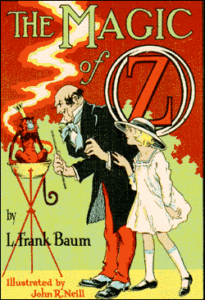
Books: The Magic Of Oz By L. Frank Baum

1919 first edition front cover image © John. R. Neill and is in the Public Domain via Wikipedia

You can download this book and the thirteen other fantasy books in the Oz series by L. Frank Baum via Project Gutenberg by clicking here.  

About The Magic Of Oz

The Magic of Oz is the thirteenth Land of Oz book written by L. Frank Baum. Published on June 7, 1919, one month after the author’s death, The Magic of Oz relates the unsuccessful attempt of the Munchkin boy Kiki Aru and former Nome King Ruggedo to conquer Oz.

The novel was dedicated to “the Children of our Soldiers, the Americans and their Allies, with unmeasured Pride and Affection.”

Release

The upsurge in sales that had greeted the previous Oz book, The Tin Woodman of Oz, in 1918 also affected The Magic of Oz, which sold 26,200 copies.  The Oz books in total sold almost twice as many copies in 1919 as in 1918, and 1918 had been an exceptionally good year.  The high sales were most likely influenced by the death of Baum earlier in 1919.

The Plot

SPOILER ALERT: Skip this bit if you haven’t read the book and are planning to do so!

At the top of Mount Munch lives a group of people known as the Hyups.  One of their numbers, a Munchkin named Bini Aru, discovered a method of transforming people and objects by merely saying the word “Pyrzqxgl”.  After Princess Ozma decreed that no one could practise magic in Oz except for Glinda the Good Witch and the Wizard of Oz, Bini wrote down the directions for pronouncing “Pyrzqxgl” and hid them in his magical laboratory.

When Bini and his wife are at a fair one day, their son Kiki Aru, who thirsts for adventure, finds the directions and afterwards transforms himself into a hawk and visits various countries outside the land of Oz.  When he alights in the land of Ev, Kiki Aru learns that he needs money to pay for a night’s lodging (versus Oz, where the money is not used at all) and changes himself into a magpie to steal a gold piece from an old man.  A sparrow confronts the then-human Kiki Aru with knowledge of the theft, and Kiki says that he did not know what it was like to be wicked before, he is glad that he is now.  This conversation is overheard by Ruggedo, the Nome who was exiled to the Earth’s surface in Tik-Tok of Oz, and he sees through Kiki Aru’s power a chance to get revenge on the people of Oz.

Kiki changes himself and Ruggedo into birds and they fly over the Deadly Desert into the Land of Oz.  They enter Oz as animals to escape detection by Glinda and to recruit an army of conquest from the country’s wild animal population.  When they first appear in the Forest of Gugu in the Gillikin Country, Kiki changes himself and Ruggedo into Li-Mon-Eags (fictional creatures with the heads of lions, the bodies of monkeys, and the wings of eagles as well as having the tails of donkeys) and lies that they’ve seen the people of the Emerald City plan to enslave the animal inhabitants of the Forest.  Ruggedo claims that the Li-Mon-Eags will transform the animals into humans and march on the Emerald City and transform its inhabitants into animals, driving them into the forest.  Ruggedo proves their power (for Kiki’s the only one who knows “Pyrzqxgl”) by having Kiki transform one of the leopard king Gugu’s advisors, Loo the unicorn, into a man and back again.  Gugu offers to meet with the leaders of the other animal tribes to decide on this matter of invasion.

Dorothy and the Wizard arrive with the Cowardly Lion and the Hungry Tiger in the Forest of Gugu during this council of war with a request for monkeys to train in time for Ozma’s upcoming birthday party.  Ruggedo recognizes his old enemies and inspires Kiki to begin transforming people and animals left and right — including Ruggedo, whom Kiki turns against by transforming him into a goose, a transformation that the Nome most fears because as a goose he might lay an egg.  (In Baum’s universe, all eggs are a deadly poison to nomes.)

The Wizard, whom Kiki transformed into a fox, follows the Li-Mon-Eag with his magic bag, the transformed Kiki, deep into the forest where he begins transforming monkeys into giant human soldiers.  However, Kiki makes them so big that they cannot move through the trees.  The Wizard, however, heard how to correctly pronounce “Pyrzqxgl” and first stops Kiki and Ruggedo by transforming them into a walnut and a hickory nut.  Then the Wizard resumes his rightful form and changes Dorothy, the Cowardly Lion, the Hungry Tiger, and Gugu back to their forms, and he agrees to change the soldiers back into monkeys.  The Wizard recruits several of the grateful monkeys and shrinks them down to bring them back to the Emerald City and train.

On arriving there, Dorothy and the Wizard are dispatched to a magic island where Cap’n Bill and Trot went to get a magic flower for Ozma’s birthday.  However, the island itself causes anything living that touches it to take root there, and that is how the sailor and his friend are found when Dorothy and the Wizard arrive.  The Wizard uses “Pyrzqxgl” to change Cap’n Bill and Trot into honeybees which narrowly avoid being eaten by the Cowardly Lion and the Hungry Tiger.  When they are human again, Cap’n Bill retrieves the flower by strapping a wood plank onto his good leg, walks with that and his wooden leg onto the island, and retrieves the flower.

Back at the Emerald City, Ozma and her friends celebrate her birthday (though without quite the pomp and fanfare from The Road to Oz) and then decide how to deal with the evil magicians transformed into nuts.  The Wizard uses “Pyrzqxgl” to change them back to Kiki Aru and Ruggedo and make them thirsty enough to drink the Water of Oblivion, which will make them forget all that they have ever known.  The now-blank slate Kiki Aru and Ruggedo will live in the Emerald City and learn to be good and kind.

Read more about The Magic Of Oz here.

The above articles were sourced from Wikipedia and are subject to change.   

Blog Posts

Notes And Links

The 1919 first edition front cover image shown at the top of this page is © John R. Neill and is in the Public Domain via Wikipedia.

Project Gutenberg – Project Gutenberg is an online library of free e-books and was the first provider of free electronic books.  Michael Hart, the founder of Project Gutenberg, invented e-books in 1971 and his memory continues to inspire the creation of them and related content today.

The Wonderful Wiki of Oz – Official website.  A wonderful and welcoming encyclopedia of all things Oz that anyone can edit or contribute Oz-related information and Oz facts to enjoy.

The Oz Archive on Facebook – Archiving and celebrating the legacy of Oz.

The Oz Archive on Twitter – Archiving and celebrating the legacy of Oz.

The Oz Archive on Instagram – Archiving and celebrating the legacy of Oz.

The Oz Archive on TikTok – Archiving and celebrating the legacy of Oz. 
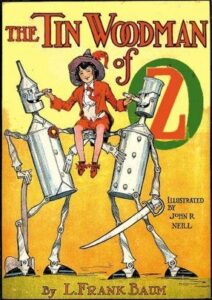
Books: The Tin Woodman Of Oz By L. Frank Baum

1918 first edition front cover image © John. R. Neill and is in the Public Domain via Wikipedia

You can download this book and the thirteen other fantasy books in the Oz series by L. Frank Baum via Project Gutenberg by clicking here.   

About The Tin Woodman Of Oz

The Tin Woodman of Oz is the twelfth Land of Oz book written by L. Frank Baum and was originally published on May 13, 1918.  The Tin Woodman is reunited with his Munchkin sweetheart Nimmie Amee from the days when he was flesh and blood.  This was a back-story from Baum’s 1900 novel, The Wonderful Wizard of Oz.

The book was dedicated to the author’s grandson Frank Alden Baum.

Context And Reception

The Tin Woodman of Oz provides the backstory for Oz itself; it was not always a fairyland and became one by being enchanted by the Fairy Queen Lurline, who left a fairy behind to rule it.  In Glinda of Oz Ozma says that she herself was that fairy, though in The Marvelous Land of Oz we are told of her restoration to a throne long held by her ancestors.

In any event, this novel marks a clear maturation of Ozma’s character, now said to appear significantly older than Dorothy (in Ozma of Oz they appeared the same age) and a fairy working her own innate magic.

Baum’s Oz books had entered a trend of declining sales after 1910.  The Tin Woodman of Oz reversed this trend; its first-year sales of 18,600 were enough to make it a bestselling success.  Significantly, the sales of earlier Oz titles also rebounded from previous declines, many selling 3000 copies that year, and two, The Marvelous Land of Oz (1904) and the previous year’s The Lost Princess of Oz (1917), selling 4000 copies. Baum earned $6,742.52 from his Oz books that year.  In 1918 the average annual salary of a clerical worker was $940.  Even Baum’s non-Oz-related early works were affected by the upsurge: John Dough and the Cherub (1906) sold 1,562 copies in 1918.

The reason for this reversal of fortune is harder to specify.  The psychological shock of the trench-warfare carnage of World War I may have inspired a wave of nostalgia for a simpler time, with Baum’s books representing a lost age of innocence.

A new edition of the book was illustrated by Dale Ulrey in 1955.  She illustrated a new edition of The Wizard of Oz for Reilly & Lee the following year, but sales did not warrant her continuing to provide new illustrations.

The Plot

SPOILER ALERT: Skip this bit if you haven’t read the book and are planning to do so!

The Tin Woodman and the Scarecrow are regaling each other with tales at the Woodman’s palace in the Winkie Country when a Gillikin boy named Woot wanders in.  After he is fed and rested, Woot asks the Woodman how he came to be made of tin.

He relates how the Wicked Witch of the East enchanted his axe and caused him to chop his body parts off limb by limb because he was in love with her ward, Nimmie Amee.  Each chopped limb was replaced by the tinsmith Ku-Klip with a counterpart made of tin.  (Since Oz is a fairyland, no one can die, even when the parts of their body are separated from each other unless those people are witches and someone drops a house onto them. )  Without a heart, the Tin Woodman felt he could no longer love Nimmie Amee and he left her.  Dorothy and the Scarecrow found him after he had rusted in the forest (an event-related in The Wonderful Wizard of Oz) and went with him to the Emerald City where the Wizard gave him a heart.  Woot suggests that the heart may have made him kind, but it did not make him loving, or he would have returned to Nimmie Amee.  This shames the Tin Woodman and inspires him to journey to the Munchkin Country and find her.

The Tin Woodman, the Scarecrow, and Woot journey into the Gillikin Country and encounter the inflatable Loons of Loonville, whom they escape by popping several of them.  They descend into Yoop Valley, where the giantess Mrs. Yoop dwells, who transforms the travellers into animals for her amusement, just as she has already done to Polychrome, the Rainbow’s Daughter.  Woot steals a magic apron that opens doors and barriers at the wearer’s request, enabling the four to escape.  Woot, as a green monkey, narrowly avoids becoming a jaguar’s meal by descending further into a den of subterranean dragons.  After escaping that ordeal, Woot, the Tin Woodman as a tin owl, the Scarecrow as a straw-stuffed bear, and Polychrome as a canary turn south into the Munchkin Country.

They arrive at the farm of Jinjur, who renews her acquaintance with them and sends them to the Emerald City for help.  Dorothy and Ozma arrive and Ozma easily restores the Scarecrow and the Tin Woodman to their rightful forms.  Polychrome takes several steps to restore to her true form.  However, Ozma discovers that the Green Monkey into which Woot is transformed has to be someone’s form; it cannot be destroyed.  Polychrome suggests as a punishment for wickedness that Mrs. Yoop the giantess be made into the Green Monkey, and Ozma thus succeeds in restoring Woot to his proper form.

The Tin Woodman, the Scarecrow, Woot, and Polychrome resume their quest and come upon the spot where the Tin Woodman had rusted and find another tin man there.  After they oil his joints, he identifies himself as Captain Fyter, a soldier who courted Nimmie Amee after the Woodman had left her.  The Wicked Witch of the East had made Fyter’s sword do what the Woodman’s axe had done—cut off his limbs, which Ku-Klip replaced with tin limbs.  He does not have a heart either, but this does not bother him.  However, he can rust, which he does one day during a rainstorm.  Both woodmen now seek the heart of Nimmie Amee, agreeing to let her choose between them.

The five come to the dwelling of the tinsmith Ku-Klip where the Tin Woodman talks to himself—that is, to the head of the man (Nick Chopper) he once was.  The Tin Woodman and the Tin Soldier also find a barrel of assorted body parts that once belonged to each of them, but some, like Captain Fyter’s head, are conspicuously missing.  Ku-Klip reveals that he used Fyter’s head and many body parts from each of them (which never decayed) to create his assistant Chopfyt.  Chopfyt complained about missing an arm until Ku-Klip made him a tin one, and he departed for the east.

The companions leave Ku-Klip and continue east themselves to find Nimmie Amee and find themselves crossing the Invisible Country, where a massive Hip-po-gy-raf helps them across in return for the Scarecrow’s straw.  Reluctantly, he gives it and consents to being stuffed with available hay, which makes his movements awkward.  They rest for the night at the house of Professor and Mrs. Swynne, pigs whose nine children live in the Emerald City under the care of the Wizard.

They leave the Swynnes and arrive at the foot of Mount Munch on the eastern border of the Munchkin Country.  At its summit is a cottage where a rabbit tells them Nimmie Amee now lives happily.  The Tin Woodman and Tin Soldier knock and are admitted by Nimmie Amee, who is now married to Chopfyt.  She refuses to leave her domestic life, even to become Empress of the Winkies (which she would become as the Tin Woodman’s wife), saying “All I ask is to be left alone and not be disturbed by visitors.”  The four return to the Emerald City and relate their adventures.  Woot is allowed free rein to roam where he pleases, Captain Fyter is dispatched by Ozma to guard duty in the Gillikin Country, and the Tin Woodman and Scarecrow return to his palace in the Winkie Country where the story began.

Read more about The Tin Woodman Of Oz here.

The above articles were sourced from Wikipedia and are subject to change.

Blog Posts

Notes And Links

The 1918 first edition front cover image shown at the top of this page is © John R. Neill and is in the Public Domain via Wikipedia.

Project Gutenberg – Project Gutenberg is an online library of free e-books and was the first provider of free electronic books.  Michael Hart, the founder of Project Gutenberg, invented e-books in 1971 and his memory continues to inspire the creation of them and related content today.

The Wonderful Wiki of Oz – Official website.  A wonderful and welcoming encyclopedia of all things Oz that anyone can edit or contribute Oz-related information and Oz facts to enjoy.

The Oz Archive on Facebook – Archiving and celebrating the legacy of Oz.

The Oz Archive on Twitter – Archiving and celebrating the legacy of Oz.

The Oz Archive on Instagram – Archiving and celebrating the legacy of Oz.

The Oz Archive on TikTok – Archiving and celebrating the legacy of Oz.  
Books: The Lost Princess Of Oz By L. Frank Baum

1917 first edition front cover image © John. R. Neill and is in the Public Domain via Wikipedia

You can download this book and the thirteen other fantasy books in the Oz series by L. Frank Baum via Project Gutenberg by clicking here.      

About The Lost Princess Of Oz

The Lost Princess of Oz is the eleventh canonical Oz book written by L. Frank Baum.  Published on June 5, 1917, it begins with the disappearance of Princess Ozma, the ruler of Oz and covers Dorothy and the Wizard’s efforts to find her.  The introduction to the book states that its inspiration was a letter a young girl had written to Baum: “I suppose if Ozma ever got hurt or losted [sic], everybody would be sorry.”

The book was dedicated to the author’s newborn granddaughter Ozma Baum, child of his youngest son Kenneth Gage Baum.

Ruth Plumly Thompson borrowed the plot of this novel for her 1937 Oz book Handy Mandy in Oz. The Frogman and Cayke’s dishpan re-appear in Jeff Freedman’s 1994 novel The Magic Dishpan of Oz.

The Plot

SPOILER ALERT: Skip this bit if you haven’t read the book and are planning to do so!

Dorothy has risen from bed for the day and is seeing to her friends in the Emerald City and notices that Ozma has not awakened yet.  Dorothy goes into Ozma’s chambers only to find she is not there.

Glinda awakens in her palace in the Quadling Country and finds her Great Book of Records is missing. She goes to prepare a magic spell to find it- only to see her magic tools are gone as well.  She dispatches a messenger to the Emerald City to relay news of the theft.  Receiving the news, the Wizard hastily offers his magic tools to assist Glinda, however, these are missing as well.  Glinda, Dorothy, and the Wizard organize search parties to find Ozma and the missing magic.  Accompanying them are Button-Bright, Trot, and Betsy Bobbin. Dorothy and the Wizard’s party begins to search the Winkie Country to the west of the Emerald City.

Meanwhile, in the southwestern corner of the Winkie Country on a plateau belonging to the Yips, and Cayke the cookie cook has had her diamond-studded gold dishpan stolen.  The self-proclaimed adviser to the Yips, a human-sized dandy of a frog called the Frogman, hears Cayke’s story and offers to help her find the dishpan.  When they have gotten down the mountain, Cayke reveals to the Frogman that the dishpan has magic powers, for her cookies come out perfect every time.

Dorothy, the Wizard, and their party enter the previously unknown communities of Thi and Herku.  The citizens of Thi are ruled by the High Coco-Lorum (really the King, but the people do not know it) and repeat the same story about the Herkus: they keep giants for their slaves.  In the Great Orchard between Thi and Herku, the party enjoys a variety of fruits. Button-Bright eats from the one peach tree in the orchard.  When he reaches the peach’s centre he discovers it to be made of gold.  He pockets the gold peach pit to show Dorothy, Betsy, and Trot later – despite warnings from the local animals that the evil Ugu the Shoemaker has enchanted it.

In the city of Herku, Dorothy and the Wizard’s party are greeted by the emaciated but jovial Czarover of Herku, who has invented a pure energy compound called zosozo that can make his people strong enough to keep giants as slaves.  The Czarover offers them six doses to use in their travels and casually reveals that Ugu the Shoemaker came from Herku.  Ugu found magic books in his attic one day because he was descended from the greatest enchanter ever known and learned over time to do a great many magical things.  The Shoemaker has since moved from Herku and built a castle high in the mountains.  This clue leads Dorothy and the Wizard to think that Ugu might be behind all the recent thefts of magic and the ruler of Oz.  They proceed from Herku toward the castle and meet with the Frogman, Cayke the Cookie Cook, and the Lavender Bear the stuffed bear who rules Bear Center.  Lavender Bear carries the Little Pink Bear, a small wind-up toy that can answer any question about the past put to it.

When the combined party arrives at Ugu’s castle, Button-Bright is separated from them and falls into a pit.  Before they rescue him, the Wizard asks the Little Pink Bear where Ozma is and it says that she is in the pit, too.  After Button-Bright is let out of the pit, the Little Pink Bear says that she is there among the party.  Unsure what to make of this seeming contradiction, the party advances toward the castle.  Sure enough, Ugu is the culprit and the castle’s magical defences are techniques from Glinda and the Wizard.  Upon overcoming these, the party finds themselves standing before the thief himself.

Ugu uses magic to send the room spinning and retreats.  Dorothy stops it by making a wish with the magic belt.  She uses its power to turn Ugu into a dove, but he modifies the enchantment so he retains human size and aggressive nature.  Fighting his way past Dorothy and her companions, Ugu the dove uses Cayke’s diamond-studded dishpan to flee to the Quadling Country.

Once the magic tools are recovered, the conquering search party turns their attention to finding Ozma.  The Little Pink Bear reveals that Ozma is being carried in Button-Bright’s jacket pocket, where he placed the gold peach pit. The  Wizard opens it with a knife, and Ozma is released from where Ugu had imprisoned her.  She was kidnapped by Ugu when she came upon him stealing her and the Wizard’s magic instruments.

The people of the Emerald City and Ozma’s friends all celebrate her return.  Days later, the transformed Ugu flies in to see Dorothy and ask her forgiveness for what he did.  She offers it and offers to change him back with the Magic Belt, but Ugu has decided that he likes being a dove much better.

Read more about The Lost Princess Of Oz here.

The above articles were sourced from Wikipedia and are subject to change.   

Blog Posts

Notes And Links

The 1917 first edition front cover image shown at the top of this page is © John R. Neill and is in the Public Domain via Wikipedia.

Project Gutenberg – Project Gutenberg is an online library of free e-books and was the first provider of free electronic books.  Michael Hart, the founder of Project Gutenberg, invented e-books in 1971 and his memory continues to inspire the creation of them and related content today.

The Wonderful Wiki of Oz – Official website.  A wonderful and welcoming encyclopedia of all things Oz that anyone can edit or contribute Oz-related information and Oz facts to enjoy.

The Oz Archive on Facebook – Archiving and celebrating the legacy of Oz.

The Oz Archive on Twitter – Archiving and celebrating the legacy of Oz.

The Oz Archive on Instagram – Archiving and celebrating the legacy of Oz.

The Oz Archive on TikTok – Archiving and celebrating the legacy of Oz.  
Books: Rinkitink In Oz By L. Frank Baum

1916 first edition front cover image © John. R. Neill and is in the Public Domain via Wikipedia

You can download this book and the thirteen other fantasy books in the Oz series by L. Frank Baum via Project Gutenberg by clicking here.   

About Rinkitink In Oz

Rinkitink in Oz is the tenth book in the Land of Oz series written by L. Frank Baum.  It was published on June 20, 1916, with full-colour and black-and-white illustrations by artist John R. Neill.  It is notable that most of the action takes place outside of Oz, and no character from Oz appears in the book until its climax; this is due to Baum’s having originally written most of the book as a fantasy novel unrelated to his Oz books over ten years earlier, in 1905.

The book was dedicated to the author’s newborn grandson Robert Alison Baum, the first child of the author’s second son Robert Stanton Baum.

Reissue

In 1939, Rinkitink in Oz was one of six Oz books specially reissued by Rand McNally in a condensed, small-format junior edition for young readers, as a promotion for the MGM film of The Wizard of Oz.

The Plot

SPOILER ALERT: Skip this bit if you haven’t read the book and are planning to do so!

Prince Inga is the son of King Kitticut and Queen Garee, who rules the island kingdom of Pingaree.  Kitticut tells Inga that years earlier when armies from the neighbouring islands of Regos and Coregos attempted to invade and conquer Pingaree, they were repelled by Kitticut himself with the aid of three magic pearls.  The blue pearl gives its bearer superhuman strength, the pink pearl protects him from any harm, and the white pearl speaks words of wisdom.

The jovial fat King Rinkitink of Gilgad arrives in Pingaree on royal holiday and remains as Kitticut’s guest for several weeks.  Rinkitink usually rides Bilbil, a surly talking goat.  One day invaders from Regos and Coregos arrive again and seize King Kitticut before he can reach his magic pearls.  All the people are carried into slavery, except Inga and Rinkitink who escape along with Bilbil.  Inga resolves to free his people with the aid of the magic pearls.  Keeping the pearls secret from Rinkitink, he hides them in his shoes and the three sail to Regos.

The wicked King Gos of Regos and his army are easily defeated by the strength and invulnerability of Inga, and they flee to the neighbouring island of Coregos, ruled by the equally wicked Queen Cor.  Inga and Rinkitink sleep in the palace, but the next morning both shoes along with the pink and blue pearls they contain are accidentally lost.  The shoes are found by a poor charcoal-burner, who takes them home to give to his daughter Zella.  Queen Cor arrives on Regos and captures the now powerless Inga and Rinkitink, and brings them back to Coregos.

Zella, wearing the shoes but unaware of the power they convey, travels to the palace on Coregos to sell honey to Queen Cor.  Inga sees her and, recognizing her shoes, trades shoes with her.  Again possessing the pearls, he overpowers Cor who escapes and flees to Regos. Inga frees the enslaved people of Pingaree, who sail back home.  However, his parents are still captives of Gos and Cor, who take them to the neighbouring country of the subterranean Nomes and pay the Nome King Kaliko to use his magic to keep them captive.

Inga, Rinkitink and Bilbil arrive in the Nome Kingdom.  For safety, Rinkitink carries the pink pearl which confers invulnerability.  The Nome King refuses to release Inga’s parents because of his promise to Cor and Gos, although he claims to bear no animosity toward the travellers.  Rinkitink and Inga sleep in the Nome King’s palace that night, but in the morning Kaliko attempts to kill both of them by various devious traps.  Both escape by means of the power of the pearls they carry.

In Oz, Dorothy learns of these events and travels to the Nome Kingdom with the Wizard of Oz to confront Kaliko.  She forces him to release Inga’s parents.  Reunited with Inga, they all travel to Oz.  The Wizard discovers that Bilbil is actually Prince Bobo of Boboland who has been turned into a goat by a cruel magician.  He and Glinda are able to restore him to human form, which also cures his disagreeable disposition.

Inga, his parents, Rinkitink, and Bobo return to the rebuilt island of Pingaree. Soon afterwards, a boat arrives from Gilgad to take Rinkitink back home.  Rinkitink objects that he does not want to return to his royal duties, but eventually is persuaded to return, accompanied by his friend Prince Bobo.

Read more about Rinkitink In Oz here.

The above articles were sourced from Wikipedia and are subject to change.   

Blog Posts

Notes And Links

The 1916 first edition front cover image shown at the top of this page is © John R. Neill and is in the Public Domain via Wikipedia.

Project Gutenberg – Project Gutenberg is an online library of free e-books and was the first provider of free electronic books.  Michael Hart, the founder of Project Gutenberg, invented e-books in 1971 and his memory continues to inspire the creation of them and related content today.

The Wonderful Wiki of Oz – Official website.  A wonderful and welcoming encyclopedia of all things Oz that anyone can edit or contribute Oz-related information and Oz facts to enjoy.

The Oz Archive on Facebook – Archiving and celebrating the legacy of Oz.

The Oz Archive on Twitter – Archiving and celebrating the legacy of Oz.

The Oz Archive on Instagram – Archiving and celebrating the legacy of Oz.

The Oz Archive on TikTok – Archiving and celebrating the legacy of Oz.  
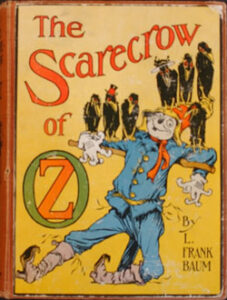
Books: The Scarecrow Of Oz By L. Frank Baum

1915 first edition front cover image © John. R. Neill and is in the Public Domain via Wikipedia

About The Scarecrow Of Oz

You can download this book and the thirteen other fantasy books in the Oz series by L. Frank Baum via Project Gutenberg by clicking here.   

The Scarecrow of Oz is the ninth book set in the Land of Oz written by L. Frank Baum.  Published on July 16, 1915, it was Baum’s personal favourite of the Oz books and tells of Cap’n Bill and Trot journeying to Oz and, with the help of the Scarecrow, overthrowing the cruel King Krewl of Jinxland.  Cap’n Bill and Trot (Mayre Griffiths) had previously appeared in two other novels by Baum, The Sea Fairies and Sky Island.

Background

The novel is dedicated to The Uplifters of Los Angeles. The Lofty and Exalted Order of Uplifters, a select subgroup of the elite Los Angeles Athletic Club, was a social and fraternal organization of prominent southern California businessmen and public figures.  Baum had been active in the group since he first moved to Los Angeles in 1909 and served among the Excelsiors, the group’s governing board.  He also wrote and acted in their shows and he played the bass drum in their band.

A small group of Uplifters were the key investors in The Oz Film Manufacturing Company, organized to make movies of Baum books and stories.  The investors put up $100,000; Baum was named president and received a block of stock in the company in payment for the cinema rights to his works.  The company’s first project was a film of The Patchwork Girl of Oz; and its second project, released in October 1914, was His Majesty, the Scarecrow of Oz, produced at a cost of $23,500, and with a cast (according to the not-always factually reliable Baum) of 130.

Baum hoped that the movie would be a success, and provide a big publicity boost to the Scarecrow novel to follow in 1915.  Things did not quite work out as the optimistic author hoped; the film did not earn enough to cover its costs.  The first edition of the novel sold around 14,300 copies, only a couple hundred more than its predecessor, Tik-Tok of Oz—though in the long run, The Scarecrow of Oz would be one of the more popular instalments in the Oz series.

Like Tik-Tok, Scarecrow contains a significant romantic element—the Rose Princess and Private Files in the former, and Gloria and Pon in the latter—that was not typical of the earlier Oz books.  Perhaps this was a factor in the books’ limited reception.  In adapting his children’s stories for stage and film versions, Baum had to compromise between appealing to children and to adults.  His films suffered with audiences because of this conflict in audience expectation.  Perhaps this confusion affected the sales of the books as well, to some degree.

Although the journey of an American child to Oz had long been a favourite plot for Baum, this work represented its last appearance: no more children would be inducted into Oz for the duration of his work on the series

The Ork, voiced by Peter MacNicol, appeared in an episode of The Oz Kids.

The Plot

SPOILER ALERT: Skip this bit if you haven’t read the book and are planning to do so!

Cap’n Bill, a sailor with a wooden peg-leg, and his friend, a little girl named Trot, set out from California on a calm day for a short ride in their rowboat.  A freak whirlpool capsizes their boat and pulls them underwater, where they are carried by mermaids (referred to but not seen) to a cave.  They are soon joined by a flying creature called an Ork.  Passing through a dark tunnel out of the cave, the three arrive at an island inhabited by a grim man calling himself Pessim the Observer.  Cap’n Bill and Trot reduce their size by eating magic shrinking-berries, and the Ork carries them away from the island to the land of Mo, where they eat another type of magic berries and resume their normal size.

They meet the Bumpy Man, who specializes in serving sugar and molasses and has some of their appearance too.  After dining on Mo rain (lemonade) and Mo snow (popcorn), they run into Button-Bright, the boy from The Road to Oz who has gotten lost again.  Cap’n Bill calls down some of the native birds (who, like all birds in fairy countries, can talk back) and offers them the growing berries to make them large enough to carry himself, Trot, and Button-Bright to the land of Oz.  When they make it across the desert, Button-Bright, Cap’n Bill, and Trot are set down in a field and the Ork leaves them to find his own country, which he got lost from on a routine flight.

The place Button-Bright, Cap’n Bill, and Trot have arrived in, Jinxland, is cut off from the rest of Oz by a range of high mountains and a bottomless crevice.  The kingdom has had a turbulent recent history.  The rightful king of Jinxland, King Kynd, was removed by his prime minister Phearse, who was in turn removed by his prime minister Krewl who now rules over the land.  An unpleasant but wealthy citizen named Googly-Goo seeks to marry King Kynd’s daughter, Princess Gloria; however, she is in love with Pon, the current gardener’s boy, who is the son of the first usurper Phearse. King Krewl and Googly-Goo hire a witch named Blinkie to freeze Gloria’s heart so that she will no longer love Pon.  Cap’n Bill happens on this plot, and to keep him from interfering, Blinkie turns him into a grasshopper.  She then freezes Gloria’s heart. Googly-Goo proposes to her, but now that her heart is frozen, she does not love anyone at all, including Googly-Goo, whose proposal she scornfully declines.

The Scarecrow is at Glinda’s palace in the Quadling Country and learns about these events from reading Glinda’s Great Book of Records, a magical volume that transcribes every event in the world at the instant it happens.  The Scarecrow wants to help Cap’n Bill, Button-Bright, and Trot, and Glinda sends him to Jinxland with some of her magic to aid him.  The Scarecrow travels to Jinxland and joins forces with Trot, Cap’n Bill (who is still a grasshopper), and the Ork, who flies off to his homeland for reinforcements.  The Scarecrow attempts to depose Krewl and is captured, with Googly-Goo suggesting the Scarecrow be burned, but then the Ork arrives just in time with fifty other Orks, who attack the Jinxlanders and turn the tables on Krewl.  The victorious party then arrives at Blinkie’s and makes her undo her magic on Cap’n Bill and Princess Gloria by using a magic powder to shrink her in size.  When she has undone her evil spells, the Scarecrow stops Blinkie’s shrinking, but she remains at a small size and loses all her magic powers.

Gloria takes the throne of Jinxland and elevates Pon to be her royal consort, and the Scarecrow, Button-Bright, Cap’n Bill, Trot, and the Orks return to the Emerald City for a celebration.

Read more about The The Scarecrow Of Oz here.

The above articles were sourced from Wikipedia and are subject to change.   

Blog Posts

Notes And Links

The 1915 first edition front cover image shown at the top of this page is © John R. Neill and is in the Public Domain via Wikipedia.

Project Gutenberg – Project Gutenberg is an online library of free e-books and was the first provider of free electronic books.  Michael Hart, the founder of Project Gutenberg, invented e-books in 1971 and his memory continues to inspire the creation of them and related content today.

The Wonderful Wiki of Oz – Official website.  A wonderful and welcoming encyclopedia of all things Oz that anyone can edit or contribute Oz-related information and Oz facts to enjoy.

The Oz Archive on Facebook – Archiving and celebrating the legacy of Oz.

The Oz Archive on Twitter – Archiving and celebrating the legacy of Oz.

The Oz Archive on Instagram – Archiving and celebrating the legacy of Oz.

The Oz Archive on TikTok – Archiving and celebrating the legacy of Oz.  
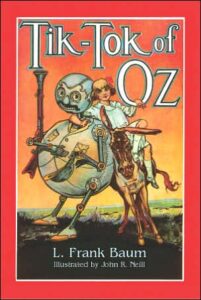
Books: Tik-Tok Of Oz By L. Frank Baum

1914 first edition front cover image © John. R. Neill and is in the Public Domain via Wikipedia

You can download this book and the thirteen other fantasy books in the Oz series by L. Frank Baum via Project Gutenberg by clicking here.   

About Tik-Tok Of Oz

Tik-Tok of Oz is the eighth Land of Oz book written by L. Frank Baum, published on June 19, 1914.  The book has little to do with Tik-Tok and is primarily the quest of the Shaggy Man (introduced in The Road to Oz) to rescue his brother and his resulting conflict with the Nome King.

The endpapers of the first edition held maps: one of Oz itself, and one of the continents on which Oz and its neighbouring countries belonged.  These were the first maps printed of Oz.

Commentary

In 1913, Baum’s long-delayed and heavily-adapted stage version of Ozma of Oz, re-titled The Tik-Tok Man of Oz, was produced in Los Angeles, with moderate success.  The music was composed by Louis F. Gottschalk, Baum’s favourite composer, who would also be the dedicatee of the Tik-Tok novel a year later.  Baum adapted some of the material from the stage production for the novel.  As in Ozma of Oz, a shipwreck precipitates the heroine into her adventure, and the quest of the Shaggy Man for his brother, who was named Wiggy in the play, is another attempt to rescue a prisoner of the Nome King.  The picking of Ozga is a motif found in Dorothy and the Wizard in Oz.

The book has several continuity errors with earlier books in the series, particularly The Road to Oz.  Whereas Polychrome met the Shaggy Man in that book, this point is neglected by Baum in Tik-Tok.  Also, whereas the Shaggy Man merely needs to carry the Love Magnet on his person for it to work in The Road to Oz, in this book it is necessary for him to remove it from his pocket and physically show it to those he wishes to love him.

Tik-Tok of Oz was more modestly produced than earlier Oz books, with twelve colour plates instead of sixteen.  Its first edition sold a little over 14,000 copies — a respectable figure, but 3,000 fewer than The Patchwork Girl of Oz had done the year before.  Baum’s books were facing stiff new competition — from his own earlier books.  The reprint house M. A. Donohue & Co. had purchased the rights to several early Baum works from Bobbs-Merrill, and was marketing cut-rate editions.  People were less willing to pay the usual $1.25 for a new Oz book when the original Wizard of Oz was selling for $0.35.

Tik-Tok of Oz also contained the first map of Oz and its neighbouring countries, which proved to be a very popular feature.  Unfortunately for the principle of consistency, this initial map of Oz was drawn backwards, with the Munchkin Country in the left and the Winkie Country in the right, with the compass rose reversed to keep the Munchkin Country in the east and the Winkie Country in the west.  Subsequent maps from the publisher corrected the compass rose, but not the locations.  This may explain why Ruth Plumly Thompson reversed the locations from Baum’s — in her books the Munchkin country is west; and her Winkies East (see for instance Ozoplaning with the Wizard of Oz but also in several other books).  James E. Haff and Dick Martin ultimately corrected these in new maps designed for The International Wizard of Oz Club.  A squarish map that largely follows Haff and Martin appears in The Dictionary of Imaginary Places.  The presence of a Davy Jones Island on this map indicates that the inclusion of the character Davy Jones, a wooden whale, as a decoration on the map, was misinterpreted by the book’s recartographers, as no such place appears in any Oz books up to that book’s publication.

The 1993 novel Queen Ann in Oz is a sequel to Tik-Tok of Oz.

The Plot

SPOILER ALERT: Skip this bit if you haven’t read the book and are planning to do so!

Queen Ann Soforth of Oogaboo, a small monarchy separated from the rest of Oz’s Winkie Country, sets out to raise an army to conquer Oz.  Seventeen men eventually make up the Army of Oogaboo (sixteen officers and one private); they march out of their valley. Glinda the Good, protector of Oz, magically rearranges the path through the mountains and Queen Ann and her army march out of Oz into a low-lying, befogged country.

Betsy Bobbin, a girl who is a year older than Dorothy Gale, and her loyal mule Hank have washed ashore during a storm.  They arrive at a large greenhouse that is the domain of the Rose Kingdom, where the roses tell them that no strangers are allowed.  Just as the Royal Gardener (apparently the only human allowed in this flowery kingdom) is about to pass a sentence on Betsy and Hank, the Shaggy Man falls through the greenhouse’s roof, and charms the Gardener into sparing all of their lives with his Love Magnet.  The flowers, not having hearts, are unaffected by the Magnet, and force the travellers to leave, taking with them the newly plucked Rose Princess Ozga, a cousin of Ozma, the ruler of Oz.

The Shaggy Man relates how Ozma sent him here via the Magic Belt because he wanted to find his brother, who went digging underground in Colorado and disappeared.  He surmised that the Nome King, ruler of the underground Nome Kingdom, captured him.  They meet up with Polychrome the Rainbow’s Daughter, and they rescue Tik-Tok from the well where the Nome King had tossed him.  Once Tik-Tok is wound up, he accompanies Betsy, Hank, the Shaggy Man, Ozga, and Polychrome to their chance encounter with Queen Ann and her army.  In a rage, Queen Ann orders them to be seized and bound, but Private Files — the only private in this army of generals, colonels, and majors — refuses to bind innocent girls.  He resigns his commission on the spot.  When Queen Ann learns of the riches to be found in the Nome King’s underground kingdom, she calms down and accepts the services of Tik-Tok as her new private.

The Nome King (who has recovered from having drunk the Water of Oblivion in The Emerald City of Oz) is aghast at this group coming toward his underground kingdom.  Since no one can be killed in Oz, the Nome King seeks to discourage them, first by taking them through the Rubber Country, and then disposing of them by dropping them through the Hollow Tube, a conduit leading to the other side of the world.

There the party enters the jurisdiction of the immortal called Tittiti-Hoochoo, the Great Jinjin, who vows to punish the Nome King for using the Hollow Tube.  He sends Tik-Tok and the others back with his Instrument of Vengeance, a lackadaisical dragon named Quox.  Quox and his riders bound from the other end of the Tube into an army of Nomes and narrowly evade them.  Queen Ann and the Army of Oogaboo fall into the Slimy Cave when they enter the Nome Kingdom; the Shaggy Man and his companions are captured by the Nome King.  Ann and her army escape the cave while the Nome King amuses himself by transforming his captives into various objects.  Quox arrives, bursting through the main cavern.  The Nome King sees the ribbon around Quox’s neck and forgets all the magic he ever knew.  The Nome King is driven out of his kingdom when Quox releases six eggs from the padlock around his neck.  The eggs, poisonous to Nomes, follow the Nome King to the Earth’s surface and confine him there.

The new Nome King, the former chief steward Kaliko, vows to help the Shaggy Man find his brother, whom he knows is in the Metal Forest.  The Shaggy Man meets his brother in the centre of the Forest, but the brother was cursed with a charm of ugliness by the former Nome King.  A kiss will break a charm.  First Betsy, a mortal maid, tries to undo the spell, then Ozga, a mortal maid who was once a fairy.  Finally, it’s the fairy Polychrome’s kiss that restores the Shaggy Man’s brother to his former self.

There is a banquet of rejoicing in the Nome Kingdom, and the former Nome King earnestly pleads to be let back into the underground lair (“No Nome can really be happy except underground”), which Kaliko allows on condition that he behave himself.  Once on the surface again, Polychrome ascends her rainbow and Ozma uses the magic belt to bring Tik-Tok back to Oz and send Queen Ann, the Army of Oogaboo, Files, and Ozga back to Oogaboo.  The Shaggy Man only agrees to return when his brother, Betsy, and Hank are allowed to enter Oz too.

Upon being welcomed in Oz, Hank, the Cowardly Lion, the Hungry Tiger, and the Saw-Horse debate who is the best mistress — Betsy (for Hank), Dorothy (for both the Lion and the Tiger), or Ozma (for the Saw-Horse).  The three girls are listening and laugh at a silly quarrel, which the animals realize is silly too.  In addition, Dorothy finally gets to hear her dog Toto speak — for all animals can in the Land of Oz.  Finally, Betsy decides to stay in Oz forever.

Read more about The Tik-Tok Of Oz here.

The above articles were sourced from Wikipedia and are subject to change.   

Blog Posts

Notes And Links

The 1914 first edition front cover image shown at the top of this page is © John R. Neill and is in the Public Domain via Wikipedia.

Project Gutenberg – Project Gutenberg is an online library of free e-books and was the first provider of free electronic books.  Michael Hart, the founder of Project Gutenberg, invented e-books in 1971 and his memory continues to inspire the creation of them and related content today.

The Wonderful Wiki of Oz – Official website.  A wonderful and welcoming encyclopedia of all things Oz that anyone can edit or contribute Oz-related information and Oz facts to enjoy.

The Oz Archive on Facebook – Archiving and celebrating the legacy of Oz.
The Oz Archive on Twitter – Archiving and celebrating the legacy of Oz.
The Oz Archive on Instagram – Archiving and celebrating the legacy of Oz.

The Oz Archive on TikTok – Archiving and celebrating the legacy of Oz.