
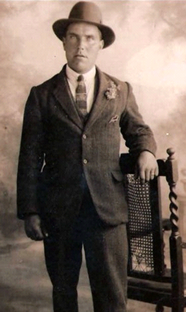
Please note this page has been slightly edited for website purposes from the original booklet and is presented to you with kind permission from Jeffery.
The original booklet is available to download and as an e-book at the bottom of this page in the Links section and will appear slightly different to what you see here but the content is the same.
In Jeffrey’s own words:
“The Allcott family were typical of the many thousands of people who once turned to the canals for their livelihood during the middle and latter part of the Victorian era. Times were especially hard for the poorest people in society, often moving about in order to find better employment or affordable accommodation, whilst the terrifying spectre of the workhouse loomed ever present should they fail to find both. Not surprising then that the canals should offer a viable alternative to life on land, with their boat providing a ready source of income, and a roof over their head. For most people boats were too expensive to have built, so they turned to well established canal carriers such as Pickford’s, Fellows Morton & Clayton and coal merchants such as Samuel Barlow for employment. Most of the canals by now had been absorbed by railway companies, such as the Shropshire Union Canal and the Trent & Mersey. By the time the Allcott’s entered life on the waterways, the great heyday of canal building was over, but they continued, even into the latter years of the 20th century, to play a key role in the economy of the country.”
Jeffrey is my Cousin via my Mom’s long, lost Brother and it was by chance we found each other, call it fate, call it whatever but everything happens for a reason.
On October 21st, 2021 I decided to join the Canal World forum in the hope I could find anything about the Allcott’s and the long boating history that goes with them, stretching back to the 1800’s.
On November 10th, 2021 Jeffrey messaged me believing we were related via his Dad, Oliver Allcott and, I was happy he did and to confirm that we were indeed related. We have been in touch since.
For a long time, Mom always wondered how my Uncle Oliver was doing in life and would have loved to know all that I know now when she was alive but, sadly, that was never to be. I did, however, get to show her family photos and documents that I came by in her final months, before me and Jeffrey first got in touch.
Jeffrey didn’t do this booklet for monetary gain, just as a family keepsake and it was never intended for publication. I, on the other hand, think more people should see the hard work he has put into it and, hopefully, more information can subsequently come from it in the not-so-distant future. If you think you are related to anyone mentioned in this post then please contact me here.
Regardless if you are family or not, if you are a lover of history and canal life then you will enjoy this book as much as I did.
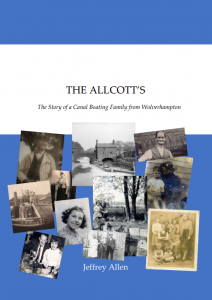
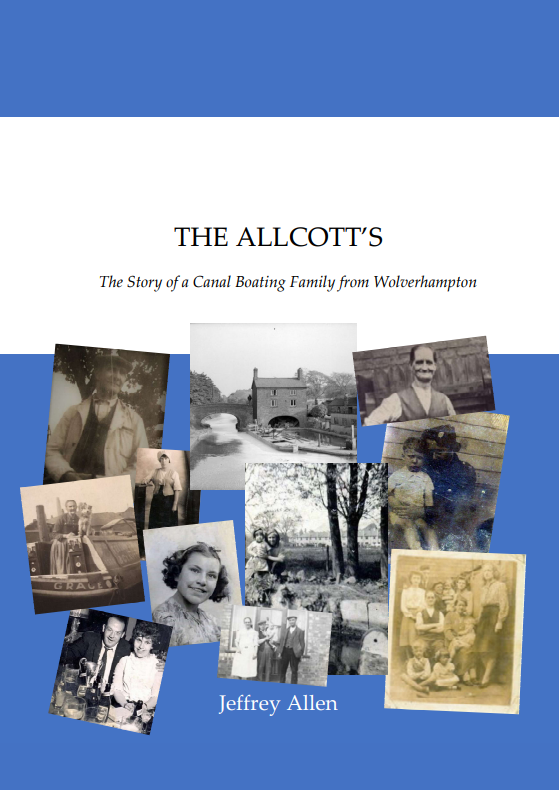
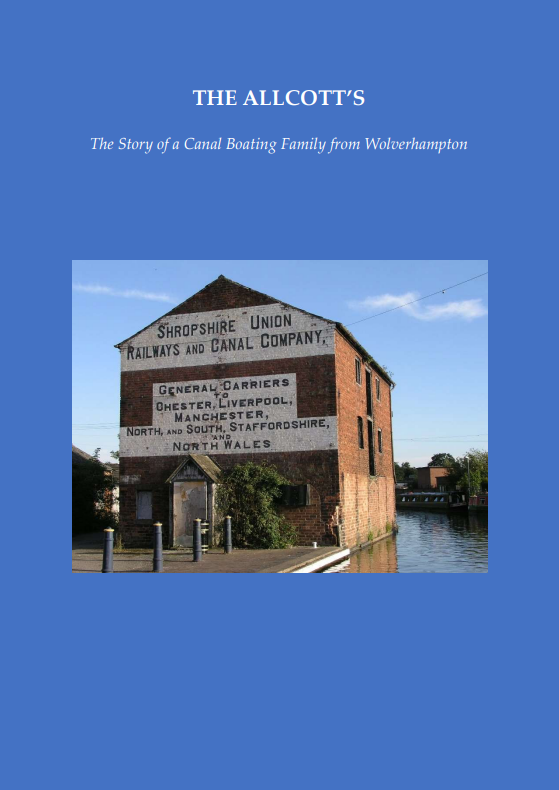
The Story of a Canal Boating Family from Wolverhampton.
A special thank you to my cousins Frank Parker and Janet Terry for supplying me with all the information on the Allcott’s. Without their kindness and love of family this booklet would not have been possible.
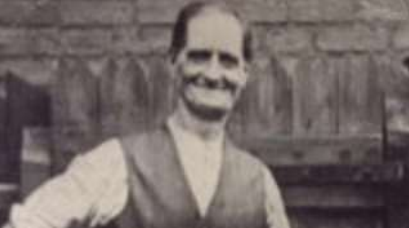
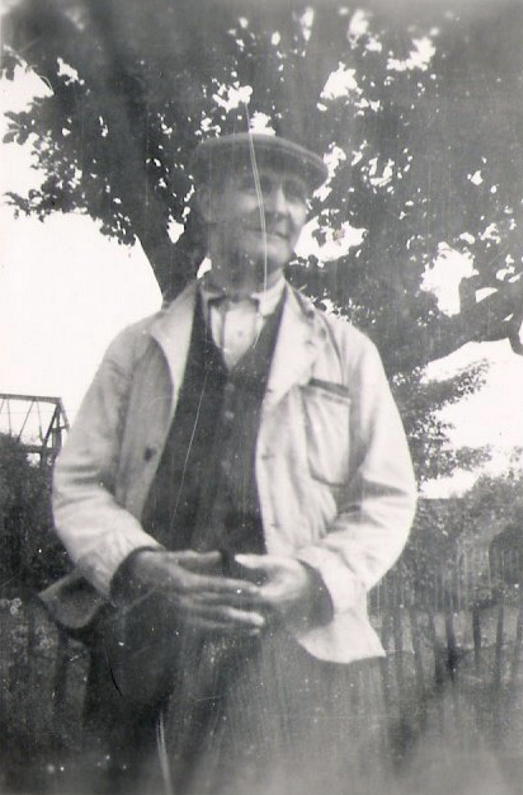
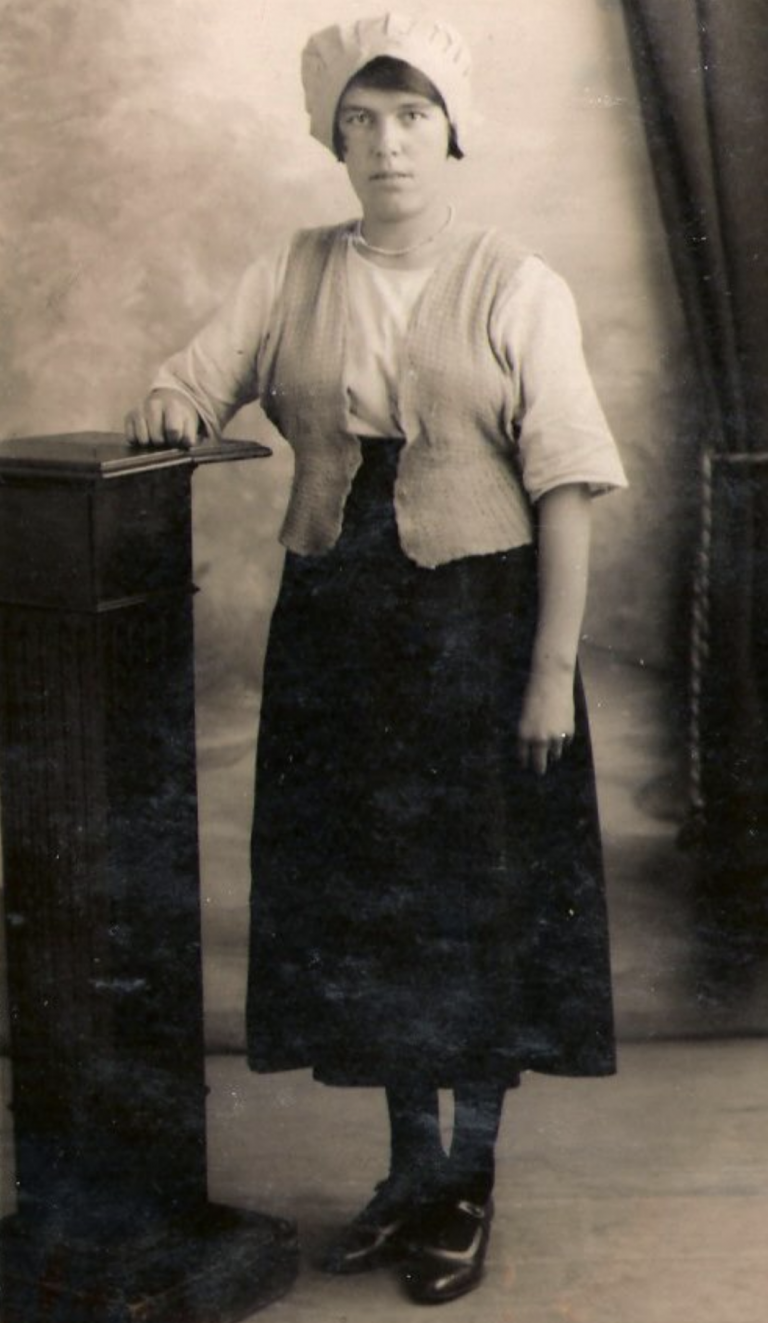
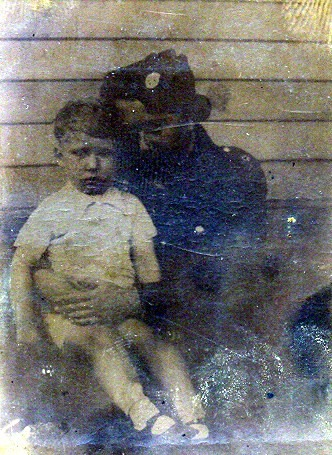
In memory of my grandfather Oliver Allcott, My grandmother Beatrice Violet Allcott, Their daughter Beatrice Mary Allcott, my aunt, And their son, Oliver Allcott, my father.
The Allcott family were typical of the many thousands of people who once turned to the canals for their livelihood during the middle and latter part of the Victorian era. Times were especially hard for the poorest people in society, often moving about in order to find better employment or affordable accommodation, whilst the terrifying spectre of the workhouse loomed ever present should they fail to find both. Not surprising then that the canals should offer a viable alternative to life on land, with their boat providing a ready source of income and a roof over their head. For most people boats were too expensive to have built, so they turned to well-established canal carriers such as Pickford’s, Fellows Morton & Clayton and coal merchants such as Samuel Barlow for employment. Most of the canals by now had been absorbed by railway companies, such as the Shropshire Union Canal and the Trent & Mersey. By the time the Allcott’s entered life on the waterways, the great heyday of canal building was over, but they continued, even into the latter years of the 20th century, to play a key role in the economy of the country.
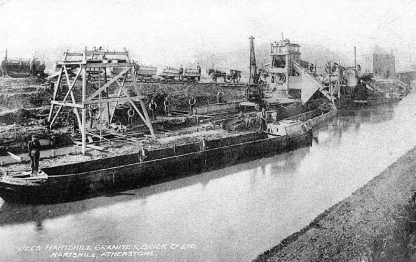
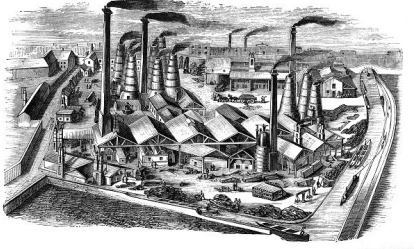
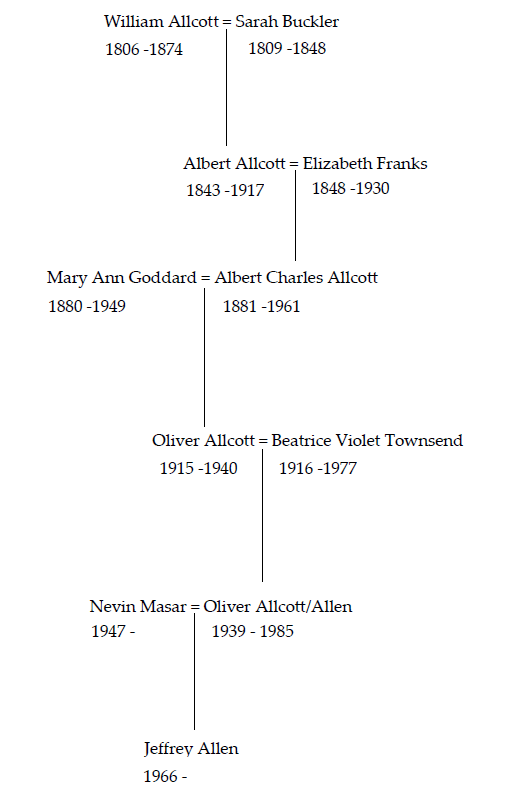
Allcott is a surname that existed in Nuneaton, Bedworth, Atherstone and Caldecote since the 17th century. Allcott derives from an Old English word eauld meaning old, and cot meaning a shelter or cottage; hence ‘a dweller in an old cottage.’ The name has its highest frequency in Herefordshire and the West Midlands. In Nuneaton for example, it first appears in records of the Quarter Sessions and Indictment Books for the years 1631-96 and the Hearth Tax of 1662. Albert Allcott was born at Hartshill, North Warwickshire, on the 17th of May 1843 to William and Sarah Allcott. Sarah (nee Buckler) was born at Bedworth on the 1st of October 1809. William was a labourer, whilst Sarah looked after their six children: Thomas (b. 20 March 1832), William (born June 15th 1833), David (born 1836), Hannah (born 1837), Sarah (born March 25th 1839) and Eliza (born 1841). Hartshill is a large village and civil parish in North Warwickshire. It borders the districts of Bedworth and Nuneaton, which is two and a half miles northwest of the village. The combined population of Bedworth and Nuneaton by 1863 was in excess of 8,600 people, and many of those were employed in silk ribbon weaving. Hartshill also borders Ansley to the south-west, where there was a coal mining colliery established in 1874; Mancetter to the north-west, Caldecote to the east, and the parish of Witherley in Leicestershire to the north-east. The market town of Atherstone is three and a half miles to the northwest. Hartshill had good communications with the rest of Warwickshire and neighbouring counties. There was a canal wharf on the Coventry Canal, (14 miles from the Coventry Basin), which served the Jees Granite & Brick Co. Ltd., which also had its own quarry. William Allcott may have worked for this company as a labourer. There was also a railway, part of the Coventry and Nuneaton branch line, with a signal box and sidings.
Not long after Albert’s birth, the family moved to Foleshill, where Sarah died in the later part of 1848 aged 39. By the mid-19th century Coventry was the centre of the ribbon trade, and at one time employed an estimated 30,000 workers, using steam-powered looms as part of a large-scale manufacturing process. William Allcott Snr. remarried two years later on the 22nd of June 1850 to Rhoda Ball from Nuneaton. The 1851 Census shows the family still living in Foleshill. William, and his son William Jnr., now aged 16, were both employed as coal miners, whilst Rhoda was a hand loom weaver, and Hannah, aged 11, was employed as a silk winder. Ten years later, both Rhoda, and her step-son Albert, now aged 18, were employed as silk weavers, whilst William was working as a day labourer. William and Rhoda had eleven children together, three boys, Henry (born June 5th 1852), Frederick (born February 28th 1858), and Joseph (born October 28th 1867); and eight girls, Emma (born September 23rd 1849), Matilda (born November 23rd 1854), Ellen (born May 8th 1856), Mary (born February 3rd 1859); all these children were born at Bedworth. Sometime after the birth of Mary in 1859, the family moved to Nuneaton, where Rose (17th of May 1863) was born, along with Sophia (22nd of May 1872) and Rhoda (31st of July 1869). Sadly, little Fanny Allcott (born 1861, Nuneaton), died when she was just three years old in 1864. Rhoda passed away in 1873 aged 47, and a year later William died aged 68. At least four of their youngest children, Rose, Sophia, Joseph and Rhoda, would not have been old enough to support themselves without their parents or older siblings.
On the 26th of March 1877 Albert Allcott, now in his mid-thirties, married Elizabeth Franks at the parish church of St Matthew, Lower Horseley Fields, Wolverhampton. His marriage certificate gives his occupation as a labourer. He may have worked for the Minerva Iron & Steel Company founded in 1857 by Isaac Jenks, who owned the Beaver Works at Lower Horseley Fields. The company exported 80% of the UK’s steel to America and had 21 puddling furnaces, 4 mills, and several forges. At one time the canal carriers Pickford’s had a wharf directly opposite the steel works at Horseley Fields.
But just four years later at the birth of their son, Albert Charles Allcott, (at Canal Street, in the town of Coseley, Wolverhampton), Albert Snr. is now a ‘boatman.’ Albert Charles was christened on the 8th of January 1882 at St Mary’s Church, Wolverhampton.
Wolverhampton was particularly noted for its iron manufacture, consisting of locks, hinges, buckles, corkscrews and japanned ware; a type of lacquer similar to shellack polish used by furniture makers. The technique of applying a heavy black lacquer originated from India, China and Japan, where it was used to glaze pottery, but in Europe, the technique was extended to small items of metal.
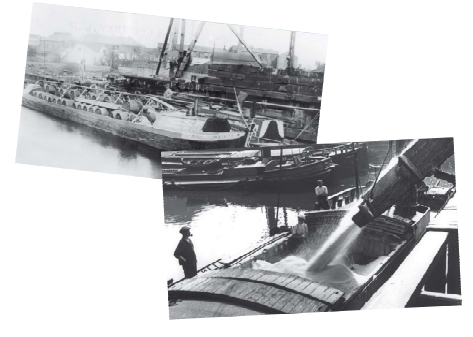
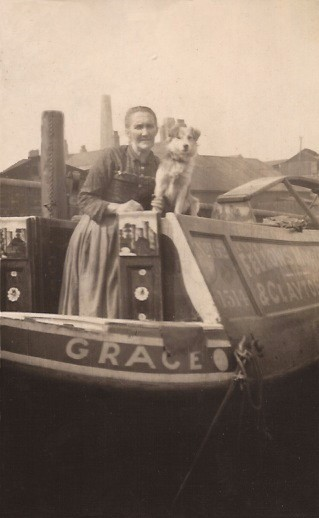
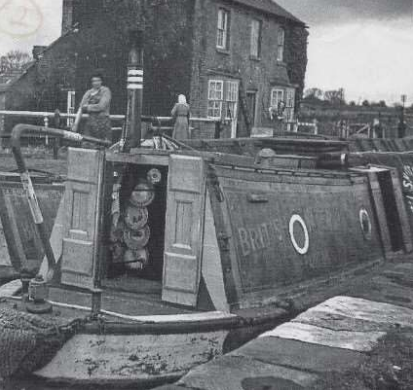
Trade directories from the first half of the 19th century show that there were 20 firms of japanners in Wolverhampton, ranging from small family workshops attached to the proprietor’s home to larger purpose-built factories employing between 250 to 300 workers. It is possible that Albert may have been working as a wharf labourer at Horseley Fields, where there is a junction on the Birmingham Main Line and Wyrley & Essington Canal, eventually leading to his employment as a boatman’s mate. The main advantage for families living and working on narrowboats was that money was saved on renting a house, but living conditions could be challenging. The typical cabin size would be around 8ft long by 6ft wide, and 5ft in height. Space was limited to just a couple of cupboards and a fold-out table. There was no toilet or running water aboard the vessel. Drinking water was obtained from pumps sited along the towpath and at canal wharves. The pay was low and only the skipper of the boat got paid. This meant the whole family helped to get the boat to its destination as quickly as possible, with children running ahead to open and close lock gates. The more cargo a boat could carry, the more the skipper got paid. Typical loads were around 20 – 30 tons for a single boat, but if a second boat was worked, referred to as the ‘butty,’ which was simply pulled along by the lead boat, the skipper would earn twice as much money, as well as having the additional living space of a second cabin.
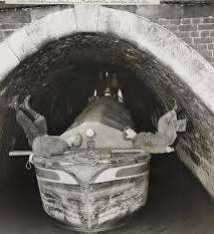
On long hauls, a family might work anything up to 15, sometimes 18 hours a day in order to reduce the journey time. It was also physically demanding for both men and women, with parents sometimes ‘bow-hauling’ a vessel through lock gates, or ‘legging’ a boat through the damp and murky conditions of a tunnel; literally pushing the boat along with their feet as they lay on their backs at the stern.
It was also incredibly dangerous work, especially for young children, with death by drowning all too common. Albert Ledward aged 11 was drowned in the Bridgewater Canal in June 1876. According to the newspaper report in the Runcorn Guardian, the family left Anderton Wharf on a Wednesday afternoon:
“… with a pair of narrow boats laden with salt to be discharged at Runcorn, and when near to Bate’s Bridge at Halton, the deceased [Albert Ledward], who had had his supper, got ashore from the second boat to drive the horse, while his brother, nine years old, who had been driving, got on board to have his supper. It was then half past eleven o’clock, and dark, and as the deceased passed the first boat which he (witness) [the father] was steering, he spoke to him [Albert], and he afterwards heard him speak to the horse. When they got to the Delf Bridge the deceased came and spoke to him, and he told him to go on and get to the horse’s head, and he did. He [the father] heard him speak to the horse, and when it got near to the gas works it “shied” at a light, but again went all right until it got opposite the Soapery, when it turned back, and he (witness) called to it to stop, and it did so. He then called out to the deceased [Albert], and receiving no answer got ashore to look for him. Not seeing him, he began to feel about in the canal with a boat hook, and there being no person near but his wife, she ran for assistance, and soon brought some men and grapples, and in about half an hour the body of the deceased was found in the canal opposite to the Soapery, and near to the spot where the horse turned. He could not tell how the deceased got into the canal, for he neither heard any splash nor a scream.”
The incident at Runcorn happened just five years prior to the birth of Albert and Elizabeth’s first child, Albert Charles. By the time of the 1901 Census, Albert and Elizabeth Allcott had five children living at home, William, Joseph, Minnie, Sarah Jane and Frederick. The registration took place at Calf Heath, Wolverhampton. Calf Heath Bridge and Wharf are on the Staffordshire & Worcestershire Canal, which commences at a junction with the River Severn at Stourport, and terminates at Great Haywood by a junction with the Trent & Mersey Canal, once owned by the North Staffordshire Railway Company. Albert Charles was now 19 years old and living away from home. At the time of the census, he was a canal boatman’s mate aboard the Fancy, moored up at Welshpool Wharf, Montgomeryshire, a Shropshire Union Canal depot. Fancy entered service in September 1899 for the London Midland & Scottish Railway Company, and it was captained by Thomas Hyde, aged 28 from Barbridge in Cheshire. Also on board was Thomas’ wife Mary and their baby girl, Jane. Hyde may have been a relative of John Hyde, an iron merchant at Wrexham who supplied large quantities of pig iron via the Shropshire Union Canal Company to factories in Wolverhampton. The Shropshire Union Railways and Canal Company (SURCCo.) was founded in 1854. The Company owned 23½ miles of railway, which was leased to the North Western Railway Company in perpetuity for a 50% dividend of North Western’s stock. They had offices in London, Birmingham, Albion Wharf at Wolverhampton, and Chester. The main line of its canal navigation was the Shropshire Union Canal from Autherley Junction near Wolverhampton to Ellesmere Port near the Wirral, a total of 66½ miles consisting of 46 locks. Thirty-eight miles into the journey from Autherley is the Nantwich Basin, the birthplace of two of Albert’s sons, William (1884) and Frederick (1895). Both went on to become boatmen.
On the 3rd of August 1903 at Ellesmere Port, Cheshire, Albert Charles married Mary Ann Goddard, aged 19 from Wolverhampton. Interestingly, Mary was born at Horseley Fields, where Albert Allcott Snr., married Elizabeth Franks some 26 years earlier. Mary’s father William was also a boatman, and it is quite possible that William Goddard and Albert Allcott had previously worked together on the same boat or stretch of canal, forming a life-long friendship between the two families, eventually leading to kinship through the marriage of their children. William’s father, Richard Goddard (1822 – 1883), first appears in the records as a boatman in 1851 at Brook Lane Wharf, Newcastle-under-Lyme, Staffordshire. In subsequent census’ he is to be found aboard canal boats Lincoln (1861), Emily (1871), and Birmingham (1881). The Goddard’s may have been instrumental in introducing Albert Allcott Snr. to life on the canals. Ellesmere Port is six miles north of Chester and eleven miles south of Liverpool. In 1905 the Wolverhampton Corrugated Iron Company built a factory at Ellesmere, employing 300 workers and their families from Wolverhampton. The company was seeking to exploit its international trade through nearby ports of Birkenhead and Liverpool. The community that grew up around the factory was affectionately referred to as ‘Wolverham.’ The following year Mary gave birth to their first child, Minnie Allcott, at Ellesmere Port. Canal boat Snap was given as the family residence, and Minnie was delivered by Harriet Didsbury, midwife, living at no. 6 Porters Row, Whitley, a row of Victorian cottages built in 1833 to house canal workers and their families. Snap was a SURCCo. boat working the Shropshire Union Canal. Albert Charles and Mary had three more children, Frederick (1905), Sarah Ann (1908) and Albert (1911). Albert Allcott Snr. was 68 at the time of the 1911 Census. He may have been retired from the boats as his occupation was not recorded. Times may have been hard for the family as Elizabeth was said to be a ‘washerwoman,’ and Sarah Jane, aged 17, was a ‘presser’ for a company manufacturing iron brackets. In those days a typical working-class family budget would have been around 22 shillings a week, with bread, flour and meat alone costing around 8s, more than a third of the household budget. Rent could be anywhere between 3 to 5s a week.
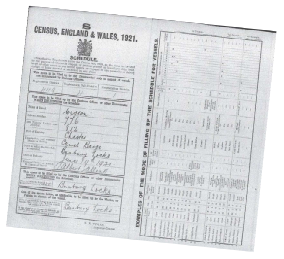
Their youngest son Frederick was 15 at the time of the census and a boatman’s mate aboard the canal boat Jim, moored at Etruria Locks, Stoke on Trent. The master was William Mallard aged 32 and his wife Emma and two children James and Mary. Their niece Elizabeth Clewes aged 18 was the third mate. Jim worked the Trent & Mersey Canal navigation. Fred’s older brother Joseph, aged 24, was a boat hand on a Shropshire Union Canal boat the Flying Fox. Flying Fox was registered on the 13th of June 1899 at Chester, reg. 550, and entered service for the SURCCo. in August 1899 fleet no. 529. As her name suggests, she may well have been a ‘fly-boat.’ Flyboats usually carried smaller loads of high-value merchandise, with a two-man crew working day and night. A fly boat could travel from Ellesmere Port to Birmingham in little more than 36 hours. In its heyday, Pickford’s specialised in the fly-boat trade, with 116 boats and 398 horses. It was an offence enforceable by law not to give their boats right of way at lock gates. By 1925 Joseph was working for the Midlands & Coastal Canal Carriers Ltd., transporting goods between Stoke-on-Trent and Ellesmere Port. He is recorded as being on their boat Mermaid, originally a motor boat registered in Wolverhampton, no. 1118. Its engines were removed in the same year, turning it into a butty. Joseph was also on a MCCC boat called Diamond, first registered in 1922 at Wolverhampton, (no. 1088). Since Albert Allcott Snr. was living in Wolverhampton at the time of the 1911 Census, the Albert Allcott mentioned as master of the Winconsin, must refer to his son Albert Charles. Winconsin was moored at the Anderton Wharf, Burslem, Stoke-on-Trent, working the Trent & Mersey Canal. His son Albert Jnr. was born at Rode Heath, Cheshire, (1911), where the Trent & Mersey runs through the middle of the village. Four years later and Mary Ann gave birth to their fifth child, Oliver Allcott, on the 2nd of June 1915. The family residence was given as canal boat Sutherland, moored at Hay Basin, Broad Street, Wolverhampton. Built by Calder Valley Marine, Sutherland belonged to the Shropshire Union Railways and Canal Company, fleet no. 481, and was ‘gauged’ for the Birmingham Canal Navigations in 1896. When war raged across Europe in 1914, Frederick Allcott enlisted in the 2nd Battalion of the South Staffordshire Regiment, at Wolverhampton. Fred was killed in action at Delville Wood, the Somme, after a German counter attack on the 28th of July 1916. He was just 21. His personal effects were returned to his family on the 4th of November 1916, along with £5 6d to his father, Albert Allcott Snr. On the 21st of October 1919, his mother Elizabeth Allcott received a further payment from the army of £9. Fred’s name can be found on the Common Wealth War Graves Commission memorial at Thiepval, the Somme, and on the Roll of Honour of the London and North Western Railwaymen; because he had been employed as a boatman at Wolverhampton delivering coal to the railways. Six months after the loss of his son, Albert snr., the first Allcott to have started work on the narrowboats, died on the 13th of February 1917, at no. 2 Southampton Street, Wolverhampton; Elizabeth, his dutiful wife of 40 years, was at his bedside. By the time of the 1921 Census, held on the 19th of June, Albert Charles was skipper of the canal boat Widgeon, moored at Bunbury Locks, on the Shropshire Union Canal. Originally built for the Chester & Liverpool Lighterage Co. Ltd., Widgeon joined the SURCCo. in March 1917, fleet no. 776. It was registered at Chester on the 10th of April 1917, registration no. 812.
Two years after the census, on the 27th of October 1923, Albert Charles’ eldest daughter Minnie, aged 19, married John Pountney, himself a boatman aged 32. Canal boat Cardigan was given as the residence of both Minnie and John on their marriage certificate. Cardigan was a Fellows Morton & Clayton boat, fleet no. 42, built at Uxbridge Docks (West London), and entered service in January 1906, registration no. Uxbridge 401.
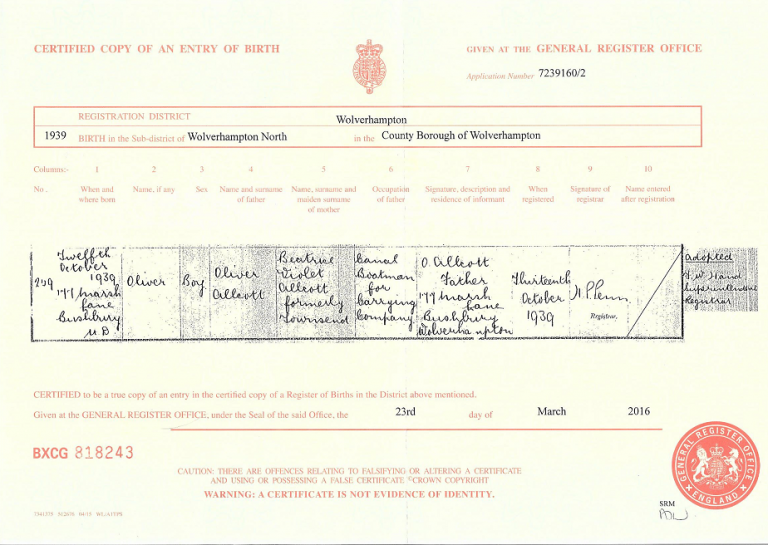
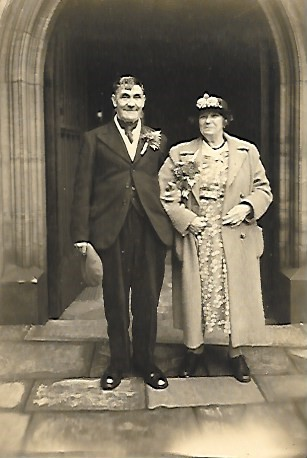
Thirteen years after the death of her husband Albert, Elizabeth Allcott died at no. 9 Barker Street, Wolverhampton, on the 10th of January 1930, aged 73. She never got to see the marriage of her son Oliver to Beatrice Violet Townsend on the 8th of April 1935. They were married at the parish church of St Chads, Staffordshire, in the presence of Ernest Williams and Sarah Ann Williams. Their address was given as 120, Jeffcock Road, Wolverhampton, but as Oliver was, like his father and grandfather before him, a boatman, it is likely that his boat was moored nearby on the Staffordshire & Worcestershire Canal, and that Jeffcock Road was a temporary residence used for the purposes of official registration. On the 28th of January 1936, Beatrice gave birth to the couple’s first child, Beatrice Mary Allcott. The address was given as no. 19, Purcel Road, Low Hill, Wolverhampton. Three years later Beatrice gave birth to a son, Oliver Allcott Jnr., this time at 177 Marsh Lane, Bushbury, Wolverhampton, on the 12th of October 1939.
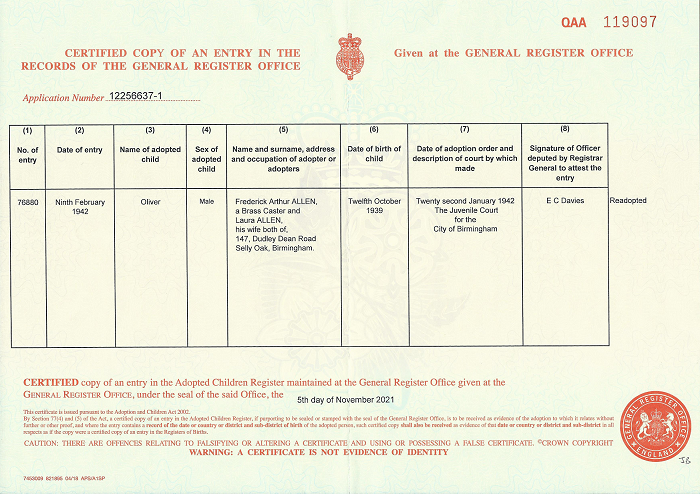
By now Oliver Snr. was seriously ill with tuberculosis, and little more than five months after the birth of his son, he passed away on the 9th of February 1940 aged just 24. He died at 376 Wolverhampton Road, Heath Town, a pseudonymous address of the former New Cross Workhouse, which became a hospital in 1930. Although officially a hospital, it still performed some of the services of the former workhouse. The death certificate gives Oliver’s occupation as ‘a Wharf Labourer for Coal Merchant,’ possibly Samuel Barlow. Two years after the death of his father, Oliver Allcott Jnr. was adopted by Frederick and Laura Allen on the 22nd of January 1942. Laura (nee Townsend) was the older sister of Beatrice Violet Allcott, so the two-year-old Oliver was being adopted by his own aunt. The couple were living at no. 147, Durley Dean Road, Selly Oak, Birmingham.
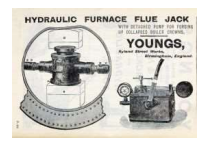
Unlike the Allcott’s, the Townsend family were involved in Birmingham’s enormous metal industry, with the family home, 37 Tower Street, not far from the famous Jewellery Quarter. In 1921, Laura was a ‘capstan lathe’ operator, putting threads on metal items usually made of brass. She may have worked for Young’s Ltd at their Ryland Street works, Edgbaston, where her younger brother Albert, aged 14, was employed as an errand boy.
Although the canal boating tradition had come to an end for one branch of the Allcott family, it continued for another. During the Second World War, William Allcott, the eldest son of Albert and Elizabeth Allcott, was working for the Grand Union Canal Carrying Company, transporting cargoes such as coal, steel, timber and grain between London and the Midlands.
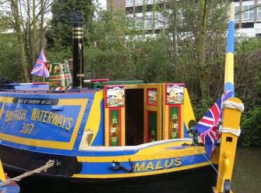
According to a manning list of paired boats for September 1944, William was the skipper of Arcas and Malus. Arcas was built by Harland and Wolff Ltd on the 16th of November 1935, and registered at Brentford, West London, on the 18th of December 1935, no. 558. She was gauged for the Grand Union Canal on the 20th of October 1936, gauge no. 12582. Malus (the butty) was built by W. J. Yarwoods & Sons of Northwich in September 1935. It was delivered on the 4th of October 1935, fleet no. 307 and registered at Coventry no. 535. She was gauged on the Grand Union Canal on the 24th of October 1936, and given the gauge no. 12412. Arcas and Malus were part of the company’s expansion program of its Southern Division during the 1930’s and 1940’s.
William’s family lived near Stowe Hill Wharf, Heyford Lane, in the village of Weedon Bec, Northamptonshire, about 6 miles south of the market town of Daventry.
The Second World War brought with it hazards all of its own, with thousands of German bombs raining down on Birmingham in Hitler’s effort to destroy Britain’s manufacturing base. During the war, Eliza Stubbs (nee Goddard) and her husband James were working for Fellows Morton & Clayton and moored up in Birmingham. Eliza was the sister-in-law of Albert Charles Allcott. Albert and his future wife Mary Ann Goddard, (Eliza’s sister), were witnesses to the wedding of Eliza and James at Ellesmere Port on the 25th of May 1903. “We were in our barge during an air-raid,” recalled Eliza. “A German bomb crashed through a warehouse roof right on to our boat. The bomb cut the boat clean in half and we were trapped in the cabin. Our son, Jim, with some other people, released us just in time.” Eliza and James were one of the 622 families then living and working on the waterways, helping to transport an estimated 12 million tonnes of essential goods a year on Britain’s canals.
A year after nationalisation took place in Britain, Albert Charles Allcott remarried in 1949 following the death of Mary Ann. His bride was Sarah Emma Shaw (nee Stubbs), sister of James Herbert Stubbs, who was also Albert Charles’ best man at the wedding. The reception was held at no. 3, Canal Terrace, Middlewich, Cheshire, the family home of Eliza and James.
The Middlewich Branch of the Shropshire Union Canal runs through the town before joining the Trent & Mersey Canal at Wardle Lock. In 1826 authorization had been given for the section of canal at Middlewich to join with the Trent & Mersey, linking Chester with the potteries in the Midlands. The Great Heywood Junction is 19 miles from Stoke-On-Trent, which connects to the Staffordshire & Worcestershire Canal with Wolverhampton. Albert died on the 18th of December 1961 at 175 Marsh Lane, Wolverhampton, aged 80. The boating tradition was carried on in the next generation of the Allcott’s. According to an article in Narrowboat Magazine, ‘British Waterways Boating’ (Spring 2018), two boats, Purton and Capella, were worked by Joseph and Lucy Allcott in the 1950’s and 1960’s on the Grand Union Canal. Joseph Allcott was born at Wolverhampton in 1927, the son of William Allcott (b. 1884). Lucy Elizabeth Jackson was five years older, being born at Northampton in 1922. They married at Brixworth, Northamptonshire on the 24th of September 1951. Along with her father Thomas Jackson, Lucy was already employed by British Waterways, a ‘boatwoman’ in her own right.
Purton was built by W.J. Yarwoods & Sons Ltd. with a National DM2 engine and joined the GUCCCo. in September 1936 fleet no. 162. She was registered at Rickmansworth on the 20th of October 1936, registration no. 104, and gauged for the Grand Union Canal on the 7th of November 1936, gauge no. 12614.
Capella (the butty) was built by Harland & Wolf Ltd. and joined the GUCCCo. in December 1935, fleet no. 247. She was registered at Brentford on the 18th of December 1935, registration no. 572, and gauged for the Grand Union Canal in December 1935, gauge no. 12549.
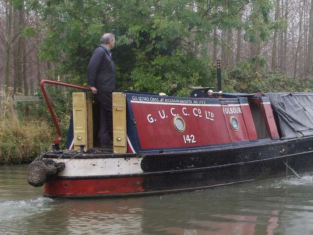
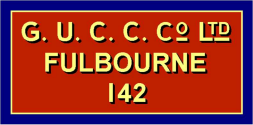
Sometime during the 1960’s British Waterways gave Purton a new Lister HA2 engine, and shortened its length to approximately 56ft. She was eventually sold off in 1987 when the transportation of goods by canal boat finally came to an end. Joseph was the steerer of Purton from January 1951 to August 1956, but not always with Capella as the butty; others included Ruislip, Asla and Hadfield. According to the Birmingham Public Health Department records, by March 1957 Joseph was steering a 72ft motor boat called Fulbourne, with Chesham as its butty. Fulbourne was built by Harland & Wolf at Woolwich and was completed in March 1937. She is a steel-hulled motor boat in the ‘Town Class’ of narrow boats, so named because twenty-four of them were named after British towns. Fulbourne was registered at Rickmansworth and gauged for the Grand Union Canal, no. 12740. She remained in the GUCCCo. fleet until nationalisation in 1947. British Waterways fleet lists from May 1958 to January 1959 show that Joseph and Lucy were still on Fulbourne, with Halton as the butty. During his time on Fulbourne, Joseph carried coal to Apsley, Colne Valley Sewage Works, Croxley and Nash Mill. They delivered grain to Wellingborough on the River Nene, took spelt from Brentford to Birmingham, and lime juice from Limehouse to Boxmoor. On one occasion they took the boat to Weston Point on the Manchester Ship Canal to unload a ship, but since the dockers were on strike at the time, they were turned away and had to pick up an alternative cargo elsewhere. Joseph died aged 61 on the 4th of December 1988. Lucy passed away eight years later in the June quarter of 1996.
Of the many newspaper reports throughout the canal network from 1881 to 1936, the Allcott’s feature in none of them. Whilst some boaters were often in trouble with the law for theft, drunkenness, and often cruelty to their animals, (and occasionally to each other), the Allcott’s were a peaceable hardworking family. The four main canal systems they worked, from Ellesmere Port in the north west, to London in the south east, spanned some 255 miles with a total of 207 locks, but Wolverhampton remained their home base for many years. With a great sense of pride, it has been my privilege to learn about the Allcott family, the many relatives connected to them, and how they lived and worked on Britain’s inland waterways.
Jeffrey Allen
March 23rd, 2022
This booklet has been a journey of discovery. My father, Oliver Allen, never knew his real parents. All that he had been told by his adoptive parents Fred and Laura, was that he was born on the 12th of October 1939 in Wolverhampton and that he had been adopted. He thought his original surname was Parker, and that he may have had a sister. It was not until the end of last year, 2021, that I finally, by pure chance, found a blood relative whilst searching online, my first cousin Frank Parker. Through Frank and his sister Janet, the story of the Allcott family slowly began to emerge, and the tragic circumstances which led to my father’s adoption in 1942. The great irony is, for all those years we lived in Daventry, he was actually surrounded by living descendants of the Allcott family. Some were living in the town itself, whilst others were working in the neighbouring villages of Weedon Bec and Braunston. In accordance with his wishes, my father’s ashes were scattered on Screel Hill, Dumfries and Galloway, Scotland, where we spent many a happy family holiday.
July 6th, 2022
The following is not in the above booklet and some information and photo’s are repeated but there is further information on the Allcott’s.
Albert Allcott (born 1843 – died 1917) was the first family member to work the canal boats, sometime between the 26th of March 1877 and the 13th of December 1881. His occupation at the time of the 1861 Census was ‘silk weaver,’ and by the time of his marriage to Elizabeth Franks in 1877, he was a labourer. They were married at the Parish Church of St Matthew in Lower Horseley Fields, Wolverhampton, where there is a junction between the Birmingham Main Line and the Wyrley & Essington Canal. It’s possible that Albert was working as a wharf labourer loading the barges before he became a boatman himself. By the time of his first child, Albert Charles Allcott in 1881, Albert’s occupation is recorded as ‘Boatman,’ with the family residence given as Canal Street in the town of Coseley, Wolverhampton.
FANCY (SURCCo.)
Shropshire Union Canal
In the 1901 Census, Albert was a mate aboard the FANCY, moored at Welshpool Wharf, a Shropshire Union Canal depot. FANCY entered service in September 1899 for the LMS Railway, fleet no. 534. Registration no. Chester 555.
The Shropshire Union Railways and Canal Company (SURCCo.) was founded in 1854. The Company owned 23½ miles of railway, which was leased to the North Western Railway Company in perpetuity for a 50% dividend of North Western’s stock. They had offices in London, Birmingham, Albion wharf at Wolverhampton, and Chester. The main line of its canal navigation was the Shropshire Union Canal from Autherley Junction near Wolverhampton to Ellesmere Port near the Wirral, a total of 66½ miles consisting of 46 locks. Thirty-eight miles into the journey from Autherley is the Nantwich Basin, Cheshire, the birthplace of two of Albert’s sons, William (1884) and Frederick (December 1895). Frederick was baptised at Lilleshall, Shropshire on January the 18th 1896. Both men went on to become boatmen.
Frederick Allcott
SNAP (SURCCo.)
Shropshire Union Canal
Given as the family residence at Ellesmere Port, Whitley, on the birth certificate of Minnie Allcott (born 1904 – died 1968).
WINCONSIN & JIM
Trent & Mersey Canal
In the 1911 Census, Albert was master of the WINCONSIN moored at Anderton Wharf, Burslem, Stoke-on-Trent, Staffordshire.
At the time of the 1911 Census, Frederick Allcott was 15 years old and worked as a canal boat mate, the master was William Mallard aged 32. The address was given as Etruria Locks, Stoke on Trent, Staffordshire. Frederick enlisted in the 2nd Batallion, South Staffordshire Regiment, at Wolverhampton.
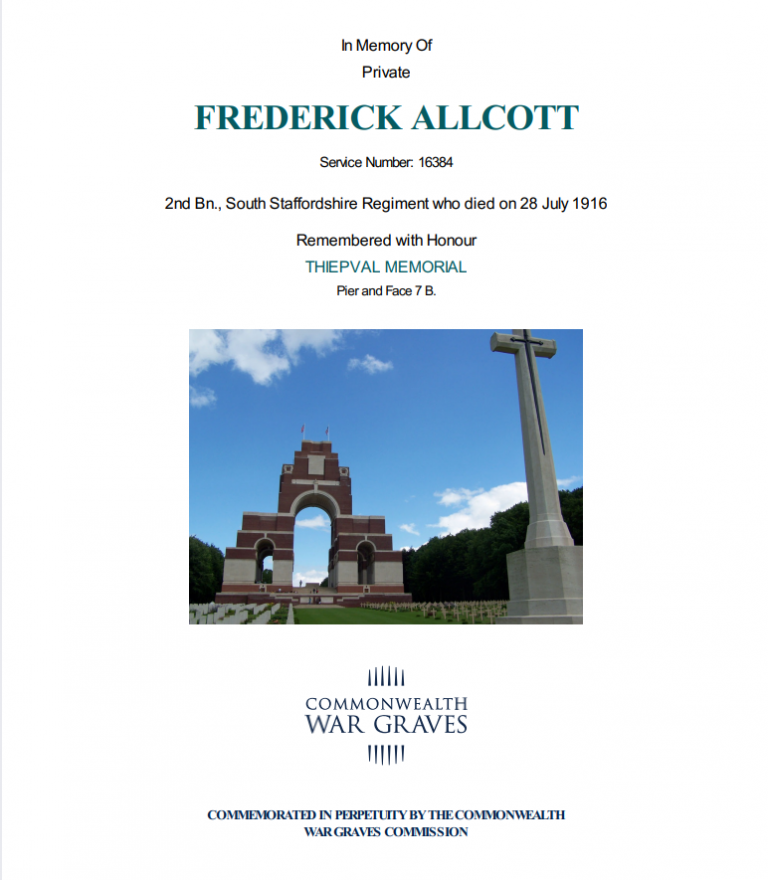
Rank: Private, Service No. 16384, Frederick was killed in action at the Battle of the Somme in 1916 in the Battle of Delville Wood. You can read more about Delville Wood here.
He was commemorated on the roll of honour of the London and North Western Railwaymen.
You can read more about Thiepval Memorial, France here.
SUTHERLAND (SURCCo.)
Shropshire Union Canal
Built by Calder Valley Marine, SUTHERLAND belonged to the Shropshire Union Railways and Canal Company, fleet no. 481, and was gauged for the Birmingham Canal Navigations in 1896. It was a powered motor boat 17.68 metres (58 ft) long, with a beam of 2.14 metres (7 ft) wide. It was a long-distance cabin boat in which the steerer plus family (and/or mate) would have been resident, at least when in transit, if not as their home. It was given as the family’s address on the birth certificate of Oliver Allcott, 2nd of June 1915, Hay Basin, Broad Street, Wolverhampton. Albert Charles Allcott was the steerer. Registered with the Canal & River Trust, No. 512465.
CARDIGAN (FM&C)
Coventry Canal
Given as the family residence of Minnie Allcott and John Pountney on their marriage certificate, October 27th 1923. CARDIGAN was moored near the Foleshill Road, Coventry. Possibly a boat of Fellows Morton & Clayton, a nation-wide canal carrying company, fleet no. 42, built at Uxbridge Dock (West London), entered service in January 1906. Registration no. Uxbridge 401.
ARCAS & MALUS (GUCCCo. paired boats, fleet no. 11)
Grand Union Canal
According to a manning list of paired boats for September 1944, William Allcott (born 1884) was working for the Grand Union Canal Carrying Company during WW2 on canal boats ARCAS and MALUS. The family lived at Stowe Hill Wharf, Heyford Lane, in the village of Weedon Bec, Northamptonshire. (Weedon is 6 miles from the market town of Daventry, where I grew up. We moved to Daventry in about 1969, living at 109 Hemans Road).
ARCAS was built by Harland and Wolff Ltd and entered service in November 1935. Registration no. Brentford 558 (West London).
MALUS (the butty) was built by W. J. Yarwoods & Sons of Northwich in September 1935 for the GUCCCo. It was delivered on 4 October 1935, fleet no. 307. Registration no. Coventry 535. She was gauged on the Grand Union Canal on October 24th 1936, and given the gauging number 12412. She was used for the carriage of cargoes such as coal, steel, timber and grain from London to the Midlands. In order to remain profitable, boatmen/boatwomen didn’t like to run between jobs without cargo. To avoid this some on the London run would load up with cocoa or chocolate crumbs before returning to Cadbury’s in the Midlands.
Download The Allcotts in PDF format by clicking here.
Read an online e-book version of The Allcott’s here.
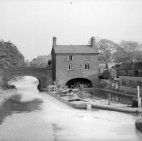
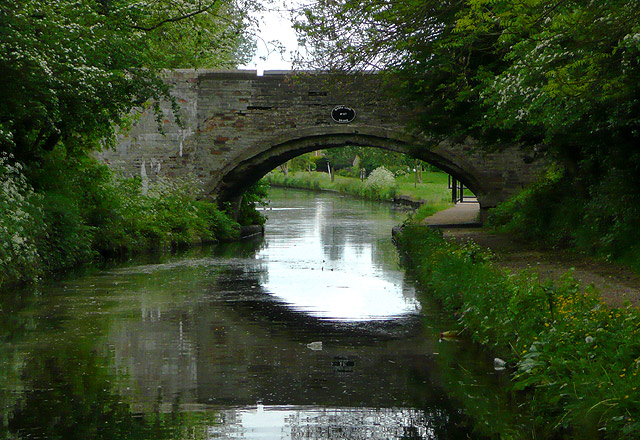
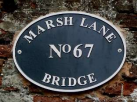
Roger Kidd’s page on Geograph – The Marsh Lane image above is the copyright of Roger Kidd. Here you will find more great work from the photographer Roger.
Geograph – The Geograph Britain and Ireland project offers lots of free, good-quality images and aims to collect geographically representative photographs and information for every square kilometre of Great Britain and Ireland, and you can be part of it.

A narrowboat is a particular type of canal boat, built to fit the narrow locks of the United Kingdom. The UK’s canal system provided a nationwide transport network during the Industrial Revolution, but with the advent of the railways, commercial canal traffic gradually diminished and the last regular long-distance transportation of goods had virtually disappeared by 1970. However, some commercial traffic continued. From the 1970’s onward narrowboats were gradually being converted into permanent residences or as holiday lettings. Currently, about 8580 narrowboats are registered as permanent homes on Britain’s waterway system and represent a growing alternative community living on semi-permanent moorings or continuously cruising.
For any boat to enter a narrow lock, it must be under 7 feet (2.13 m) wide, so most narrowboats are nominally 6 feet 10 inches (2.08 m) wide. A narrowboat’s maximum length is generally 72 feet (21.95 m), as anything longer will be unable to navigate much of the British canal network because the nominal maximum length of locks is 75 feet (22.86 m). Some locks are shorter than 72 feet (21.95 m), so to access the entire canal network the maximum length is 57 feet (17.37 m).
The first narrow boats played a vital role in the economic changes of the British Industrial Revolution. They were wooden boats drawn by a horse walking on the canal towpath led by a crew member. Horses were gradually replaced by steam and then diesel engines. By the end of the 19th century, it was common practice to paint roses and castles on narrowboats and their fixtures and fittings. This tradition has continued into the 21st century, but not all narrowboats have such decorations.
Modern narrowboats are used for holidays, weekend breaks, touring, or as permanent or part-time residences. Usually, they have steel hulls and a steel superstructure. The hull’s flat base is usually 10mm thick, the hull sides 6mm or 8mm, the cabin sides 6mm, and the roof 4mm or 6mm. The number of boats has been rising, with the number of licensed boats (not all of them narrowboats) on canals and rivers managed by the Canal & River Trust (CRT) estimated at about 27,000 in 2006; by 2019, this had risen to 34,367. Although a small number of steel narrowboats dispense with the need for a rear steering deck entirely, by imitating some river cruisers in providing wheel steering from a central cockpit, most narrowboats’ steering is by a tiller on the stern. There are three major configurations for the stern: traditional stern, cruiser stern and semi-traditional stern.
Narrowboats are Category D boats intended only for navigating rivers, canals and small lakes; but some intrepid boaters have crossed the English Channel in a narrowboat.

The narrowboat (one word) definition in the Oxford English Dictionary is:
“A British canal boat of traditional long, narrow design, steered with a tiller; spec. one not exceeding 7 feet (approx. 2.1 metres) in width or 72 feet (approx. 21.9 metres) in length.”
Earlier quotations listed in the Oxford English Dictionary use the term “narrow boat”, with the most recent, a quotation from an advertisement in Canal Boat & Inland Waterways in 1998, uses “narrowboat”.
The single word “narrowboat” has been adopted by authorities such as the Canal and River Trust, Scottish Canals and the authoritative magazine Waterways World to refer to all boats built in the style and tradition of commercial boats that were able to fit in the narrow canal locks.
Although some narrow boats are built to a design based on river barges and many conform to the strict definition of the term, it is incorrect to refer to a narrowboat (or narrow boat) as a widebeam or as a barge, both of which are definable by their greater width. In the context of British inland waterways, a barge is usually a much wider, cargo-carrying boat or a modern boat modelled on one, certainly more than 7 feet (2.13 m) wide.
Another historic term for a narrow boat is a long boat, which has been noted in the Midlands and especially on the River Severn and connecting waterways to Birmingham.
Usage has not quite settled as regards (a) boats based on narrowboat design, but too wide for narrow canals, or (b) boats the same width as narrowboats but based on other types of boats.
Narrowboats may have ship prefix NB.
The key distinguishing feature of a narrowboat is its width, which must be less than 7 feet (2.13 m) wide to navigate British narrow canals. Some old boats are very close to this limit (often built 7 feet 1+1⁄2 inches or 2.17 metres or slightly wider), and can have trouble using certain narrow locks whose width has been reduced over time because of subsidence. Modern boats are usually produced to a maximum of 6 feet 10 inches (2.08 m) wide to guarantee easy passage throughout the complete system.
Because of their slenderness, some narrowboats seem very long. The maximum length is about 72 feet (21.95 m), which matches the length of the longest locks on the system. Modern narrowboats tend to be shorter, to permit cruising anywhere on the connected network of British canals, including on canals built for wider, but shorter, boats. The shortest lock on the main network is Salterhebble Middle Lock on the Calder and Hebble Navigation, at about 56 feet (17.07 m) long. However, the C&H is a wide canal, so the lock is about 14 feet 2 inches (4.32 m) wide. This makes the largest go-anywhere-on-the-network narrowboat slightly longer (about 58 feet or 17.68 metres) than the straight length of the lock because it can (with a certain amount of shoehorning) lie diagonally. Some locks on isolated waterways are as short as 40 feet (12.19 m). Where it was possible to avoid going through locks, narrow boats were sometimes built a little larger. Wharf boats or more usually ‘Amptons, operated on the Wolverhampton level of the Birmingham Canal Navigations and were up to 89 feet in length and 7 foot 10.5 inches wide.
Hire fleets on British canals usually consist of narrow boats of varying lengths from 30 feet (9.14 m) upwards, to allow parties of different numbers or varying budgets to be able to hire a boat and get afloat.
The first narrowboats played a key part in the economic changes of the British Industrial Revolution. They were wooden boats drawn by a horse walking on the canal towpath led by a crew member, often a child. Narrowboats were chiefly designed for carrying cargo, though some packet boats carried passengers, luggage, mail and parcels.
The first canals to feature locks in the now standard size were the canals designed by James Brindley and approved by Parliament in 1766, including the Staffordshire and Worcestershire Canal and Trent and Mersey Canal. Although construction took many years, the lock size became standard for many canal-building projects.
Boatmen’s families originally lived ashore, but in the 1830’s as canals started to suffer competition from the burgeoning railway system, families (especially those of independent single boat owners/skippers) began to live on board, partly because they could no longer afford rents, partly to provide extra hands to work the boats harder, faster and further, partly to keep families together. As late as 1858, a Household Words article states that “the Grand Junction Canal company did not allow the boatmen’s families on board.” The crew of the non-stopping flyboat in the article (skipper, two crew and a youth) is said to be typical.
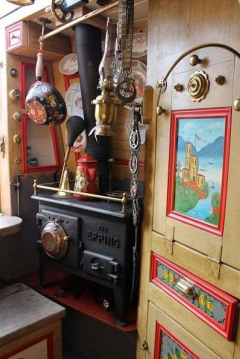
The rear portion of the boat became the boatman’s cabin, familiar from picture postcards and museums, famous for its space-saving ingenuity and interior made attractive by a warm stove, a steaming kettle, gleaming brass, fancy lace, painted housewares and decorated plates. Such descriptions rarely consider the actual comfort of a (sometimes large) family, working brutally hard and long days, sleeping in one tiny cabin. However many shore-bound workers endured harder indoor trades in less healthy conditions and in worse accommodation, where the family was separated for long hours rather than being together all day. The lifestyle afloat, by definition itinerant, made it impossible for children to attend school. Most boat people were effectively illiterate and ostracised by those living on the bank, who considered themselves superior.
As steam and diesel progressively replaced the tow-horse in the early years of the 20th century, it became possible to move even more cargo with fewer hands by towing a second, un-powered boat, referred to as a butty, buttyboat or butty boat. Although there was no longer a horse to maintain, the butty had to be steered while being towed. So that the butty boatman could lengthen or shorten the towline as needed, the towline wasn’t tied off on the bow, instead travelled over the buttyboat through permanent running blocks on stands or retractable middle masts and managed in the stern. On a wide canal, such as the Grand Union Canal, the pair could be roped side-to-side (breasted up) and handled as a unit through working locks.
Cargo-carrying by narrow boat diminished from 1945 and the last regular long-distance traffic disappeared in 1970. However, some traffic continued into the 1980’s and beyond. Two million tonnes of aggregate were carried on the Grand Union (River Soar) between 1976 and 1996, latterly using wide beam barges. Aggregate continues to be carried between Denham and West Drayton on the (wide) Grand Union Canal and on the tidal estuary of Bow Creek (which is the eventual outflow of the Lee & Stort Navigation).
A few people are doing their best in the 21st century to keep the tradition of canal-borne cargo-carrying alive, mostly by one-off deliveries rather than regular runs, or by selling goods such as coal to other boaters. Enthusiasts remain dedicated to restoring the remaining old narrow boats, often as members of the Historic Narrow Boat Owners Club. There are many replicas, such as Hadar, ornately painted with traditional designs, usually of roses and castles. Boats not horse-drawn may have a refurbished, slow-revving, vintage semi-diesel engine. There are some steam-driven narrow boats such as the ex-Fellows Morton & Clayton steamer President.
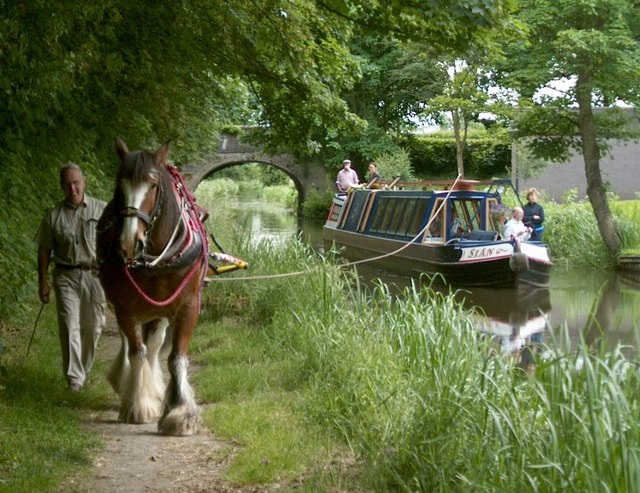

By the end of the 19th century, it was common practice to paint roses and castles on narrow boats and their fixtures and fittings. Common sites include the doors to the cabin, the water can or barrel and the side of the boat along with ornate lettering giving the boat’s name and owner. This tradition did not happen in all regions, the Chesterfield Canal being one waterway where narrow boats never bore such decorations.
The origin of the roses and castles found on canal boats is unclear. The first written reference to them appears to be in an 1858 edition of the magazine Household Words in one of a series of articles titled “On the Canal”, showing that the art form must have existed by this date. For some time, a popular suggestion was that it had some form of Romani origin; however, there does not appear to be a significant link between the Romani and boating communities. Other suggestions include the transfer of styles from the clock-making industry (in particular the decoration on the face), the japanning industry or the pottery industry. There is certainly a similarity in style and a geographical overlap, but no solid proof of a link. There are similar styles of folk art in Scandinavia, Germany, Turkey and Bangladesh.
In the 18th century, similar Dutch Hindeloopen paintwork would only have been a sailing barge journey away from the Thames. There is also an article in the Midland Daily Telegraph on July 22nd 1914 that credits the practice of painting of water cans, at least, to a Mr Arthur Atkins.
While the practice declined as commercial use of the canals dwindled, it has seen something of a revival in recent times with the emergence of leisure boating. Narrowboat decorations with roses and castle themes are a common sight on today’s canals, although these may utilise cheaper printed vinyl transfers in place of the traditional craft of hand-painted designs.

The number of licensed boats on canals and rivers managed by the Canal & River Trust (CRT), a charitable trust, formerly British Waterways, was estimated at about 27,000 in 2006. By 2014 this number had risen to over 30,000. There were perhaps another 5,000 unlicensed boats kept in private moorings or on other waterways in 2006. Most boats on CRT waterways are steel (or occasionally, aluminium) cruisers popularly referred to as narrowboats.
Modern leisure narrowboats are used for holidays, weekend breaks, touring, and as permanent or part-time residences. Usually, they have steel hulls and a steel superstructure, but when they were first developed for leisure use in the 1970’s glass reinforced plastic (fibre-glass) or timber was often used above gunwale height. Newer narrowboats, say post-1990, are usually powered by modern diesel engines and may be fitted inside to a high standard. There will be at least 6 feet (1.8 m) internal headroom and often or usually similar domestic facilities as land homes: central heating, flush toilets, shower or even bath, four-ring hobs, oven, grill, microwave oven, and refrigerator; some may have satellite television and mobile broadband, using 4G technology. Externally, their resemblance to traditional boats can vary from a faithful imitation (false rivets, and copies of traditional paintwork) through interpretation (clean lines and simplified paintwork) through to a free-style approach which does not try to pretend in any way that this is a traditional boat.
They are owned by individuals, shared by a group of friends (or by a more formally organised syndicate), rented out by holiday firms, or used as cruising hotels. A few boats are lived on permanently: either based in one place (though long-term moorings for residential narrowboats are currently very difficult to find) or continuously moving around the network (perhaps with a fixed location for the coldest months, when many stretches of the canal are closed by repair works or stoppages).
A support infrastructure has developed to provide services to the leisure boats, with some narrowboats being used as platforms to provide services such as engine maintenance and boat surveys; while some others are used as fuel tenders, that provide diesel, solid fuel (coal and wood) and Calor Gas.

On almost all narrowboats steering is by tiller, as was the case on all working narrow boats. The steerer stands at the stern of the boat, aft of the hatchway and/or rear doors at the top of the steps up from the cabin. The steering area comes in three basic types, each meeting different needs of maximising internal space; having a more traditional appearance; having a big enough rear deck for everyone to enjoy summer weather or long evenings; or protection outside in bad weather. Each type has its advocates. However, the boundaries are not fixed, and some boats blur the categories as new designers try out different arrangements and combinations.
Many modern canal boats retain the traditional layout of a small open, unguarded counter or deck behind the rear doors from which the crew can step onto land. It is possible to steer from the counter, but this is not very safe, with the propeller churning below only one missed step away. The tiller extension allows the steerer to stand in safety on the top step, forward of the rear doors. On a working boat, this step would have been over the top of the coal box. On cold days, the steerer can even close the rear doors behind themselves, and be in relative comfort, their lower body in the warmth of the cabin, and only their upper body emerging from the hatchway and exposed to the elements. In good weather, many trad-stern steerers sit up on the hatchway edge, a high vantage point giving good all-around visibility. On trad boats, the bow well-deck forms the main outside viewing area, because the traditional stern is not large enough for anyone other than the steerer to stand on safely. Internally, trads may have an engine room forward of a traditional boatman’s cabin, or an enclosed engine tucked away out of sight and the increased living space this brings.
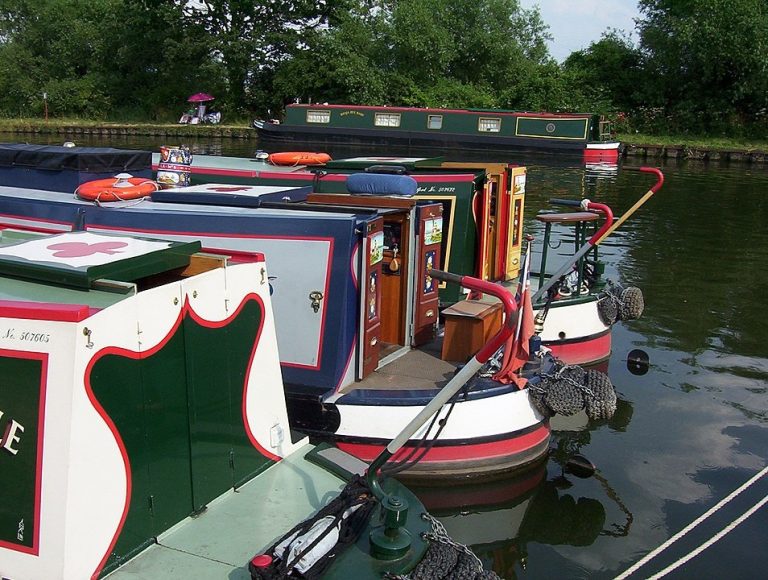
The name for this style arises from the large open rear deck resembling that of the large rear cockpits common on glass-fibre (glass-reinforced plastic or GRP) river cruisers which in turn derives from elliptical sterns used on cruisers and larger warships in the 20th century. At the stern, a cruiser narrowboat looks very different from traditional boats: the hatch and rear doors are considerably further forward than on a trad, creating a large open deck between the counter and rear doors, protected by a railing (perhaps with built-in seating) around back and sides. The large rear deck provides a good al fresco dining area or social space, allowing people to congregate on the deck in good weather and the summer holiday season.
In winter (or less than perfect weather in summer) the steerer may be unprotected from the elements. The lack of an enclosed engine room means that engine heat does not contribute to keeping the boat warm and there may be wasted space above the deck area. A cruiser stern allows the engine to be located under the deck, rather than in the body of the boat. Although this may make access to the engine more of a nuisance (due to weather considerations) the whole deck can usually be lifted off in whole or in sections, allowing the operative to stand inside the engine bay, the cruiser stern has a major advantage that the engine is located entirely outside the living space. In this configuration also, it is common to find that the engine bay contains batteries, isolator switching, fuel tanks and seldom-used kit, spares and equipment.

A semi–traditional stern is a compromise to gain some of the social benefits of a cruiser stern while retaining a more traditional design and providing some protection for the steerer in bad weather or in cooler seasons. As with the cruiser stern, the deck is extended back from the hatch and rear doors, but in this case, most of the deck is protected at the sides by walls which extend back from the cabin sides – giving a more sheltered area for the steerer and companions, usually with lockers to sit on. The engine is located under the deck, much like a cruiser, again allowing a separation between the cabin and the engine bay, with the steps down to the cabin being located past the false sides of the semi-trad social area.

A butty boat is an unpowered boat traditionally with a larger rudder with (usually) a wooden tiller (known as an elum, a corruption of helm) as the steering does not benefit from the force of water generated by the propeller. The tiller is usually removed and reversed in the rudder-post socket to get it out of the way when moored. A few butty boats have been converted into powered narrowboats like NB Sirius. The term butty is derived from the dialect word buddy, meaning companion.
While the vast majority of narrowboats have tiller steering at the stern, a small number of steel narrowboats dispense with the need for a rear steering deck entirely, by imitating some river cruisers in providing wheel steering from a central cockpit. This layout has the advantage (as many Dutch barges) of enabling an aft cabin to be separate from the forward accommodation.

National Association of Boat Owners (NABO).
National Community Boats Association (NCBA).
Read more here.
The above articles were taken from Wikipedia and are subject to change.
The narrowboat interior image above is unknown copyright and was taken from here.
The modern narrowboats for leisure cruising image above is the copyright of photographer Roger Haworth and you can find more great work from him by clicking here.
The historic working narrowboats image above is the copyright of photographer G-Man and you can find more great work from him by clicking here.
The Horse-drawn narrowboat image above is, as far as I know, the copyright of photographer Mike Fascione.
The narrowboat decoration image above is the copyright of photographer Laurence White.
The modern narrowboats on the Kennet and Avon Canal image above is the copyright of photographer Per Palmkvist Knudsen.
The traditional stern narrowboats image above is the copyright of photographer Jongleur100 and you can find more great work from him by clicking here.
The cruiser stern narrowboat decoration image above is the copyright of photographer Norman Rogers.
The semi-traditional stern image above is, as far as I know, the copyright of photographer Mark Ahsmann.
The narrowboat with a centre cockpit image above is the copyright of photographer PBS.
All the above images were found on Wikipedia with the exception of the Narrowboat interior one.

I have lived in Birmingham all my life, which is the main part of the West Midlands as far as I am concerned.
The areas I cover on my website regarding the West Midlands are areas I have visited the most, which are, obviously, Birmingham and The Black Country, which in turn covers Dudley, Sandwell, Walsall and Wolverhampton. Wolverhampton holds a special place in my heart as it is part of my roots.
You can also read any relevant West Midlands topics, such as places I have visited in it, in associated pages, blog posts and in my decades section.
There is no sub menu for Birmingham in The West Midlands category in the main menu because it as its own dedicated place. I could not justify sticking my home town as a sub category of it. I am proud to be a Brummie and Birmingham deserves to stand out towards the top of the main menu.
The West Midlands is one of nine official regions of England at the first level of NUTS for statistical purposes. It covers the western half of the area traditionally known as the Midlands. The region consists of the counties of Herefordshire, Shropshire, Staffordshire, Warwickshire, West Midlands and Worcestershire. The largest city in the region is Birmingham.
The West Midlands region is geographically diverse, from the urban central areas of the conurbation to the rural western counties of Shropshire and Herefordshire which border Wales. The longest river in the UK, the River Severn, traverses the region southeastwards, flowing through the county towns of Shrewsbury and Worcester, and the Ironbridge Gorge, a UNESCO World Heritage Site. Staffordshire is home to the industrialised Potteries conurbation, including the city of Stoke-on-Trent, and the Staffordshire Moorlands area, which borders the southeastern Peak District National Park near Leek. The region also encompasses five Areas of Outstanding Natural Beauty, the Wye Valley, Shropshire Hills, Cannock Chase, Malvern Hills, and parts of the Cotswolds. Warwickshire is home to the towns of Stratford upon Avon, the birthplace of writer William Shakespeare, Rugby, the birthplace of Rugby football and Nuneaton, birthplace to author George Eliot.
The RAF Fauld explosion on 27 November 1944 in east Staffordshire produced a 100-foot deep crater, and is the UK’s largest explosion, being caused by around 4,000 tonnes of high explosive, and may be the world’s largest non-nuclear explosion.
Birmingham was the third most bombed city in the UK after London and Liverpool; Spitfires were built in Castle Bromwich, Lancasters at Austin’s works in Longbridge at Cofton Hackett, and the Birmingham Small Arms Company at Small Heath produced the M1919 Browning machine gun. Boulton Paul Aircraft had their main aircraft factory in the north of Wolverhampton. RAF Defford, in the south of Worcestershire between Pershore and Croome Park, was where many important airborne radars were developed, such as H2S (radar) and anti-submarine radars.
Thomas Wedgwood, son of Josiah Wedgwood, discovered the first photo-sensitive (light-sensitive) chemicals – silver nitrate and silver chloride in the 1790s.
Sir Norman Lockyer of Rugby discovered helium in 1868, for which he used electromagnetic spectroscopy.
Edward Weston of Oswestry, who emigrated to the US, built the first accurate voltmeter in the late 1880s, and the Weston cell in 1893.
Francis W. Aston of Harborne, educated at the University of Birmingham, developed mass spectrometry in 1919, which helped him to identify the first isotopes, receiving the Nobel Prize for Chemistry in 1922.
Dennis Gabor invented holography at British Thomson-Houston in Rugby in 1947, receiving the Nobel Prize for Physics in 1971.
James Glaisher in 1862 took a record balloon flight with Henry Tracey Coxwell for the BAAS near Wolverhampton. They reached 29,000 feet (8,800 m) the composition of the Earth’s atmosphere until then was not understood; the altitude records for the UK have not been exceeded since; Project Excelsior in the US in 1960 would later reach 20 miles (110,000 ft).
Philip Lawley of Burton upon Trent was the first person to realise that chemical damage to DNA caused cancer (at the Chester Beatty Research Institute in London) in the early 1960s.
Francis Galton (d. 1911) of the Darwin–Wedgwood family’s Birmingham branch was an early eugenicist rooted in improving animal breeding stock and examining heredity. He invented the terms eugenics and nature versus nurture. His limited calls for human eugenics were widened by the German Society for Racial Hygiene in 1905 founded by Alfred Ploetz, which coupled with the racial superiority fallacies of Aryanism reached its nadir in genocidal antisemitism. Moral teachings and inherent repulsions towards human eugenics were overcome by a minority of those in power espousing racial equality; European media and leaders lamented the loss of the Empire, advocated ultranationalism and prized military physical advantage; Galton saw human eugenics as part of all means to do better.
Much of the Industrial Revolution in the United Kingdom began in Birmingham and the Black Country area of West Midlands. The Industrial Revolution is thought to have begun when Abraham Darby substituted coke in the place of charcoal to smelt iron, at his Old Furnace. The Black Country may be regarded as the world’s first industrial landscape, while nearby Ironbridge Gorge claims to be the Birthplace of Industry. The world’s first cast iron bridge in 1779 spans the Gorge. The first self-propelled locomotive to run on rails in 1803 at Coalbrookdale, was built by Richard Trevithick. The first iron rails for horse-drawn transport were made at Coalbrookdale in 1768 by Richard Reynolds at Ketley Ironworks. Iron rails only became widely successful in 1820 when made out of wrought iron at Bedlington Ironworks in northeast England.
Birmingham’s industrial development was triggered by discussions at the Lunar Society of Birmingham at Soho House, Boulton’s house, and products were carried along the BCN Main Line canal. Soho Manufactory was the first man-made-powered factory in the world. Chance Brothers of Smethwick built the glass for The Crystal Palace in 1851. Smethwick Engine, now at Thinktank, Birmingham Science Museum, is the oldest working steam engine, made in 1779, and is the oldest working engine in the world. Smethwick was a main centre for making lighthouse lanterns.
Valor Fires in Erdington developed the first radiant gas fire in 1967, a balanced flue fire in 1973, and a natural flame gas fire in 1978. The Erdington site, owned by Iceland’s BDR Thermea, closed in May 2012. The company also built gas cookers; since 2011 the company has been part of Glen Dimplex, which has a site at Cooper’s Bank, south of Gornalwood.
Read more here.
J. R. R. Tolkien grew up in Birmingham, Kings Heath, then part of Worcestershire, and was inspired by Moseley Bog and Sarehole, and perhaps by the Perrott’s Folly. Philip Larkin came from Coventry. Rowland Hill (stamps) was from Kidderminster. The writer George Eliot came from Nuneaton. Anthony E. Pratt from Birmingham invented Cluedo.
Frederick Gibberd of Coventry designed Liverpool Metropolitan Cathedral. Edward Cave from Rugby made Britain’s first magazine in 1731 – The Gentleman’s Magazine. Philip Astley from Newcastle under Lyme invented the modern-day circus in 1768 – Astley’s Amphitheatre.
The Castlemorton Common Festival in May 1992 near Malvern, led to the Criminal Justice and Public Order Act 1994.
The Nowka Bais is a Bengali boat racing festival that takes place annually in Birmingham. It is a cultural event in the West Midlands, United Kingdom attracting not only the Bangladeshi diaspora but a variety of cultures. It is also the largest kind of boat race in the United Kingdom.
Read more about the West Midlands here.
The above articles were taken from Wikipedia and are subject to change.
Birmingham: The Old Crown In Digbeth.
Birmingham: The Old Crown In Digbeth Photos (Part 1).
Birmingham: The Old Crown In Digbeth Photos (Part 2).
The Birmingham Buddhist Vihara.
The Birmingham Buddhist Vihara Photos: Page 1.
The Birmingham Buddhist Vihara Photos: Page 2.
Denitsa Sharankova on Pixabay – The image shown at the top of this page is the copyright of DenitsaVal. You can find more great work from the photographer Denitsa and lots more free stock photo’s at Pixabay.

Sandwell is a metropolitan borough of the West Midlands county in England. The borough is named after the Sandwell Priory and spans a densely populated part of the West Midlands conurbation. According to Sandwell Metropolitan Borough Council, the borough comprises the six amalgamated towns of Oldbury, Rowley Regis, Smethwick, Tipton, Wednesbury, and West Bromwich, although these places consist of numerous smaller settlements and localities. Sandwell’s Strategic Town Centre is designated as West Bromwich, the largest town in the borough, while Sandwell Council House (the headquarters of the local authority) is situated in Oldbury. In 2019 Sandwell was ranked 12th most deprived of England’s 317 boroughs.
Bordering Sandwell is the City of Birmingham to the east, the Metropolitan Borough of Dudley to the south and west, the Metropolitan Borough of Walsall to the north, and the City of Wolverhampton to the north-west. Spanning the borough are the parliamentary constituencies of West Bromwich West, West Bromwich East, Warley, and part of Halesowen and Rowley Regis, which crosses into the Dudley borough.
At the 2011 census, the borough had a population of 309,000 and an area of 86 square kilometres (33 sq mi).
The Metropolitan Borough of Sandwell was formed on 1 April 1974 as an amalgamation of the county boroughs of Warley (ceremonially within Worcestershire) and West Bromwich (ceremonially within Staffordshire), under the Local Government Act 1972. Warley had been formed in 1966 by a merger of the county borough of Smethwick with the municipal boroughs of Rowley Regis and Oldbury; at the same time, West Bromwich had absorbed the boroughs of Tipton and Wednesbury.
For its first 12 years of existence, Sandwell had a two-tier system of local government; Sandwell Council shared power with the West Midlands County Council. In 1986 the county council was abolished, and Sandwell effectively became a unitary authority. The borough is divided into 24 wards and is represented by 72 ward councillors on the borough council.
The borough was named after Sandwell Priory, the ruins of which are located in Sandwell Valley. The local council has considered changing its name in the past over confusion outside the West Midlands as to the whereabouts of the borough, and in June 2002 a survey of borough residents was carried out. Sixty-five percent of those surveyed favoured retaining the name Sandwell.
Read more here.
The above articles were taken from Wikipedia and are subject to change.
The image shown at the top of this page is copyright unknown and was found on Wikipedia.
Sandwell College – Official website. Links to their social media sites are on there.

Dudley has a history dating back to Anglo-Saxon times, its name deriving from the Old English Duddan Leah, meaning Dudda’s clearing, and one of its churches being named in honour of the Anglo-Saxon King and Saint, Edmund.
Mentioned in the Domesday Book as Dudelei, in the hundred of Clent in Worcestershire, the town was listed as being a medium-sized manor in the possession of Earl Edwin of Mercia prior to the Norman Conquest, with William Fitz-Ansculf as Lord of the Manor in 1086. Dudley Castle, constructed in 1070 by William’s father Ansculf de Picquigny after his acquisition of the town, served as the seat of the extensive Barony of Dudley, which possessed estates in eleven different counties across England.
Of historical significance, the town was attacked by King Stephen in 1138, after a failed siege of the castle following the Baron’s decision to support Empress Matilda’s claim to the throne during The Anarchy.
Dudley has a history dating back to Anglo-Saxon times, its name deriving from the Old English Duddan Leah, meaning Dudda’s clearing, and one of its churches being named in honour of the Anglo-Saxon King and Saint, Edmund.
Mentioned in the Domesday Book as Dudelei, in the hundred of Clent in Worcestershire, the town was listed as being a medium-sized manor in the possession of Earl Edwin of Mercia prior to the Norman Conquest, with William Fitz-Ansculf as Lord of the Manor in 1086. Dudley Castle, constructed in 1070 by William’s father Ansculf de Picquigny after his acquisition of the town, served as the seat of the extensive Barony of Dudley, which possessed estates in eleven different counties across England.
Of historical significance, the town was attacked by King Stephen in 1138, after a failed siege of the castle following the Baron’s decision to support Empress Matilda’s claim to the throne during The Anarchy.
By the early 16th century the Dudley estate, now held by the Sutton family, had become severely in debt and was first mortgaged to distant relative John Dudley, Duke of Northumberland, before being sold outright in 1535. Following Dudley’s execution in 1553, the estate returned to the Sutton family, during whose ownership the town was visited by Queen Elizabeth during a tour of England.
In 1605, conspirators of the Gunpowder Plot fled to Holbeche House in nearby Wall Heath, where they were defeated and captured by the forces of the Sheriff of Worcestershire.
During the English Civil, War Dudley served as a Royalist stronghold, with the castle besieged twice by the Parliamentarians and later partly demolished on the orders of the Government after the Royalist surrender. It is also from around this time that the oldest excavated condoms, found in the remains of Dudley Castle, were believed to have originated.
Dudley had become an incredibly impoverished place during the 16th and 17th centuries, but the advent of the Industrial Revolution began to reverse this trend. In the early 17th century, Dud Dudley, an illegitimate son of Edward Sutton, 5th Baron Dudley and Elizabeth Tomlinson, devised a method of smelting Iron ore using coke at his father’s works in Cradley and Pensnett Chase, though his trade was unsuccessful due to circumstances of the time. Abraham Darby was descended from Dud Dudley’s sister, Jane, and was the first person to produce iron commercially using coke instead of charcoal at his works in Coalbrookdale, Shropshire in 1709. Abraham Darby was born near Wrens Nest Hill near the town of Dudley and it is claimed that he may have known about Dud Dudley’s earlier work.
Dud Dudley’s discovery, together with improvements to the local road network and the construction of the Dudley Canal, made Dudley into an important industrial and commercial centre. The first Newcomen steam engine, used to pump water from the mines of the Lord Dudley’s estates, was installed at the Conygree coal works a mile east of Dudley Castle in 1712, though this is challenged by Wolverhampton, which also claims to have been the location of the first working Newcomen engine.
Read more here.
The above articles were sourced from Wikipedia and are subject to change.
The following Dudley Zoo & Castle leaflets are available to download in PDF format. There is a link to a free PDF reader below if you don’t have one.


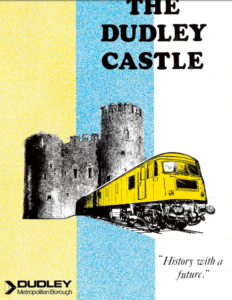
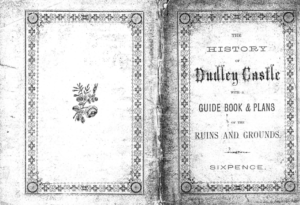
philwild on Pixabay – The image shown at the top of this page is the copyright of philwild. You can find more great work from the photographer Phil and lots more free stock photo’s at Pixabay.
Dudley Zoo & Castle – Official website. The images shown above are copyright of Dudley Zoo And Castle. They run as a not for profit charity relying on ticket sales in order to operate and care for more than 1300 animals, and has nigh on 200 species, including some of the rarest creatures on Planet Earth. Please consider donating to them if you can as well as purchasing tickets to visit.
Note: I am not affiliated with Dudley Zoo & Castle whatsoever. I simply want to raise awareness to help in any way I can.
Adobe Acrobat DC Reader – This PDF reader from Adobe is the free global standard for reliably viewing, printing, and commenting on PDF documents.
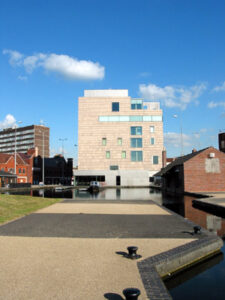
Walsall is a market town and administrative centre in West Midlands County, England. Historically part of Staffordshire, it is located 9 miles (14 km) north-west of Birmingham, 7 miles (11 km) east of Wolverhampton and 9 miles (14 km) from Lichfield.
Walsall is the administrative centre of the wider Metropolitan Borough of Walsall. At the 2011 census, the town’s built-up area had a population of 67,594, with the wider borough having a population of 269,323. Neighbouring settlements in the borough include Darlaston, Brownhills, Pelsall, Willenhall, Bloxwich and Aldridge.
The name Walsall is derived from “Walh halh”, meaning “valley of the Welsh”, referring to the British who first lived in the area. However, it is believed that a manor was held here by William FitzAnsculf, who held numerous manors in the Midlands. By the first part of the 13th century, Walsall was a small market town, with the weekly market being introduced in 1220 and held on Tuesdays. The mayor of Walsall was created as a political position in the 14th century.
The Manor of Walsall was held by the Crown and given as a reward to royal proteges. In 1525, it was given to the King’s illegitimate son, Henry Duke of Richmond, and in 1541 to the courtier Sir John Dudley, later Duke of Northumberland. It was seized by Queen Mary in 1553 after Northumberland had been found guilty of treason.
Queen Mary’s Grammar School was founded in 1554, and the school carries the queen’s personal badge as its emblem: the Tudor Rose and the sheaf of arrows of Mary’s mother Catherine of Aragon tied with a Staffordshire Knot.
The town was visited by Queen Elizabeth I, when it was known as ‘Walshale’. It was also visited by Henrietta Maria in 1643. She stayed in the town for one night at a building named the ‘White Hart’ in the area of Caldmore.
The Manor of Walsall was later sold to the Wilbrahim and Newport families and passed by inheritance to the Earls of Bradford. On the death of the fourth Earl in 1762, the estate was transferred to his sister Diana, Countess of Mountrath and then reverted to the Earls of Bradford until the estates were sold after World War II. The family’s connection with Walsall is reflected in local placenames, including Bridgeman Street, Bradford Lane, Bradford Street and Mountrath Street.
The Industrial Revolution changed Walsall from a village of 2,000 people in the 16th century to a town of over 86,000 in approximately 200 years. The town manufactured a wide range of products including saddles, chains, buckles and plated ware. Nearby, limestone quarrying provided the town with much prosperity.
In 1824, the Walsall Corporation received an Act of Parliament to improve the town by providing lighting and gas works. The gas works were built in 1826 at a cost of £4,000. In 1825, the corporation built eleven tiled, brick almshouses for poor women. They were known to the area as ‘Molesley’s Almshouses’.
The ‘Walsall Improvement and Market Act’ was passed in 1848 and amended in 1850. The Act provided facilities for the poor, improving and extending the sewerage system and giving the commissioners the powers to construct new gas works. On 10 October 1847, a gas explosion killed one person and destroyed the west window of St Matthew’s Church.
Walsall finally received a railway line in 1847, 48 years after canals reached the town, Bescot having been served since 1838 by the Grand Junction Railway. In 1855, Walsall’s first newspaper, the Walsall Courier and South Staffordshire Gazette was published.
The Whittimere Street drill hall was completed in 1866.
Read more here.
The above articles were taken from Wikipedia and are subject to change.
The image shown at the top of this page is the copyright of Richard Gallagher and was found on Wikipedia.
The New Art Gallery Walsall – Official website. Links to their social media sites are on there.

Both my mom and dad were born in Wolverhampton and I have many relatives living there. I am just as proud of these roots as I am of my Birmingham ones.
Wolverhampton is a city, metropolitan borough, and administrative centre in the West Midlands, England. At the 2011 census, it had a population of 249,470. Natives of the city are called “Wulfrunians”.
Historically part of Staffordshire, the city grew initially as a market town specialising in the wool trade. In the Industrial Revolution, it became a major centre for coal mining, steel production, lock making, and the manufacture of cars and motorcycles. The economy of the city is still based on engineering, including a large aerospace industry, as well as the service sector.
The city is named after Wulfrun, who founded the town in 985, from the Anglo-Saxon Wulfrūnehēantūn (“Wulfrūn’s high or principal enclosure or farm”). Before the Norman Conquest, the area’s name appears only as variants of Heantune or Hamtun, the prefix Wulfrun or similar appearing in 1070 and thereafter. Alternatively, the city may have earned its original name from Wulfereēantūn (“Wulfhere’s high or principal enclosure or farm”) after the Mercian King, who according to tradition established an abbey in 659, though no evidence of an abbey has been found. The variation Wolveren Hampton is seen in medieval records, e.g. in 1381.
A local tradition states that King Wulfhere of Mercia founded an abbey of St Mary at Wolverhampton in 659.
Wolverhampton is recorded as being the site of a decisive battle between the unified Mercian Angles and West Saxons against the raiding Danes in 910, although sources are unclear as to whether the battle itself took place in Wednesfield or Tettenhall. The Mercians and West Saxons claimed a decisive victory, and the field of Woden is recognised by numerous place names in Wednesfield.
In 985, King Ethelred the Unready granted lands at a place referred to as Heantun to Lady Wulfrun by royal charter, and hence founding the settlement.
In 994, a monastery was consecrated in Wolverhampton for which Wulfrun granted land at Upper Arley in Worcestershire, Bilston, Willenhall, Wednesfield, Pelsall, Ogley Hay near Brownhills, Hilton near Wall, Hatherton, Kinvaston, Hilton near Wolverhampton, and Featherstone. This became the site for the current St. Peter’s Church. A statue of Lady Wulfrun, sculpted by Sir Charles Wheeler, can be seen on the stairs outside the church.
Wolverhampton is recorded in the Domesday Book in 1086 as being in the Hundred of Seisdon and the county of Staffordshire. The lords of the manor are listed as the canons of St Mary (the church’s dedication was changed to St Peter after this date), with the tenant-in-chief being Samson, William the Conqueror’s personal chaplain. Wolverhampton at this date is a large settlement of fifty households.
In 1179, there is mention of a market held in the town, and in 1204 it had come to the attention of King John that the town did not possess a Royal Charter for holding a market. This charter for a weekly market held on a Wednesday was eventually granted on 4 February 1258 by Henry III.
It is held that in the 14th and 15th centuries that Wolverhampton was one of the “staple towns” of the woollen trade, which today can be seen by the inclusion of a woolpack on the city’s coat of arms, and by the many small streets, especially in the city centre, called “Fold” (examples being Blossom’s Fold, Farmers Fold, Townwell Fold and Victoria Fold), as well as Woolpack Street and Woolpack Alley.
In 1512, Sir Stephen Jenyns, a former Lord Mayor of London and a twice Master of the Worshipful Company of Merchant Taylors, who was born in the city, founded Wolverhampton Grammar School, one of the oldest active schools in Britain.
From the 16th century onwards, Wolverhampton became home to a number of metal industries including lock and key making and iron and brass working.
Wolverhampton suffered two Great Fires: the first in April 1590, and the second in September 1696. Both fires started in today’s Salop Street. The first fire lasted for five days and left nearly 700 people homeless, whilst the second destroyed 60 homes in the first five hours. This second fire led to the purchase of the first fire engine within the city in September 1703.
On 27 January 1606, two farmers, Thomas Smart and John Holyhead of Rowley Regis, were executed on High Green, now Queen Square, for sheltering two of the Gunpowder Plotters, Robert Wintour and Stephen Littleton, who had fled to the Midlands. The pair played no part in the original plot nevertheless suffered a traitor’s death of being hanged, drawn and quartered on butcher’s blocks set up in the square a few days before the execution of Guy Fawkes and several other plotters in London.
There is also evidence that Wolverhampton may have been the location of the first working Newcomen Steam Engine in 1712.
Read more here.
The above articles were taken from Wikipedia and are subject to change.
jorono on Pexels – The image shown at the top of this page is the copyright of jorono. You can find more great work from the photographer and lots more free stock photo’s at Pixabay.

Not only am I proud of my Birmingham roots I am also proud of my Black Country roots too.
The Black Country is an area of the West Midlands county, in the United Kingdom covering most of the Metropolitan Boroughs of Dudley, Sandwell, and some minor parts of Walsall. Dudley and Tipton are generally considered to be the centre. It became industrialised during its role as one of the birthplaces of the Industrial Revolution across the English Midlands with coal mines, coking, iron foundries, glass factories, brickworks and steel mills, producing a high level of air pollution.
The name dates from the 1840s and is believed to come from the soot that the heavy industries covered the area in, although the 30-foot-thick coal seam close to the surface is another possible origin.
The 14-mile (23 km) road between Wolverhampton and Birmingham was described as “one continuous town” in 1785.
Read more here.
A few Black Country places such as Wolverhampton, Bilston and Wednesfield are mentioned in Anglo-Saxon charters and chronicles and the forerunners of a number of Black Country towns and villages such as Cradley, Dudley, Smethwick, and Halesowen are included in the Domesday Book of 1086. At this early date, the area was mostly rural. A monastery was founded in Wolverhampton in the Anglo-Saxon period and a castle and priory were built at Dudley during the period of Norman rule. Another religious house, Premonstratensian Abbey of Halesowen, was founded in the early 13th century. A number of Black Country villages developed into market towns and boroughs in the twelfth and thirteenth centuries, notably Dudley, Walsall and Wolverhampton. Coal mining was carried out for several centuries in the Black Country, starting from medieval times, and metalworking was important in the Black Country area as early as the 16th century spurred on by the presence of iron ore and coal in a seam 30 feet (9 m) thick, the thickest seam in Great Britain, which outcropped in various places. The first blast furnace recorded in the Black Country was built at West Bromwich in the early 1560s. Many people had an agricultural smallholding and supplemented their income by working as nailers or smiths, an example of a phenomenon known to economic historians as proto-industrialisation. In 1583, the accounts of the building of Henry VIII’s Nonsuch Palace record that nails were supplied by Reynolde Warde of Dudley at a cost of 11s 4d per thousand. By the 1620s “Within ten miles [16 km] of Dudley Castle there were 20,000 smiths of all sorts”.
In the early 17th century, Dud Dudley, a natural son of the Baron of Dudley, experimented with making iron using coal rather than charcoal. Two patents were granted for the process: one in 1621 to Lord Dudley and one in 1638 to Dud Dudley and three others. In his work Metallum Martis, published in 1665, he claimed to have “made Iron to profit with Pit-cole”. However, considerable doubt has been cast on this claim by later writers.
An important development in the early 17th century was the introduction of the slitting mill to the Midlands area. In the Black Country, the establishment of this device was associated with Richard Foley, son of a Dudley nailer, who built a slitting mill near Kinver in 1628. The slitting mill made it much simpler to produce nail rods from iron bars.
Another development of the early 17th century was the introduction of glass making to the Stourbridge area. One attraction of the region for glass makers was the local deposits of fireclay, a material suitable for making the pots in which glass was melted.
In 1642 at the start of the Civil War, Charles I failed to capture the two arsenals of Portsmouth and Hull, which although in cities loyal to Parliament were located in counties loyal to him. As he had failed to capture the arsenals, Charles did not possess any supply of swords, pikes, guns, or shot; all these the Black Country could and did provide. From Stourbridge came shot, from Dudley cannon. Numerous small forges which then existed on every brook in the north of Worcestershire turned out successive supplies of sword blades and pike heads. It was said that among the many causes of anger Charles had against Birmingham was that one of the best sword makers of the day, Robert Porter, who manufactured swords in Digbeth, Birmingham, refused at any price to supply swords for “that man of blood” (A Puritan nickname for King Charles), or any of his adherents. As an offset to this sword-cutler and men like him in Birmingham, the Royalists had among their adherents Dud Dudley, now a Colonel in the Royalist army, who had experience in iron making, and who claimed he could turn out “all sorts of bar iron fit for making of muskets, carbines, and iron for great bolts”, both more cheaply, more speedily and more excellent than could be done in any other way.
In 1712, a Newcomen Engine was constructed near Dudley and used to pump water from coal mines belonging to Lord Dudley. This is the earliest documented working steam engine.
Read more here.
The above articles were taken from Wikipedia and are subject to change.
Gracie Sheppard interview – The image shown at the top of this page is the copyright of Gracie Sheppard. This interview is from the 16th August, 2019 with Black Country T-Shirts. Gracie designed the Black Country flag shown at the top of this page in 2013 when she was just 12 years old.
Black Country T-Shirts – Official website. Links to their social media sites are on there.

The city I was born in. I am proud of its history. There was only ever one football team for me to support when I was younger and that is Birmingham City. Blue is my favourite colour and I AM PROUD TO BE A BRUMMIE, it was a no brainer!
Although I do have a West Midlands section on my website, I could not justify sticking my home town as a subcategory of it. It deserves pride of place on its own in my website menu.
Read about it, and any memories regarding it in associated blog posts and my decades section as well.
Birmingham is a city and metropolitan borough in the West Midlands, England. It is the second-largest city, urban area and metropolitan area in England and the United Kingdom, with roughly 1.1 million inhabitants within the city area, 2.9 million inhabitants within the urban area and 3.6 million inhabitants within the metropolitan area. The city proper is the most populated English local government district. Birmingham is commonly referred to as the “second city of the United Kingdom”.
Located in the West Midlands county and region in England, approximately 100 miles (160 km) from Central London, Birmingham, as one of the United Kingdom’s major cities, is considered to be the social, cultural, financial, and commercial centre of the Midlands. Distinctively, Birmingham only has small rivers flowing through it, mainly the River Tame and its tributaries River Rea and River Cole – one of the closest main rivers are the Severn, approximately 20 miles (32 km) west of the city centre.
Historically a market town in Warwickshire in the medieval period. Birmingham grew during the 18th-century during the Midlands Enlightenment and during the Industrial Revolution, which saw advances in science, technology, and economic development, producing a series of innovations that laid many of the foundations of modern industrial society. By 1791, it was being hailed as “the first manufacturing town in the world”. Birmingham’s distinctive economic profile, with thousands of small workshops practising a wide variety of specialised and highly skilled trades, encouraged exceptional levels of creativity and innovation and provided an economic base for prosperity that was to last into the final quarter of the 20th century. The Watt steam engine was invented in Birmingham.
The resulting high level of social mobility also fostered a culture of political radicalism which, under leaders from Thomas Attwood to Joseph Chamberlain, was to give it a political influence unparalleled in Britain outside London, and a pivotal role in the development of British democracy. From the summer of 1940 to the spring of 1943, Birmingham was bombed heavily by the German Luftwaffe in what is known as the Birmingham Blitz. The damage done to the city’s infrastructure, in addition to a deliberate policy of demolition and new building by planners, led to extensive urban regeneration in subsequent decades.
Read more here.
Birmingham has seen 1400 years of growth, during which time it has evolved from a small 7th century Anglo Saxon hamlet on the edge of the Forest of Arden at the fringe of early Mercia to become a major city. A combination of immigration, innovation and civic pride helped to bring about major social and economic reforms and to create the Industrial Revolution, inspiring the growth of similar cities across the world.
The last 200 years have seen Birmingham rise from a market town into the fastest-growing city of the 19th century, spurred on by a combination of civic investment, scientific achievement, commercial innovation and a steady influx of migrant workers into its suburbs. By the 20th century, Birmingham had become the metropolitan hub of the United Kingdom’s manufacturing and automotive industries, having earned itself a reputation first as a city of canals, then of cars, and most recently as a major European convention and shopping destination.
By the beginning of the 21st century, Birmingham lay at the heart of a major post-industrial metropolis surrounded by significant educational, manufacturing, shopping, sporting and conferencing facilities.
Read more here.
The above articles were taken from Wikipedia and are subject to change.
Sunil060902’s page on Wikipedia – The image shown at the top of this page is the copyright of Sunhil060902. You can find more great work from the photographer Sunhil and lots more free stock photo’s at Wikipedia.
Birmingham History Forum – An excellent website for Birmingham related content covering plenty of different topics. Join today and look out for bluebrummie on their because that is me!
I am and forever will be a Blue Nose until the day I die. There is only one team in Birmingham worth supporting with true passion, and that is Birmingham. I have been supporting them since 1978 when Jim Smith was the manager. He is my favourite manager to date, with current manager Chris Davies coming a very close second.
Although I do have a section for Sport on my website, I could not justify sticking the Blues as a subcategory of it. They have been and are an important part of my life growing up to the present day, and as such deserve pride of place on its own in my website menu, joys, sorrows and all!
Read about them, and any memories regarding them, in the associated blog posts and my decades section as well.
For Blues fixtures, results and goalscorers for the current season, click here.
There is information, including kits, squads, etc., for the current season in the Blog Posts at the bottom of the page.
Birmingham City Football Club is a professional football club based in Birmingham, England. Formed in 1875 as Small Heath Alliance, it was renamed Small Heath in 1888, Birmingham in 1905, and Birmingham City in 1943. The club compete in the E.F.L. Championship, which is the second tier of the English football league system. Their nickname is Blues, after the colour of their kit, and the fans are known as Blue Noses.
As Small Heath, Blues played in the Football Alliance before becoming founder members and first champions of the Football League Second Division. The most successful period in our history was in the 1950’s and early 1960’s. We achieved our highest finishing position of sixth in the First Division in the 1955–56 season and reached the 1956 F.A. Cup Final. Blues played in two Inter-Cities Fairs Cup finals, in 1960, as the first English club side to reach a major European final, and again the following year. We won the League Cup in 1963 and again in 2011. Birmingham City have played in the top tier of English football for around half of their history. The longest period spent outside the top division was between 1986 and 2002, which included two brief spells in the third tier of English football, during which time we won the Football League Trophy twice.
St Andrew’s, renamed St. Andrew’s @ Knighthead Park in 2024 for sponsorship reasons (although many fans will still refer to it as St. Andrew’s, as I will), has been our home ground since 1906.
Blues have a long-standing and fierce rivalry with Aston Villa.
Keep Right On is one of the most well-known anthems in football, famously sung by Birmingham City fans.
The song originally came from Scotland. The song was written and sung by Sir Henry Lauder, a singer and a comedian. Lauder was very popular during the early 1900’s and he achieved international success.
The song was written and composed in 1924 by Lauder and William Dillon. The song was then released in 1925.
The song was inspired by personal tragedy. Lauder wrote the song after his son was killed in action during the First World War.
For Lauder’s original Keep Right On, the lyrics went like this:
“Every road through life is a long, long road.
Filled with joys and sorrows too.
As we journey on how your heart will yearn.
For the things most dear to you.
With wealth and love ‘tis so.
But onward we must go.
Keep right on to the end of the road.
Keep right on to the end.
Though the way be long, let your heart be strong.
Keep right on round the bend.
If you’re tired and weary still journey on.
Till you come to your happy abode.
Where all you love and you’re dreaming of.
Will be there at the end of the road.
Keep right on to the end of the road.
With a big stout heart to a long steep hill.
We may get there with a smile.
With a good kind thought and an end in view.
We can cut short many a mile.
So let courage every day.
Be your guiding star always.
Keep right on to the end of the road.
Keep right on to the end.
Though the way be long, let your heart be strong.
Keep right on round the bend.
If you’re tired and weary still journey on.
Till you come to your happy abode.
Where all you love and you’re dreaming of.
Will be there at the end of the road.
Keep right on to the end of the road.
Keep right on to the end.
Though the way be long, let your heart be strong.
Keep right on round the bend.
If you’re tired and weary still journey on.
Till you come to your happy abode.
Where all you love and you’re dreaming of.
Will be there at the end of the road.”
Keep Right On To The End Of The Road by Harry Lauder.
Keep Right On arrived into the terraces of St Andrews in the mid-1950’s.
Blues were on our way to Leyton Orient in the fourth round of the F.A. Cup and manager Arthur Turner got the squad to sing the anthem as a pre-match ritual to calm the nerves before a big game.
Birmingham City legend Alex Govan, a winger who played for Blues during the 1950’s, introduced the team to Lauder’s famous song as the club went on to reach the FA Cup final in 1956.
Since then, the song has been adopted as the club’s anthem and the rest is history.
Govan once said to BBC WM: “We always had a sing-song on the coach wherever we went away from home… And Arthur Turner turned and said “Come on Alex, give us something from Scotland.””
“I couldn’t sing “I belong to Glasgow”, he continued, “so I sang “Keep right on to the end of the road”, it was the easiest one to sing… The fans heard us through the windows and it’s been magic ever since.”
As we all know, Keep Right On, has fans’ hairs standing up on the backs of their necks whenever it is belted around St Andrews. You have to be there to truly experience the magic of it all.
Two great examples of this anthem at its finest were before the Carling Cup final in 2011, and after Paul Caddis scored the equaliser against Bolton at the then-named Reebok Stadium, which saved Blues from relegation to League One on the final day of the season.
Birmingham City Legend Alex Govan.
As you go through life it’s a long, long road.
There’ll be joys and sorrows too.
As we journey on we will sing this song.
For the boys in royal blue.
We’re often partisan.
We will journey on.
Keep right on to the end of the road.
Keep right on to the end.
Though the way be long.
Let your heart beat strong.
Keep right on to the end.
Though you’re tired and weary.
Still journey on.
Till you come to your happy abode.
Where all the love you’ve been dreaming of will be there.
Where?
At the end of the road.
Birmingham.
Birmingham.
Birmingham.
Birmingham City fans singing Keep Right On To The End Of The Road before The Carling Cup Final Kick-Off.
Read more here.
Birmingham City was founded as Small Heath Alliance in 1875, and from 1877 we played our home games at Muntz Street in Small Heath, Birmingham. The club turned professional in 1885 and three years later became the first football club to become a limited company with a board of directors, under the name of Small Heath F.C. Ltd. From the 1889 – 90 season Blues played in the Football Alliance, which ran alongside the Football League. In 1892, Small Heath, along with the other Alliance teams, was invited to join the newly formed Football League Second Division. We finished as champions, but failed to win promotion via the test match system. The following season promotion to the First Division was secured after a second-place finish and test match victory over Darwen. The club adopted the name Birmingham Football Club in 1905 and moved into their new home, St Andrew’s, the following year. Matters on the field failed to live up to their surroundings. Birmingham was relegated in 1908, obliged to apply for re-election two years later, and remained in the Second Division until after the First World War.
Frank Womack’s captaincy and the creativity of Scottish international playmaker Johnny Crosbie contributed much to Birmingham winning Blues a second Division Two title in 1920–21. Womack went on to make 515 appearances, a club record for an outfielder, over a twenty-year career. 1920 also saw the debut of the 19-year-old Joe Bradford, who went on to score a club record 267 goals in 445 games and won 12 caps for England. In 1931, manager Leslie Knighton led the club to their first FA Cup Final, which they lost 2–1 to Second Division club West Bromwich Albion. Though Birmingham remained in the top flight for 18 seasons, we struggled in the league, with much reliance placed on England goalkeeper Harry Hibbs to make up for the lack of goals, Bradford excepted, at the other end. Blues were finally relegated in 1939, the last full season before the Football League was abandoned for the duration of the Second World War.
Second Division Champions Small Heath F.C. in 1893.
The name Birmingham City F.C. was adopted in 1943. Under Harry Storer, appointed manager in 1945, the club won the Football League South wartime league and reached the semifinal of the first post-war F.A. Cup. Two years later Blues won our third Second Division title, conceding only 24 goals in the 42-game season. Storer’s successor Bob Brocklebank, though unable to stave off relegation in 1950, brought in players who made a major contribution to the club’s successes of the next decade. When Arthur Turner took over as manager in November 1954, he made them play closer to their potential, and a 5 – 1 win on the last day of the 1954 – 55 season confirmed Birmingham City as champions. In our first season back in the First Division, Birmingham achieved our highest league finish of sixth place. We also reached the F.A. Cup final, losing 3 – 1 to Manchester City in the game notable for City’s goalkeeper Bert Trautmann playing the last 20 minutes with a broken bone in his neck. The following season the club lost in the F.A. Cup semi-final for the third time since the war, this time beaten 2 – 0 by Manchester United’s Busby Babes.
Birmingham became the first English club side to take part in European competition when they played their first group game in the inaugural Inter-Cities Fairs Cup competition on the 15th of May 1956. We went on to reach the semi-final where we drew 4 – 4 on aggregate with Barcelona, losing the replay 2 – 1. We were also the first English club side to reach a European final, losing 4 – 1 on aggregate to Barcelona in the 1960 Fairs Cup final and 4 -2 to A.S. Roma the following year. In the 1961 semi-final, Blues beat Internazionale home and away and no other English club won a competitive game in the San Siro until Arsenal managed it in 2003. Gil Merrick’s side saved their best form for cup competitions. Though opponents in the 1963 League Cup final, local rivals Aston Villa, were pre-match favourites, Birmingham raised their game and won 3 – 1 on aggregate to lift their first major trophy. In 1965, after ten years in the top flight, we returned to the Second Division.
Businessman Clifford Coombs took over as chairman in 1965, luring Stan Cullis out of retirement to manage the club. Cullis’s team played attractive football which took Blues to the semi-finals of the League Cup in 1967 and of the F.A. Cup in 1968, but league football needed a different approach. Successor Freddie Goodwin produced a team playing skilful, aggressive football that won promotion as well as reaching an F.A. Cup semi-final. Two years later, the club raised money by selling Bob Latchford to Everton for a British record fee of £350,000, but without his goals, the team struggled. Sir Alf Ramsey briefly managed the club before Jim Smith took over in 1978 (the year I started supporting them). With relegation a certainty, the club sold Trevor Francis to Nottingham Forest, making him the first player transferred for a fee of £1 million. Francis had scored 133 goals in 329 appearances over his nine years at Blues.
Smith took Birmingham City straight back to the First Division, but a poor start to the 1981 – 82 season saw him replaced by Ron Saunders, who had just resigned from Aston Villa. Saunders’ team struggled to score goals and was relegated in 1984. Blues bounced back up the following season. Saunders quit after F.A. Cup defeat to non-League team Altrincham, staff were laid off, the training ground was sold, and by 1989 Birmingham was in the Third Division for the first time in their history.
In April 1989 the Kumar brothers, owners of a clothing chain, bought the club. A rapid turnover of managers, the absence of promised investment, and a threatened mass refusal of players to renew contracts were relieved only by a victorious trip to Wembley in the Associate Members’ Cup. Terry Cooper delivered promotion, but the collapse of the Bank of Credit and Commerce International (B.C.C.I.) put the Kumars’ businesses into receivership. In November 1992 B.C..C.I.’s liquidator put up for sale their 84% holding in the football club.
The club continued in administration for four months, until Sport Newspapers’ proprietor David Sullivan bought it for £700,000, installed the then 23-year-old Karren Brady as managing director and allowed Cooper money for signings. On the last day of the season, the team avoided relegation back to the third tier, but after a poor start to the 1993–94 season, manager Terry Cooper was replaced by Barry Fry. The change did not prevent relegation, but Fry’s first full season brought promotion back to the second tier as champions, and victory over Carlisle United in the Football League Trophy via Paul Tait’s golden goal completed the lower-league Double. After one more year, Fry was dismissed to make way for the return of Trevor Francis.
Reinforced by players with top-level experience, including Manchester United captain Steve Bruce, Francis’s team narrowly missed out on a play-off position in 1998, and three years of play-off semi-final defeats followed. Blues reached the 2001 League Cup final against Liverpool at Cardiff’s Millennium Stadium. Birmingham equalised in the last minute of normal time, but the match went to a penalty shoot-out which Liverpool won. By October 2001, lack of progress had made Francis’s position untenable and after a 6–0 League Cup defeat to Manchester City, he left by mutual consent. Bruce’s return as manager shook up a stale team. He took them from mid-table to the play-offs and beat Norwich City on penalties in the final to secure promotion to the Premier League.
Motivated by the inspirational Christophe Dugarry, Birmingham’s first top-flight season for 16 years finished in mid-table. Loan signing Mikael Forssell’s 17 league goals helped Blues to a top-half finish in 2003 – 04, but when he was injured, the 2004 – 05 team struggled for goals. In July 2005, chairman David Gold said it was time to start talking about being as good as anyone outside the top three or four with the best squad of players for 25 years.
Injuries, loss of form, and lack of transfer window investment saw us get relegated in a season whose lowlight was a 7 – 0 F.A. Cup defeat to Liverpool. Jermaine Pennant and Emile Heskey left for record fees, and many others were released, but Bruce’s amended recruitment strategy, combining free-transfer experience with young hungry players and shrewd exploitation of the loan market, brought automatic promotion at the end of a season which had included calls for his head.
Manager Steve Bruce at a pre-season tournament at Weiden, Germany in 2004.
Bruce led Birmingham City to promotion to the Premier League in 2002 and 2007.
In July 2007, Hong Kong-based businessman Carson Yeung bought 29.9% of shares in the club, making him the biggest single shareholder, with a view to taking full control in the future. Uncertain as to his future under possible new owners, Bruce left in mid-season. His successor, Scotland national team manager Alex McLeish, was unable to stave off relegation but achieved promotion back to the Premier League at the first attempt. Yeung’s company completed the takeover in 2009, and the team finished in ninth place, our highest in 51 years. In 2011, we combined a second League Cup, defeating favourites Arsenal 2 – 1 with goals from Nikola Zigic and Obafemi Martins and securing qualification for the Europa League, with relegation back to the second-tier, after which McLeish resigned to join Aston Villa.
Birmingham narrowly failed to reach the knockout rounds of the Europa League and the play-off final. With the club in financial turmoil and under a transfer embargo, manager Chris Hughton left. Under Lee Clark, Blues twice retained our divisional status, albeit through Paul Caddis’s 93rd-minute goal in the last match of 2013 – 14 to avoid relegation on goal difference, but continued poor form saw him dismissed in October 2014. Gary Rowett stabilised the team and led us to two tenth-place finishes before being controversially dismissed by new owners Trillion Trophy Asia in favour of the pedigree of Gianfranco Zola, who would aid the club’s strategic, long-term view to take the club in a new direction.
Two wins from 24 matches under Zola left Birmingham needing two wins from the last three games to stay up, which they achieved under the managership of Harry Redknapp. Redknapp lasted another month, his former assistant Steve Cotterill five months, leaving successor Garry Monk another (ultimately successful) relegation battle. Despite budgetary restrictions and a nine-point deduction for breaches of the League’s Profitability and Sustainability (P&S) rules, Blues finished 17th in 2018 – 19. However, Monk was sacked in June after conflict with the board. He was succeeded by his assistant, Pep Clotet, initially as caretaker. In the 2019 – 20 season, a season that was suspended from March to June 2020 due to COVID, the club once again avoided relegation despite a 14-match winless run at the end of the season and the threat of a further points deduction. Academy product Jude Bellingham was sold to Borussia Dortmund in the summer for a club-record deal reported to be worth up to £30 million, after which Aitor Karanka lasted eight months as head coach before being replaced by former Birmingham player Lee Bowyer. After 16 months and yet another relegation struggle, amid rumours of an imminent takeover, Bowyer was replaced by John Eustace.
After two takeover attempts fell through, Shelby Companies Ltd, a subsidiary of US-based Knighthead Capital Management and fronted by that company’s co-founder Tom Wagner, purchased a controlling stake in the club and full ownership of the stadium on the 13th of July 2023. Former Manchester City C.E.O. Garry Cook was appointed to the corresponding role at Birmingham City, and the club gained considerable publicity from the arrival of American football player Tom Brady as minority owner.
In early October, with the team in the play-off places, John Eustace was sacked as manager. In a move that echoed Gary Rowett’s replacement by Gianfranco Zola seven years prior, the board stressed the need for a winning mentality and a culture of ambition across the club and a new appointment with responsibility for creating an identity and clear no-fear playing style. After former England international player Wayne Rooney‘s two wins from 15 matches left Birmingham in 20th place, Tony Mowbray was appointed manager. His need for medical leave brought the interim appointment of Gary Rowett, whose 11 points from the last eight games was not enough to prevent relegation to League One after 29 years at a higher level. On the 6th of June, 2024, Blues announced that our new manager would be Chris Davies who was previously at Tottenham Hotspur as their assistant manager.
Click here to read more about the start of the New Era of Birmingham City in 2023.
The Small Heath Alliance members decided among themselves that their colours would be blue. In the early days, they wore whatever blue shirt they had. The first uniform kit was a dark blue shirt with a white sash and white shorts. Several variations on a blue theme were tried and the one that stuck was the royal blue shirt with a white V, adopted during the First World War and retained until the late 1920’s. Though the design changed, royal blue remained. In 1971 Blues adopted the penguin strip (royal blue with a broad white central front panel) which lasted five years. This is probably most Blues fans, of a certain age’s favourite kit (it certainly is mine). Since then we have generally worn plain, nominally royal blue tops, though the actual shade used has varied. Shorts have been either blue or white, and socks usually blue, white or a combination. White, yellow, red and black, on their own or in combination, have been the most frequently used colours for the away kit.
There were aberrations: the 1992 kit, sponsored by Triton Showers, was made of a blue material covered with multicoloured splashes. The home shirt has only once featured stripes. In 1999, the blue shirt had a front central panel in narrow blue and white stripes.
You can view all of Birmingham City’s football kits past and present here.
When the club changed its name from Small Heath to Birmingham in 1905 it adopted the city’s coat of arms as its badge, although this was not always worn on the Blues tops. The 1970’s penguin top carried the letters B.C.F.C. intertwined at the centre of the chest. The Sports Argus newspaper ran a competition in 1972 to design a new badge for the club. The winning entry, a line-drawn globe and ball, with a ribbon carrying the club’s name and date of foundation, in plain blue and white, was adopted by the club but not worn on playing shirts until 1976, after the design was granted by the College of Arms in 1975. The design recorded at the College did not include the ribbon and was blazoned as a football ensigned by a terrestrial globe proper. This was granted as a heraldic badge to the English Football League and was licensed to Birmingham City. An experiment was made in the early 1990’s with colouring in the globe and ball, but was soon abandoned.
The first sponsor to have its name on the shirt was Birmingham-based brewery Ansell’s in 1983. They withdrew in mid-1985, and the shirts went unsponsored until January 1987, when Co-op Milk paid a five-figure sum to have its name displayed until the end of the season, which was a relief to the club not only financially; the vice-chairman claimed that as a “big club… people expect us to have a shirt sponsor and we have been lagging behind”. Later sponsors included car retailer P.J. Evans/Evans Halshaw (1988 – 1989), Mark One (1989 – 1992), Triton Showers (1992 – 1995), Auto Windscreens (1995 – 2001), Phones 4u (2001 – 2003), Flybe (2003 – 2007), F&C Investments (2007 – 2011), foreign exchange company RationalFX (2011 – 2012), lifestyle and leisure business EZE Group (2012 – 2013 and 2015 – 2016), e-cigarette company Nicolites (2013 – 2014), mobile payment enabler Zapaygo (2014 – 2015), 888sport (2016 – 2019) and Irish bookmaker BoyleSports (2019 – 2023). L.A.-based sports brand Undefeated is the current sponsor (2023 – ) which is supplied by Nike.
Click here to see the current Birmingham City kits.
Small Heath Alliance’s first football kit from 1875.

Birmingham City’s club badge.
Small Heath Alliance played their first home games on waste ground off Arthur Street in Bordesley Green, Birmingham. As interest grew, we moved to a fenced-off field in Ladypool Road, Sparkbrook, where admission could be charged. A year later, we moved again, to a field adjoining Muntz Street, Small Heath, Birmingham, near the main Coventry Road, with a capacity of about 10,000. The Muntz Street ground was adequate for 1880’s friendly matches, and the capacity was gradually raised to around 30,000, but when several thousand spectators scaled walls and broke down turnstiles to get into a First Division match against Aston Villa, it became clear that it could no longer cope with the demand.
Director Harry Morris identified a site for a new ground in Small Heath, Bordesley Green, Birmingham, some three-quarters of a mile from Muntz Street towards the city centre. The site was where a brickworks once operated. The land sloped steeply down to stagnant pools, yet the stadium was constructed in under twelve months from land clearance to the opening ceremony on Boxing Day 1906. Heavy snow nearly prevented the opening; volunteers had to clear the pitch and terraces before the match, a goalless draw against Middlesbrough, could go ahead. The ground is reputed to have been cursed by gypsies evicted from the site; although gypsies are known to have camped nearby, there is no contemporary evidence for their eviction by the club.
The original capacity of St Andrew’s was reported as 75,000, with 4,000 seats in the Main Stand and space for 22,000 under cover. By 1938, the official capacity was 68,000, and February 1939 saw the attendance record set at the fifth round FA Cup tie against Everton, variously recorded as 66,844 or 67,341. On the outbreak of the Second World War, the Chief Constable ordered the ground’s closure because of the danger from air raids; it was the only ground to be thus closed and was only re-opened after the matter was raised in Parliament. It was badly damaged during the Birmingham Blitz: the Railway End and the Kop as a result of the bombing, while the Main Stand burnt down when a fireman mistook petrol for water.
The replacement Main Stand used a propped cantilever roof design, which meant fewer pillars to block spectators’ view of the pitch. Floodlights were installed in 1956 and officially switched on for a friendly match against Borussia Dortmund in 1957. By the early 1960’s a stand had been built at the Railway End to the same design as the Main Stand, roofs had been put on the Kop and Tilton Road End, and the ground capacity was down to about 55,000.
Resulting from the 1986 Popplewell Report into the safety of sports grounds and the later Taylor Report, the capacity of St Andrew’s was set at 28,235 for safety reasons, but it was accepted that the stadium had to be brought up to modern all-seated standards. After the last home game of the 1993 – 94 season, the Kop and Tilton Road terraces were demolished (fans took home a significant proportion as souvenirs) to be replaced at the start of the new season by a 7,000-seat Tilton Road Stand, continuing round the corner into the 9,500-seat Kop, which opened two months later. The 8,000-seat Railway Stand followed in 1999; ten years later, this was renamed the Gil Merrick Stand, in honour of the club’s appearance record-holder and former manager, but the Main Stand has still to be modernised. In 2019, the club website listed the stadium capacity as 29,409.
In 2004, a proposal was put forward to build a sports village comprising a 55,000-capacity City of Birmingham Stadium, other sports and leisure facilities, and a super casino, to be jointly financed by Birmingham City Council, Birmingham City F.C. (via the proceeds of the sale of St Andrew’s) and the casino group Las Vegas Sands. The feasibility of the plan depended on the government issuing a licence for a super casino and Birmingham being chosen as the venue, but this did not happen. The club have planning permission to redevelop the Main Stand, but the club and council continued to seek alternative sources of funding for the City of Birmingham Stadium project.
In 2013, the Birmingham City Supporters’ Trust’s application for listing St Andrew’s as an Asset of Community Value (A.C.V.). This is a building or other land whose main use furthers the social well-being or social interests of the local community and where it is realistic to believe it could do so in the future. The Localism Act 2011 was approved by Birmingham City Council. This requires any proposed sale to be notified to the Council and provides for a six-month moratorium on that sale to allow the Trust and other community groups to submit their own bid. In 2018, the club’s owners agreed to a three-year sponsorship deal under which the name became St Andrew’s Trillion Trophy Stadium. This would be changed back to St. Andrews in 2021. In 2024 Blues made an announcement that they had entered into a multi-million pound, multi-year naming rights agreement with Shelby Companies Limited, which is majority-owned by Knighthead and certain other minority investors, including seven-time Super Bowl champion and entrepreneur, Tom Brady. It is the largest commercial agreement in the Club’s history. Under the terms of the deal, the Club’s stadium was re-named St. Andrew’s @ Knighthead Park. The Club’s Wast Hills training ground was renamed The Knighthead Training and Academy Grounds, and a new fan entertainment zone @ Knighthead Park will be built, situated on Club-owned land close to the Tilton and Main Stand at the Stadium. These will be launched before the end of the 2023/24 Season.
On the 9th of April, 2024, Blues announced Knighthead’s acquisition of the 48-acre former Wheels site in Bordesley Park, East Birmingham, bringing their total land holding to more than 60 acres, excluding St. Andrew’s @ Knighthead Park. This is a key step toward creating a vibrant Sports Quarter and a new world-class stadium.
Read more about Muntz Street here.
Read more about St. Andrew’s here.
See more about the club’s plans for a new stadium here.
St. Andrews.
St. Andrews main stand in 2005.
In the first four weeks of owning Birmingham City, which included 100% of St. Andrew’s, Tom Wagner, Knighthead and Shelby Companies made it clear they were going to improve everything to do with Blues, on and off the pitch going forward. They did more for morale for Blues in the first four weeks since they took over than the previous Chinese owners ever did in sixteen years.
The stadium got a much-needed new look in that time that included a giant badge that lights up along with the new lettering and two large screens on either side of it. and what a fantastic improvement it turned out to be.
The following photos were taken before Blues first home game of the 2023/24 season against Leeds United.
Inside the new look St. Andrews showing the improved giant screen.
Inside the new look St. Andrews.
Outside the new look St. Andrews showing the new giant badge and lettering.
Inside the new look St. Andrews.
Inside the new look St. Andrews showing the improved dug-out seats.
Inside the new look St. Andrews showing the improved player’s tunnel.
Inside the new look St. Andrews showing the improved player’s changing room.
Despite all the brilliant work that has been done above, the contractor, Buckingham Group, responsible for working on the lower tiers of the Tilton and Kop stands (which include safe standing) had gone into administration. It was announced by Blues on the 17th of August, 2023. You can read about it here.
Birmingham fans consider our main rivals to be Aston Villa, our nearest neighbours geographically, with whom we contest the Second City derby. Lesser rivalries include fellow West Midlands clubs Wolverhampton Wanderers and West Bromwich Albion.
Blues supporters are generally referred to as Blue Noses in the media and by the fans themselves. A piece of public sculpture in the form of a ten-times-life-size head lying on a mound near St Andrew’s, Ondré Nowakowski’s Sleeping Iron Giant, has been repeatedly painted with blue paint on its nose. Between 1994 and 1997, the club mascot took the form of a blue nose, though it is now a dog named Beau Brummie (which had first appeared on our football programmes back in the 1960’s) , a play on the name Beau Brummell and Brummie, the slang word for a person from Birmingham.
A number of supporters’ clubs are affiliated with the football club, both in England and abroad. An action group was formed in 1991 to protest against chairman Samesh Kumar, the club blamed an internet petition for the collapse of the purchase of player Lee Bowyer in 2005, and antipathy towards the board provoked hostile chanting and a pitch invasion after the last match of the 2007 – 2008 season, but when the club was in financial difficulties, supporters contributed to schemes which funded the purchase of players Brian Roberts in 1984 and Paul Peschisolido in 1992. A supporters’ trust was formed under the auspices of Supporters Direct in 2012.
There have been several fanzines published by supporters. Made in Brum, first issued in 2000, was the only one regularly on sale in 2013. The Zulu began some years earlier and ran for at least 16 seasons.
Our fans’ anthem is Keep Right On (as mentioned above).
Birmingham City’s mascot Beau Brummie.
Birmingham City fans during the club’s first away appearance in the group stage of the U.E.F.A. Europa League in 2011.
Small Heath F.C. became a limited company in 1888. Its first share issue was to the value of £650. The board was made up of local businessmen and dignitaries until 1965, when the club was sold to Clifford Coombs. By the mid-1980’s the club was in financial trouble. Control passed from the Coombs family to former Walsall F.C. chairman Ken Wheldon, who cut costs, made redundancies, and sold off assets, including the club’s training ground. Still unable to make the club pay, Wheldon sold it to the Kumar brothers, owners of a clothing chain. Debt was still increasing when matters came to a head; the collapse of the Bank of Credit and Commerce International (BCCI) put the Kumars’ businesses into receivership. The club continued in administration for four months until Sport Newspapers’ proprietor David Sullivan bought the Kumars’ 84% holding for £700,000 from BCCI’s liquidator in March 1993. Birmingham City plc, of which the football club was a wholly owned subsidiary, was floated on the Alternative Investment Market (A.I.M.) in 1997 with an issue of 15 million new shares, raising £7.5 million of new investment. It made a pre-tax profit of £4.3M in the year ending on the 31st of August 2008.
In July 2007, Hong Kong businessman Carson Yeung, via the Hong Kong Stock Exchange (S.E.H.K.)-listed company Grandtop International Holdings Limited (G.I.H.), bought 29.9% of the plc from its directors. Although his intention to take full control of the club initially came to nothing, G.I.H. completed the purchase in October 2009 at a total cost of £81.5M, re-registered the club as a private company, and renamed the holding company Birmingham International Holdings (B.I.H.).
Trading in B.I.H. shares was suspended in June 2011 after Yeung’s arrest on charges of money laundering. Publication of financial results was repeatedly delayed, which led the Football League to impose a transfer embargo, and offers for the club were entertained from 2012 onwards. After Yeung resigned his positions with both club and company in early 2014, share trading resumed, and following his conviction, efforts intensified to dispose of the club, which had to be done piecemeal in order to retain B.I.H.’s share listing.
Going into 2015, the Football League made public their concerns over Yeung’s attempts to impose his choice of directors on the B.I.H.L. board despite his conviction disqualifying him from exerting influence over a club. Relationships became increasingly factional, as illustrated by the failure of three directors, including the club’s de facto chief executive Panos Pavlakis, to gain re-election, followed the next day by their reinstatement. On the 17th of February, 2015, the board voluntarily appointed receivers from accountants Ernst & Young to take over management of the company. Their statement stressed that no winding-up petition had been issued and the company was not in liquidation.
In June 2015, the receivers struck deals with the previous major shareholders such that legal action against them would be dropped in return for their agreement not to obstruct any transfer of ownership to their preferred bidder, the British Virgin Islands-registered investment vehicle Trillion Trophy Asia (T.T.A.), wholly owned by Chinese businessman Paul Suen Cho Hung, who in turn agreed that the company would not be sold on within two years. The process was completed in October 2016, leaving T.T.A. owning 50.64% of BIH’s share capital, a level of ownership that required them to make an offer for the remainder.
To keep the company running, T.T.A. arranged loans which it settled with discounted shares to the same value; the process of creating such shares diluted the percentage holding of all shareholders. Attempts to diversify the company’s holdings to make it less reliant on the football club were similarly funded. To reduce the club’s losses in light of breaches of the EFL’s Profitability and Sustainability Regulations, the stadium was sold for £22.8 million to Birmingham City Stadium Ltd, a new company wholly owned by the football club’s parent, and would be leased back to the club. In December 2020, 21.64% of the club and 25% of Birmingham City Stadium were sold to Vong Pech’s Oriental Rainbow, and in April 2021, the remaining 75% of the stadium was sold.
A June 2022 attempt to purchase the club by a group fronted by former Watford F.C. owner Laurence Bassini, involving financier Keith Harris and money loaned by David Sullivan, came to nothing. A consortium led by fashion industry businessman Paul Richardson and Argentine former footballer Maxi López announced in July that they were close to completing the purchase of a stake in the club, and later confirmed that they were providing operating funds, but pulled out in December citing a failure to agree revisions to the original terms of agreement. In April 2023, Richardson, López and their proposed chief executive, former Charlton Athletic chairman Matt Southall, were sanctioned by the EFL after admitting to breaching regulations by taking effective control of the club without approval.
In April 2023, Birmingham Sports Holdings confirmed letters of intent had been signed to sell 24% of Birmingham City plc shares held by themselves and the 21.64% owned by Oriental Rainbow, as well as the whole of Birmingham City Stadium Ltd, to a then-unnamed potential purchaser, definitive agreements to be reached within a two-month exclusivity period. The purchaser was named Shelby Companies Ltd, a subsidiary of asset management company Knighthead Capital Management fronted by Tom Wagner, Knighthead’s co-founder and co-C.E.O. The agreements were subject to approval by the English Football League (E.F.L.), which was forthcoming in early June, and by the Hong Kong Stock Exchange (H.K.S.E.), and an extraordinary general meeting (E.G.M.) on the 13th of July, 2023, voted overwhelmingly to accept. Although B.S.H. retains 51% of the shares, Wagner confirmed that Shelby was responsible for the operations of the club moving forward and that nothing about the way the transaction is structured would prevent them from obtaining the long-term goals they have for the club.
On the 14th of July, 2023, Wagner installed Garry Cook as C.E.O. of the club. A lifelong Birmingham City fan, Cook said, “The landscape of Birmingham is continuing to positively change. It’s young, multicultural and dynamic. It is time for the football club that bears its name, and shares its values, to add to this exciting story. With the support of Tom and the Knighthead team, and in partnership with the city of Birmingham, we aim to be world-class in everything that we do.”
On the 3rd of August, 2023, it was announced that N.F.L. legend Tom Brady would become a minority owner and chairman of a new advisory board at the club, in partnership with Knighthead Capital Management L.L.C.
Birmingham City’s honours include the following:
Second Division / First Division / The Championship (level 2):
Champions:
1892 – 1993, 1920 – 1921, 1947 – 1948, 1954 – 1955.
Runners-up:
1893 – 1994, 1900 – 1901, 1902 – 1903, 1971 – 1972, 1984 – 1985, 2006 – 2007, 2008 – 2009.
Play-off winners:
2001 – 2002.
Third Division / Second Division (level 3):
Champions:
1994 – 1995.
Runners-up:
1991 – 1992.
F.A. Cup:
Runners-up:
1930 – 1931, 1955 – 56.
Football League Cup:
Winners:
1962 – 1963, 2010 – 11.
Runners-up:
2000 – 2001.
Inter-Cities Fairs Cup:
Runners-up:
1958 – 1960, 1960 – 1961.
Associate Members’ Cup / Football League Trophy:
Winners:
1990 – 91, 1994 – 95.
Birmingham Senior Cup:
Winners:
1905.
Football League South (wartime):
Champions:
1945 – 1946.
Birmingham City’s trophy cabinet showing the Carling Cup.
Read more about Records And Statistics here.
Blues achieved our highest finishing position, of sixth in the top flight, in the 1955 – 1956 First Division. Frank Womack holds the record for Birmingham league appearances, having played 491 matches between 1908 and 1928, closely followed by Gil Merrick with 485 between 1946 and 1959. If all senior competitions are included, Merrick has 551, less closely followed by Womack’s 515 which is the record for an outfield player. The player who won the most international caps while at the club is Maik Taylor with 58 for Northern Ireland.
The goalscoring record is held by Joe Bradford, with 249 league goals, 267 altogether, scored between 1920 and 1935; no other player comes close. Walter Abbott holds the records for the most goals scored in a season, in 1898 – 99, with 34 league goals in the Second Division and 42 goals in total.
The club’s widest victory margin in the league was 12 – 0, a scoreline which they achieved once in the Football Alliance, against Nottingham Forest in 1899, and twice in the Second Division, against Walsall Town Swifts in 1892 and Doncaster Rovers in 1903. They have lost a league match by an eight-goal margin on eight occasions: twice in the Football Alliance and five times in the First Division, all away from home, and once at home, beaten 8 – 0 by A.F.C. Bournemouth in the Championship in 2014. Our record F.A. Cup win was 10 – 0 against Druids in the fourth qualifying round of the 1899 competition; their record F.A. Cup defeat was 7 – 0 at home to Liverpool in the 2006 quarter-final.
Birmingham’s home attendance record was set at the fifth-round F.A. Cup tie against Everton on the 11th of February, 1939. It is variously recorded as 66,844 or 67,341. The highest transfer fee received for a Birmingham player is, according to the Sky Sports website, a guaranteed £25 million up front received in July 2020 from Borussia Dortmund for Jude Bellingham, which made him the most expensive 17-year-old in world football. The deal also included add-ons worth several millions more. The highest fee paid is £6.3m for Croatian midfielder Ivan Šunjić, who joined from Dinamo Zagreb in July 2019.
In appreciation of Jude Bellingham’s contribution in a short time with the first team. Bellingham was the club’s youngest debutant, at 16 years and 38 days, and the youngest goalscorer, he completed a full season before becoming Birmingham’s record transfer and the world’s most expensive 17-year-old, showing what can be achieved through talent, hard work and dedication while retaining a caring, humble and engaging off-the-field demeanour. The club retired his number 22 shirt to remember one of their own and to inspire others.
You can read about Birmingham City players’ past and present in-depth by clicking here.
Click here to see the current first team of Birmingham City and their squad numbers
Click here to see the current staff of Birmingham City.
For full information on Birmingham City’s Reserves and Academy players click here.
For full information on Birmingham City’s Women’s team click here.

Birmingham City Ladies mascot Belle Brummie.
Shelby Companies Ltd – 45.96%
Chairman:
Tom Wagner.
C.E.O:
Directors:
Matthew Alvarez.
Andrew Shannahan.
Kyle Kneisly.
Wenqing Zhao.
Gannan Zheng.
Chairman Of The Advisory Board: Tom Brady.
Directors: Matthew Alvarez, Andrew Shannahan, Kyle Kneisly, Laura Torrado, Wenqing Zhao and Gannan Zheng.
Read more from the Birmingham City page on Wikipedia here.
KEEP RIGHT ON.

The above information was sourced from the Birmingham City Wikipedia page except for “Birmingham City F.C. Anthem” which was sourced from the Birmingham Mail’s Birmingham City page.
Wikipedia content is subject to change.
The Birmingham City club logo shown at the top of this page and the 150th Year Anniversary Banner at the bottom is the copyright of Birmingham City F.C. and come from their website and social media pages.
The Home Kit photos are copyright of Birmingham City F.C. and came from their official website.
The Small Heath F.C. champions team photo from 1893 above is copyright unknown and came from Wikipedia.
The Steve Bruce photo from 2004 above is in the public domain and came from Wikipedia. It is copyright of Wikipedia user Struway.
The photo above of Beau Brummie is copyright of B.C.F.C and came from the Blues Store Online.
The photo above of Belle Brummie is copyright of B.C.F.C and came from the Blues Store.
The Small Heath F.C. original 1875 kit image from above is copyright of Historical Football Kits Birmingham City page.
The photo above of St. Andrews is copyright of photographer Slobozhansky and came from Wikimapia.
The photo above of St. Andrews in 2005 is copyright of photographer Struway and came from Wikipedia.
The photo above of Birmingham City away fans in 2011 is copyright of photographer Ratipok and came from Wikipedia.
The photo above of Birmingham City’s trophy cabinet is copyright of photographer Lokomotive74 and came from Wikipedia. You can view more of his or her great work here.
Birmingham City F.C. – Official website.
Birmingham City on Facebook – This is their official Facebook page.
Birmingham City on Twitter – This is their official Twitter page.
Birmingham City on YouTube – This is their official YouTube page.
Blues Store Online – Birmingham City’s official club store online.
List of Birmingham City F.C. seasons – List of seasons, including league division and statistics, cup results, top scorer and average league attendance from 1878 to the present day.
Birmingham Mail – Official website. The Birmingham Mail is a newspaper based in Birmingham, England but distributed around Birmingham, the Black Country, Solihull and parts of Warwickshire, Worcestershire and Staffordshire.
Historical Football Kits – Official website. They have a very detailed and comprehensive graphic archive of football kits available including every team from the English and Scottish Leagues.
Wikipedia – Official website. Its purpose is to benefit readers by acting as a widely accessible and free encyclopedia that contains information on all branches of knowledge. Funded and hosted by the Wikimedia Foundation, Wikipedia consists of freely editable content whose articles also provide numerous links to guide readers to related pages with more information.
Wikimapia – Official website. Wikimapia is a multilingual open-content collaborative map, where anyone can create place tags and share their knowledge. Their goal is to describe the whole world by compiling as much useful information about all geographical objects as possible, organising it, and providing free access to their data for the public domain.