My YouTube Channel

Facebook And Instagram Profile Picture
Image © Frank Parker

YouTube began in 2005, and most of you reading this are aware of it and have used it, or do use it often, unless you live on another planet!

I created my YouTube channel in 2006 and, sadly, I haven’t done much on it due to many personal and health reasons, mainly because of struggling with my Mental Health.  I planned to do more, I planned to get better confidence wise and content wise and then my life got in the way and shit happened and often, but now, in 2026, I am trying hard to rectify all that.  I can’t change the past, and I am not looking into the future, but right now, I am doing the best I can to make the present a better place to live in for my state of mind.  I take every day as it comes and working on my YouTube channel and website are an important part of that for me.

The original videos I put up were about my favourite Football team Birmingham City, my beloved, and sadly missed, pets, Rocky and Rosie, a Black Country L.P. that was my Dad’s and one about fire! 

Since then, I added short videos to update the channel with more short and long website related content to come.

Below are links to all my YouTube channel playlists, blog posts, etc. 

To all my original subscribers, if you are still around THANK YOU so much for sticking with me, and if you are new, then THANK YOU equally as much for joining.

I hope you enjoy looking at my videos and if you do please like them, share them and subscribe. This means a lot to me and helps me grow my channel, which will only boost my confidence further.

Playlists

Click here to view a list of all my current playlists.

Blog Posts

Links

The image shown at the top is the copyright of Frank Parker.

YouTube on Facebook.

YouTube on X.

YouTube on Instagram.


My YouTube Channel Playlists: History

History YouTube Logo
Image © YouTube and edited by Frank Parker

YouTube began in 2005, and most of you reading this are aware of it and have used it, or do use it often, unless you live on another planet!

I created my YouTube channel in 2006 and, sadly, I haven’t done much on it due to many personal and health reasons, mainly because of struggling with my Mental Health I planned to do more, I planned to get better confidence wise and content wise and then my life got in the way and shit happened and often, but now, in 2026, I am trying hard to rectify all that.  I can’t change the past, and I am not looking into the future, but right now, I am doing the best I can to make the present a better place to live in for my state of mind.  I take every day as it comes and working on My YouTube Channel and website are an important part of that for me.

The original videos I put up were about my favourite Football team Birmingham City, my beloved, and sadly missed, pets, Rocky and Rosie, a Black Country L.P. that was my Dad’s and one about fire! 

Since then, I added short videos to update the channel with more short and long website related content to come.

Below are all links to my History playlist and other playlists, blog posts, etc. 

To all my original subscribers, if you are still around THANK YOU so much for sticking with me, and if you are new, then THANK YOU equally as much for joining.

I hope you enjoy looking at my videos and if you do please like them, share them and subscribe. This means a lot to me and helps me grow my channel, which will only boost my confidence further.

History

On this page is anything related to History. The videos that are in its playlist below appear in other playlists and cover anything to do with my favourite football team, the mighty Blues. 

History Playlist

Click here to directly see the list of videos in my History playlist via my YouTube channel.

The latest video from it is showing below. 

You can also view the full list of videos on this playlist by clicking on the three lines symbol showing in the top right of the video.  You can also see other options to click on at the bottom as well.

When you are there PLEASE SUBSCRIBE, PRESS THE BELL to be notified when a new video comes out and LIKE and SHARE this video.  It would mean a lot to me and THANK YOU in advance if you do any/all of the above.

The Latest Video In This Playlist

To find out more information about the video above, and to comment if you’d like to, then click on where it says YOUTUBE in the bottom right and that will take you directly to my YouTube channel.

PLEASE SUBSCRIBE, PRESS THE BELL to be notified when a new video comes out and LIKE and SHARE this video.  It would mean a lot to me and THANK YOU in advance if you do any/all of the above. 

Blog Posts

Links

The image shown at the top is the copyright of YouTube and edited by Frank Parker.

YouTube on Facebook.

YouTube on X.

YouTube on Instagram.

My YouTube Channel Playlists: Pets

Pets YouTube Logo
Image © YouTube via Wikipedia and edited by Frank Parker

YouTube began in 2005, and most of you reading this are aware of it and have used it, or do use it often, unless you live on another planet!

I created my YouTube channel in 2006 and, sadly, I haven’t done much on it due to many personal and health reasons, mainly because of struggling with my Mental Health I planned to do more, I planned to get better confidence wise and content wise and then my life got in the way and shit happened and often, but now, in 2026, I am trying hard to rectify all that.  I can’t change the past, and I am not looking into the future, but right now, I am doing the best I can to make the present a better place to live in for my state of mind.  I take every day as it comes and working on My YouTube Channel and website are an important part of that for me.

The original videos I put up were about my favourite Football team Birmingham City, my beloved, and sadly missed, pets, Rocky and Rosie, a Black Country L.P. that was my Dad’s and one about fire! 

Since then, I added short videos to update the channel with more short and long website related content to come.

Below are all links to my History playlist and other playlists, blog posts, etc. 

To all my original subscribers, if you are still around THANK YOU so much for sticking with me, and if you are new, then THANK YOU equally as much for joining.

I hope you enjoy looking at my videos and if you do please like them, share them and subscribe. This means a lot to me and helps me grow my channel, which will only boost my confidence further.

Pets 

These videos are dedicated to the family pets that I have had the fortune of having in my life, or other family members pets they have owned and have crossed the rainbow bridge and are no longer with us now.  These videos cover anything to do with mine and my family’s pets.

Pets Playlist

Click here to directly see the list of videos in my Pets playlist via my YouTube channel.

The latest video from it is showing below. 

You can also view the full list of videos on this playlist by clicking on the three lines symbol showing in the top right of the video.  You can also see other options to click on at the bottom as well.

When you are there PLEASE SUBSCRIBE, PRESS THE BELL to be notified when a new video comes out and LIKE and SHARE this video.  It would mean a lot to me, and THANK YOU in advance if you do any/all of the above.

The Latest Video In This Playlist

Blog Posts

Links

The image shown at the top is the copyright of YouTube and edited by Frank Parker.

YouTube on Facebook.

YouTube on X.

YouTube on Instagram.

My YouTube Channel Playlists: Inspiration

Inspiration YouTube Logo
Image © YouTube via Wikipedia and edited by Frank Parker

YouTube began in 2005, and most of you reading this are aware of it and have used it, or do use it often, unless you live on another planet!

I created my YouTube channel in 2006 and, sadly, I haven’t done much on it due to many personal and health reasons, mainly because of struggling with my Mental Health I planned to do more, I planned to get better confidence wise and content wise and then my life got in the way and shit happened and often, but now, in 2026, I am trying hard to rectify all that.  I can’t change the past, and I am not looking into the future, but right now, I am doing the best I can to make the present a better place to live in for my state of mind.  I take every day as it comes and working on My YouTube Channel and website are an important part of that for me.

The original videos I put up were about my favourite Football team Birmingham City, my beloved, and sadly missed, pets, Rocky and Rosie, a Black Country L.P. that was my Dad’s and one about fire! 

Since then, I added short videos to update the channel with more short and long website related content to come.

Below are all links to my History playlist and other playlists, blog posts, etc. 

To all my original subscribers, if you are still around THANK YOU so much for sticking with me, and if you are new, then THANK YOU equally as much for joining.

I hope you enjoy looking at my videos and if you do please like them, share them and subscribe. This means a lot to me and helps me grow my channel, which will only boost my confidence further.

Inspiration 

On this page is anything related to Inspiration.  Hopefully, they will inspire you or just help in any way possible.  The videos that are in its playlist below appear in other playlists and cover anything to do with inspiration. 

Inspiration Playlist

Click here to directly see the list of videos in my Inspiration playlist via my YouTube channel.

The latest video from it is showing below. 

You can also view the full list of videos on this playlist by clicking on the three lines symbol showing in the top right of the video.  You can also see other options to click on at the bottom as well.

When you are there PLEASE SUBSCRIBE, PRESS THE BELL to be notified when a new video comes out and LIKE and SHARE this video.  It would mean a lot to me and THANK YOU in advance if you do any/all of the above.

The Latest Video In This Playlist

To find out more information about the video above, and to comment if you’d like to, then click on where it says YOUTUBE in the bottom right and that will take you directly to my YouTube channel.

PLEASE SUBSCRIBE, PRESS THE BELL to be notified when a new video comes out and LIKE and SHARE this video.  It would mean a lot to me and THANK YOU in advance if you do any/all of the above.

Blog Posts

Links

The image shown at the top is the copyright of YouTube and edited by Frank Parker.

YouTube on Facebook.

YouTube on X.

YouTube on Instagram.

My YouTube Channel Playlists: Music

Music YouTube Logo
Image © YouTube and edited by Frank Parker

YouTube began in 2005, and most of you reading this are aware of it and have used it, or do use it often, unless you live on another planet!

I created my YouTube channel in 2006 and, sadly, I haven’t done much on it due to many personal and health reasons, mainly because of struggling with my Mental Health I planned to do more, I planned to get better confidence wise and content wise and then my life got in the way and shit happened and often, but now, in 2026, I am trying hard to rectify all that.  I can’t change the past, and I am not looking into the future, but right now, I am doing the best I can to make the present a better place to live in for my state of mind.  I take every day as it comes and working on My YouTube Channel and website are an important part of that for me.

The original videos I put up were about my favourite Football team Birmingham City, my beloved, and sadly missed, pets, Rocky and Rosie, a Black Country L.P. that was my Dad’s and one about fire! 

Since then, I added short videos to update the channel with more short and long website related content to come.

Below are all links to my History playlist and other playlists, blog posts, etc. 

To all my original subscribers, if you are still around THANK YOU so much for sticking with me, and if you are new, then THANK YOU equally as much for joining.

I hope you enjoy looking at my videos and if you do please like them, share them and subscribe. This means a lot to me and helps me grow my channel, which will only boost my confidence further.

Music

I love music.  I have since I was little.  It is my drug, my therapy, my life, my everything. It keeps me alive every day. On this page is anything related to Music. The videos that are in its playlist below appear in other playlists and cover anything to do with Music.

Music Playlist

Click here to directly see the list of videos in my Music playlist via my YouTube channel.

The latest video from it is showing below. 

You can also view the full list of videos on this playlist by clicking on the three lines symbol showing in the top right of the video.  You can also see other options to click on at the bottom as well.

When you are there PLEASE SUBSCRIBE, PRESS THE BELL to be notified when a new video comes out and LIKE and SHARE this video.  It would mean a lot to me and THANK YOU in advance if you do any/all of the above.

The Latest Video In This Playlist

To find out more information about the video above, and to comment if you’d like to, then click on where it says YOUTUBE in the bottom right and that will take you directly to my YouTube channel.

PLEASE SUBSCRIBE, PRESS THE BELL to be notified when a new video comes out and LIKE and SHARE this video.  It would mean a lot to me and THANK YOU in advance if you do any/all of the above. 

Blog Posts

Links

The image shown at the top is the copyright of YouTube and edited by Frank Parker.

YouTube on Facebook.

YouTube on X.

YouTube on Instagram.

My YouTube Channel Playlists: Sports

Sports YouTube Logo
Image © YouTube via Wikipedia and edited by Frank Parker

YouTube began in 2005, and most of you reading this are aware of it and have used it, or do use it often, unless you live on another planet!

I created my YouTube channel in 2006 and, sadly, I haven’t done much on it due to many personal and health reasons, mainly because of struggling with my Mental Health I planned to do more, I planned to get better confidence wise and content wise and then my life got in the way and shit happened and often, but now, in 2026, I am trying hard to rectify all that.  I can’t change the past, and I am not looking into the future, but right now, I am doing the best I can to make the present a better place to live in for my state of mind.  I take every day as it comes and working on My YouTube Channel and website are an important part of that for me.

The original videos I put up were about my favourite Football team Birmingham City, my beloved, and sadly missed, pets, Rocky and Rosie, a Black Country L.P. that was my Dad’s and one about fire! 

Since then, I added short videos to update the channel with more short and long website related content to come.

Below are all links to my History playlist and other playlists, blog posts, etc. 

To all my original subscribers, if you are still around THANK YOU so much for sticking with me, and if you are new, then THANK YOU equally as much for joining.

I hope you enjoy looking at my videos and if you do please like them, share them and subscribe. This means a lot to me and helps me grow my channel, which will only boost my confidence further.

Sports 

These videos are about sports that I like to watch and/or have participated in.  They appear in other playlists and cover anything to do with sports.  

Sports Playlist

Click here to directly see the list of videos in my Sports playlist via my YouTube channel.

The latest video from it is shown below. 

You can also view the full list of videos on this playlist by clicking on the three lines symbol showing in the top right of the video.  You can also see other options to click on at the bottom as well.

When you are there PLEASE SUBSCRIBE, PRESS THE BELL to be notified when a new video comes out and LIKE and SHARE this video.  It would mean a lot to me, and THANK YOU in advance if you do any/all of the above.

The Latest Video In This Playlist

Blog Posts

Links

The image shown at the top is the copyright of YouTube and edited by Frank Parker.

YouTube on Facebook.

YouTube on X.

YouTube on Instagram.

My YouTube Channel Playlists: Anything Goes

Anything Goes YouTube Logo
Image © YouTube edited by Frank Parker

YouTube began in 2005, and most of you reading this are aware of it and have used it, or do use it often, unless you live on another planet!

I created My YouTube Channel in 2006 and, sadly, I haven’t done much on it due to many personal and health reasons, mainly because of struggling with my Mental Health I planned to do more, I planned to get better confidence wise and content wise and then my life got in the way and shit happened and often, but now, in 2026, I am trying hard to rectify all that.  I can’t change the past, and I am not looking into the future, but right now, I am doing the best I can to make the present a better place to live in for my state of mind.  I take every day as it comes and working on my YouTube channel and website are an important part of that for me.

The original videos I put up were about my favourite Football team Birmingham City, my beloved, and sadly missed, pets, Rocky and Rosie, a Black Country L.P. that was my Dad’s and one about fire! 

Since then, I added short videos to update the channel with more short and long website related content to come.

To all my original subscribers, if you are still around THANK YOU so much for sticking with me, and if you are new, then THANK YOU equally as much for joining.

I hope you enjoy looking at my videos and if you do please like them, share them and subscribe. This means a lot to me and helps me grow my channel, which will only boost my confidence further.

Anything Goes 

Click here to directly see the list of videos in my Anything Goes playlist via my YouTube channel.

The latest video from it is showing below. 

You can also view the full list of videos on this playlist by clicking on the three lines symbol showing in the top right of the video.  You can also see other options to click on at the bottom as well.

When you are there PLEASE SUBSCRIBE, PRESS THE BELL to be notified when a new video comes out and LIKE and SHARE this video.  It would mean a lot to me and THANK YOU in advance if you do any/all of the above.

Anything Goes Playlist

On this page is anything related to Anything Goes. The videos that are in its playlist don’t appear in other playlists and cover basically miscellaneous videos that don’t have a category/playlist of their own so get gathered on there.  

The Latest Video In This Playlist

To find out more information about the video above, and to comment if you’d like to, then click on where it says YOUTUBE in the bottom right and that will take you directly to my YouTube channel.

PLEASE SUBSCRIBE, PRESS THE BELL to be notified when a new video comes out and LIKE and SHARE this video.  It would mean a lot to me and THANK YOU in advance if you do any/all of the above. 

Blog Posts

Links

The image shown at the top is the copyright of YouTube and edited by Frank Parker.

YouTube on Facebook.

YouTube on X.

YouTube on Instagram.

My YouTube Channel Playlists: Animals

Animals YouTube Logo
Image © YouTube and edited by Frank Parker

YouTube began in 2005, and most of you reading this are aware of it and have used it, or do use it often, unless you live on another planet!

I created My YouTube Channel in 2006 and, sadly, I haven’t done much on it due to many personal and health reasons, mainly because of struggling with my Mental Health. I planned to do more, I planned to get better confidence wise and content wise and then my life got in the way and shit happened and often, but now, in 2026, I am trying hard to rectify all that.  I can’t change the past, and I am not looking into the future, but right now, I am doing the best I can to make the present a better place to live in for my state of mind.  I take every day as it comes and working on my YouTube channel and website are an important part of that for me.

The original videos I put up were about my favourite Football team Birmingham City, my beloved, and sadly missed, pets, Rocky and Rosie, a Black Country L.P. that was my Dad’s and one about fire! 

Since then, I added short videos to update the channel with more short and long website related content to come.

To all my original subscribers, if you are still around THANK YOU so much for sticking with me, and if you are new, then THANK YOU equally as much for joining.

I hope you enjoy looking at my videos and if you do please like them, share them and subscribe. This means a lot to me and helps me grow my channel, which will only boost my confidence further.

Animals 

On this page is anything related to Animals. The videos that are in its playlist below appear in other playlists and cover anything to do with Animals. 

Animals Playlist

Click here to directly see the list of videos in my Animals playlist via my YouTube channel.

The latest video from it is showing below. 

You can also view the full list of videos on this playlist by clicking on the three lines symbol showing in the top right of the video.  You can also see other options to click on at the bottom as well.

When you are there PLEASE SUBSCRIBE, PRESS THE BELL to be notified when a new video comes out and LIKE and SHARE this video.  It would mean a lot to me and THANK YOU in advance if you do any/all of the above.

The Latest Video In This Playlist

To find out more information about the video above, and to comment if you’d like to, then click on where it says YOUTUBE in the bottom right and that will take you directly to my YouTube channel.

PLEASE SUBSCRIBE, PRESS THE BELL to be notified when a new video comes out and LIKE and SHARE this video.  It would mean a lot to me and THANK YOU in advance if you do any/all of the above.

Blog Posts

Links

The image shown at the top is the copyright of YouTube and edited by Frank Parker.

YouTube on Facebook.

YouTube on X.

YouTube on Instagram.

Freedom Of Speech

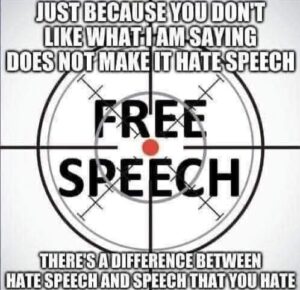
Free Speech
Image © unknown via Wake Up on Facebook

What is Freedom Of Speech and do we have it, especially here in England and the rest of the United Kingdom? The answer is yes, barely, but it is looking more likely as each year passes that it will disappear unless we STAND UP for our rights.

Whatever is thrown at us we SHOULD NOT be made to feel afraid and NEVER stop speaking out on what we believe is  RIGHT as long as we cause no harm or hate towards anyone and DO NOT cause criminal damage. I am NOT a violent man and I DO NOT condone any of the things I have mentioned.

We are all entitled to our opinions and we can RESPECTABLY agree to disagree on  them, but remember RESPECT GOES BOTH WAYS, and if your opinion drowns out mine and you have no respect for me or my opinions then you are opinionated and I have no room in my life for anyone like that. 

If people are being silenced for their opinions because they don’t fit the narrative of whoever is giving theirs then it is WRONG.

This page explains what Freedom Of Speech is and, for me, to PEACEFULLY express how I feel about certain topics.  Many will agree with me and many won’t but if my right to express myself is overruled or punished by others who clearly do not have peaceful intentions, and want to shut me up, and many like me, and jail us for our rightful opinions of something that isn’t just, then they become tyrannical oppressors.

I am a loving, peaceful man but I have a right to be angry about things I disagree with as long as I do so in a non-violent way.  I have a right to protect my Kids and Grandkids and want a better, safer future for them without being labelled far right whilst certain people are protected by two-tier policing and are allowed to do things that are against the law.  They are NOT punished for their actions and face no consequences.  How is that fair?

I am tired of becoming a second-class citizen in my own country and something has to change for the better and it has to happen much sooner than later.  

WRONG IS WRONG AND ENOUGH IS ENOUGH!

About Freedom Of Speech

Freedom of speech is a principle that supports the freedom of an individual or a community to articulate their opinions and ideas without fear of retaliation, censorship, or legal sanction. The right to freedom of expression has been recognised as a human right in the Universal Declaration of Human Rights and international human rights law by the United Nations.  Many countries have constitutional law that protects free speech.  Terms like free speech, freedom of speech, and freedom of expression are used interchangeably in political discourse.  However, in a legal sense, freedom of expression includes any activity of seeking, receiving, and imparting information or ideas, regardless of the medium used. 

Article 19 of the U.D.H.R. states that everyone shall have the right to hold opinions without interference and everyone shall have the right to freedom of expression.  This right shall include freedom to seek, receive, and impart information and ideas of all kinds, regardless of frontiers, either orally, in writing or in print, in the form of art, or through any other media of his choice.  The version of Article 19 in the I.C.C.P.R. later amends this by stating that the exercise of these rights carries special duties and responsibilities and may therefore be subject to certain restrictions when necessary for respect of the rights or reputation of others or the protection of national security or public order, or public health or morals.

Freedom of speech and expression, therefore, may not be recognised as being absolute, and common limitations or boundaries to freedom of speech relate to libel, slander, obscenity, pornography, sedition, incitement, fighting words, hate speech, classified information, copyright violation, trade secrets, food labelling, non-disclosure agreements, the right to privacy, dignity, the right to be forgotten, public security,  blasphemy and perjury. Justifications for such include the harm principle, proposed by John Stuart Mill in On Liberty, which suggests that the only purpose for which power can be rightfully exercised over any member of a civilised community, against his will, is to prevent harm to others.

The idea of the offence principle is also used to justify speech limitations, describing the restriction on forms of expression deemed offensive to society, considering factors such as extent, duration, motives of the speaker, and ease with which it could be avoided.  With the evolution of the digital age, the application of freedom of speech becomes more controversial as new means of communication and restrictions arise, for example, the Golden Shield Project, an initiative by the Chinese government’s Ministry of Public Security that filters potentially unfavourable data from foreign countries.  Facebook routinely and automatically eliminates what it perceives as hate speech, even if such words are used ironically or poetically with no intent to insult others.

The Human Rights Measurement Initiative measures the right to opinion and expression for countries around the world, using a survey of in-country human rights experts.

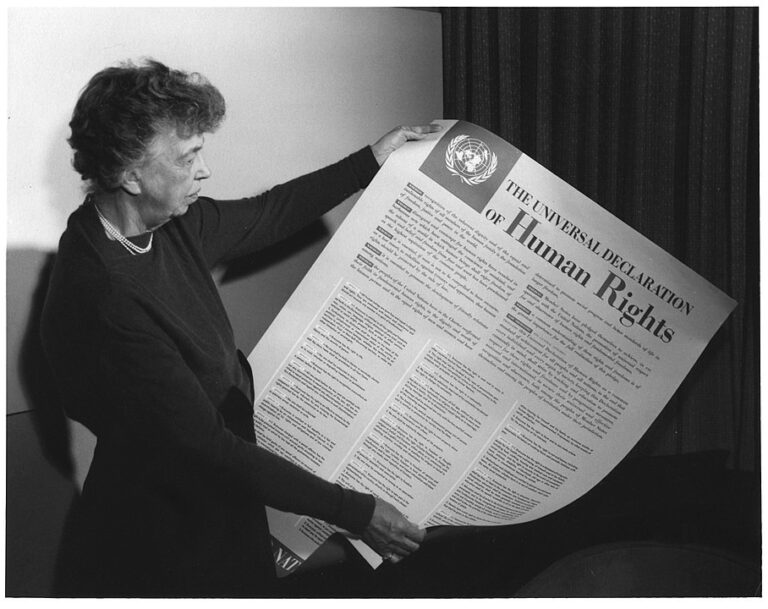
Eleanor Roosevelt And The Universal Declaration Of Human Rights In 1949
Image © Unknown via Wikipedia

Eleanor Roosevelt and the Universal Declaration of Human Rights in 1949.

From the F.D.R. Presidential Library & Museum.

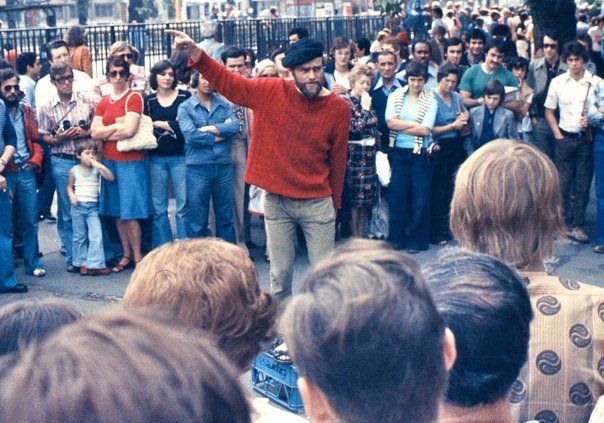
An Orator And Crowd At Speakers Corner, London In 1974
Image © of BeenAroundAWhile via Wikipedia

An Orator and Crowd at Speakers Corner, London in 1974.

Taken in Hyde Park.

The History Of Freedom Of Speech

Freedom of speech and expression has a long history that predates modern international human rights instruments.  It is thought that the ancient Athenian democratic principle of free speech may have emerged in the late 6th or early 5th century B.C.

Freedom of speech was vindicated by Erasmus and Milton.  Edward Coke claimed freedom of speech as an ancient custom of Parliament in the 1590’s, and it was affirmed in the Protestation of 1621.  Restating what is written in the English Declaration of Rights, 1689, England’s Bill of Rights 1689 legally established the constitutional right of freedom of speech in Parliament, which is still in effect.  This so-called parliamentary privilege includes no possible defamation claims meaning Parliamentarians are free to speak up in the House without fear of legal action.  This protection extends to written proceedings, for example, written and oral questions, motions and amendments tabled to bills and motions.

One of the world’s first freedom of the press acts was introduced in Sweden in 1766 (Swedish Freedom of the Press Act), mainly due to the classical liberal member of parliament and Ostrobothnian priest Anders Chydenius.  In a report published in 1776, he wrote:

“No evidence should be needed that a certain freedom of writing and printing is one of the strongest bulwarks of a free organisation of the state, as, without it, the estates would not have sufficient information for the drafting of good laws, and those dispensing justice would not be monitored, nor would the subjects know the requirements of the law, the limits of the rights of government, and their responsibilities.  Education and ethical conduct would be crushed. Coarseness in thought, speech, and manners would prevail, and dimness would darken the entire sky of our freedom in a few years.”

Under the leadership of Anders Chydenius, the Caps at the Swedish Riksdag in Gavle on the 2nd of December, 1766, the adoption of a freedom of the press regulation that stopped censorship and introduced the principle of public access to official records in Sweden was passed.  Excluded were defamation of the king’s majesty and the Swedish Church.

The Declaration of the Rights of Man and of the Citizen, adopted during the French Revolution in 1789, specifically affirmed freedom of speech as an inalienable right.  Adopted in 1791, freedom of speech is a feature of the First Amendment to the United States Constitution.  The French Declaration provides for freedom of expression in Article 11, which states that:

“The free communication of ideas and opinions is one of the most precious of the rights of man.  Every citizen may, accordingly, speak, write, and print with freedom, but shall be responsible for such abuses of this freedom as shall be defined by law.

Article 19 of the Universal Declaration of Human Rights, adopted in 1948, states that:

“Everyone has the right to freedom of opinion and expression.  This right includes the freedom to hold opinions without interference and to seek, receive and impart information and ideas through any media regardless of frontiers.

Today, freedom of speech, or the freedom of expression, is recognised in international and regional human rights law.  The right is enshrined in Article 19 of the International Covenant on Civil and Political Rights, Article 10 of the European Convention on Human Rights, Article 13 of the American Convention on Human Rights and Article 9 of the African Charter on Human and Peoples’ Rights.  Based on John Milton’s arguments, freedom of speech is understood as a multi-faceted right that includes not only the right to express, or disseminate, information and ideas but three further distinct aspects, which are, the right to seek information and ideas, the right to receive information and ideas and the right to impart information and ideas.

International, regional and national standards also recognise that freedom of speech, as the freedom of expression, includes any medium, whether orally, in writing, in print, through the internet or in art forms.  This means that the protection of freedom of speech as a right includes the content and the means of expression.

Relationship To Other Rights

The right to freedom of speech and expression is closely related to other rights.  It may be limited when conflicting with other rights (see limitations on freedom of speech below). The right to freedom of expression is also related to the right to a fair trial and court proceeding which may limit access to the search for information, or determine the opportunity and means in which freedom of expression is manifested within court proceedings.  As a general principle freedom of expression may not limit the right to privacy, as well as the honour and reputation of others.  However, greater latitude is given when criticism of public figures is involved.

The right to freedom of expression is particularly important for media, which play a special role as the bearer of the general right to freedom of expression for all.  However, freedom of the press does not necessarily enable freedom of speech.  Judith Lichtenberg has outlined conditions in which freedom of the press may constrain freedom of speech.  For example, if all the people who control the various mediums of publication suppress information or stifle the diversity of voices inherent in freedom of speech.  This limitation was famously summarised by the New Yorker on the 14th of May, 1960, as freedom of the press is guaranteed only to those who own one.  Lichtenberg argues that freedom of the press is simply a form of property right summed up by the principle of no money, no voice.

As A Negative Right

Freedom of speech is usually seen as a negative right.  This means that the government is legally obliged to take no action against the speaker based on the speaker’s views, but that no one is obliged to help any speakers publish their views, and no one is required to listen to, agree with, or acknowledge the speaker or the speaker’s views.  These concepts correspond to earlier traditions of natural law and common law rights.

Democracy In Relation To Social Interaction

Freedom of speech is understood to be fundamental in a democracy.  The norms on limiting freedom of expression mean that public debate may not be completely suppressed even in times of emergency.  One of the most notable proponents of the link between freedom of speech and democracy is Alexander Meiklejohn.  He has argued that the concept of democracy is that of self-government by the people.  For such a system to work, an informed electorate is necessary.  To be appropriately knowledgeable, there must be no constraints on the free flow of information and ideas.  According to Meiklejohn, democracy will not be true to its essential ideal if those in power can manipulate the electorate by withholding information and stifling criticism.  Meiklejohn acknowledges that the desire to manipulate opinion can stem from the motive of seeking to benefit society.  However, he argues, choosing manipulation negates, in its means, the democratic ideal.

Eric Barendt has called this defence of free speech on the grounds of democracy probably the most attractive and certainly the most fashionable free speech theory in modern Western democracies.  Thomas I. Emerson expanded on this defence when he argued that freedom of speech helps to provide a balance between stability and change.  Freedom of speech acts as a safety valve to let off steam when people might otherwise be bent on revolution.  He argues that the principle of open discussion is a method of achieving a more adaptable and at the same time more stable community, of maintaining the precarious balance between healthy cleavage and necessary consensus.  Emerson furthermore maintains that opposition serves a vital social function in offsetting or ameliorating the normal process of bureaucratic decay.

Research undertaken by the Worldwide Governance Indicators project at the World Bank indicates that freedom of speech, and the process of accountability that follows it, have a significant impact on the quality of governance of a country.  Voice and Accountability within a country, defined as the extent to which a country’s citizens can participate in selecting their government, as well as freedom of expression, freedom of association, and free media is one of the six dimensions of governance that the Worldwide Governance Indicators measure for more than 200 countries.  Against this backdrop, development agencies must create grounds for effective support for a free press in developing countries.

Richard Moon has developed the argument that the value of freedom of speech and freedom of expression lies in social interactions.  Moon said that by communicating an individual forms relationships and associations with others such as family, friends, co-workers, church congregation, and countrymen.  By entering into discussion with others an individual participates in the development of knowledge and the direction of the community.

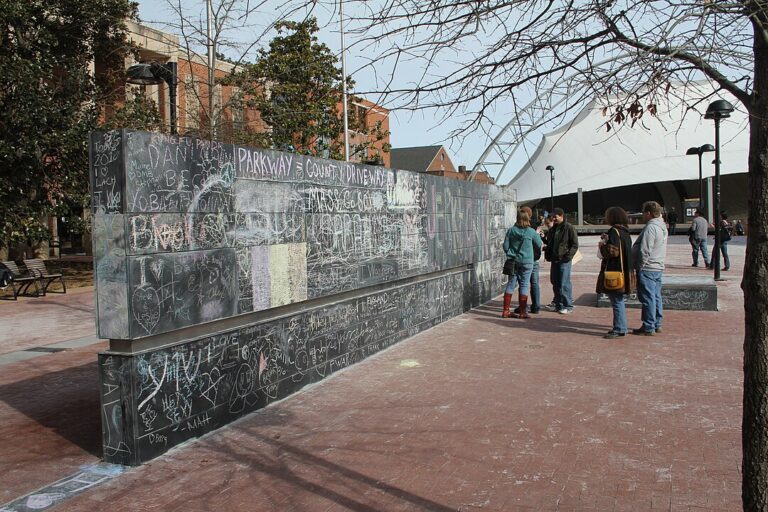
The Permanent Free Speech Wall In Charlottesville, Virginia, U.S.A.
Image © of Daniel Rothamel via Wikipedia

The permanent Free Speech Wall In Charlottesville, Virginia, U.S.A.

Limitations Of Freedom Of Speech

Read more here and here. 

Freedom of speech is not regarded as absolute by some, with most legal systems generally setting limits on the freedom of speech, particularly when freedom of speech conflicts with other rights and protections, such as in the cases of libel, slander, pornography, obscenity, fighting words, and intellectual property.

In fact, during the transition period between freedom of speech and media ethics, the yellow media prevailed in the United States, and the media in the past focused on how stimulating and interesting people rather than facts.  As a result, there were articles in the media that were at odds with other rights, such as defamation, slander, and pornography, and minimum censorship and media ethics were needed to prevent them.

Some limitations to freedom of speech may occur through legal sanction, and others may occur through social disapprobation.  In Saudi Arabia, journalists are forbidden to write with disrespect or disapproval of the royal family, religion, or the government.  Journalists are also not given any legal protection for their writing in Saudi Arabia. Journalist Jamal Khashoggi was a critic of the Saudi Arabian government.  He was killed in 2018 by Saudi Arabian officials for his writing.

2022 Holocaust Denial Laws
Image © of Beyond My Ken via Wikipedia

2022 Holocaust Denial Laws.

The Holocaust denial laws globally in 2022 above show red being illegal, pink in the process of being illegal.  It was pdated to make Canada red.

Content Viewed As Harmful And Offensive

Some views are illegal to express because they are perceived by some to be harmful to others.  This category often includes speech that is both false and potentially dangerous, for example, such as falsely shouting “Fire!” in a theatre and causing panic.  Justifications for limitations to freedom of speech often reference the harm principle or the offence principle.

In On Liberty (1859), John Stuart Mill argued that there ought to exist the fullest liberty of professing and discussing, as a matter of ethical conviction, any doctrine, however immoral it may be considered.  Mill argues that the fullest liberty of expression is required to push arguments to their logical limits, rather than the limits of social embarrassment.

In 1985, Joel Feinberg introduced what is known as the offence principle.  Feinberg said it is always a good reason in support of a proposed criminal prohibition that it would probably be an effective way of preventing serious offence (as opposed to injury or harm) to persons other than the actor, and that it is probably a necessary means to that end.  Hence Feinberg argues that the harm principle sets the bar too high and that some forms of expression can be legitimately prohibited by law because they are very offensive.  Nevertheless, as offending someone is less serious than harming someone, the penalties imposed should be higher for causing harm.  In contrast, Mill does not support legal penalties unless they are based on the harm principle.  Because the degree to which people may take offence varies or may be the result of unjustified prejudice, Feinberg suggests that several factors need to be taken into account when applying the offence principle, including the extent, duration and social value of the speech, the ease with which it can be avoided, the motives of the speaker, the number of people offended, the intensity of the offence, and the general interest of the community at large.

Jasper Doomen argued that harm should be defined from the point of view of the individual citizen, not limiting harm to physical harm since nonphysical harm may also be involved.  Feinberg’s distinction between harm and offence is criticised as largely trivial.

In 1999, Bernard Harcourt wrote about the collapse of the harm principle by saying, “Today the debate is characterised by a cacophony of competing harm arguments without any way to resolve them.  There is no longer an argument within the structure of the debate to resolve the competing claims of harm.  The original harm principle was never equipped to determine the relative importance of harms”.

Interpretations of both the harm and offence limitations to freedom of speech are culturally and politically relative.   Many European countries outlaw speech that might be interpreted as Holocaust denial.  These include Austria, Belgium, Canada, the Czech Republic, France, Germany, Hungary, Israel, Liechtenstein, Lithuania, Luxembourg, the Netherlands, Poland, Portugal, Russia, Slovakia, Switzerland and Romania.  Armenian genocide denial is also illegal in some countries.

Certain public institutions may also enact policies restricting the freedom of speech, for example, speech codes at state-operated schools.

In the U.S., the standing landmark opinion on political speech is Brandenburg Ohio (1969)expressly overruling Whitney v California.  In Brandenburg, the U.S. Supreme Court referred to the right even to speak openly of violent action and revolution in broad terms:

“Our decisions have fashioned the principle that the constitutional guarantees of free speech and free press do not allow a State to forbid or proscribe advocacy of the use of force or law violation except where such advocacy is directed to inciting or producing imminent lawless action and is likely to incite or cause such action.

The opinion in Brandenburg discarded the previous test of clear and present danger and made the right to freedom of (political) speech protections in the United States almost absolute.  Hate speech is also protected by the First Amendment in the United States, as decided in R.A.V. v. City of St. Paul, (1992) in which the Supreme Court ruled that hate speech is permissible, except in the case of imminent violence.  The First Amendment to the United States Constitution gives more detailed information on this decision and its historical background.

Time, Place And Manner

Read more here.

Limitations based on time, place, and manner apply to all speech, regardless of the view expressed.  They are generally restrictions that are intended to balance other rights or a legitimate government interest.  For example, a time, place, and manner restriction might prohibit a noisy political demonstration at a politician’s home during the middle of the night, as that impinges upon the rights of the politician’s neighbours to quiet enjoyment of their own homes.  An otherwise identical activity might be permitted if it happened at a different time (e.g., during the day), at a different place (e.g., at a government building or in another public forum), or in a different manner (e.g., a silent protest).  Funeral Protests are a complex issue in the United States.  It is the right of Americans to be able to hold a peaceful protest against various policies they deem unreasonable.  It is a question of whether or not it is appropriate through the time, place and manner outlook to protest funeral proceedings.  Because of recent flare-ups of this occurring, legislation has been put into action to limit this.  Now, funeral protests are governed and prohibited by law on a state-to-state basis inside the United States.

The Internet And Information Society

Jo Glanville, editor of the Index on Censorship, states that the Internet has been a revolution for censorship as much as for free speech.  International, national and regional standards recognise that freedom of speech, as one form of freedom of expression, applies to any medium, including the Internet.  The Communications Decency Act (C.D.A.) of 1996 was the first major attempt by the United States Congress to regulate pornographic material on the Internet.  In 1997, in the landmark cyberlaw case of Reno v. ACLU, the U.S. Supreme Court partially overturned the law.  Judge Stewart R. Dalzell, one of the three federal judges who in June 1996 declared parts of the C.D.A. unconstitutional, in his opinion stated the following:

“The Internet is a far more speech-enhancing medium than print, the village green, or the mails.  Because it would necessarily affect the Internet itself, the C.D.A. would necessarily reduce the speech available for adults on the medium.  This is a constitutionally intolerable result.  Some of the dialogue on the Internet surely tests the limits of conventional discourse.  Speech on the Internet can be unfiltered, unpolished, and unconventional, even emotionally charged, sexually explicit, and vulgar, in a word, indecent in many communities.  But we should expect such speech to occur in a medium in which citizens from all walks of life have a voice.  We should also protect the autonomy that such a medium confers to ordinary people as well as media magnates.  My analysis does not deprive the Government of all means of protecting children from the dangers of Internet communication.  The Government can continue to protect children from pornography on the Internet through vigorous enforcement of existing laws criminalising obscenity and child pornography.  As we learned at the hearing, there is also a compelling need for public educations about the benefits and dangers of this new medium, and the Government can fill that role as well.  In my view, our action today should only mean that Government’s permissible supervision of Internet contents stops at the traditional line of unprotected speech.  The absence of governmental regulation of Internet content has unquestionably produced a kind of chaos, but as one of the plaintiff’s experts put it with such resonance at the hearing: “What achieved success was the very chaos that the Internet is. The strength of the Internet is chaos.”  Just as the strength of the Internet is chaos, so that strength of our liberty depends upon the chaos and cacophony of the unfettered speech the First Amendment protects.”

The World Summit on the Information Society (W.S.I.S.) Declaration of Principles adopted in 2003 makes specific reference to the importance of the right to freedom of expression for the Information Society in stating:

We reaffirm, as an essential foundation of the Information society, and as outlined in Article 19 of the Universal Declaration of Human Rights, that everyone has the right to freedom of opinion and expression, that this right includes freedom to hold opinions without interference and to seek, receive and impart information and ideas through any media and regardless of frontiers.  Communication is a fundamental social process, a basic human need and the foundation of all social organisation. It is central to the Information Society.  Everyone, everywhere should have the opportunity to participate and no one should be excluded from the benefits of the Information Society offers.”

According to Bernt Hugenholtz and Lucie Guibault, the public domain is under pressure from the commodification of information as information with previously little or no economic value has acquired independent economic value in the information age.  This includes factual data, personal data, genetic information and pure ideas.  The commodification of information is taking place through intellectual property law, contract law, as well as broadcasting and telecommunications law.

The Free Speech Flag
Image © of John Marcotte via Wikipedia and is in the Public Domain

The Free Speech Flag.

“Our government has become increasingly willing to sacrifice the rights of its citizens at the altar of corporate greed.  As ridiculous as it sounds, even numbers have become “intellectual property” that corporations can claim ownership of.  We here at Badmouth think that idea stinks.  We want to start a movement, a movement to reclaim personal liberties and decorporatise the laws of our nation.  To that end we have made a flag, a symbol to show support for personal freedoms.  Spread it as far and wide as you can.  We give this flag away freely, and also give away the rights for people to make similar, derivative works.  The colors of the flag are (in hex code format): #09F911 #029D74 #E35BD8 #4156C5 #635688. The letters “C0” are added to signify that simply publishing a number is “Crime Zero”.  Spread the word.” – Creator John Marcotte.

Freedom Of Information

Read more here.

Freedom of information is an extension of freedom of speech where the medium of expression is the Internet.  Freedom of information may also refer to the right to privacy in the context of the Internet and information technology.  As with the right to freedom of expression, the right to privacy is a recognised human right and freedom of information acts as an extension to this right.  Freedom of information may also concern censorship in an information technology context, i.e., the ability to access Web content, without censorship or restrictions.

Freedom of information is also explicitly protected by acts such as the Freedom of Information and Protection of Privacy Act of Ontario, in Canada.  The Access to Information Act gives Canadian citizens, permanent residents, and any person or corporation present in Canada a right to access records of government institutions that are subject to the Act.

Internet Censorship

Read more here and here.

The concept of freedom of information has emerged in response to state-sponsored censorship, monitoring and surveillance of the internet.  Internet censorship includes the control or suppression of the publishing or accessing of information on the Internet.  The Global Internet Freedom Consortium claims to remove blocks to the free flow of information for what they term closed societies.  According to Reporters without Borders (R.W.B), mainland China, Cuba, Iran, Myanmar/Burma, North Korea, Saudi Arabia, Syria, Turkmenistan, Uzbekistan, and Vietnam engage in pervasive internet censorship.

A widely publicised example of internet censorship is the Great Firewall of China (in reference both to its role as a network firewall and the ancient Great Wall of China).  The system blocks content by preventing I.P. addresses from being routed through and consists of standard firewall and proxy servers at the internet gateways.  The system also selectively engages in D.N.S. poisoning when particular sites are requested.  The government does not appear to be systematically examining Internet content, as this appears to be technically impractical.  Internet censorship in the People’s Republic of China is conducted under a wide variety of laws and administrative regulations, including more than sixty regulations directed at the Internet.  Censorship systems are vigorously implemented by provincial branches of state-owned I.S.P’s, business companies, and organisations.

Saudi Arabia’s government had been intensifying the scrutiny of social media accounts, under which they were detaining several activists, critics and even normal social media users over a few critical tweets.  A law professor, Awad Al-Qarni became a victim of Saudi’s internet censorship and was facing a death sentence.  Saudi-controlled media portrayed him as a dangerous preacher due to his X and WhatsApp posts, but dissidents considered him an important intellectual who maintained strong social media influence.

Relationship With Disinformation

Read more here.

Some legal scholars (such as Tim Wu of Columbia University) have argued that the traditional issues of free speech, the main threat to free speech, is the censorship of suppressive states, and that ill-informed or malevolent speech can and should be overcome by more and better speech rather than censorship assumes scarcity of information.  This scarcity prevailed during the 20th century, but with the arrival of the internet, information became plentiful but the attention of listeners was scarce.  Furthermore, in the words of Wu, this cheap speech made possible by the internet may be used to attack, harass, and silence as much as it is used to illuminate or debate.  The Electronic Frontier Foundation (E.F.F.) has argued that censorship cannot be the only answer to disinformation online and that tech companies have a history of overcorrecting and censoring accurate, useful speech or even worse, reinforcing misinformation with their policies.

According to Wu, in the 21st century, the danger is not suppressive states that target speakers directly, but that targets listeners or it undermines speakers indirectly.  More precisely, emerging techniques of speech control depend on (1) a range of new punishments, like unleashing troll armies to abuse the press and other critics, and (2) flooding tactics (sometimes called reverse censorship) that distort or drown out disfavored speech through the creation and dissemination of fake news, the payment of fake commentators, and the deployment of propaganda robots.

As journalist Peter Pomerantsev writes, these techniques employ information in weaponised terms, as a tool to confuse, blackmail, demoralise, subvert and paralyse.

History Of Dissent And Truth

The examples and perspectives below deal primarily with Western culture and do not represent a worldwide view of the subject.

Before the invention of the printing press, a written work, once created, could only be physically multiplied by highly laborious and error-prone manual copying.  No elaborate system of censorship and control over scribes existed, who until the 14th century were restricted to religious institutions, and their works rarely caused wider controversy.  In response to the printing press, and the theological heresies it allowed to spread, the Roman Catholic Church moved to impose censorship.  Printing allowed for multiple exact copies of a work, leading to a more rapid and widespread circulation of ideas and information.  The origins of copyright law in most European countries lie in efforts by the Roman Catholic Church and governments to regulate and control the output of printers.

In 1501, Pope Alexander VI issued a Bill against the unlicensed printing of books.  In 1559, Pope Paul IV promulgated the Index Expurgatorius, or List of Prohibited Books.  The Index Expurgatorius is the most famous and long-lasting example of bad books catalogues issued by the Roman Catholic Church, which presumed to be in authority over private thoughts and opinions, and suppressed views that went against its doctrines.  The Index Expurgatorius was administered by the Roman Inquisition, but enforced by local government authorities, and went through 300 editions.  Amongst others, it banned or censored books written by René Descartes, Giordano Bruno, Galileo Galilei, David Hume, John Locke, Daniel Defoe, Jean-Jacques Rousseau and Voltaire. While governments and the church encouraged printing in many ways because it allowed for the dissemination of Bibles and government information, works of dissent and criticism could also circulate rapidly.  Consequently, governments established controls over printers across Europe, requiring them to have official licenses to trade and produce books.

The notion that the expression of dissent or subversive views should be tolerated, not censured or punished by law, developed alongside the rise of printing and the press.  Areopagitica, published in 1644, was John Milton’s response to the Parliament of England’s re-introduction of government licensing of printers, hence publishers.  Church authorities had previously ensured that Milton’s essay on the right to divorce was refused a license for publication.  In Areopagitica, published without a license, Milton made an impassioned plea for freedom of expression and toleration of falsehood, stating:

“Give me the liberty to know, to utter, and to argue freely according to conscience, above all liberties.

Milton’s defence of freedom of expression was grounded in a Protestant worldview.  He thought that the English people had the mission to work out the truth of the Reformation, which would lead to the enlightenment of all people.  Nevertheless, Milton also articulated the main strands of future discussions about freedom of expression.  By defining the scope of freedom of expression and harmful speech, Milton argued against the principle of pre-censorship and in favour of tolerance for a wide range of views.  Freedom of the press ceased being regulated in England in 1695 when the Licensing Order of 1643 was allowed to expire after the introduction of the Bill of Rights in 1689 shortly after the Glorious Revolution.  The emergence of publications like the Tatler (1709) and the Spectator (1711) are credited for creating a bourgeois public sphere in England that allowed for a free exchange of ideas and information.

More governments attempted to centralise control as the menace of printing spread.  The French crown repressed printing and the printer Etienne Dolet was burned at the stake in 1546.  In 1557 the British Crown thought to stem the flow of seditious and heretical books by chartering the Stationers’ Company.  The right to print was limited to the members of that guild and was restricted to two universities and the 21 existing printers in the city of London, which had 53 printing presses.  As the British crown took control of type founding in 1637, printers fled to the Netherlands.  Confrontation with authority made printers radical and rebellious, with 800 authors, printers, and book dealers being incarcerated in the Bastille in Paris before it was stormed in 1789.

A succession of English thinkers was at the forefront of early discussion on the right to freedom of expression, among them John Milton (1608 – 74) and John Locke (1632 – 1704).  Locke established the individual as the unit of value and the bearer of rights to life, liberty, property and the pursuit of happiness.  However, Locke’s ideas evolved primarily around the concept of the right to seek salvation for one’s soul.  He was thus primarily concerned with theological matters.  Locke neither supported a universal toleration of peoples nor freedom of speech,  according to his ideas some groups, such as atheists, should not be allowed.

By the second half of the 17th century philosophers on the European continent like Baruch Spinoza and Pierre Bayle developed ideas encompassing a more universal aspect of freedom of speech and toleration than the early English philosophers.  By the 18th century, the idea of freedom of speech was being discussed by thinkers all over the Western world, especially by French philosophes like Denis Diderot, Baron d’Holbach and Claude Adrien Helvetius.  The idea began to be incorporated in political theory both in theory as well as practice, the first state edict in history proclaiming complete freedom of speech was the one issued on the 4th of December, 1770 in Denmark-Norway during the regency of Johann Friedrich Struensee.  However Struensee himself imposed some minor limitations to this edict on the 7th of October, 1771, and it was even further limited after the fall of Struensee with legislation introduced in 1773, although censorship was not reintroduced.

John Stuart Mill (1806 – 1873) argued that without human freedom, there could be no progress in science, law, or politics, which according to Mill, required free discussion of opinion.  Mill’s On Liberty, published in 1859, became a classic defence of the right to freedom of expression.  Mill argued that truth drives out falsity, therefore the free expression of ideas, true or false, should not be feared.  Truth is not stable or fixed but evolves with time.  Mill argued that much of what we once considered true has turned out false.  Therefore, views should not be prohibited for their apparent falsity.  Mill also argued that free discussion is necessary to prevent the deep slumber of a decided opinion.  Discussion would drive the march of truth, and by considering false views, the basis of true views could be re-affirmed.  Furthermore, Mill argued that an opinion only carries intrinsic value to the owner of that opinion, thus silencing the expression of that opinion is an injustice to a basic human right.  It is generally held that for Mill, the only instance in which speech can be justifiably suppressed is to prevent harm from a clear and direct threat.  Neither economic or moral implications nor the speaker’s well-being would justify suppression of speech.  However Mill in On Liberty suggests the speech of pimps (instigating clients and sex workers to have sex) should be restricted.  This suggests he may be willing to restrict some speech that, while not harming others, undermines their decisional autonomy.

In her 1906 biography of Voltaire, Evelyn Beatrice Hall coined the following sentence to illustrate Voltaire’s beliefs:

“I disapprove of what you say, but I will defend to the death your right to say it”.

Hall’s quote is frequently cited to describe the principle of freedom of speech.  Noam Chomsky stated:

“If you believe in freedom of speech, you believe in freedom of speech for views you don’t like.  Dictators such as Stalin and Hitler, were in favour of freedom of speech for views they liked only.  If you’re in favour of freedom of speech, that means you’re in favour of freedom of speech precisely for views you despise”.

Lee Bollinger argues that the free speech principle involves a special act of carving out one area of social interaction for extraordinary self-restraint, the purpose of which is to develop and demonstrate a social capacity to control feelings evoked by a host of social encounters.  Bollinger argues that tolerance is a desirable value, if not essential.  However, critics argue that society should be concerned by those who directly deny or advocate, for example, genocide (see limitations of freedom of speech above).

As chairman of the London-based P.E.N. International, a club which defends freedom of expression and a free press, English author H. G. Wells met with Stalin in 1934 and was hopeful of reform in the Soviet Union. However, during their meeting in Moscow, Wells said:

“The free expression of opinion, even of opposition opinion, I do not know if you are prepared yet for that much freedom here”.

The 1928 novel Lady Chatterley’s Lover by D. H. Lawrence was banned for obscenity in several countries, including the United Kingdom, the United States, Australia, Canada, and India.  In the late 1950’s and early 1960’s, it was the subject of landmark court rulings that saw the ban on obscenity overturned.  Dominic Sandbrook of The Telegraph in the U.K. wrote:

“Now that public obscenity has become commonplace, it is hard to recapture the atmosphere of a society that saw fit to ban books such as Lady Chatterley’s Lover because it was likely to deprave and corrupt its readers”.

Fred Kaplan of The New York Times stated the overturning of the obscenity laws set off an explosion of free speech in the U.S.   The 1960’s also saw the Free Speech Movement, a massive long-lasting student protest on the campus of the University of California, Berkeley, during the 1964 – 65 academic year.

In contrast to Anglophone nations, France was a haven for literary freedom.  The innate French regard for the mind meant that France was disinclined to punish literary figures for their writing, and prosecutions were rare.  While it was prohibited everywhere else, James Joyce’s Ulysses was published in Paris in 1922.  Henry Miller’s 1934 novel Tropic of Cancer (banned in the U.S. until 1963) and Lawrence’s Lady Chatterley’s Lover were published in France decades before they were available in the respective authors’ home countries.

In 1964 comedian Lenny Bruce was arrested in the U.S. due to complaints again about his use of various obscenities.  A three-judge panel presided over his widely publicised six-month trial.  He was found guilty of obscenity in November 1964.  He was sentenced on the 21st of December, 1964, to four months in a workhouse.  He was set free on bail during the appeals process and died before the appeal was decided.  On the 23rd of December, 2003, thirty-seven years after Bruce’s death, New York Governor George Pataki granted him a posthumous pardon for his obscenity conviction.

In the United States, the right to freedom of expression has been interpreted to include the right to take and publish photographs of strangers in public areas without their permission or knowledge.  This is not the case worldwide.

Image from Unknown via Wikipedia and is in the Public Domain

List Of Prohibited Books By Unknown (1564).

The Index Librorum Prohibitorum (List of Prohibited Books) is a list of publications which the Catholic Church censored for being a danger to itself and its members.  It was first printed in 1564 in Venice, Italy.

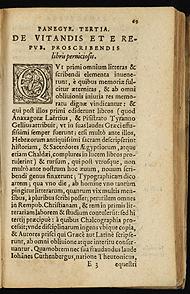
Panegyricae Orationes Septem By Henric Van Cuyck (1596)
Image From Henric Van Cuyck via Wikipedia and is in the Public Domain

Panegyricae Orationes Septem By Henric Van Cuyck (1596).

The Panegyricae Orationes Septem is by Henric Van Cuyck, the Bishop of Roermond (1546 – 1609). 

First printed in 1596, it is a collection of seven essays by Van Cuyck in the Netherlands, including one defending the need for censorship of the press.  He praised the essential role of writing within the history of Christian learning, but argued that the invention of printing by Johannes Gutenberg had resulted in a world infected by pernicious lies. 

Van Cuyck particularly singles out the writings of Martin Luther and Jean Calvin, the Talmud, and the Koran, as well as Erasmus of Rotterdam. He also lamented that prohibited books were what printers and booksellers profited from most.

Offences

Read more here.

In some countries, people are not allowed to talk about certain things such as Lese-majeste which is an offence against the dignity of a reigning sovereign or a state.  Doing so constitutes an offence.  For example, Saudi Arabia was responsible for executing journalist Jamal Khashoggi in 2018.  As he entered the Saudi embassy in Turkey, a team of Saudi assassins killed him.  Another Saudi writer, Raif Badawi, was arrested in 2012 and lashed.

On the 4th of March, 2022, Russian President Vladimir Putin signed into law a bill introducing prison sentences of up to 15 years for spreading fake news about Russia’s military operation in Ukraine.  As of December 2022, more than 4,000 Russians were prosecuted under fake news laws.  The 1993 Russian Constitution expressly prohibits censorship in Article 29 of Chapter 2, Rights and Liberties of Man and Citizen.

See Also

The above articles were taken from Wikipedia and are subject to change.

Blog Posts

Notes And Links

Wake Up on Facebook – The image shown at the top of this page is the copyright unknown via Wake Up’s page on Facebook.

The image above of Eleanor Roosevelt And The Universal Declaration Of Human Rights In 1949 is copyright of unknown and comes via Wikipedia.   It comes with a Creative Commons licence (CC BY 2.0).  

The image above of An Orator And Crowd At Speakers Corner, London In 1974 was the copyright of Wikipedia user BeenAroundAWhile.  It comes with a Creative Commons licence (CC BY-SA 3.0) 

The image above of The Permanent Free Speech Wall In Charlottesville, Virginia, U.S.A. is the copyright of Wikipedia user Daniel Rothamel.  It comes with a Creative Commons licence (CC BY 2.0). You can find more great work from him by clicking here.

The image above of 2022 Holocaust Denial Laws is the copyright of Wikipedia user Beyond My Ken.   It comes with a Creative Commons licence (CC BY-SA 4.0)

The image above of The Free Speech Flag is copyright of John Marcotte via Wikipedia.   It is in the Public Domain.  

The image above of List Of Prohibited Books By Unknown (1564) is copyright unknown via Wikipedia.   It is in the Public Domain.  

The image above of Panegyricae Orationes Septem By Henric Van Cuyck (1596) is via Wikipedia.   It is in the Public Domain.  

Elon Musk on X – This is his official X page.

Tommy Robinson on X – This is his official X page.

Urban Scoop on X – This is their official X page.

Katie Hopkins on X – This is her official X page.

Danny Tommo on X – This is his official X page.

Jordan Peterson on X – This is his official X page.

Liam Tuffs on X – This is his official X page.

James English on X – This is his official X page.

Laurence Fox on X – This is his official X page.

Calvin Robinson on X – This is his official X page.

Richard Inman on X – This is his official X page.

Jeff Taylor on X – This is his official X page.

Carl Benjamin on X – This is his official X page.

Mahyar Tousi on X – This is his official X page.

Sammy Woodhouse on X – This is her official X page.

Paul Joseph Watson on X – This is his official X page.

Alex Jones on X – This is his official X page.

Douglas Murray on X – This is his official X page.

Tucker Carlson on X – This is his official X page.

Rebel News Online on X – This is the official X page of Ezra Levant.

Avi Yemeni on X – This is his official X page.

Harman Singh Kapoor on X – This is his official X page.

Pat Condell on X – This is his official X page.

Lee Harris on X – This is his official X page.

Voice Of Wales on X – This is their official X page.

Stan Voice Of Wales on X – This is his official X page.

Gad Saad on X – This is his official X page.

Tamara Lich on X – This is her official X page.

Louise Distras on X – This is her official X page.

Kelly Lamb on X – This is her official X page.

Dominic Frisby on X – This is his official X page.

Geert Wilders on X – This is his official X page.

Donald Trump on X – This is his official X page. 

Holidays: Christmas

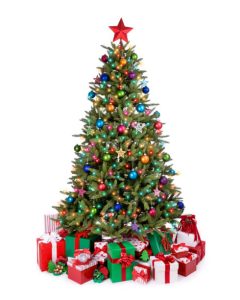
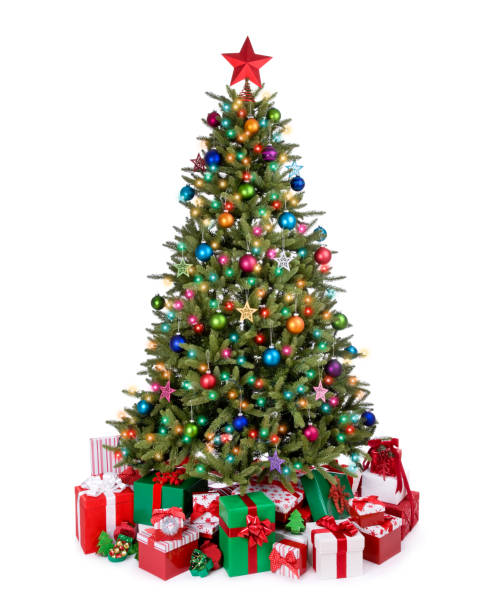
Image © of Liliboas via iStock

I have many happy memories over the decades, especially family ones from when I was younger in the 70’s and ’80s and when my kids were younger.  Sadly my mental health suffered in my adult years, especially in the 2010’s right up to the start of the 2020’s and it was difficult to enjoy them and love them like I used to but thankfully I can start to LOVE CHRISTMAS again.

For me, Christmas is about being with family and friends.  It is enjoying good company and eating, drinking and being merry.  It is reminiscing about the happy Christmases of old and remembering people and animals that shared those precious times with us but are no longer here with us.  It is about wonderful Christmas trees and the giving and recieving of presents.  It is about the beautiful colours that come with it.  It is about traditions.  It is about listening to Christmas music and watching Christmas films and programmes. It is about the spirit of Christmas and the feeling of peace.  It is not just a holiday, it is a state of mind.  

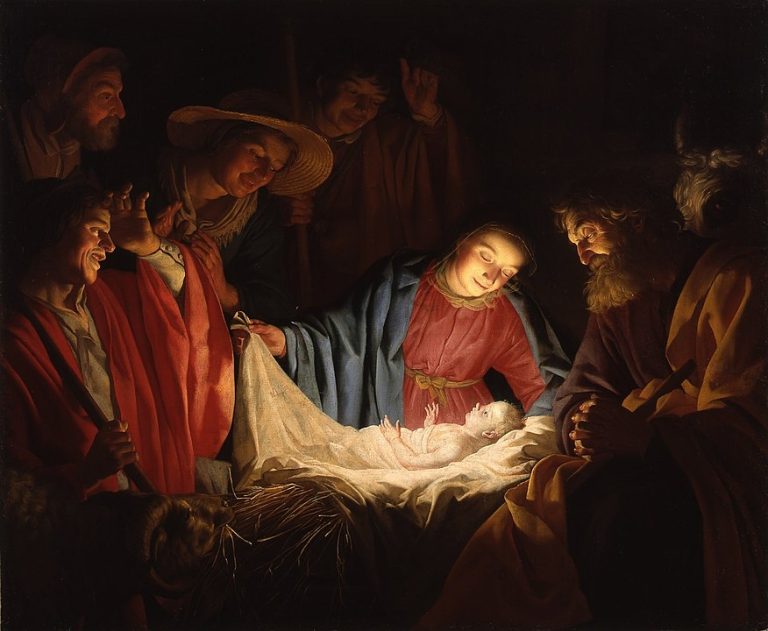
Living in the mostly Christian country of England when I was younger (not so much now) and being a former Christian myself I always celebrated Christmas regarding the birth of Jesus Christ.

The older I got, as an atheist, I came to realise the bible just contradicts itself and is full of fictional stories.  The date of that birth itself, December the 25th, can’t be agreed upon or proved throughout the centuries (and I’m not bothering to cover all that below) but to be honest I don’t care about the date or what did or didn’t happen on it or if anyone involved with it is real but that is not here or there.

I am someone who tries hard to avoid talking about religion, royalty and politics but it would be impossible to talk about Christmas and not refer to religion regarding what is written below, however, it is written respectfully.  As I have always said about religion, as long as it doesn’t involve harm or hatred and is peaceful, I will respect your right to believe whatever you like as long as you respect my right not to believe.  Royalty and politics are briefly mentioned as it is hard to avoid them when it is part of Christmas history but mainly I wanted to keep this page interesting and informative about Christmas.

If you are reading this in December then have a very HAPPY CHRISTMAS!

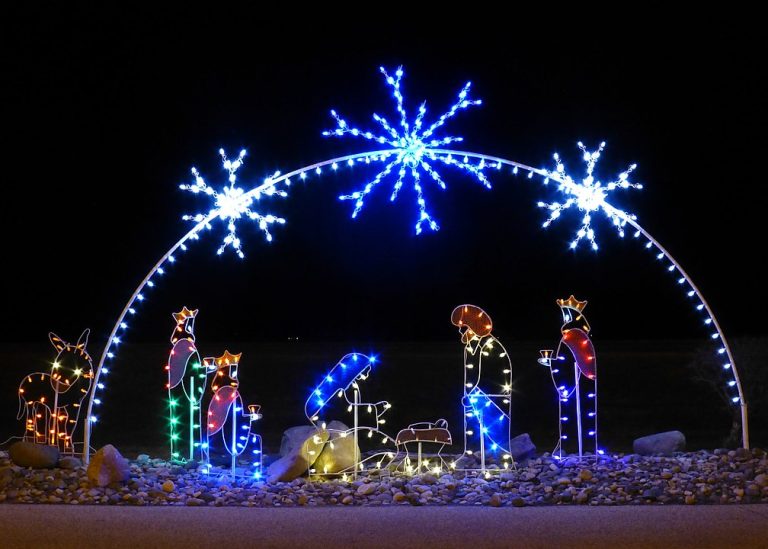
Image © of Crumpled Fire via Wikipedia

A Nativity Scene made with Christmas lights.

About Christmas

Christmas is an annual festival commemorating the birth of Jesus Christ, primarily observed on December the 25th as a religious and cultural celebration among billions of people around the world.  A feast central to the Christian liturgical year, it follows the season of Advent (which begins four Sundays before) or the Nativity Fast, and initiates the season of Christmastide, which historically in the West lasts twelve days and culminates on Twelfth Night.  Christmas Day is a public holiday in many countries, is celebrated religiously by a majority of Christians, as well as culturally by many non-Christians, and forms an integral part of the holiday season organised around it.

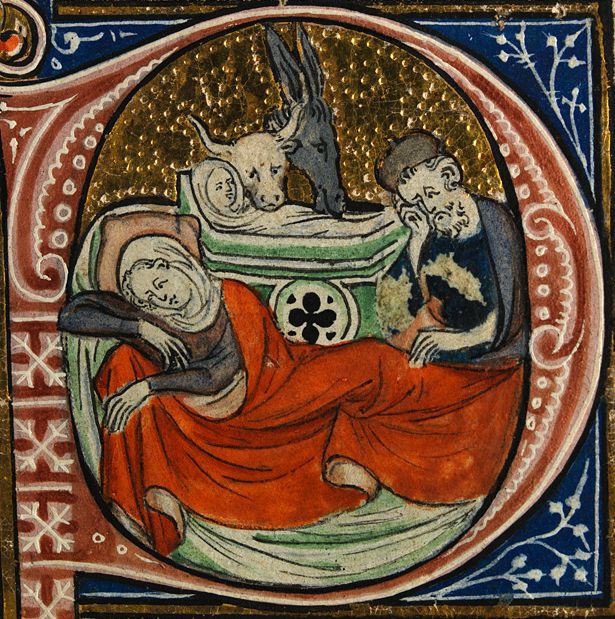
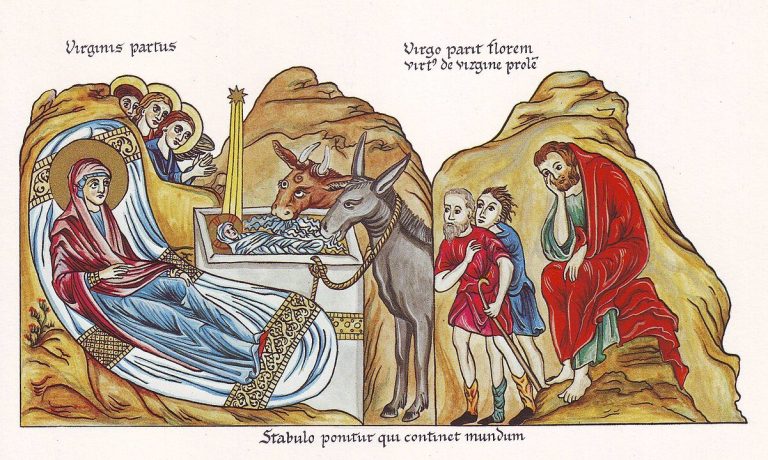
The traditional Christmas narrative recounted in the New Testament, known as the Nativity of Jesus, says that Jesus was born in Bethlehem, under messianic prophecies.  When Joseph and Mary arrived in the city, the inn had no room so they were offered a stable where the Christ Child was soon born, with angels proclaiming this news to shepherds who then spread the word.

There are different hypotheses regarding the date of Jesus’ birth and in the early fourth century, the church fixed the date as December the 25th.  This corresponds to the traditional date of the winter solstice on the Roman calendar.  It is exactly nine months after the Annunciation on March the 25th, also the date of the spring equinox.  Most Christians celebrate on December the 25th in the Gregorian calendar, which has been adopted almost universally in the civil calendars used in countries worldwide.  However, some of the Eastern Christian Churches celebrate Christmas on December the 25th of the older Julian calendar, which currently corresponds to January the 7th in the Gregorian calendar.  For Christians, believing that God came into the world in the form of man to atone for the sins of humanity, rather than knowing Jesus’ exact birth date, is considered to be the primary purpose of celebrating Christmas.
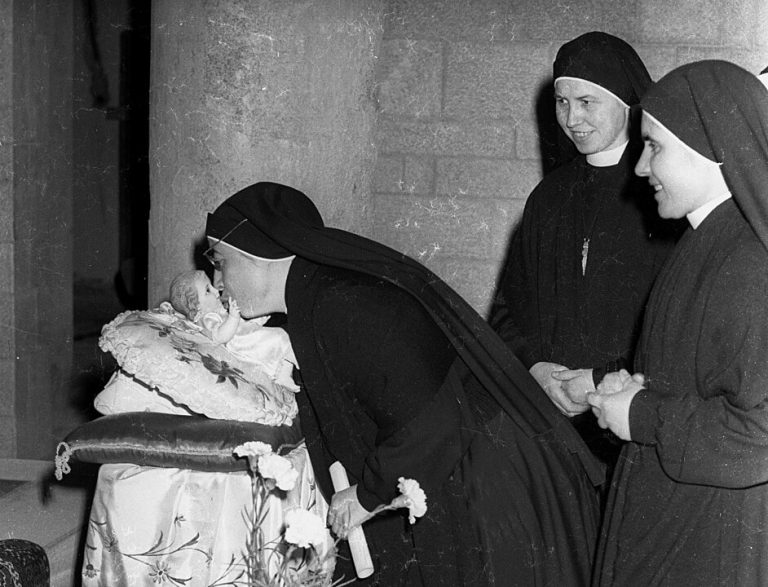
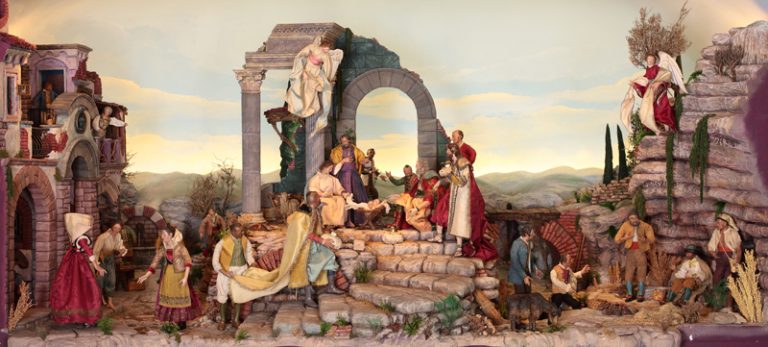
The celebratory customs associated in various countries with Christmas have a mix of pre-Christian, Christian, and secular themes and origins.  Popular modern customs of the holiday include gift giving, completing an Advent calendar or Advent wreath, Christmas music and caroling, watching Christmas movies, viewing a Nativity play, an exchange of Christmas cards, church services, a special meal, and the display of various Christmas decorations, including Christmas trees, Christmas lights, nativity scenes, garlands, wreaths, mistletoe, and holly. In addition, several closely related and often interchangeable figures, known as Father Christmas, Santa Claus,  Saint Nicholas, and the Christkind, are associated with bringing gifts to children during Christmas and have their own body of traditions and lore.  Because gift-giving and many other aspects of the Christmas festival involve heightened economic activity, the holiday has become a significant event and a key sales period for retailers and businesses.   Over the past few centuries, Christmas has had a steadily growing economic effect in many regions of the world. 

Etymology

Other Names 

In addition to Christmas, the holiday has had various other English names throughout its history.  The Anglo-Saxons referred to the feast as midwinter, or, more rarely, as Nātiuiteð, which comes from the Latin nātīvitās.  Nativity, meaning birth, is also from the Latin nātīvitāsIn Old English, Gēola (Yule) referred to the period corresponding to December and January, which was eventually equated with Christian Christmas.  Noel (also Nowel or Nowell, as in The First Nowell) entered English in the late 14th century and is from the Old French noël or naël, itself ultimately from the Latin nātālis (diēs) meaning birth (day).

Koleda is the traditional Slavic name for Christmas and the period from Christmas to Epiphany or, more generally, to Slavic Christmas-related rituals, some dating to pre-Christian times.

The History Of Christmas

In the 2nd century, the earliest church records indicate that Christians were remembering and celebrating the birth of Jesus, an observance that sprang up organically from the authentic devotion of ordinary believers although a set date was not agreed on.  Though Christmas did not appear on the lists of festivals given by the early Christian writers Irenaeus and Tertullian, the early Church Fathers John Chrysostom, Augustine of Hippo, and Jerome attested to December the 25th as the date of Christmas toward the end of the fourth century.  A passage in Commentary on the Prophet Daniel (AD 204) by Hippolytus of Rome identifies December the 25th as Jesus’s birth date, but this passage is considered a later interpolation.

In the East, the birth of Jesus was celebrated in connection with the Epiphany on January the 6th.  This holiday was not primarily about Christ’s birth, but rather his baptism.  Christmas was promoted in the East as part of the revival of Orthodox Christianity that followed the death of the pro-Arian Emperor Valens at the Battle of Adrianople in 378.  The feast was introduced in Constantinople in 379, in Antioch by John Chrysostom towards the end of the fourth century, probably in 388, and in Alexandria in the following century.  The Georgian Iadgari demonstrates that Christmas was celebrated in Jerusalem by the sixth century.

Post-Classical History

Christmas played a role in the Arian controversy of the fourth century.   After this controversy ran its course, the prominence of the holiday declined for a few centuries.

In the Early Middle Ages, Christmas Day was overshadowed by Epiphany, which in Western Christianity focused on the visit of the magi.  However, the medieval calendar was dominated by Christmas-related holidays.  The forty days before Christmas became the forty days of St. Martin (which began on November the 11th, the feast of St. Martin of Tours), now known as Advent.  In Italy, former Saturnalian traditions were attached to Advent.  Around the 12th century, these traditions transferred again to the Twelve Days of Christmas (December the 25th to January the 5th).  This is a time that appears in the liturgical calendars as Christmastide or Twelve Holy Days.

In 567, the Council of Tours put in place the season of Christmastide, proclaiming the twelve days from Christmas to Epiphany as a sacred and festive season, and established the duty of Advent fasting in preparation for the feast.  This was done to solve the administrative problem for the Roman Empire as it tried to coordinate the solar Julian calendar with the lunar calendars of its provinces in the east.

The prominence of Christmas Day increased gradually after Charlemagne was crowned Emperor on Christmas Day in 800.  King Edmund the Martyr was anointed on Christmas in 855 and King William I of England was crowned on Christmas Day 1066.

By the High Middle Ages, the holiday had become so prominent that chroniclers routinely noted where various magnates celebrated Christmas.  King Richard II of England hosted a Christmas feast in 1377 at which 28 oxen and 300 sheep were eaten.  The Yule boar was a common feature of medieval Christmas feasts.  Carolling also became popular and was originally performed by a group of dancers who sang.  The group was composed of a lead singer and a ring of dancers that provided the chorus.  Various writers of the time condemned carolling as lewd, indicating that the unruly traditions of Saturnalia and Yule may have continued in this form.  Misrule (drunkenness, promiscuity, gambling) was also an important aspect of the festival.  In England, gifts were exchanged on New Year’s Day, and there was a special Christmas ale.

Christmas during the Middle Ages was a public festival that incorporated ivy, holly, and other evergreens. Christmas gift-giving during the Middle Ages was usually between people with legal relationships, such as tenants and landlords.  The annual indulgence in eating, dancing, singing, sporting, and card playing escalated in England, and by the 17th century, the Christmas season featured lavish dinners, elaborate masques, and pageants.  In 1607, King James I insisted that a play be acted on Christmas night and that the court indulge in games.  It was during the Reformation in 16th – 17th-century Europe that many Protestants changed the gift bringer to the Christ Child or Christkindl, and the date of giving gifts changed from December the 6th to Christmas Eve.

Image is by unknown via Wikipedia and is in the public domain

The Nativity by unknown.

This beautiful image comes from a 14th-century Missal.  It is made from parchment and originates from East Anglia.   It is considered a very important manuscript as it is one of the earliest examples of a Missal of an English source. 

Sarum Missals were books produced by the Church during the Middle Ages for celebrating Mass throughout the year

Image is by Julius Schnorr von Carolsfeld via Wikipedia and is in the public domain

The Coronation of Charlemagne on Christmas of 800 by Julius Schnorr von Carolsfeld.

Modern History

17th And 18th Centuries

Following the Protestant Reformation, many of the new denominations, including the Anglican Church and Lutheran Church, continued to celebrate Christmas.  In 1629, the Anglican poet John Milton penned On the Morning of Christ’s Nativity, a poem that has since been read by many during Christmastide.  Donald Heinz, a professor at California State University, states that Martin Luther inaugurated a period in which Germany would produce a unique culture of Christmas, much copied in North America.  Among the congregations of the Dutch Reformed Church, Christmas was celebrated as one of the principal evangelical feasts.
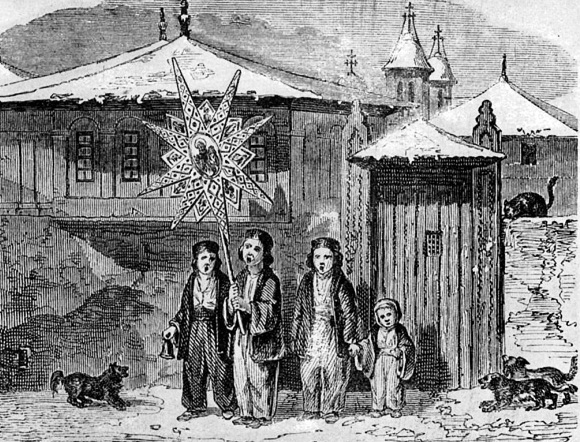
However, in 17th century England, some groups such as the Puritans strongly condemned the celebration of Christmas, considering it a Catholic invention and the trappings of popery or the rags of the Beast.  In contrast, the established Anglican Church pressed for a more elaborate observance of feasts, penitential seasons, and saints’ days.  The calendar reform became a major point of tension between the Anglican party and the Puritan party.  The Catholic Church also responded, promoting the festival in a more religiously oriented form.  King Charles I of England directed his noblemen and gentry to return to their landed estates in midwinter to keep up their old-style Christmas generosity.  Following the Parliamentarian victory over Charles I during the English Civil War, England’s Puritan rulers banned Christmas in 1647.

Protests followed as pro-Christmas rioting broke out in several cities and for weeks Canterbury was controlled by the rioters, who decorated doorways with holly and shouted royalist slogans.  Football, among the sports the Puritans banned on a Sunday, was also used as a rebellious force.  When Puritans outlawed Christmas in England in December 1647 the crowd brought out footballs as a symbol of festive misrule.  The book, The Vindication of Christmas (London, 1652), argued against the Puritans and makes note of Old English Christmas traditions, dinner, roast apples on the fire, card playing, dances with plow-boys and maidservants, old Father Christmas and carol singing.  During the ban, semi-clandestine religious services marking Christ’s birth continued to be held, and people sang carols in secret.

It was restored as a legal holiday in England with the Restoration of King Charles II in 1660 when Puritan legislation was declared null and void, with Christmas again freely celebrated in England.  Many Calvinist clergymen disapproved of Christmas celebrations.  As such, in Scotland, the Presbyterian Church of Scotland discouraged the observance of Christmas, and though James VI commanded its celebration in 1618, church attendance was scant.  The Parliament of Scotland officially abolished the observance of Christmas in 1640, claiming that the church had been purged of all superstitious observation of days.  Whereas in England, Wales and Ireland Christmas Day is a common law holiday, having been a customary holiday since time immemorial, it was not until 1871 that it was designated a bank holiday in Scotland.  The diary of James Woodforde, from the latter half of the 18th century, details the observance of Christmas and celebrations associated with the season over several years.

As in England, Puritans in Colonial America staunchly opposed the observation of Christmas.  The Pilgrims of New England pointedly spent their first 25th of December in the New World working normally.  Puritans such as Cotton Mather condemned Christmas both because scripture did not mention its observance and because Christmas celebrations of the day often involved boisterous behaviour.  Many non-Puritans in New England deplored the loss of the holidays enjoyed by the labouring classes in England.  Christmas observance was outlawed in Boston in 1659.  The ban on Christmas observance was revoked in 1681 by English governor Edmund Andros, but it was not until the mid-19th century that celebrating Christmas became fashionable in the Boston region.

At the same time, Christian residents of Virginia and New York observed the holiday freely.  Pennsylvania Dutch settlers, predominantly Moravian settlers of Bethlehem, Nazareth, and Lititz in Pennsylvania and the Wachovia settlements in North Carolina, were enthusiastic celebrators of Christmas.  The Moravians in Bethlehem had the first Christmas trees in America as well as the first Nativity Scenes.  Christmas fell out of favour in the United States after the American Revolution, when it was considered an English custom.  George Washington attacked Hessian (German) mercenaries on the day after Christmas during the Battle of Trenton on December the 26th, 1776.  Christmas was much more popular in Germany than in America at this time.

With the atheistic Cult of Reason in power during the era of Revolutionary France, Christian Christmas religious services were banned and the Three Kings cake was renamed the equality cake under anticlerical government policies.

Image is by Josiah King via Wikipedia and is in the public domain

The Examination and Tryal of Old Father Christmas by Josiah King.

This was published after Christmas and reinstated as a holy day in England.  It shows the frontispiece to King’s pamphlet The Examination and Tryal of Old Father Christmas, published in 1687. He had previously published a pamphlet with a very similar title The Examination and Tryall of Old Father Christmas in 1658 using the same image as the frontispiece.

19th Century

In the early 19th century, Christmas festivities and services became widespread with the rise of the Oxford Movement in the Church of England that emphasised the centrality of Christmas in Christianity and charity to the poor, along with Charles Dickens, Washington Irving, and other authors emphasising family, children, kind-heartedness, gift-giving, and Father Christmas (for Dickens) or Santa Claus (for Irving).

In the early-19th century, writers imagined Tudor-period Christmas as a time of heartfelt celebration. In 1843, Charles Dickens wrote the novel A Christmas Carol, which helped revive the spirit of Christmas and seasonal merriment.  Its instant popularity played a major role in portraying Christmas as a holiday emphasising family, goodwill, and compassion.

Dickens sought to construct Christmas as a family-centred festival of generosity, linking worship and feasting, within a context of social reconciliation.  Superimposing his humanitarian vision of the holiday, in what has been termed Carol Philosophy, Dickens influenced many aspects of Christmas that are celebrated today in Western culture, such as family gatherings, seasonal food and drink, dancing, games, and a festive generosity of spirit.  A prominent phrase from the tale, Merry Christmas, was popularised following the appearance of the story.  This coincided with the appearance of the Oxford Movement and the growth of Anglo-Catholicism, which led to a revival in traditional rituals and religious observances.

In 1822, Clement Clarke Moore wrote the poem A Visit From St. Nicholas (popularly known by its first line Twas the Night Before Christmas).  The poem helped popularise the tradition of exchanging gifts, and seasonal Christmas shopping began to assume economic importance.  This also started the cultural conflict between the holiday’s spiritual significance and its associated commercialism which some see as corrupting the holiday.  In her 1850 book The First Christmas in New England, Harriet Beecher Stowe includes a character who complains that the true meaning of Christmas was lost in a shopping spree.

While the celebration of Christmas was not yet customary in some regions in the U.S., Henry Wadsworth Longfellow detected a transition state about Christmas in New England in 1856.  He stated that the old Puritan feeling prevented it from being a cheerful, hearty holiday, though every year made it more so.  In Reading, Pennsylvania, a newspaper remarked in 1861, that “even our Presbyterian friends who have hitherto steadfastly ignored Christmas threw open their church doors and assembled in force to celebrate the anniversary of the Savior’s birth.”

The First Congregational Church of Rockford, Illinois, (although of genuine Puritan stock) was preparing for a grand Christmas jubilee, a news correspondent reported in 1864.  By 1860, fourteen states including several from New England had adopted Christmas as a legal holiday.  In 1875, Louis Prang introduced the Christmas card to Americans.  He has been called the father of the American Christmas card.  On June the 28th, 1870, Christmas was formally declared a United States federal holiday.

Image by John Leech via Wikipedia and is in the public domain

Scrooge’s Third Visitor by John Leech.

This image is from Charles Dickens’ A Christmas Carol published in 1843.  It is from one of four hand-coloured etchings included in the first edition.  There were also four black and white engravings.

Image by Joseph Lionel Williams via Wikipedia and is in the public domain

The Queen’s Christmas Tree at Windsor Castle by Joseph Lionel Williams.

This wood engraving print was made for The Illustrated London News, Christmas Number 1848.

Image by Adolph Tidemand via Wikipedia and is in the public domain

A Norwegian Christmas by Adolph Tidemand.

This painting is from 1846.

20th Century

During the First World War and particularly (but not exclusively) in 1914, a series of informal truces took place for Christmas between opposing armies.  The truces, which were organised spontaneously by fighting men, ranged from promises not to shoot (shouted at a distance to ease the pressure of war for the day) to friendly socialising, gift-giving and even sport between enemies.  These incidents became a well-known and semi-mythologised part of popular memory.  They have been described as a symbol of common humanity even in the darkest of situations and used to demonstrate to children the ideals of Christmas.

Up to the 1950’s in the United Kingdom, many Christmas customs were restricted to the upper and middle classes.   Most of the population had not yet adopted many Christmas rituals that later became popular, including Christmas trees.  Christmas dinner would normally include beef or goose, not turkey as would later be common.  Children would get fruit and sweets in their stockings rather than elaborate gifts.  The full celebration of a family Christmas with all the trimmings only became widespread with increased prosperity from the 1950’s.  National papers were published on Christmas Day until 1912.  Post was still delivered on Christmas Day until 1961.  League football matches continued in Scotland until the 1970’s while in England they ceased at the end of the 1950’s.

Image by unknown via Wikipedia and is in the public domain

The Christmas Visit by unknown.

This postcard is from circa 1910. 

Nativity

The gospels of Luke and Matthew describe Jesus as being born in Bethlehem to the Virgin Mary.   In the Gospel of Luke, Joseph and Mary travel from Nazareth to Bethlehem to be counted for a census, and Jesus is born there and placed in a manger. Angels proclaim him a saviour for all people, and three shepherds come to adore him.  In the Gospel of Matthew, by contrast, three magi follow a star to Bethlehem to bring gifts to Jesus, born the king of the Jews.  King Herod orders the massacre of all the boys less than two years old in Bethlehem, but the family flees to Egypt and later returns to Nazareth.

Read more about The Nativity here.

Image is by Gerard van Honthorst via Wikipedia and is in the public domain

Adoration of the Shepherds by Gerard van Honthorst.

This painting of Mary, Jesus and the shepherds was created in 1622.

Relation To Concurrent Celebrations

Many popular customs associated with Christmas developed independently of the commemoration of Jesus’ birth, with some claiming that certain elements are Christianised and have origins in pre-Christian festivals that were celebrated by pagan populations who were later converted to Christianity.  Other scholars reject these claims and affirm that Christmas customs largely developed in a Christian context.  The prevailing atmosphere of Christmas has also continually evolved since the holiday’s inception, ranging from a sometimes raucous, drunken, carnival-like state in the Middle Ages, to a tamer family-oriented and children-centered theme introduced in a 19th-century transformation.  The celebration of Christmas was banned on more than one occasion within certain groups, such as the Puritans and Jehovah’s Witnesses (who do not celebrate birthdays in general), due to concerns that it was too unbiblical.

Prior to and through the early Christian centuries, winter festivals were the most popular of the year in many European pagan cultures.  Reasons included the fact that less agricultural work needed to be done during the winter, as well as an expectation of better weather as spring approached.  Celtic winter herbs such as mistletoe and ivy, and the custom of kissing under a mistletoe, are common in modern Christmas celebrations in the English-speaking countries.

The pre-Christian Germanic peoples (including the Anglo-Saxons and the Norse) celebrated a winter festival called Yule, held in the late December to early January period, yielding modern English yule, today used as a synonym for Christmas.  In Germanic language-speaking areas, numerous elements of modern Christmas folk custom and iconography may have originated from Yule, including the Yule log, Yule boar, and the Yule goat.  Often leading a ghostly procession through the sky (the Wild Hunt), the long-bearded god Odin is referred to as the Yule one and Yule father in Old Norse texts, while other gods are referred to as Yule beings.  On the other hand, as there are no reliable existing references to a Christmas log prior to the 16th century, the burning of the Christmas block may have been an early modern invention by Christians unrelated to the pagan practice.

In eastern Europe also, pre-Christian traditions were incorporated into Christmas celebrations there, an example being the Koleda, which shares parallels with the Christmas carol.

Image is by Herrad of Landsberg via Wikipedia and is in the public domain

The Nativity of Christ by Herrad of Landsberg.

This 12th-century, medieval illustration is from the Hortus deliciarum.

Observance And Traditions

Christmas Day is celebrated as a major festival and public holiday in countries around the world, including many whose populations are mostly non-Christian. In some non-Christian areas, periods of former colonial rule introduced the celebration (e.g. Hong Kong); in others, Christian minorities or foreign cultural influences have led populations to observe the holiday. Countries such as Japan, where Christmas is popular despite there being only a small number of Christians, have adopted many of the cultural aspects of Christmas, such as gift-giving, decorations, and Christmas trees. A similar example is in Turkey, being Muslim-majority and with a small number of Christians, where Christmas trees and decorations tend to line public streets during the festival.

Among countries with a strong Christian tradition, a variety of Christmas celebrations have developed that incorporate regional and local cultures.

Read more about Observance And Traditions here and here.

Image © Israel Press and Photo Agency via Wikipedia

Christmas at the Annunciation Church in Nazareth.

This photo by Dan Hadani, from his collection Collection at the National Library of Israel, was taken on Christmas Eve, 1965.

Decorations

Nativity scenes are known from 10th-century Rome. They were popularised by Saint Francis of Assisi from 1223, quickly spreading across Europe.  Different types of decorations developed across the Christian world, dependent on local tradition and available resources, and can vary from simple representations of the crib to far more elaborate sets.  Renowned manger scene traditions include the colourful Krakow szopka in Poland, which imitate Krakow’s historical buildings as settings, the elaborate Italian presepi (Neapolitan, Genoese and Bolognese), or the Provencal creches in southern France, using hand-painted terracotta figurines called santons.  In certain parts of the world, notably Sicily, living nativity scenes following the tradition of Saint Francis are a popular alternative to static creches.  The first commercially produced decorations appeared in Germany in the 1860’s, inspired by paper chains made by children.  In countries where a representation of the Nativity scene is very popular, people are encouraged to compete and create the most original or realistic ones.  Within some families, the pieces used to make the representation are considered a valuable family heirloom.

The traditional colours of Christmas decorations are red, green, and gold.  Red symbolises the blood of Jesus, which was shed in his crucifixion, green symbolises eternal life, and in particular the evergreen tree, which does not lose its leaves in the winter and gold is the first colour associated with Christmas, as one of the three gifts of the Magi, symbolising royalty.

The Christmas tree was first used by German Lutherans in the 16th century, with records indicating that a Christmas tree was placed in the Cathedral of Strassburg in 1539, under the leadership of the Protestant Reformer, Martin Bucer.  In the United States, these German Lutherans brought the decorated Christmas tree with them.  The Moravians put lighted candles on the trees.  When decorating the Christmas tree, many individuals place a star at the top of the tree symbolising the Star of Bethlehem, a fact recorded by The School Journal in 1897.  Professor David Albert Jones of Oxford University wrote that in the 19th century, it became popular for people to also use an angel to top the Christmas tree in order to symbolise the angels mentioned in the accounts of the Nativity of Jesus.   Aditionally, in the context of a Christian celebration of Christmas, the Christmas tree, being evergreen in colour, is symbolic of Christ, who offers eternal life and the candles or lights on the tree represent the Light of the World.  Christian services for family use and public worship have been published for the blessing of a Christmas tree, after it has been erected.  The Christmas tree is considered by some as Christianisation of pagan tradition and ritual surrounding the Winter Solstice, which included the use of evergreen boughs, and an adaptation of pagan tree worship.  According to eighth-century biographer Æddi Stephanus, Saint Boniface (634 – 709), who was a missionary in Germany, took an ax to an oak tree dedicated to Thor and pointed out a fir tree, which he stated was a more fitting object of reverence because it pointed to heaven and it had a triangular shape, which he said was symbolic of the Trinity.  The English language phrase Christmas tree is first recorded in 1835 and represents an importation from the German language.

Since the 16th century, the poinsettia, a native plant from Mexico, has been associated with Christmas carrying the Christian symbolism of the Star of Bethlehem; in that country it is known in Spanish as the Flower of the Holy Night. Other popular holiday plants include holly, mistletoe, red amaryllis, and Christmas cactus.

Other traditional decorations include bells, candles, candy canes, stockings, wreaths, and angels.  Both the displaying of wreaths and candles in each window are a more traditional Christmas display.  The concentric assortment of leaves, usually from an evergreen, make up Christmas wreaths and are designed to prepare Christians for the Advent season.  Candles in each window are meant to demonstrate the fact that Christians believe that Jesus Christ is the ultimate light of the world.

Christmas lights and banners may be hung along streets, music played from speakers, and Christmas trees placed in prominent places.  It is common in many parts of the world for town squares and consumer shopping areas to sponsor and display decorations.  Rolls of brightly coloured paper with secular or religious Christmas motifs are manufactured to wrap gifts.  In some countries, Christmas decorations are traditionally taken down on the Twelfth Night.

Read more about Decorations here and here.

Image by unknown is from the Diocesan Museum of Sacred Art via Wikipedia

A typical Neapolitan Nativity scene by unknown.

This Eighteenth-century nativity scene painting is also known as a presepe or presepio and can be found at the Diocesan Museum of Sacred Art in Bilbao, Spain.  

Local creches are renowned for their ornate decorations and symbolic figurines, often mirroring daily life.

Image © of TaniaLuz via iStock

A Christmas tree and presents.

Image by Robert Knudsen is from the Kennedy Library via Wikipedia and is in the public domain

The official White House Christmas tree for 1962 by Robert Knudsen.

The official White House Christmas tree above is in the entrance hall.  It is usually located in the Blue Room, this was one of a few instances since 1961 where the tree has been displayed here.

It was presented by President John F. Kennedy and First Lady Jacqueline Kennedy at the Christmas Reception on the 12th of December, 1962 at the White House, U.S.A. 

Image © of PFAStudent via Wikipedia

The Christ Candle in the centre of an Advent wreath.

This is traditionally lit in many church services.  This one is in the chancel of Broadway United Methodist Church, located in New Philadelphia, U.S.A.

The Advent wreath consists of four coloured candles of the same size, arranged around a larger white Christ candle.

Nativity Play

For the Christian celebration of Christmas, the viewing of the Nativity play is one of the oldest Christmastime traditions, with the first reenactment of the Nativity of Jesus taking place in 1223 A.D.  In that year, Francis of Assisi assembled a Nativity scene outside of his church in Italy and children sung Christmas carols celebrating the birth of Jesus.  Each year, this grew larger and people travelled from afar to see Francis’ depiction of the Nativity of Jesus that came to feature drama and music.  Nativity plays eventually spread throughout all of Europe, where they remain popular.  Christmas Eve and Christmas Day church services often came to feature Nativity plays, as did schools and theatres.  In France, Germany, Mexico and Spain, Nativity plays are often reenacted outdoors in the streets.

Read more about Nativity Play here.

Image © of Wesley Fryer via Wikipedia

Children in Oklahoma reenact a Nativity play.

These children are performing their nativity play in 2007 at the First Presbyterian Church in Edmond, Oklahoma, U.S.A.

Music And Carols

The earliest extant specifically Christmas hymns appear in fourth-century Rome.  Latin hymns such as Veni redemptor gentium, written by Ambrose, Archbishop of Milan, were austere statements of the theological doctrine of the Incarnation in opposition to Arianism.  Corde natus ex Parentis (Of the Father’s love begotten) by the Spanish poet Prudentius (died 413) is still sung in some churches today.  In the 9th and 10th centuries, the Christmas Sequence or Prose was introduced in North European monasteries, developing under Bernard of Clairvaux into a sequence of rhymed stanzas. In the 12th century the Parisian monk Adam of St. Victor began to derive music from popular songs, introducing something closer to the traditional Christmas carol.  Christmas carols in English appear in a 1426 work of John Awdlay who lists twenty-five “caroles of Cristemas”, probably sung by groups of wassailers, who went from house to house.

Read more about Music And Carols here.

Christmas carolers in Jersey.

Image © of Man vyi via Wikipedia and is in the public domain
Image by unknown is via Wikipedia and is in the public domain

Child singers in Bucharest by unknown.

This picture is from 1842 and depicts the singers carrying a star with an icon of a saint on it.

Christmas Food

A special Christmas family meal is traditionally an important part of the holiday celebration, and the food that is served varies greatly from country to country.  Some regions have special meals for Christmas Eve, such as Sicily, where 12 kinds of fish are served.  In the United Kingdom and countries influenced by its traditions, a standard Christmas meal usually includes turkey, goose or other large bird, gravy, potatoes, vegetables, sometimes bread, cider or some other alcoholic drink for the adults.  Special desserts are also prepared, such as Christmas pudding, mince pies, Christmas cake, Panettone and a Yule log cake.  A traditional Christmas meal in Central Europe features fried carp or other fish.

Read more about Christmas Food here.

Image © of Austin McGee via Wikipedia

A Christmas dinner setting.

Christmas Cards

Christmas cards are illustrated messages of greeting exchanged between friends and family members during the weeks preceding Christmas Day.  The traditional greeting reads wishing you a Merry Christmas and a Happy New Year, much like that of the first commercial Christmas card, produced by Sir Henry Cole in London in 1843.  The custom of sending them has become popular among a wide cross-section of people with the emergence of the modern trend towards exchanging E-cards.

Christmas cards are purchased in considerable quantities and feature artwork, is commercially designed and relevant to the season.  The content of the design might relate directly to the Christmas narrative, with depictions of the Nativity of Jesus, or Christian symbols such as the Star of Bethlehem, or a white dove, which can represent both the Holy Spirit and Peace on Earth.  Other Christmas cards are more secular and can depict Christmas traditions, mythical figures such as Father Christmas, objects directly associated with Christmas such as candles, holly, and baubles, or a variety of images associated with the season, such as Christmastide activities, snow scenes, and the wildlife of the northern winter.

Some prefer cards with a poem, prayer, or Biblical verse, while others distance themselves from religion with an all-inclusive Season’s greetings.

Read more about Christmas Cards here.

Image by unknown is from the Souvenir Post Card Company via Wikipedia and is in the public domain

A Christmas postcard with Father Christmas and some of his reindeer by unknown.

This card was published by the Souvenir Post Card Company in New York, U.S.A. in 1907. 

Christmas Stamps

A number of nations have issued commemorative stamps at Christmastide.  Postal customers will often use these stamps to mail Christmas cards, and they are popular with philatelists.  These stamps are regular postage stamps, unlike Christmas seals, and are valid for postage year-round.  They usually go on sale sometime between early October and early December and are printed in considerable quantities.

Read more about Christmas Stamps here.
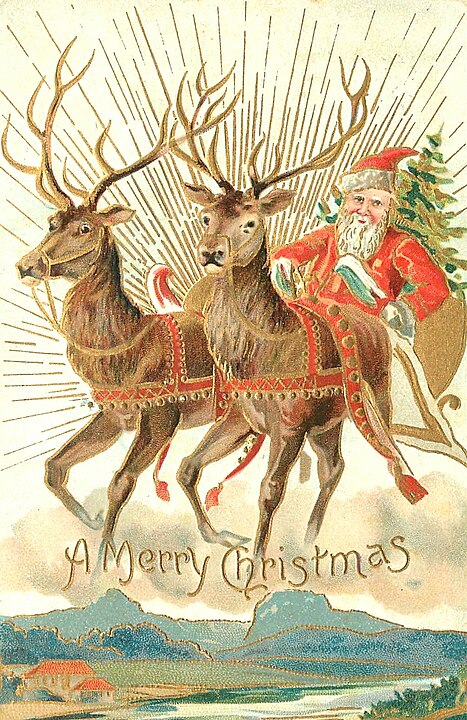
Christmas Gifts

The exchanging of gifts is one of the core aspects of the modern Christmas celebration, making it the most profitable time of year for retailers and businesses throughout the world.  On Christmas, people exchange gifts based on the Christian tradition associated with Saint Nicholas, and the gifts of gold, frankincense, and myrrh which were given to the baby Jesus by the Magi.  The practice of gift giving in the Roman celebration of Saturnalia may have influenced Christian customs, but on the other hand the Christian core dogma of the Incarnation, however, solidly established the giving and receiving of gifts as the structural principle of that recurrent yet unique event, because it was the Biblical Magi, together with all their fellow men, who received the gift of God through man’s renewed participation in the divine life. However, Thomas J. Talley holds that the Roman Emperor Aurelian placed the alternate festival on December the 25th in order to compete with the growing rate of the Christian Church, which had already been celebrating Christmas on that date first.

Read more about Christmas Gifts here.

Image © of Kelvin Kay via Wikipedia

Christmas gifts under a Christmas tree.

Gift-Bearing Figures

Several figures are associated with Christmas and the seasonal giving of gifts. Among these, the best known of these figures today is the red-dressed  Father Christmas (more well-known in the United Kingdom although the American term Santa Claus is becoming more popular.  Amongst many names around the world, he is known as  Pere Noel,  Joulupukki, Babbo Natale, Ded Moroz and tomte.  The Scandinavian tomte (also called nisse) is sometimes depicted as a gnome instead of Santa Claus.   

The name Santa Claus can be traced back to the Dutch Sinterklaas (Saint Nicholas). Nicholas was a 4th-century Greek bishop of Myra, a city in the Roman province of Lycia, whose ruins are 3 kilometres (1.9 mi) from modern Demre in southwest Turkey.  Among other saintly attributes, he was noted for the care of children, generosity, and the giving of gifts.  His feast day, December the 6th, came to be celebrated in many countries with the giving of gifts.

Saint Nicholas traditionally appeared in bishop’s attire, accompanied by helpers, inquiring about the behaviour of children during the past year before deciding whether they deserved a gift or not.  By the 13th century, Saint Nicholas was well known in the Netherlands, and the practice of gift-giving in his name spread to other parts of central and southern Europe.  At the Reformation in 16th- and 17th-century Europe, many Protestants changed the gift bringer to the Christ Child or Christkindl, corrupted in English to Kris Kringle, and the date of giving gifts changed from December the 6th to Christmas Eve.

The modern popular image of Father Christmas, however, was created in the United States, and in particular in New York.  The transformation was accomplished with the aid of notable contributors including Washington Irving and the German-American cartoonist Thomas Nast (1840 – 1902).  Following the American Revolutionary War, some of the inhabitants of New York City sought out symbols of the city’s non-English past.  New York had originally been established as the Dutch colonial town of New Amsterdam and the Dutch Sinterklaas tradition was reinvented as Saint Nicholas.

Current tradition in several Latin American countries (such as Venezuela and Colombia) holds that while Father Christmas makes the toys, he then gives them to Baby Jesus, who is the one who delivers them to the children’s homes, a reconciliation between traditional religious beliefs and the iconography of Santa Claus imported from the United States.

In South Tyrol (Italy), Austria, Czech Republic, Southern Germany, Hungary, Liechtenstein, Slovakia, and Switzerland, the Christkind (Jezisek in Czech, Jezuska in Hungarian and Jezisko in Slovak) brings the presents.  Greek children get their presents from Saint Basil on New Year’s Eve, the eve of that saint’s liturgical feast.  The German St. Nikolaus is not identical to the Weihnachtsmann (who is the German version of Father Christmas).  St. Nikolaus wears a bishop’s dress and still brings small gifts (usually candies, nuts, and fruits) on December the 6th and is accompanied by Knecht Ruprecht.  Although many parents around the world routinely teach their children about Father Christmas and other gift bringers, some have come to reject this practice, considering it deceptive.

Multiple gift-giver figures exist in Poland, varying between regions and individual families. St Nicholas (Swiety Mikolaj) dominates Central and North-East areas, the Starman (Gwiazdor) is most common in Greater Poland, Baby Jesus (Dzieciątko) is unique to Upper Silesia, with the Little Star (Gwiazdka) and the Little Angel (Aniołek) being common in the South and the South-East.  Grandfather Frost (Dziadek Mroz) is less commonly accepted in some areas of Eastern Poland.  It is worth noting that across all of Poland, St Nicholas is the gift giver on Saint Nicholas Day on December the 6th.

You can read a well-known poem about St. Nicholas here.

Read more about Gift-Bearing Figures here.

Image © of CrazyPhunk via Wikipedia

Saint Nicholas.

See Also

Christmas in July – Second Christmas celebration.

Christmas Peace – Finnish tradition.

Christmas Sunday – Sunday after Christmas.

List of Christmas films.

List of Christmas novels – Christmas as depicted in literature.

Little Christmas – Alternative title for 6 January.

NochebuenaEvening or entire day before Christmas Day.

Mithraism in comparison with other belief systems.

Christmas by medium – Christmas represented in different media.

You can see notes, references, further reading and external links to the above articles here.  The above was sourced from a page on Wikipedia and is subject to change. 

Blog Posts

Links

Liliboas on iStock.  The image shown at the top of this page of a Christmas tree and presents is the copyright of Liliboas.  You can find more great work from the photographer Lili and lots more free stock photos at iStock.

The image above of a nativity scene made with Christmas lights is the copyright of Wikipedia user Crumpled Fire.  It comes with a Creative Commons licence (CC BY-SA 2.0).

The image above of the Nativity by unknown comes via Wikipedia and is in the public domain.

The image above of the Coronation of Charlemagne on Christmas of 800 by Julius Schnorr von Carolsfeld comes via Wikipedia and is in the public domain.

The image above of the Examination and Tryal of Old Father Christmas by Josiah King comes via Wikipedia and is in the public domain.

The image above of the Queen’s Christmas Tree at Windsor Castle by Joseph Lionel Williams comes via Wikipedia and is in the public domain.

The image above of a Norwegian Christmas by Adolph Tidemand comes via Wikipedia and is in the public domain.

The image above of the Christmas visit by unknown comes via Wikipedia and is in the public domain.

The image above of Adoration of the Shepherds by Gerard van Honthorst comes via Wikipedia and is in the public domain.

The image above of the  Nativity of Christ by Herrad of Landsberg comes via Wikipedia and is in the public domain.

The image above of Christmas at the Annunciation Church in Nazareth is the copyright of Wikipedia user Israel Press and Photo Agency.  It comes with a Creative Commons licence (CC BY-SA 4.0)

The image above of a typical Neapolitan Nativity scene by unknown comes from the Diocesan Museum of Sacred Art.  It comes with a Creative Commons licence (CC BY-SA 4.0)

The image above of the official White House Christmas tree for 1962 by Robert Knudsen comes from the Kennedy Library via Wikipedia and is in the public domain.

The image above of the Christ Candle in the centre of an Advent wreath is the copyright of Wikipedia user PFAStudent.  It comes with a Creative Commons licence (CC BY-SA 3.0).

The image above of children in Oklahoma reenact a Nativity play is the copyright of Wikipedia user Wesley Fryer.  It comes with a Creative Commons licence (CC BY-SA 2.0).

The image above of Christmas carolers in Jersey is copyright of Wikipedia user Man vyi and is in the public domain.

The image above of a Christmas dinner setting is the copyright of Wikipedia user Austin McGee.  It comes with a Creative Commons licence (CC BY-SA 2.0).

The image above of a Christmas postcard with Father Christmas and some of his reindeer by unknown comes via Wikipedia and is in the public domain.

The image above of  Christmas gifts under a Christmas tree is the copyright of Wikipedia user Kelvin Kay.  It comes with a Creative Commons licence (CC BY-SA 2.0).

The image above of Saint Nicholas is the copyright of Wikipedia user CrazyPhunk.  It comes with a Creative Commons licence (CC BY-SA 3.0).