

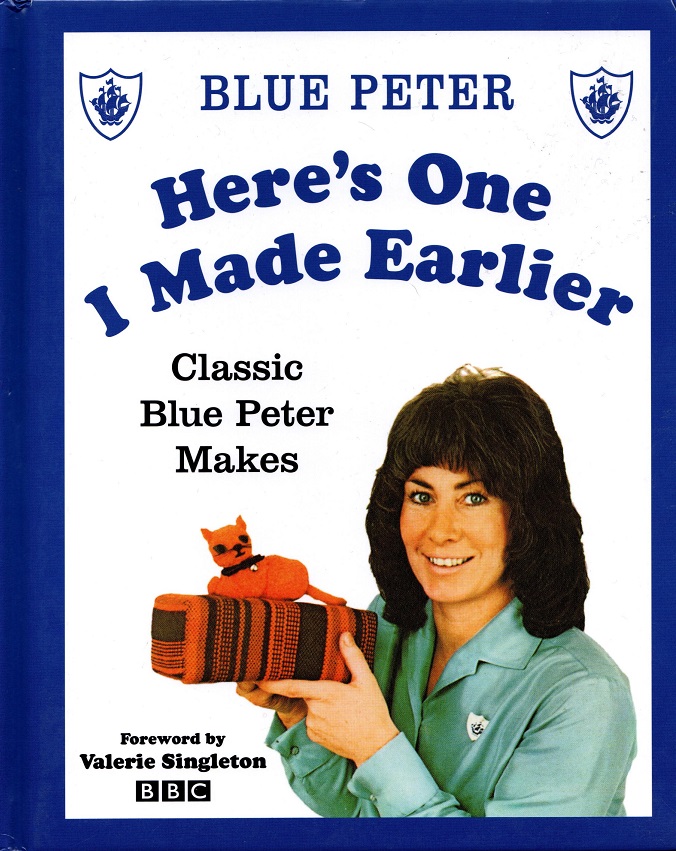

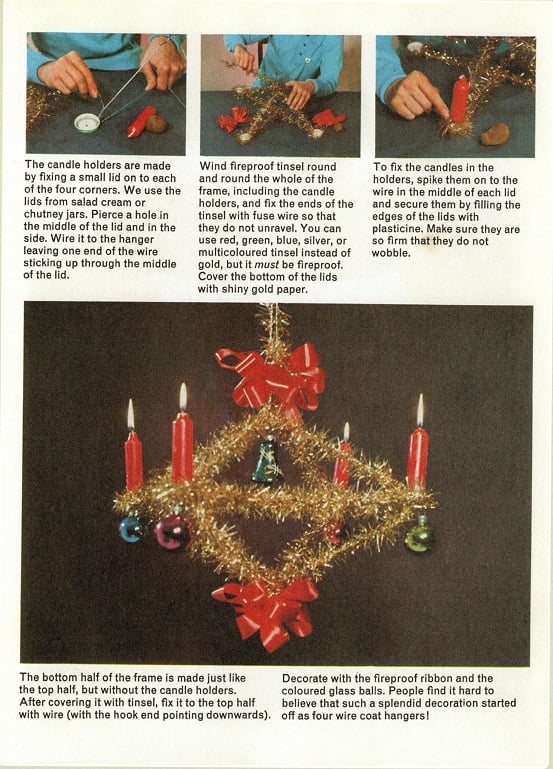
Blue Peter, the world’s longest-running children’s television programme, is known for its famous ‘makes’ – creative projects which transform everyday household objects into toys and gifts.
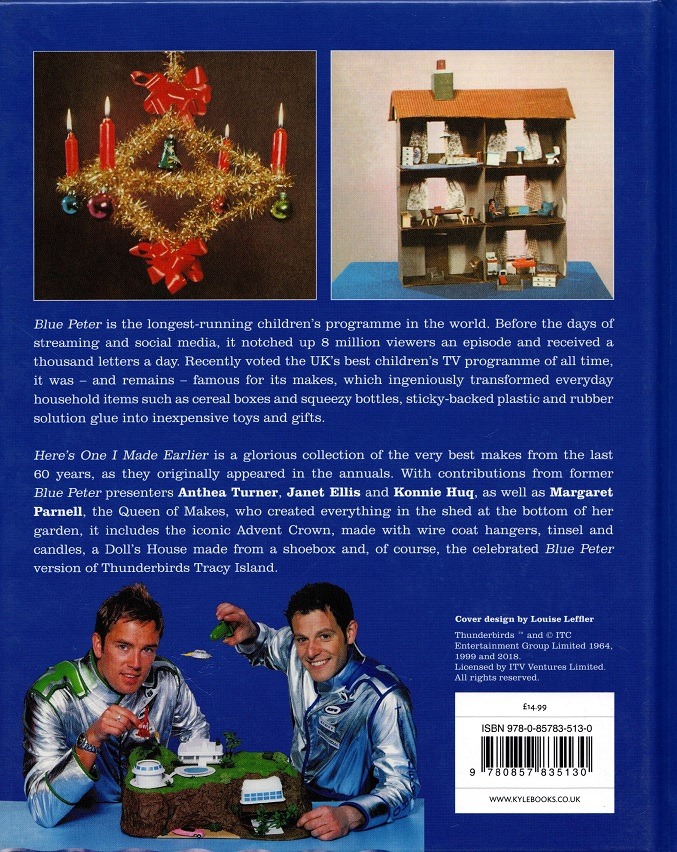
The make featured on this page is taken from “Here’s One I Made Earlier”, a book I got from The Works at a bargain price of 75p!
The collection in this book reproduces some of Blue Peter’s most memorable designs and has a foreword by Valerie Singleton and contributions from former presenters and the ‘Queen of Makes’, Margaret Parnell.
You can read all about Blue Peter here.
Blue Peter – Official page on CBBC.
You can read about Valerie Singelton here.
You can read about John Noakes here.
The images on this page are copyright of the BBC and Octopus Publishing Group.

Although started in 1958, I associate Blue Peter in my life mainly to the 1970’s and 1980’s for it is in these decades I watched it the most. I wouldn’t say I was a fan of the show, I preferred Magpie more, but I watched it sometimes as a school kid back in the day when the mood took me.
When Jnr and Deb were kids I may have watched a few then but it was more on in the background and I never paid much attention to it as the nostalgia for it had gone for me by then.

Blue Peter Logo.
Blue Peter is a British children’s television magazine programme created by John Hunter Blair. It is the longest-running children’s TV show in the world, having been broadcast since October 1958. It was broadcast primarily from BBC Television Centre in London until September 2011, when the programme moved to dock10 studios at MediaCityUK in Salford, Greater Manchester. It is currently shown live on the CBBC television channel on Thursdays at 5 pm.
Following its original creation, the programme was developed by a BBC team led by Biddy Baxter; she became the programme editor in 1965, relinquishing the role in 1988. Throughout the show’s history, there have been 40 presenters; currently, it is hosted by Richie Driss, Mwaksy Mudenda, and Adam Beales.
The show used a nautical title and theme. Its content, which follows a magazine/entertainment format, features viewer and presenter challenges, competitions, celebrity interviews, popular culture and sections on making arts and crafts items from household items. The show has had a garden in both London and Salford, known as the Blue Peter Garden, which is used during the summer and for outdoor activities. The programme has featured a number of pets that became household names, such as dogs Petra, Shep, and Goldie, as well as other animals such as tortoises, cats, and parrots. The longevity of Blue Peter has established it as a significant part of British culture and British heritage.
Click here to hear every Blue Peter opening theme from 1958 to the present day.
Blue Peter‘s content is wide-ranging. Most programmes are broadcast live but usually include at least one filmed report. There will also often be a demonstration of an activity in the studio, or a music or dance performance. Between the 1960s and 2011 the programme was made at BBC Television Centre, and often came from Studio 1, the fourth-largest TV studio in Britain and one of the largest in Europe. This enabled Blue Peter to include large-scale demonstrations and performances within the live programme. From the September 2007 series, the programme was broadcast from a small fixed set in Studio 2. However, from 2009 the series began to use the larger studios once more; also more programmes were broadcast in their entirety from the Blue Peter Garden. The show is also famous for its “makes”, which are demonstrations of how to construct a useful object or prepare food. These have given rise to the oft-used phrase “Here’s one I made earlier”, as presenters bring out a perfect and completed version of the object they are making – a phrase credited to Christopher Trace, though Marguerite Patten is another possibility. Trace also used the line “And now for something completely different”, which was later taken up by Monty Python. Time is also often given over to reading letters and showing pictures sent in by viewers.
Over 5,000 editions have been produced since 1958, and almost every episode from 1964 onwards still exists in the BBC archives. This is unusual for programmes of that era. Editor Biddy Baxter personally ensured that telerecordings and, from 1970, video recordings were kept of each episode.
Many items from Blue Peter‘s history have become embedded in British popular culture, especially moments when things have gone wrong, such as the much-repeated clip of Lulu the baby elephant (from a 1969 edition) who urinated and defecated on the studio floor, appeared to tread on the foot of presenter John Noakes and then proceeded to attempt an exit, dragging her keeper along behind her. Although it is often assumed to have been broadcast live, the edition featuring Lulu was one of the rare occasions when the programme was pre-recorded, as the presenters were en route to Ceylon for the summer expedition at the time of transmission. Other well-remembered and much-repeated items from this era include the Girl Guides’ campfire that got out of hand on the 1970 Christmas edition, John Noakes’s report on the cleaning of Nelson’s Column, and Simon Groom referring to a previous item on the production of a facsimile door knocker for Durham Cathedral which was displayed alongside the original, with the words ‘what a beautiful pair of knockers’.
Blue Peter was first aired on 16 October 1958. It had been commissioned to producer John Hunter Blair by Owen Reed, the head of children’s programmes at the BBC, as there were no programmes for children aged between five and eight. Reed got his inspiration after watching Children’s Television Club, the brainchild of former radio producer, Trevor Hill, who created the latter show as a successor to his programme Out of School, broadcast on BBC Radio’s Children’s Hour; Hill networked the programme from BBC Manchester and launched it aboard the MV Royal Iris ferry on the River Mersey, Liverpool with presenter Judith Chalmers welcoming everyone aboard at the bottom of the gangplank.
It was subsequently televised about once a month. Hill relates how Reed came to stay with him and his wife, Margaret Potter, in Cheshire and was so taken with the “Blue Peter” flag on the side of the ship and the programme in general, that he asked to rename it and take it to London to be broadcast on a weekly basis (see Reed’s obituary). The “Blue Peter” is used as a maritime signal, indicating that the vessel flying it is about to leave, and Reed chose the name to represent ‘a voyage of adventure’ on which the programme would set out. Hunter Blair also pointed out that blue was a popular colour with children, and Peter was a common name of a typical child’s friend.
The first two presenters were Christopher Trace, an actor, and Leila Williams, winner of Miss Great Britain in 1957. The two presenters were responsible for activities that matched the traditional gender roles. As broadcasting historian, Asa Briggs expressed it in 1995: “Leila played with dolls; Chris played with trains”. They were supported on occasion by Tony Hart, an artist who later designed the ship logo, who told stories about an elephant called Packi (or Packie). It was broadcast every Thursday for fifteen minutes (17.00–17.15) on BBC TV (which later became BBC One). Over the first few months, more features were added, including competitions, documentaries, cartoons, and stories. Early programmes were almost entirely studio-based, with very few filmed inserts being made.
From Monday 10 October 1960, Blue Peter was switched to every Monday and extended from 15 minutes to 20 minutes (17.00–17.20). In 1961, Hunter Blair became ill and was often absent. After he produced his last edition on 12 June 1961, a series of temporary producers took up the post. Hunter Blair was replaced the following September by Clive Parkhurst. He did not get along with Leila Williams, who recalled “he could not find anything for me to do”, and in October, Williams did not appear for six editions, and was eventually fired, leaving Christopher Trace on his own or with one-off presenters. Parkhurst was replaced by John Furness, and Anita West joined Trace on 7 May 1962. She featured in just 16 editions, making her the shortest-serving presenter, and was replaced by Valerie Singleton, who presented regularly until 1972 and on special assignments until 1981. Following the departure of Furness, a new producer who was committed to Blue Peter was required, so Biddy Baxter was appointed. At the time she was contracted to schools’ programmes on the radio, and therefore unable to take up her new post immediately.
It was suggested that Edward Barnes, a production assistant, would temporarily produce the show until Baxter arrived, at which point he would become her assistant. This suggestion was turned down, and a more experienced producer, Leonard Chase, was appointed, with Barnes as his assistant. Baxter eventually joined Blue Peter at the end of October 1962.
During this period, many iconic features of Blue Peter were introduced. The first appeal took place in December 1962, replacing the practice of reviewing toys that children would ask for themselves. Blue Peter‘s first pet, a brown and white mongrel dog named Petra, was introduced on 17 December 1962. The puppy soon died of distemper, and having decided against upsetting young viewers over the news, Barnes and Baxter had to search London pet shops for a convincing clandestine replacement. Features such as “makes” (normally involving creating something such as an advent crown, out of household junk) and cooking became regular instalments on Blue Peter and continue to be used today. The Blue Peter badge was introduced in 1963, along with the programme’s new logo designed by Tony Hart. Baxter introduced a system that ensured replies sent to viewers’ letters were personal; as a girl, she had written to Enid Blyton and twice received a standard reply, which had upset her.
The next year, from 28 September 1964, Blue Peter began to be broadcast twice weekly, with Baxter becoming the editor in 1965, and Barnes and Rosemary Gill (an assistant producer who had joined as a temporary producer while Baxter was doing jury service) becoming the programme’s producers. The first Blue Peter book, an annual in all but name, was published that year, and one was produced nearly every year after that, until 2010. A third presenter, John Noakes, was introduced at the end of 1965 and became the longest-serving presenter. A complete contrast to Trace, Noakes set the scene for “daredevil” presenters that have continued through the generations of presenters. Trace left Blue Peter in July 1967, and was replaced by Peter Purves in November. The trio of Valerie Singleton, John Noakes and Peter Purves lasted five years, and according to Richard Marson were ‘the most famous presenting team in the show’s history. In 1965, the first Summer Expedition (a filming trip abroad) was held in Norway, and continued every year (except 1986 and 2011) until 2012, all over the world.
The first colour edition of Blue Peter aired on 14 September 1970, and the last black and white edition on 24 June 1974. A regular feature of the 1970s was the Special Assignments, which were essentially reports on interesting topics, filmed on location. Singleton took this role, and in effect became the programme’s “roving reporter”. Blue Peter also offered breaking news on occasion, such as the 1971 eruption of Mount Etna, as well as unique items such as the first appearance of Uri Geller on British television. In May 1976, presenter Lesley Judd interviewed Otto Frank, father of Anne Frank, after he had agreed to bring his daughter’s diaries to Britain. From 1971 the summer expedition from the previous year was edited into special programmes broadcast under the title Blue Peter Flies The World, televised during the summer break when the team were recording the latest expedition. The first was shown in July 1971 and featured the expedition to Jamaica.
In 1974, the Blue Peter Garden was officially opened in a green space outside the Television Centre restaurant block. By this time, Blue Peter had become an established children’s programme, with regular features which have since become traditions. In 1978, the show celebrated its twentieth anniversary with a nationwide balloon launch from five regional cities during a special edition of the programme when Christopher Trace, Leila Williams, Valerie Singleton and Peter Purves returned. John Noakes contributed a message pre-recorded on film. At this time, Trace introduced the Blue Peter Outstanding Endeavour Award. Its theme music was updated by Mike Oldfield in 1979, and at the end of the decade a new presenting team was brought in, consisting of Simon Groom, Tina Heath and Christopher Wenner. They were overshadowed by the success of the previous two decades and failed to make as much of an impact. Heath decided to leave after a year when she discovered she was pregnant but agreed to have a live scan of her baby, something which had never been done on television before. Blue Peter was praised for this by the National Childbirth Trust who told the BBC that in ‘five minutes, Blue Peter had done more to educate children about birth than they’d achieved in ten years of sending out leaflets’. Wenner decided to leave along with Heath on 23 June 1980.
Sarah Greene and Peter Duncan both joined in 1980, and a new producer, Lewis Bronze, joined in 1982. The 1980s saw the Blue Peter studio become more colourful and bright, with the presenters gradually wearing more fashionable outfits, in contrast to the more formal appearance of previous decades. Several videos of Blue Peter were made available from 1982, the first being Blue Peter Makes, and an omnibus comprising the two weekly editions appeared in 1986 on Sunday mornings. Ahead of the show’s 25th anniversary in October 1983, BBC1 ran a series Blue Peter Goes Silver, revisiting previous summer expeditions. The 25th anniversary itself was commemorated by a documentary presented by Valerie Singleton shown on BBC1 on Sunday, 16 October 1983. This was followed the next day by a special edition of the programme when Christopher Trace presented the annual Outstanding Endeavour Award and Valerie Singleton, Peter Purves, Christopher Wenner, Tina Heath and Sarah Greene returned to celebrate the show’s birthday with the current presenting trio of Simon Groom, Peter Duncan and Janet Ellis who launched a national balloon treasure hunt. On 27 June 1988, Baxter took part in her final show, after nearly 26 years of involvement, and Bronze took her place as editor. Around this time, Blue Peter became distinctively environmentally aware and introduced a green badge in November 1988 for achievements related to the environment. Shortly before, in October 1988, the show celebrated its thirtieth anniversary with a competition to design the cover of a commemorative issue of the ‘Radio Times’ and Valerie Singleton presented the Outstanding Endeavour Award on the birthday show itself. The following year, the award was presented for the last time.
On 13 September 1984, Champion trampolinist and professional performer Michael Sundin presented for the first time, as a replacement for Peter Duncan. He had been talent-spotted by the Blue Peter team when they filmed an item on the set of “Return to OZ” (Sundin was playing the part of Tik-Tok.) After 77 appearances as a Blue Peter presenter, his contract was not renewed. It has since been explained by Biddy Baxter, that he attracted complaints from viewers, stating in her Autobiography that homophobia was not the reason for his departure, “he came across as a whinger….and an effeminate whinger to boot”, “… it was nothing to do with his sexual proclivities”. Sundin successfully continued his performing career but lost his life to an AIDS-related illness in 1989.
In 1989 (and again in 1992 and 1994), new arrangements of the theme tune were introduced. Due to falling ratings in BBC children’s programming, BBC1 controller Alan Yentob suggested airing a third edition of Blue Peter each week from 1995. This meant that it was sometimes pre-recorded; Joe Godwin, the director, suggested that the Friday edition should be a lighter version of Blue Peter, which would concentrate on music, celebrities and games. Helen Lederer presented a documentary on BBC2 to celebrate the show’s 35th anniversary Here’s One I Made Earlier, with a special edition of the regular programme featuring the returns of Leila Williams, John Noakes and Lesley Judd amongst many other presenters. Neither Noakes nor Judd had appeared in the studio since leaving the programme and Williams was returning for the first time in 15 years. A fourth presenter, Katy Hill, was introduced in 1995, but unlike earlier decades, there was little stability in the line-up, with resignations and new additions made almost every year of the decade. The 1990s also saw many more live broadcasts on location, with many shot entirely away from the studio. Blue Peter was also one of the first television series to launch a website. Oliver Macfarlane replaced Bronze as editor in 1996.
1998 marked the 40th anniversary of the TV show. Apart from two summer proms concerts, the most talked about event to celebrate the milestone was a trip behind LNER Peppercorn Class A2 60532 Blue Peter on an Edinburgh to London rail tour. The special train in question was Days out Limited’s “Heart of Midlothian” from London Kings Cross to Edinburgh Waverley on Sun 19 April 1998, with 60532 working the train from Edinburgh. Due to safety rules, none of the presenters was supposed to ride onboard the footplate during the trip. Peter Kirk, who was in charge onboard the train and who was presenting from the footplate, however, allowed Stuart Miles to travel onboard the footplate between Newark-on-Trent and Peterborough. This was the stretch of track which, on 3 July 1938, saw the world speed record for steam locomotives of 126 mph (203 km/h) set by LNER A4 Locomotive no. 4468 Mallard.
In October 1998, Richard Bacon was sacked, following reports in News of the World that he had taken cocaine. This incident followed shortly after the show’s 40th anniversary when previous presenters returned for a special programme. Those returning included Leila Williams, Valerie Singleton, John Noakes, Peter Purves, Diane Louise Jordan, Anthea Turner, John Leslie, Tim Vincent, Yvette Fielding, Caron Keating, Mark Curry, Janet Ellis, Peter Duncan, Sarah Greene, Tina Heath, Simon Groom and Christopher Wenner. Steve Hocking then replaced Macfarlane as editor, at what was regarded as a difficult period for the programme. He introduced a further re-arrangement of the theme tune and a new graphics package in September 1999.
The 2000s began with the opening of two previously buried time capsules. Former presenters including Singleton, Purves and Noakes were invited back to assist, and the programme also looked at life in the 1970s when the first capsule was buried. With Hill’s departure and replacement by Liz Barker in 2000, the new team of herself, Konnie Huq, Simon Thomas, and Matt Baker were consistent for the next few years. The Friday edition, as in the previous decade, featured games, competitions and celebrities, but additionally, there was a drama series, The Quest, which featured cameos of many former presenters.
It was at this time that the new Head of the BBC Children’s Department, Nigel Pickard, asked for Blue Peter to be broadcast all year round. This was achieved by having two editions per week instead of three during the summer months and using pre-recorded material. The early 2000s also introduced Christmas productions, in which the presenters took part. In 2003, Richard Marson became the new editor, and his first tasks included changing the output of Blue Peter on the digital CBBC. The first year of the channel’s launch consisted of repeated editions, plus spin-off series Blue Peter Unleashed and Blue Peter Flies the World. This new arrangement involved a complex schedule of live programmes and pre-recorded material, being broadcast on BBC One and CBBC. Marson also introduced a brand new set, graphics and music.
In September 2007, a new editor, Tim Levell, took over. At the same time, budget cuts meant that the programme came from a smaller studio. In February 2008 the BBC One programme was moved from 5 pm to 4.35 pm to accommodate The Weakest Link, and as a result, Blue Peter‘s ratings initially dropped to as low as 100,000 viewers in the age 6–12 bracket, before steadily improving.
As with the previous decade, numerous presenters joined and left the programme. This included the exits of Thomas, Baker and Barker and the additions of Zöe Salmon, Gethin Jones and Andy Akinwolere. Early 2008 saw the departure of Huq, who had become the longest-serving female presenter with over ten years on the show. Later that year, Salmon and Jones both left and the presenting team of Akinwolere with new additions Helen Skelton and Joel Defries was introduced.
On 16 October 2008, Blue Peter celebrated its 50th Anniversary with a reception at Buckingham Palace hosted by Queen Elizabeth II and featuring several former presenters. There was a special live edition of the show broadcast to celebrate the anniversary with many returning presenters and a 60-minute documentary on BBC1 featuring interviews with many previous presenters and production staff, including Edward Barnes, Biddy Baxter and Rosemary Gill.
Writing in the BBC’s in-house magazine, Ariel, in 2009, BBC Children’s Controller Richard Deverell announced plans to re-invent the show to be more like the BBC’s motoring programme Top Gear. Deverell hopes that by adding “danger and excitement”, Blue Peter will achieve the same “playground buzz” among children as Top Gear.
In January 2011 Barney Harwood was introduced to the programme as a replacement for Defries, who had departed in late 2010 after two years. Unusually, Harwood was no stranger to Blue Peter viewers, having appeared as a presenter on CBBC for many years, on shows including Prank Patrol and Bear Behaving Badly.
On 29 March 2011 Blue Peter became the first programme in the UK to broadcast an entire show in 360 degrees on the web. Viewers were able to watch the programme via their TVs and simultaneously interact with the television studio in front of and behind the cameras on the website. Viewers were also challenged to play a game where they had to find particular crew members and staff dressed up in distinctive costumes.
The final edition of Blue Peter to broadcast from the BBC’s Television Centre in London was broadcast on 28 June 2011, before a move to the BBC’s new facilities at Dock10, MediaCityUK. The set left behind at BBC Television Centre was subsequently purchased and installed at Sunderland University’s David Puttnam Media Centre in August 2013.
When the new series started on 26 September 2011, after the usual summer break, Harwood and Skelton revealed the new look Blue Peter studio along with the new music and title sequence. Departed presenter Andy Akinwolere was not initially replaced, and for the first time in 50 years, only two presenters remained on the programme. The new Blue Peter Garden, located outside the studios, was officially opened by Princess Anne in February 2012.
From 12 January 2012, Blue Peter has been broadcast all year round (with no break for summer) once a week, its original premiere being on CBBC on Thursdays at 5.45 pm, changed to 5.30 pm from April 2013 then 5:00 pm from March 2015. It was usually repeated on Fridays on BBC One, although this ceased in December 2012. A repeat airs at 9.00 am on Sundays. At this time, Levell left to work at BBC Radio 5 Live; he was replaced (initially in an acting capacity) as editor by Ewan Vinnicombe, who had worked on the programme as a producer since 2007. The reformatted Blue Peter occasionally also included specials and spin-offs such as “Helen’s Polar Adventure” or the Stargazing Live special on other days of the week.
In 2013 Lindsey Russell was voted the 36th presenter via Blue Peter – You Decide!, a series of five programmes hosted by Dick and Dom, where ten aspiring presenters were set a number of challenges to prove that they were worthy of the position. Judges Cel Spellman, Eamonn Holmes and Myleene Klass decided the final three before viewers were given the chance to vote online. Russell joined Blue Peter in September of that year, shortly before Skelton’s departure and the introduction of her replacement Radzi Chinyanganya.
From October 2013, the team consisted of Harwood, Russell and Chinyanganya. The format adapted with slightly different branding and a more classic take on the show, as well as beginning Blue Peter Bites, which are five-minute clips showing just one challenge or video from episodes broadcast on CBBC. Blue Peter guide pup Iggy joined the team in 2014 and Shelley the Tortoise continues to make occasional appearances. The Blue Peter Garden is currently maintained by child gardener George who appears throughout the year. The team made more use of the website with more quizzes and videos such as ‘Blue Peter VS…’ and ‘Ultimate Challenges’ as well as holding a fan club hour after the show where fans could leave comments as to the answers of riddles or headline suggestions and ask guests questions. A popular game on the programme, Spot Shelley was also introduced, where, in most episodes, an animated version of Shelley the tortoise is hiding somewhere/on something and viewers must leave a comment on the website during the show, the first person to spot her wins a shout-out (or some more expensive or weird prizes as Harwood would often joke, such as a house in Spain or a unicorn called Eric). From April 2017, the show reverted to 5:30 pm. In September 2017, Harwood left the show, again leaving just two presenters.
In the summerBlue Peter often challenges its viewers to earn all of their Blue Peter badges (with the exception of orange and gold) through five weeks, where the team look at each individual badge for a week, finishing with the limited time Sports badge which appears every summer with a different design. In the show before these weeks, the team show viewers how to make something to keep their badges in/on and continue the theme through the weeks, these have included the Badge Baton Relay in 2016, where badges stored within a baton tube and the Big Badge Boat Bonanza in 2017, where badges displayed on the iconic BP ship, a 2D model that can be made from paper.
Ahead of their Jubilee celebrations, Blue Peter introduced its first-ever Guest Editor to the show on 19 October 2017 which was children’s author Dame Jacqueline Wilson. Guest Editors have control for the day and plan what they what to show on their edition, as well as taking control behind the scenes.
A special programme broadcast on 1 February 2018, marked Blue Peter’s 5000th edition. A brand new Diamond badge was revealed for the first time, designed by Henry Holland. This was only to be awarded within the special 60th year of 2018.
On 12 October 2017, it was revealed that outside of MediaCityUK, a Hollywood style walk of fame would be created with the names of famous people who have received a Gold Blue Peter badge. The walkway would lead up to the front of the studios and would help to mark 60 years of Blue Peter.
There were various celebrations across the UK for “The Big Birthday Year”. In January, a competition was launched to design Blue Peter‘s second birthday balloon to be flown. In May, the Millennium Time Capsule formally buried under the Millennium Dome, which was dug up accidentally in 2017 by builders went on tour with various past presenters around the country. A play, “Once Seen On Blue Peter”, ran at the Edinburgh Festival Fringe in August, with six former presenters appearing in it.
On 16 October 2018, a special one-hour live edition of the programme, entitled Blue Peter: Big 60th Birthday, was broadcast on CBBC. Guests included The Vamps, Sophie Ellis-Bextor and Ed Sheeran, who was presented with a gold Blue Peter badge. Former presenters returned for the show and contributed to the broadcast, including Leila Williams, Anita West, Valerie Singleton, Peter Purves, Lesley Judd, Sarah Greene, Peter Duncan, Janet Ellis, Yvette Fielding, John Leslie, Diane-Louise Jordan, Anthea Turner, Tim Vincent, Stuart Miles, Katy Hill, Romana D’Annunzio, Richard Bacon, Konnie Huq, Simon Thomas, Liz Barker, Zöe Salmon, Andy Akinwolere, Helen Skelton, Joel Defries and Barney Harwood. Matt Baker contributed a pre-recorded message and Mark Curry was represented by a lego model as he had to cancel his contribution due to ill health. The programme was repeated on BBC Two on 20 October. The celebration was also marked by other BBC programming, including The One Show hosted by Matt Baker and former Blue Peter contributor Gabby Logan, which featured Sarah Greene, Mark Curry, Simon Thomas and Konnie Huq; ITV’s Lorraine, where Greene appeared with Leila Williams and Anthea Turner; and BBC Breakfast which featured Lesley Judd. A documentary entitled Happy Birthday Blue Peter was broadcast that evening on BBC Radio 2. It was hosted by Barney Harwood and featured interviews with past and present presenters, as well as members of the production team. As part of the birthday celebrations, a new plant species was named “Blue Peter”. In February 2019 a gritter was named and decorated “Blue Peter”, unveiled by Russell.
On 3 June 2021, the show received a refresh with a new logo, title sequence, music and studio. This was the first major refresh since the show’s move to Salford in 2011. The studio is environmentally-friendly and is composed of upcycled materials from past studios.
On 24 June 2021, Russell announced that she would be leaving the show, after eight years. Her final show aired on 15 July 2021.
Read more about Blue Peter here.
The above articles were sourced from Wikipedia and are subject to change.
Max Rahubovskiy on Pexels – The image shown at the top of this page is the copyright of Max Rahubovskiy. You can find more great work from the photographer Max by clicking the link above and you can get lots more free stock photos at Pexels.
Blue Peter – Official page on CBBC. The image at top of this page is the copyright of BBC.
Ever since I was little I have loved Universal classic monsters, for it is they that started my love of Horror off, even if they scared the hell out of me at first and I hid under my Mom’s arm or behind the settee at first watching them, ha ha. That changed the older I got.
When Halloween comes around you can be sure someone is wearing an Halloween costume that relates to one of the classic monsters mentioned below.
There will be more references to Universal Classic Monsters in the appropriate Decades sections and articles via the Horror index below.
Universal Classic Monsters (also known as Universal Monsters and Universal Studios Monsters) is a media franchise based on a series of horror films primarily produced by Universal Pictures from the 1930s to the 1950s. Although not initially conceived as a franchise, the enduring popularity and legacy of the films and the characters featured in them have led the studio to market them under the collective brand name of Universal Studios Monsters. Steve Jones of USA Today described Universal’s most famous monsters as pop culture icons, specifically Dracula, Frankenstein, The Mummy and The Wolf Man.
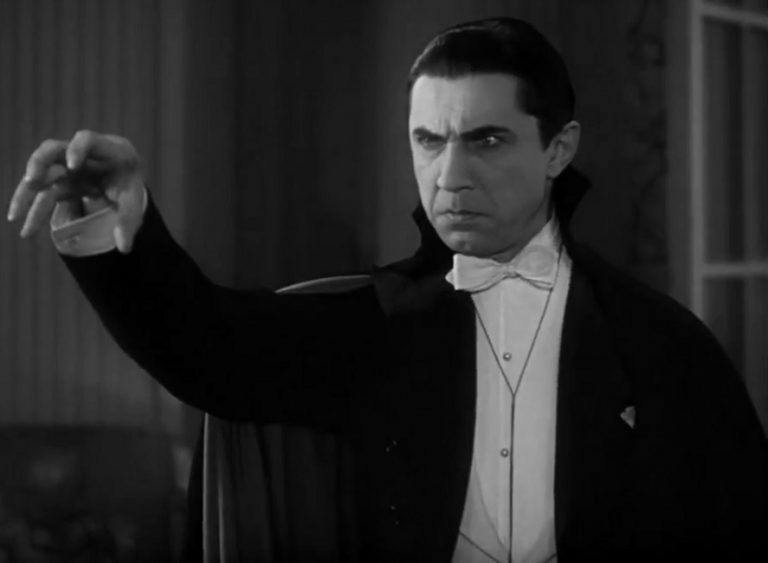
Bela Lugosi as Dracula.
This is a screenshot from the Internet Archive of the classic 1931 film Dracula. You can see the trailer it came from here.
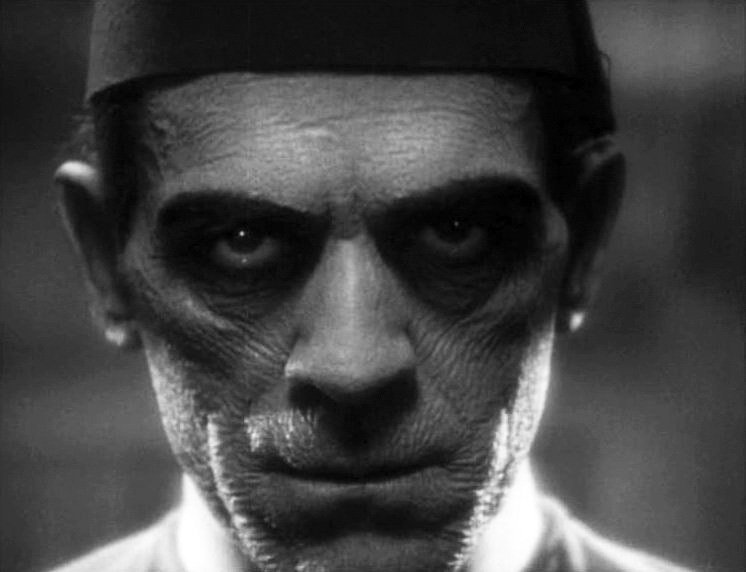
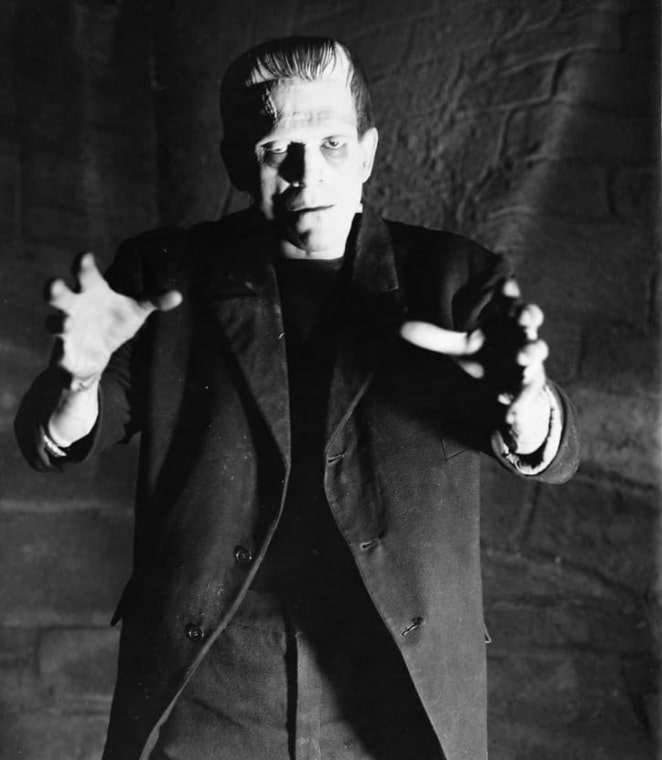
Boris Karloff as Frankenstein’s Monster.
Directed by James Whale.
You can see the trailer for the classic Frankenstein film from 1931 via The Internet Archive here.
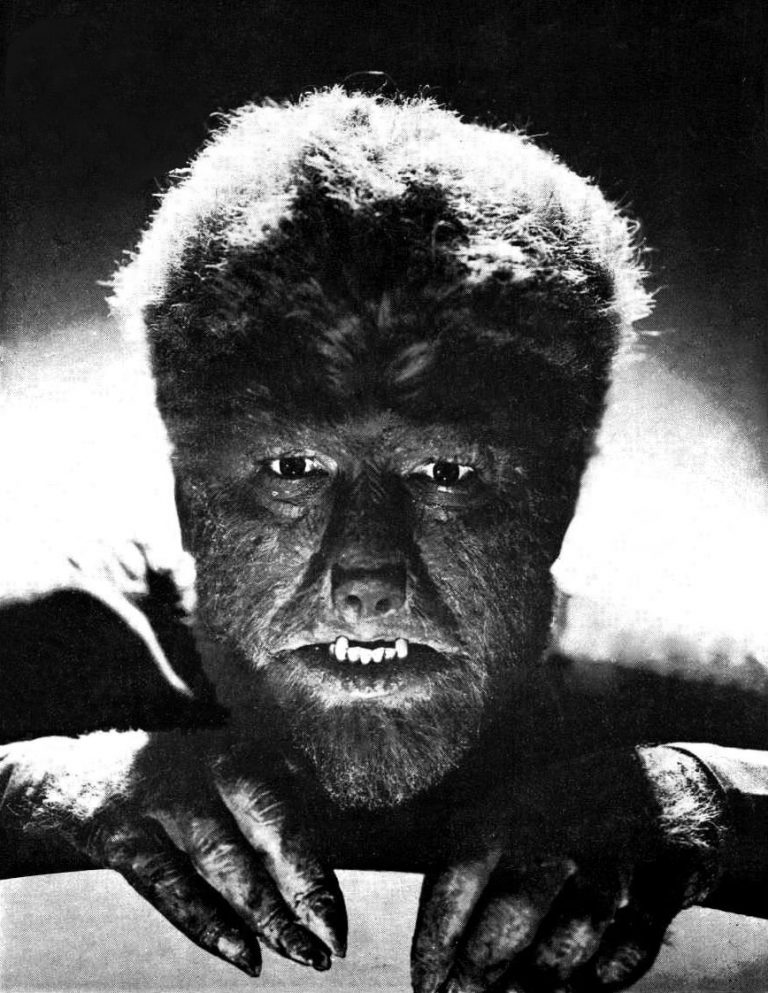
Lon Chaney Jnr. as The Wolf Man.
This promotional photo is from the classic1941 film The Wolf Man.
You can see the trailer for The Wolf Man via The Internet Archive here.
See more photos and relevant information further down below.
For an extensive list of Universal Monsters Films click here.
Below are just some of the great Universal Monsters films for you to enjoy.
They are not all classic films to me but if I have watched one and I think it is I will say so.
Watch the classic 1925 silent film The Phantom Of The Opera starring Lon Chaney via The Internet Archive here.
See information about this classic film further down at the top of the page.
Watch the classic 1931 film Dracula starring Bela Lugosi via The Internet Archive here.
See information about this classic film at the top of the page.
Watch the classic 1931 film Frankenstein starring Boris Karloff via The Internet Archive here.
See information about this classic film at the top of the page.
Watch the classic 1932 film The Mummy starring Boris Karloff via The Internet Archive here.
See information about this classic film at the top of the page.
Watch the classic 1933 film The Invisible Man starring Claude Rains via The Internet Archive here.
See information about this classic film further down at the bottom of the page.
Watch the 1935 film The Bride Of Frankenstein starring Boris Karloff via The Internet Archive here.
See information about this film further down at the bottom of the page.
Watch the 1942 film Frankenstein Meets The Wolf Man starring Boris Karloff and Lon Chaney Jnr via The Internet Archive here.
See information about this film further down at the bottom of the page.
Universal Classic Monsters logo.
This is the official franchise logo as displayed on home video releases
Louis Feola was the head of Worldwide Home Video for Universal Studios and said in 1999 that “a couple of years ago” he decided to “reinvigorate and re-market” Universal’s Classic Monsters catalogue which included the series Dracula, Frankenstein, The Invisible Man, The Phantom of the Opera, The Wolf Man, and The Mummy. In 1992, in an interview with Billboard, Feola stated that to market and sell home video, the most important thing was the packaging of their sales which was “probably our single biggest priority and has been for a number of years”, and that it was key to make the series of films “look like a line”.
In 1995, MCA/Universal released a collection of the film on home video under the title The Universal Studios Monsters Classic Collection. This series included Frankenstein, Dracula, The Mummy, The Invisible Man, and The Creature From the Black Lagoon series. A collection of stamps featuring Universal Classic Monsters was also released in September 1997 titled the Universal Classic Movie Monsters series. Other characters included in the series included the Mummy and Frankenstein’s monster, both played by Boris Karloff), the Phantom of the Opera played by Lon Chaney and the Wolf Man played by Lon Chaney Jnr.
After the Universal horror films were syndicated to television, this led to a rise in the popularity of merchandise based on Frankenstein’s monster and Dracula. Throughout the 1960s and into the 1970s, the Universal monsters were promoted via merchandising which included: Halloween costumes, Aurora model kits, paperback novelizations, makeup how-to manuals, T-shirt iron-ons, posters, trading cards, and more. Since 1991, Halloween Horror Nights at Universal Parks & Resorts have featured characters from the Universal Classic Monsters franchise. From 2006 to 2014, the characters also appeared in the year-round walk-through attraction, Universal’s House of Horrors, at Universal Studios Hollywood. The franchise is also the central theme of Universal’s Horror Make-Up Show. The live show opened in 1990 at Universal Studios Florida and is still in operation. Merchandising of the characters in formats such as clothing and board games has continued into the 21st century.
Below are just some of the great Universal Monsters films photos for you to enjoy. They are not all classic films to me but if I have watched one and I think it is I will say so.
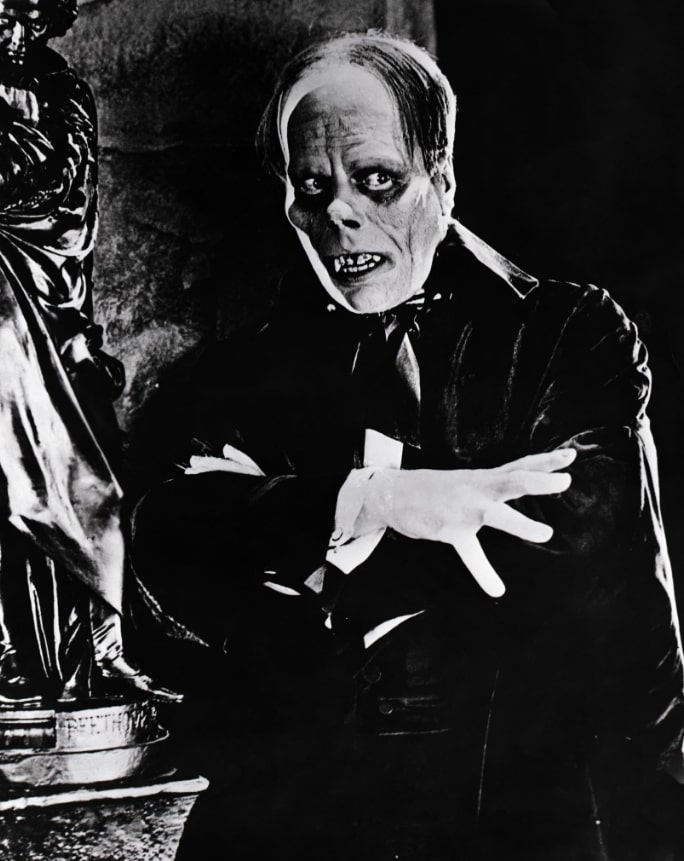
Lon Chaney as The Phantom Of The Opera.
This photo is from the classic 1925 silent film The Phantom Of The Opera.
You can see the trailer for The Phantom Of The Opera via the Internet Archive here.
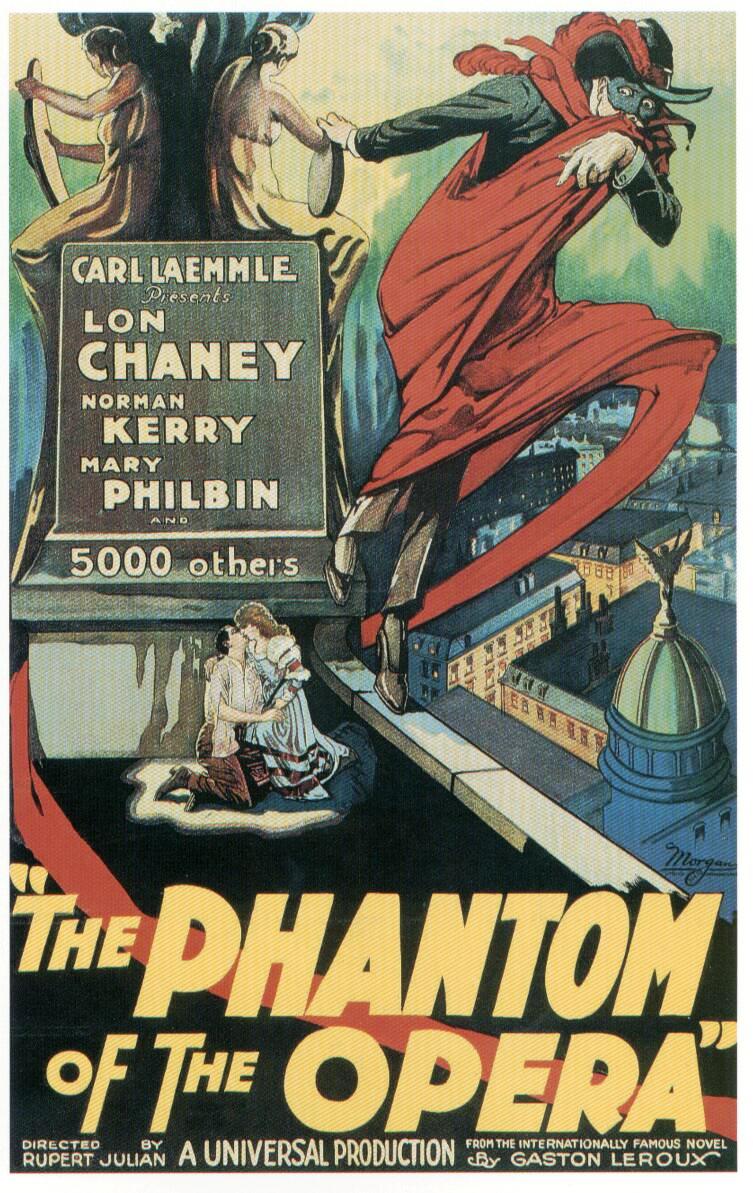
The Phantom Of The Opera 1925 film poster.
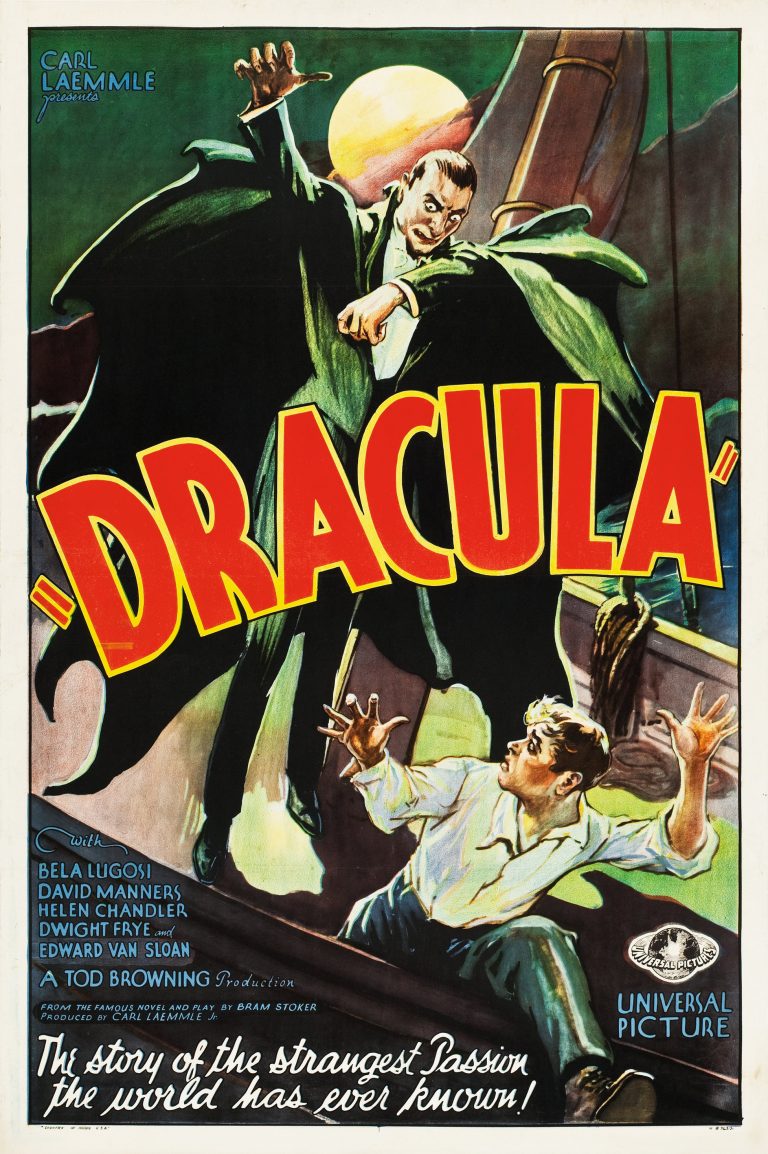
Dracula 1931 film poster.
See information about this classic film at the top of the page.
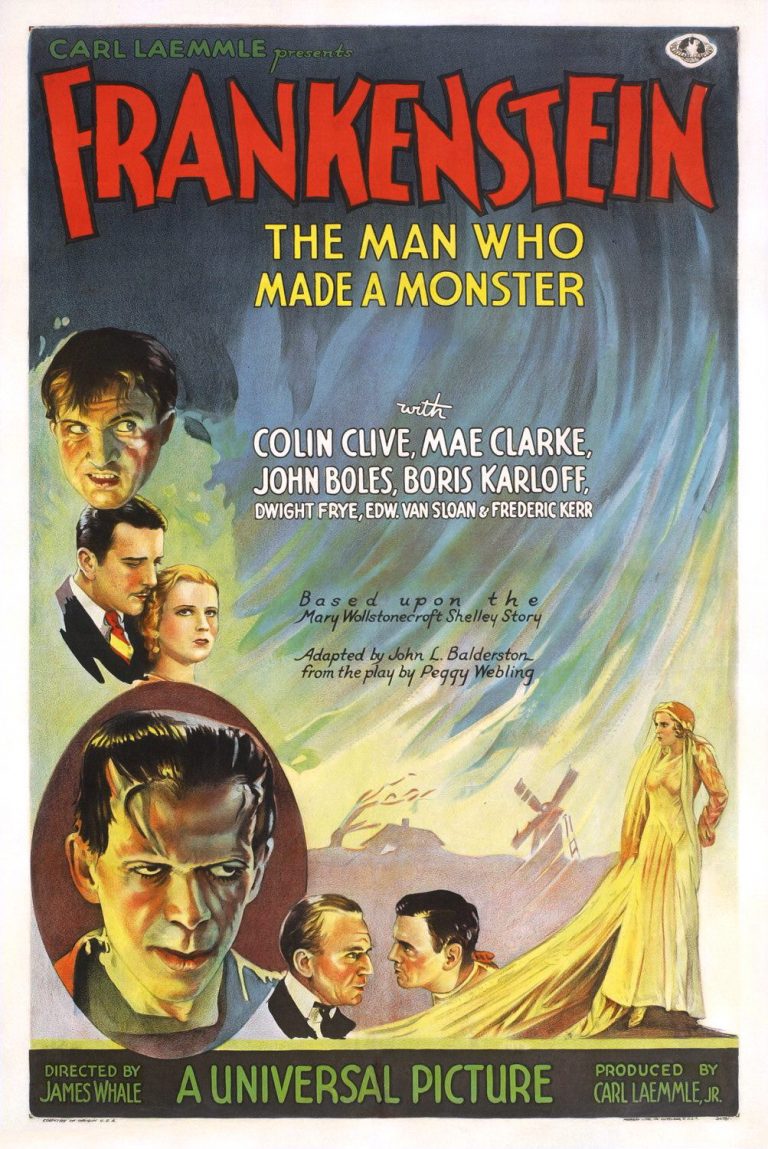
Frankenstein 1931 film poster.
See information about this classic film at the top of the page.



The EXCELLENT Frankenstein mask from Trick Or Treat Studios.
This is a very cool Universal Classic Monsters mask I purchased for Halloween 2023. It is officially licenced by Universal Studios and made for Trick Or Treat Studios. It is, to date, the favourite mask I have in my mask collection and what I have worn for Halloween parties. To see me in this and many more masks click here.
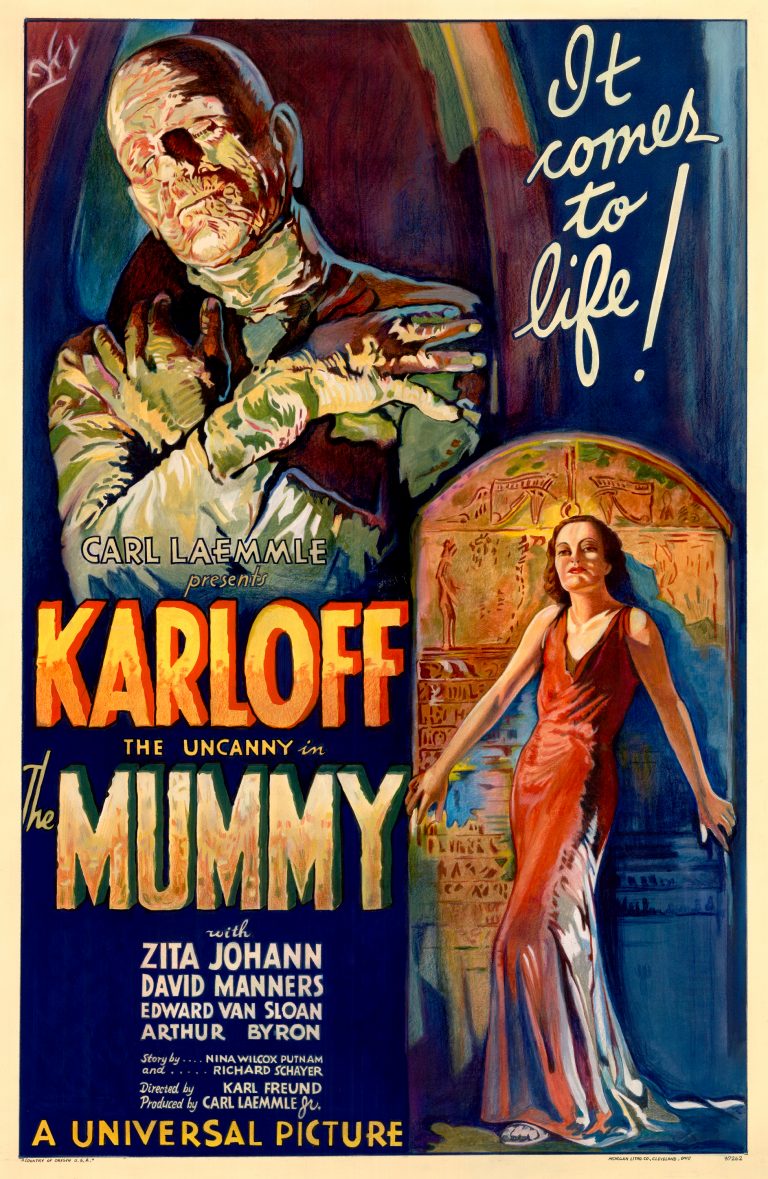
The Mummy 1932 film poster.
See information about this classic film at the top of the page.
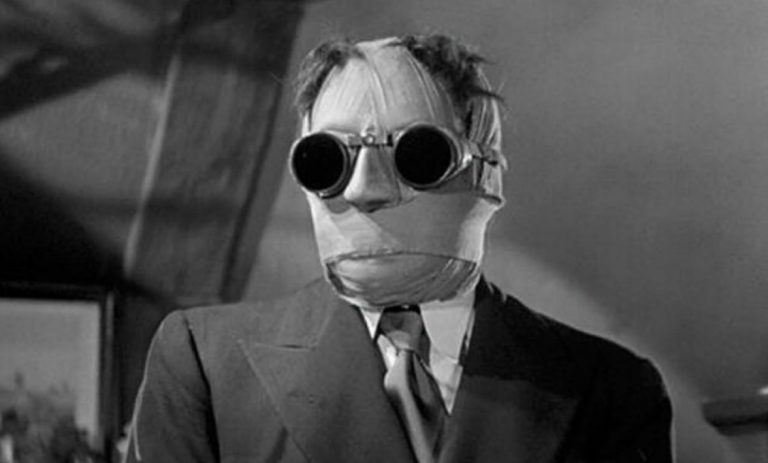
Claude Rains as The Invisible Man.
This photo is from the classic 1933 film The Invisible Man.
Directed by James Whale.
You can see the trailer for The Invisible Man via YouTube here.
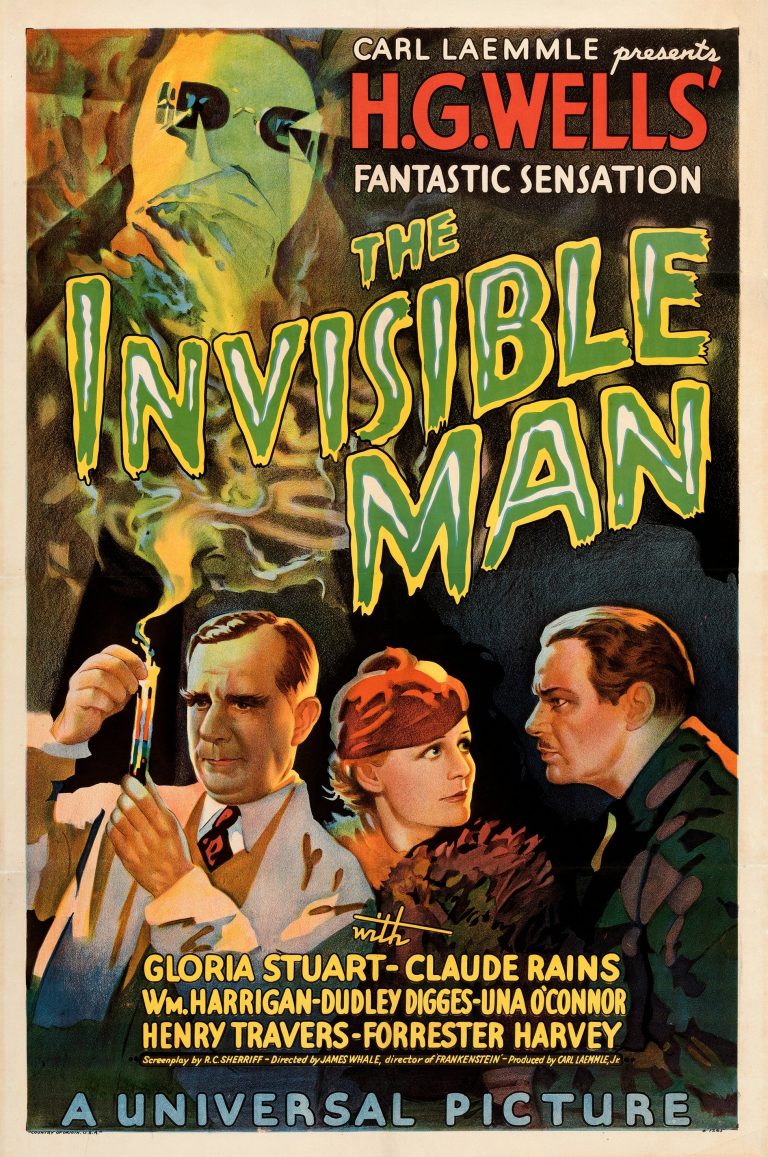
The Invisible Man 1933 film poster.
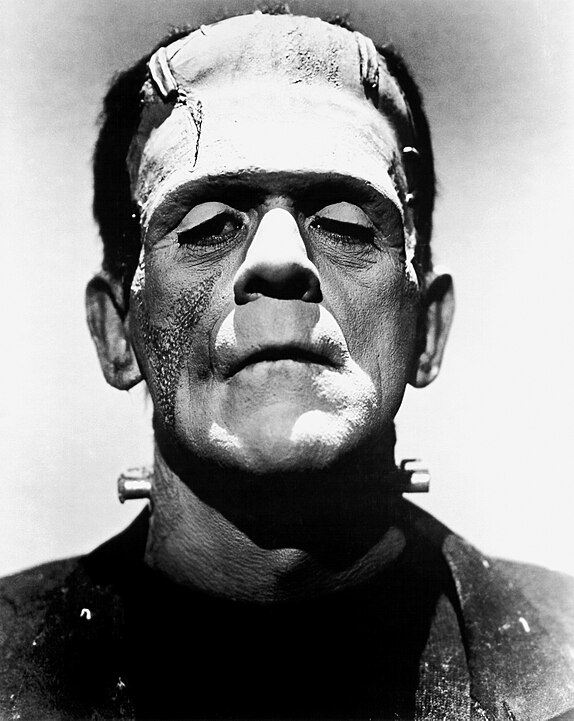
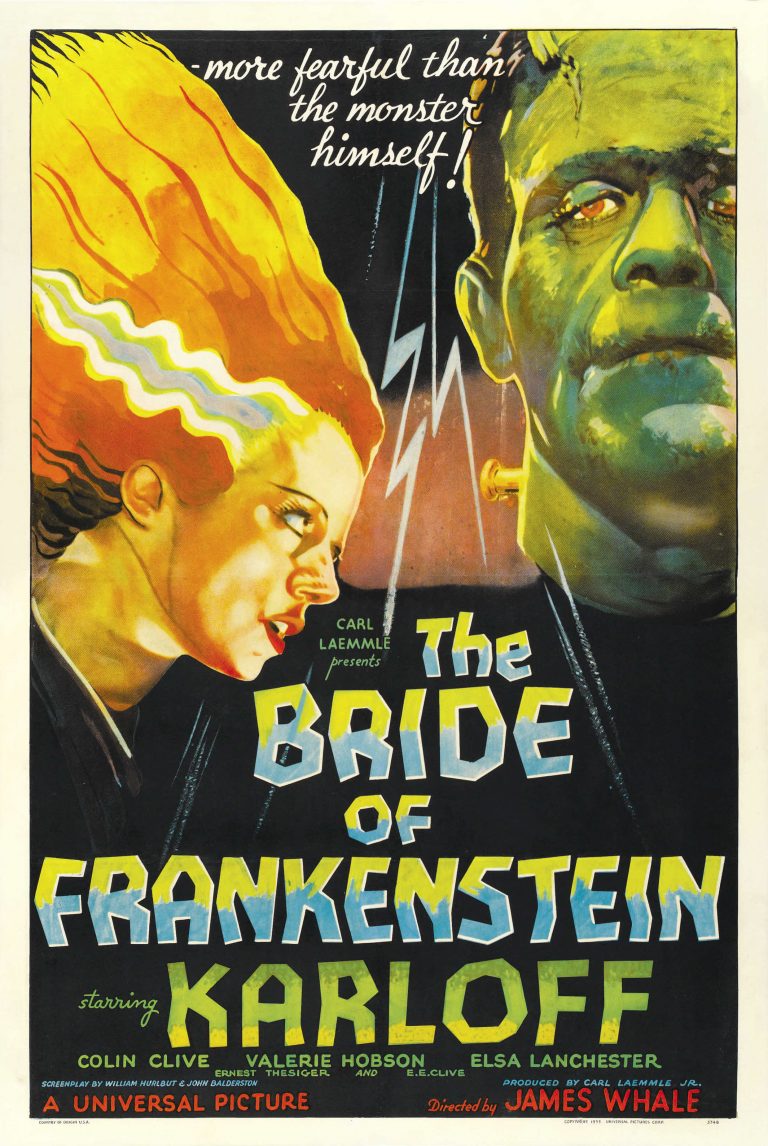
Boris Karloff as Frankenstein’s Monster.
This promotional photo is from the 1935 film The Bride of Frankenstein.
Directed by James Whale.
You can see the trailer for The Bride Of Frankenstein via the Internet Archive here.
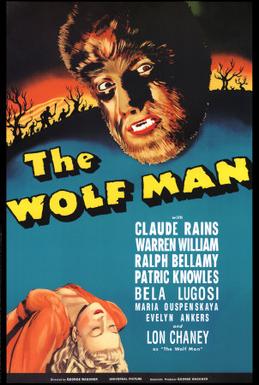
The Wolf Man 1942 film poster.
See information about this classic film at the top of the page.
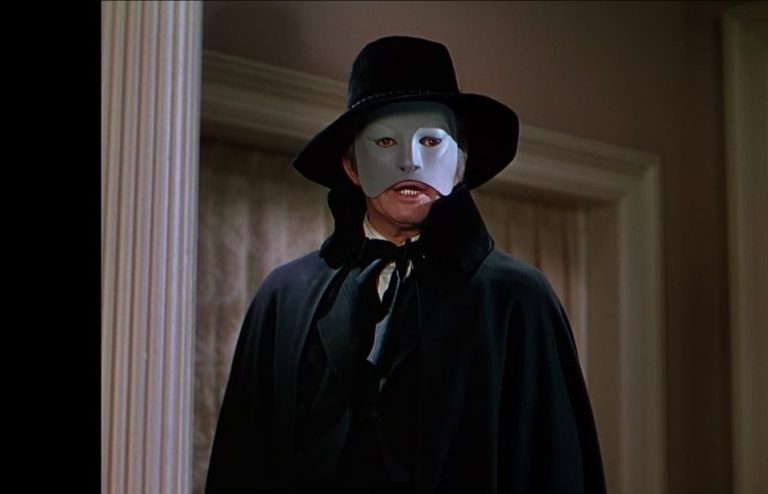
Nelson Eddy as The Phantom Of The Opera.
This photo is from the 1943 film Phantom Of The Opera.
You can see the trailer for Phantom Of The Opera via YouTube here.
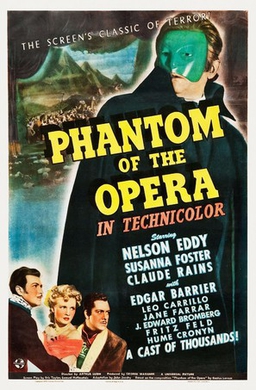
Phantom Of The Opera 1943 film poster.
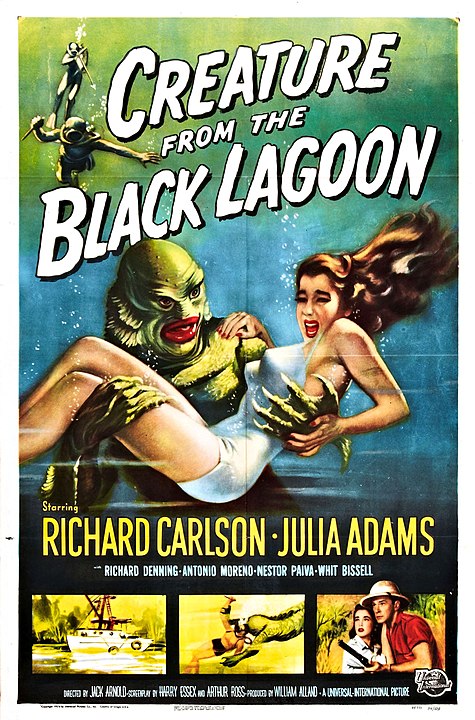
Creature From The Black Lagoon 1945 film poster.
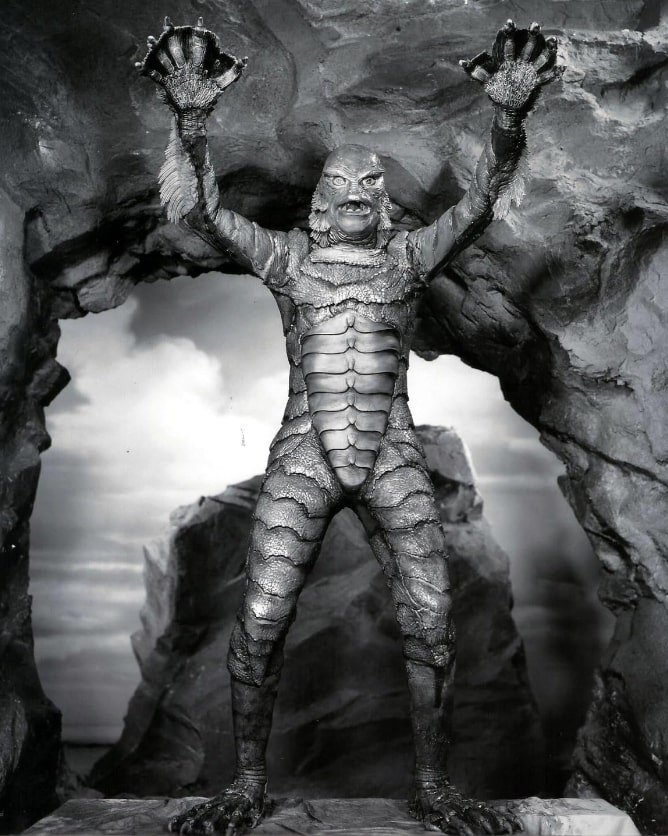
Ben Chapman as The Creature From The Black Lagoon.
There were two men playing the creature in the film, Ricou Browning in the water and Ben Chapman out of the water (shown here). None of them were credited which was unfair in my opinion considering they were both playing the actual monster in the film title and for that reason, I have rightly acknowledged them both here.
This photo is from the 1954 film Creature From The Black Lagoon.
You can see the trailer for Creature From The Black Lagoon via the Internet Archive here.
Universal Pictures – Official website. The image shown at the top of this page, and elsewhere, of the Universal Classic Monsters logo is the copyright of Universal Pictures and was taken from Wikipedia.
The image above of Bela Lugosi as Dracula is from the Internet Archive via Wikipedia and is in the public domain.
The image above of Boris Karloff as The Mummy is from the Internet Archive via Wikipedia and is in the public domain.
The image above of Boris Karloff as Frankenstein’s Monster is via Wikipedia and in the public domain.
The image above of Lon Chaney Jnr. as The Wolf Man is via Wikipedia.
The image above of Lon Chaney as The Phantom Of The Opera is via IMDb.
The image above of The Phantom Of The Opera 1925 film poster by unknown is via Wikipedia and in the public domain.
The image above of the Dracula 1931 film poster by unknown is via Wikipedia and in the public domain.
The image above of the Frankenstein 1931 film poster by Karoly Grosz is via Wikipedia and in the public domain.
The Frankenstein mask photos above are copyright of Universal via Universal Studios and Trick Or Treat Studios.
The image above of The Mummy 1932 film poster by Karoly Grosz is via Wikipedia and in the public domain.
The image above of Claude Rains as The Invisible Man is from IMDb.
The image above of The Invisible Man 1933 film poster by Karoly Grosz is via Wikipedia and in the public domain.
The image above of Frankenstein’s monster is via Wikipedia and in the public domain.
The image above of The Bride Of Frankenstein 1935 film poster is via Wikipedia and in the public domain.
The image above of The Wolf Man 1942 film poster by unknown is via Wikipedia.
The image above of Nelson Eddy as The Phantom Of The Opera is via IMDb.
The image above of Phantom Of The Opera 1943 film poster by inknown is via Wikipedia and in the public domain.
IMDb on YouTube.
Universal Pictures – U.K. official website.
Universal Pictures on YouTube.
Universal Pictures on Facebook.
Universal Pictures on Twitter.
Universal Studios – Official website.
Universal Studios on Facebook.
Trick Or Treat Studios – Official website.
Trick Or Treat Studios on YouTube.
Trick Or Treat Studios on Facebook.
Trick Or Treat Studios on Twitter.
Trick Or Treat Studios on Instagram.
Trick Or Treat Studios on TikTok.
Wikipedia – Official website. Wikipedia is a free online encyclopedia that anyone can edit in good faith. Its purpose is to benefit readers by containing information on all branches of knowledge. Hosted by the Wikimedia Foundation, it consists of freely editable content, whose articles also have numerous links to guide readers to more information.

What is there not to like about horror? It is an escapism from the real world and so damn cool. I love so much about it. This page concentrates on the Horror genre and anything I post about that can be seen in Blog Posts below.
I have been a fan of Horror, particularly Horror films since I was little. I have loved Universal classic monsters, for it is they that started my love of Horror off, even if they scared the hell out of me at first and I hid under my Mom’s arm or behind the settee at first watching them., ha ha. That changed the older I got.
If you mention anything to do with horror then it is inevitable Halloween is mentioned.
Growing up in England from a child to a teenager in the 1960’s, 1970’s and 1980’s, Halloween was an American thing you saw on the telly. There was no dressing up and trick-or-treating, not in my family home anyway. Even when my kids were younger I never really bothered much about Halloween. It was just all too American for me and just liked the English traditions I was brought up with. They had fun wearing masks, bobbing for apples etc. but we never went out dressed up knocking on people’s doors. in fact, I don’t recall ever seeing anyone else do it either.
Nowadays all of the above is a common sight. I am no killjoy and I don’t knock anyone who really enjoys it. I admit it’s a fun thing for kids to do and a good excuse for a party for the adults which I have enjoyed going to in the past few years. When you have suffered from depression and anxiety for as long as I have, just to be included can be a lifesaver.
The main thing I like about Halloween is dressing up and the Horror theme to it. I have never celebrated Halloween in my life in the past because, since I was a kid, I have loved horror. Every day is Halloween for me, ha ha.
Horror is a genre of fiction that is intended to disturb, frighten or scare. Horror is often divided into the sub-genres of psychological horror and supernatural horror, which are in the realm of speculative fiction. Literary historian J. A. Cuddon, in 1984, defined the horror story as “a piece of fiction in prose of variable length… which shocks, or even frightens the reader, or perhaps induces a feeling of repulsion or loathing”. Horror intends to create an eerie and frightening atmosphere for the reader. Often the central menace of a work of horror fiction can be interpreted as a metaphor for larger fears of a society.
Prevalent elements include ghosts, demons, vampires, monsters, zombies, werewolves, the Devil, serial killers, extraterrestrial life, killer toys, psychopaths, gore, torture, evil clowns, cults, cannibalism, vicious animals, the apocalypse, evil witches, dystopia and man-made or natural disasters.
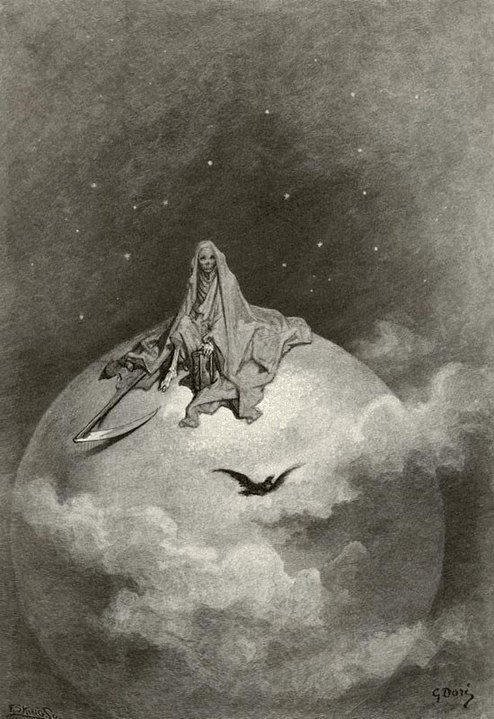
The Raven by Gustave Dore.
This is an illustration of the 1884 edition of Edgar Allan Poe’s The Raven. It is referring to the illustration “Doubting, dreaming dreams no mortal ever dared to dream before.”
The horror genre has ancient origins, with roots in folklore and religious traditions focusing on death, the afterlife, evil, the demonic and the principle of the thing embodied in the person. These manifested in stories of beings such as demons, witches, vampires, werewolves and ghosts. European horror fiction became established through the works of the Ancient Greeks and Ancient Romans. Mary Shelley’s well-known 1818 novel about Frankenstein was greatly influenced by the story of Hippolytus, whom Asclepius revives from death. Euripides wrote plays based on the story, Hippolytos Kalyptomenos and Hippolytus. In Plutarch’s The Lives of the Noble Grecians and Romans in the account of Cimon, the author describes the spirit of a murderer, Damon, who himself was murdered in a bathhouse in Chaeronea.
Pliny the Younger (61 to circa 113) tells the tale of Athenodorus Cananites, who bought a haunted house in Athens. Athenodorus was cautious since the house seemed inexpensive. While writing a book on philosophy, he was visited by a ghostly figure bound in chains. The figure disappeared in the courtyard and the following day, the magistrates dug in the courtyard and found an unmarked grave.
Elements of the horror genre also occur in Biblical texts, notably in the Book of Revelation.
The Witch of Berkeley by William of Malmesbury has been viewed as an early horror story. Werewolf stories were popular in medieval French literature. One of Marie de France’s twelve lais is a werewolf story titled Bisclavret.
The Countess Yolande commissioned a werewolf story titled Guillaume de Palerme. Anonymous writers penned two werewolf stories, Biclarel and Melion.
Much horror fiction derives from the cruellest personages of the 15th century. Dracula can be traced to the Prince of Wallachia Vlad III, whose alleged war crimes were published in German pamphlets. A 1499 pamphlet was published by Markus Ayrer, which is most notable for its woodcut imagery. The alleged serial killer sprees of Gilles de Rais have been seen as the inspiration for Bluebeard. The motif of the vampiress is most notably derived from the real-life noblewoman and murderer, Elizabeth Bathory, and helped usher in the emergence of horror fiction in the 18th century, such as through Laszlo Turoczi’s 1729 book Tragica Historia.
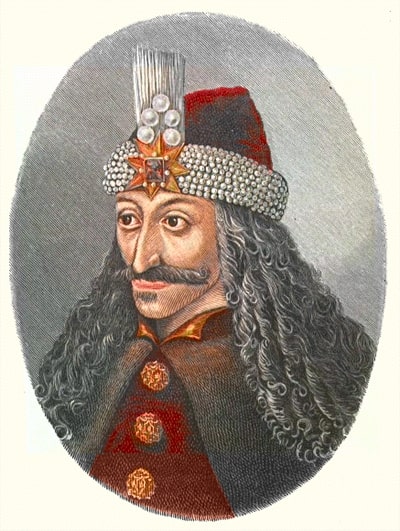
Vlad The Impaler.
This is a portrait of Vlad Tzepesh (Vlad III). He was the inspiration for Count Dracula. Tzepesh ruled from 1455 – 1462 and 1483 – 1496.
The 18th century saw the gradual development of Romanticism and the Gothic horror genre. It drew on the written and material heritage of the Late Middle Ages, finding its form with Horace Walpole’s seminal and controversial 1764 novel, The Castle of Otranto. In fact, the first edition was published disguised as an actual medieval romance from Italy, discovered and republished by a fictitious translator. Once revealed as modern, many found it anachronistic, reactionary, or simply in poor taste but it proved immediately popular. Otranto inspired Vathek (1786) by William Beckford, A Sicilian Romance (1790), The Mysteries of Udolpho (1794) and The Italian (1796) by Ann Radcliffe and The Monk (1797) by Matthew Lewis. A significant amount of horror fiction of this era was written by women and marketed towards a female audience, a typical scenario of the novels being a resourceful female menaced in a gloomy castle.
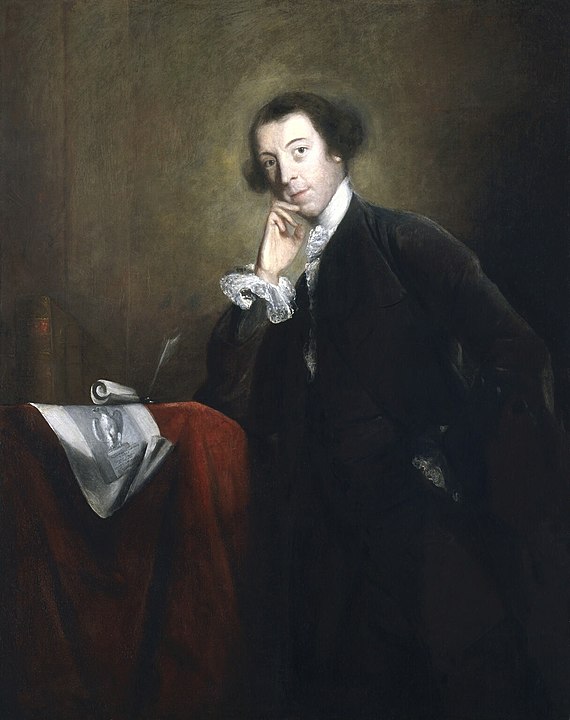
Horace Walpole by Joshua Reynolds.
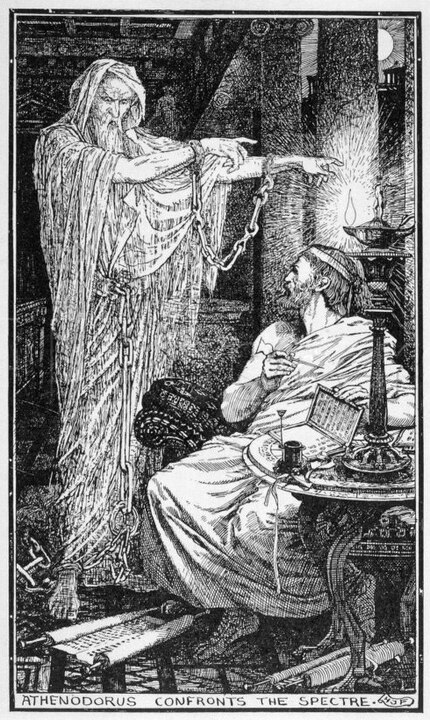
Athenodorus by Henry Justice Ford.
Here Athenodorus confronts the Spectre. It is from The Strange Story Book by Leonora Blanche Lang and Andrew Lang.
The Gothic tradition blossomed into the genre that modern readers today call horror literature in the 19th century. Influential works and characters that continue resonating in fiction and film today saw their genesis in the Brothers Grimm’s Hansel and Gretel (1812), Mary Shelley’s Frankenstein (1818), John Polidori’s The Vampyre (1819), Charles Maturin’s Melmoth the Wanderer (1820), Washington Irving’s The Legend of Sleepy Hollow (1820), Jane C. Loudon’s The Mummy!: Or a Tale of the Twenty-Second Century (1827), Victor Hugo’s The Hunchback of Notre Dame (1831), Thomas Peckett Prest’s Varney the Vampire (1847), the works of Edgar Allan Poe, the works of Sheridan Le Fanu, Robert Louis Stevenson’s Strange Case of Dr Jekyll and Mr Hyde (1886), Oscar Wilde’s The Picture of Dorian Gray (1890), H. G. Wells’ The Invisible Man (1897), and Bram Stoker’s Dracula (1897). Each of these works created an enduring icon of horror seen in later re-imaginings on the page, stage and screen.
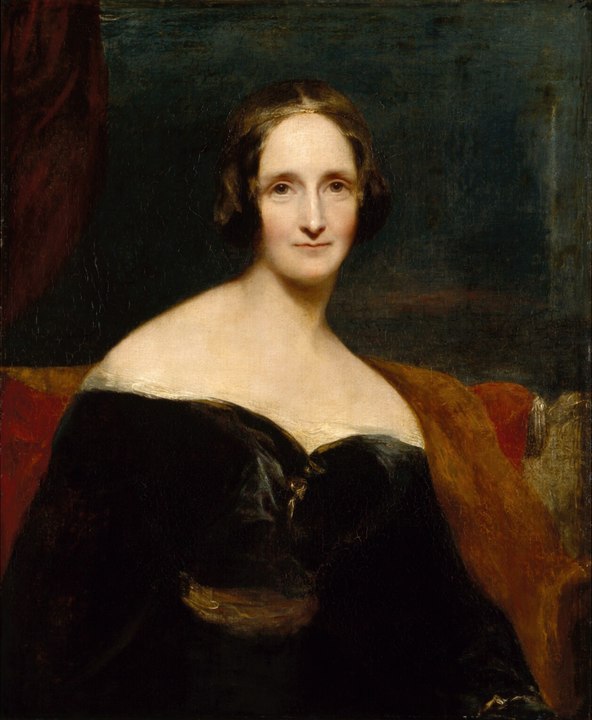
Mary Shelley By Richard Rothwell.
A proliferation of cheap periodicals around the turn of the century led to a boom in horror writing. For example, Gaston Leroux serialised his Le Fantome de l’Opera (The Phantom Of The Opera) before it became a novel in 1910. One writer who specialised in horror fiction for mainstream pulps, such as All-Story Magazine, was Tod Robbins, whose fiction deals with themes of madness and cruelty. In Russia, the writer Alexander Belyaev popularised these themes in his story Professor Dowell’s Head (1925), in which a mad doctor performs experimental head transplants and reanimations on bodies stolen from the morgue, and which was first published as a magazine serial before being turned into a novel. Later, specialist publications emerged to give horror writers an outlet, prominent among them were Weird Tales and Unknown Worlds.
Influential horror writers of the early 20th century made inroads into these mediums. Particularly, the venerated horror author H. P. Lovecraft, and his enduring Cthulhu Mythos transformed and popularised the genre of cosmic horror, and M. R. James is credited with redefining the ghost story in that era.
The serial murderer became a recurring theme. Yellow journalism and sensationalism of various murderers, such as Jack the Ripper, and lesser so, Carl Panzram, Fritz Haarman, and Albert Fish, all perpetuated this phenomenon. The trend continued in the postwar era, partly renewed after the murders committed by Ed Gein. In 1959, Robert Bloch, inspired by the murders, wrote Psycho. The crimes committed in 1969 by the Manson Family influenced the slasher theme in horror fiction of the 1970’s. In 1981, Thomas Harris wrote Red Dragon, introducing Dr. Hannibal Lecter. In 1988, the sequel to that novel, The Silence of the Lambs, was published.
Early cinema was inspired by many aspects of horror literature and started a strong tradition of horror films and subgenres that continues to this day. Up until the graphic depictions of violence and gore on the screen commonly associated with 1960’s and 1970’s slasher films and splatter films, comic books such as those published by EC Comics (most notably Tales From The Crypt) in the 1950’s satisfied readers’ quests for horror imagery that the silver screen could not provide. This imagery made these comics controversial, and as a consequence, they were frequently censored.
The modern zombie tale dealing with the motif of the living dead harks back to works including H. P. Lovecraft’s stories Cool Air (1925), In The Vault (1926), and The Outsider (1926), and Dennis Wheatley’s Strange Conflict (1941). Richard Matheson’s novel I Am Legend (1954) influenced an entire genre of apocalyptic zombie fiction emblematized by the films of George A. Romero.
In the late 1960’s and early 1970’s, the enormous commercial success of three books – Rosemary’s Baby (1967) by Ira Levin, The Exorcist by William Peter Blatty, and The Other by Thomas Tryon encouraged publishers to begin releasing numerous other horror novels, thus creating a horror boom.
One of the best-known late-20th-century horror writers is Stephen King, known for Carrie, The Shining, It, Misery and several dozen other novels and about 200 short stories. Beginning in the 1970’s, King’s stories have attracted a large audience, for which he was awarded by the U.S. National Book Foundation in 2003. Other popular horror authors of the period included Anne Rice, Brian Lumley, Graham Masterton, James Herbert, Dean Koontz, Richard Laymon, Clive Barker, Ramsey Campbell, and Peter Straub.

Stephen King.
This photo of King was taken at the 2007 New York Comicon in America.
Best-selling book series of contemporary times exist in genres related to horror fiction, such as the werewolf fiction urban fantasy Kitty Norville books by Carrie Vaughn (2005 onward). Horror elements continue to expand outside the genre. The alternate history of more traditional historical horror in Dan Simmons’s 2007 novel The Terror sits on bookstore shelves next to genre mash-ups such as Pride and Prejudice and Zombies (2009), and historical fantasy and horror comics such as Hellblazer (1993 onward) and Mike Mignola’s Hellboy (1993 onward). Horror also serves as one of the central genres in more complex modern works such as Mark Z. Danielewski’s House of Leaves (2000), a finalist for the National Book Award. There are many horror novels for children and teens, such as R. L. Stine’s Goosebumps series or The Monstrumologist by Rick Yancey. Additionally, many movies for young audiences, particularly animated ones, use horror aesthetics and conventions, for example, ParaNorman. These are what can be collectively referred to as children’s horror. Although it is unknown for sure why children enjoy these movies (as it seems counter-intuitive), it is theorised that it is, in part, grotesque monsters that fascinate kids. Tangential to this, the internalised impact of horror television programs and films on children is rather under-researched, especially when compared to the research done on the similar subject of violence in TV and film’s impact on the young mind. What little research there is tends to be inconclusive on the impact that viewing such media has.
History of horror films.
One defining trait of the horror genre is that it provokes an emotional, psychological, or physical response within readers that causes them to react with fear. One of H. P. Lovecraft’s most famous quotes about the genre is “The oldest and strongest emotion of mankind is fear, and the oldest and strongest kind of fear is fear of the unknown.”. This is the first sentence from his seminal essay, Supernatural Horror in Literature. Science fiction historian Darrell Schweitzer has stated, “In the simplest sense, a horror story is one that scares us” and “the true horror story requires a sense of evil, not in necessarily in a theological sense, but the menaces must be truly menacing, life-destroying, and antithetical to happiness.”
In her essay Elements of Aversion, Elizabeth Barrette articulates the need by some for horror tales in a modern world. She says, “The old fight or flight reaction of our evolutionary heritage once played a major role in the life of every human. Our ancestors lived and died by it. Then someone invented the fascinating game of civilization, and things began to calm down. Development pushed wilderness back from settled lands. War, crime, and other forms of social violence came with civilization and humans started preying on each other, but by and large daily life calmed down. We began to feel restless, to feel something missing, the excitement of living on the edge, the tension between hunter and hunted. So we told each other stories through the long, dark nights. when the fires burned low, we did our best to scare the daylights out of each other. The rush of adrenaline feels good. Our hearts pound, our breath quickens, and we can imagine ourselves on the edge. Yet we also appreciate the insightful aspects of horror. Sometimes a story intends to shock and disgust, but the best horror intends to rattle our cages and shake us out of our complacency. It makes us think, forces us to confront ideas we might rather ignore, and challenges preconceptions of all kinds. Horror reminds us that the world is not always as safe as it seems, which exercises our mental muscles and reminds us to keep a little healthy caution close at hand.”
In a sense similar to the reason a person seeks out the controlled thrill of a roller coaster, readers in the modern era seek out feelings of horror and terror to feel a sense of excitement. However, Barrette adds that horror fiction is one of the few mediums where readers seek out a form of art that forces themselves to confront ideas and images they “might rather ignore to challenge preconceptions of all kinds.”
One can see the confrontation of ideas that readers and characters would rather ignore throughout literature in famous moments such as Hamlet’s musings about the skull of Yorick, its implications of the mortality of humanity, and the gruesome end that bodies inevitably come to. In horror fiction, the confrontation with the gruesome is often a metaphor for the problems facing the current generation of the author.
There are many theories as to why people enjoy being scared. For example, people who like horror films are more likely to score highly for openness to experience, a personality trait linked to intellect and imagination.
It is a now commonly accepted view that the horror elements of Dracula’s portrayal of vampirism are metaphors for sexuality in a repressed Victorian era. But this is merely one of many interpretations of the metaphor of Dracula. Jack Halberstam postulates many of these in his essay Technologies of Monstrosity: Bram Stoker’s Dracula. He writes, “[The] image of dusty and unused gold, coins from many nations and old unworn jewels, immediately connects Dracula to the old money of a corrupt class, to a kind of piracy of nations and to the worst excesses of the aristocracy.”
Halberstram articulates a view of Dracula as manifesting the growing perception of the aristocracy as an evil and outdated notion to be defeated. The depiction of a multinational band of protagonists using the latest technologies (such as a telegraph) to quickly share, collate, and act upon new information is what leads to the destruction of the vampire. This is one of many interpretations of the metaphor of only one central figure of the canon of horror fiction, as over a dozen possible metaphors are referenced in the analysis, from the religious to the antisemitic.
Noel Carroll’s Philosophy of Horror postulates that a modern piece of horror fiction’s monster, villain, or a more inclusive menace must exhibit the following two traits which is a menace that is threatening (either physically, psychologically, socially, morally, spiritually, or some combination of the aforementioned) and a menace that is impure (that violates the generally accepted schemes of cultural categorisation.
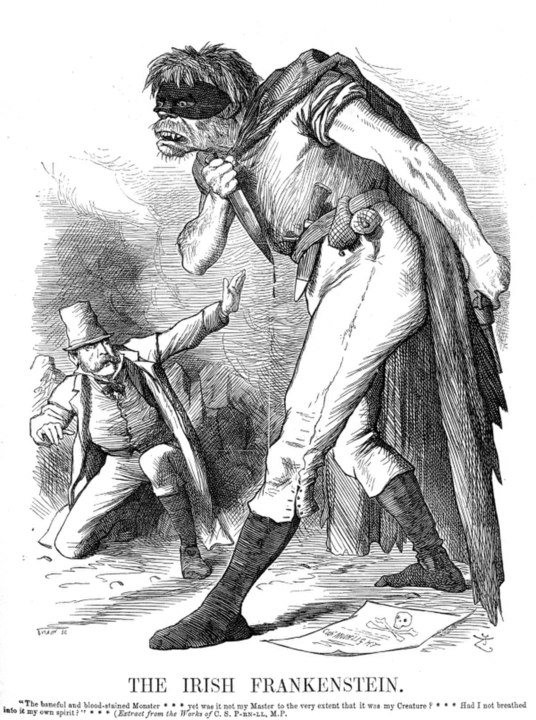
The Irish Frankenstein by John Tenniel.
This illustration is from an 1882 issue of Punch and is anti-Irish propaganda. Tenniel conceives the Irish Fenian movement as akin to Frankenstein’s monster, in the wake of the Phoenix Park killings. Menacing villains and monsters in horror literature can often be seen as metaphors for the fears incarnate of a society.
In addition to those essays and articles shown above, scholarship on horror fiction is almost as old as horror fiction itself. In 1826, the gothic novelist Ann Radcliffe published an essay distinguishing two elements of horror fiction, terror and horror. Whereas terror is a feeling of dread that takes place before an event happens, horror is a feeling of revulsion or disgust after an event has happened. Radcliffe describes terror as that which expands the soul and awakens the faculties to a high degree of life, whereas horror is described as that which freezes and nearly annihilates them.
Modern scholarship on horror fiction draws upon a range of sources. In their historical studies of the gothic novel, both Devandra Varma and S.L. Varnado make reference to the theologian Rudolf Otto, whose concept of the numinous was originally used to describe religious experience.
Achievements in horror fiction are recognised by numerous awards. The Horror Writers Association presents the Bram Stoker Awards for Superior Achievement, named in honour of Bram Stoker, author of the seminal horror novel Dracula. The Australian Horror Writers Association presents the annual Australian Shadows Awards. The International Horror Guild Award was presented annually to works of horror and dark fantasy from 1995 to 2008. The Shirley Jackson Awards are literary awards for outstanding achievement in the literature of psychological suspense, horror, and dark fantastic works. Other important awards for horror literature are included as subcategories within general awards for fantasy and science fiction in such awards as the Aurealis Award.
Some writers of fiction normally classified as horror tend to dislike the term, considering it too lurid. They instead use the terms dark fantasy or Gothic fantasy for supernatural horror, or psychological thriller for non-supernatural horror.
Alexas_Fotos on Pixabay – The image shown at the top of this page is the copyright of Alexas_Fotos. You can find more great work from the photographer Alexa and lots more free stock photos at Pixabay.
The image above of The Raven by Gustave Dore is via Wikipedia and is in the public domain.
The image above of Vlad the Impaler is unknown via Wikipedia and is in the public domain.
The image above of Horace Walpole by Joshua Reynolds is via Wikipedia and is in the public domain.
The image above of Athenodorus by Henry Justice Ford is via Wikipedia and is in the public domain.
The image above of Mary Shelley by Richard Rothwell is via Wikipedia and is in the public domain.
The image shown above of Stephen King is the copyright of Wikipedia user Pinguino Kolb. It comes with a Creative Commons licence (CC BY-SA 2.0).
The image above of The Irish Frankenstein by John Tenniel is via Wikipedia and is in the public domain.
Universal Pictures – U.K. official website.
Universal Pictures on YouTube.
Universal Pictures on Facebook.
Universal Pictures on Twitter.
Universal Studios – Official website.
I am and forever will be a Blue Nose until the day I die. There is only one team in Birmingham worth supporting with true passion, and that is Birmingham. I have been supporting them since 1978 when Jim Smith was the manager. He is my favourite manager to date, with current manager Chris Davies coming a very close second.
Although I do have a section for Sport on my website, I could not justify sticking the Blues as a subcategory of it. They have been and are an important part of my life growing up to the present day, and as such deserve pride of place on its own in my website menu, joys, sorrows and all!
Read about them, and any memories regarding them, in the associated blog posts and my decades section as well.
For Blues fixtures, results and goalscorers for the current season, click here.
There is information, including kits, squads, etc., for the current season in the Blog Posts at the bottom of the page.
Birmingham City Football Club is a professional football club based in Birmingham, England. Formed in 1875 as Small Heath Alliance, it was renamed Small Heath in 1888, Birmingham in 1905, and Birmingham City in 1943. The club compete in the E.F.L. Championship, which is the second tier of the English football league system. Their nickname is Blues, after the colour of their kit, and the fans are known as Blue Noses.
As Small Heath, Blues played in the Football Alliance before becoming founder members and first champions of the Football League Second Division. The most successful period in our history was in the 1950’s and early 1960’s. We achieved our highest finishing position of sixth in the First Division in the 1955–56 season and reached the 1956 F.A. Cup Final. Blues played in two Inter-Cities Fairs Cup finals, in 1960, as the first English club side to reach a major European final, and again the following year. We won the League Cup in 1963 and again in 2011. Birmingham City have played in the top tier of English football for around half of their history. The longest period spent outside the top division was between 1986 and 2002, which included two brief spells in the third tier of English football, during which time we won the Football League Trophy twice.
St Andrew’s, renamed St. Andrew’s @ Knighthead Park in 2024 for sponsorship reasons (although many fans will still refer to it as St. Andrew’s, as I will), has been our home ground since 1906.
Blues have a long-standing and fierce rivalry with Aston Villa.
Keep Right On is one of the most well-known anthems in football, famously sung by Birmingham City fans.
The song originally came from Scotland. The song was written and sung by Sir Henry Lauder, a singer and a comedian. Lauder was very popular during the early 1900’s and he achieved international success.
The song was written and composed in 1924 by Lauder and William Dillon. The song was then released in 1925.
The song was inspired by personal tragedy. Lauder wrote the song after his son was killed in action during the First World War.
For Lauder’s original Keep Right On, the lyrics went like this:
“Every road through life is a long, long road.
Filled with joys and sorrows too.
As we journey on how your heart will yearn.
For the things most dear to you.
With wealth and love ‘tis so.
But onward we must go.
Keep right on to the end of the road.
Keep right on to the end.
Though the way be long, let your heart be strong.
Keep right on round the bend.
If you’re tired and weary still journey on.
Till you come to your happy abode.
Where all you love and you’re dreaming of.
Will be there at the end of the road.
Keep right on to the end of the road.
With a big stout heart to a long steep hill.
We may get there with a smile.
With a good kind thought and an end in view.
We can cut short many a mile.
So let courage every day.
Be your guiding star always.
Keep right on to the end of the road.
Keep right on to the end.
Though the way be long, let your heart be strong.
Keep right on round the bend.
If you’re tired and weary still journey on.
Till you come to your happy abode.
Where all you love and you’re dreaming of.
Will be there at the end of the road.
Keep right on to the end of the road.
Keep right on to the end.
Though the way be long, let your heart be strong.
Keep right on round the bend.
If you’re tired and weary still journey on.
Till you come to your happy abode.
Where all you love and you’re dreaming of.
Will be there at the end of the road.”
Keep Right On To The End Of The Road by Harry Lauder.
Keep Right On arrived into the terraces of St Andrews in the mid-1950’s.
Blues were on our way to Leyton Orient in the fourth round of the F.A. Cup and manager Arthur Turner got the squad to sing the anthem as a pre-match ritual to calm the nerves before a big game.
Birmingham City legend Alex Govan, a winger who played for Blues during the 1950’s, introduced the team to Lauder’s famous song as the club went on to reach the FA Cup final in 1956.
Since then, the song has been adopted as the club’s anthem and the rest is history.
Govan once said to BBC WM: “We always had a sing-song on the coach wherever we went away from home… And Arthur Turner turned and said “Come on Alex, give us something from Scotland.””
“I couldn’t sing “I belong to Glasgow”, he continued, “so I sang “Keep right on to the end of the road”, it was the easiest one to sing… The fans heard us through the windows and it’s been magic ever since.”
As we all know, Keep Right On, has fans’ hairs standing up on the backs of their necks whenever it is belted around St Andrews. You have to be there to truly experience the magic of it all.
Two great examples of this anthem at its finest were before the Carling Cup final in 2011, and after Paul Caddis scored the equaliser against Bolton at the then-named Reebok Stadium, which saved Blues from relegation to League One on the final day of the season.
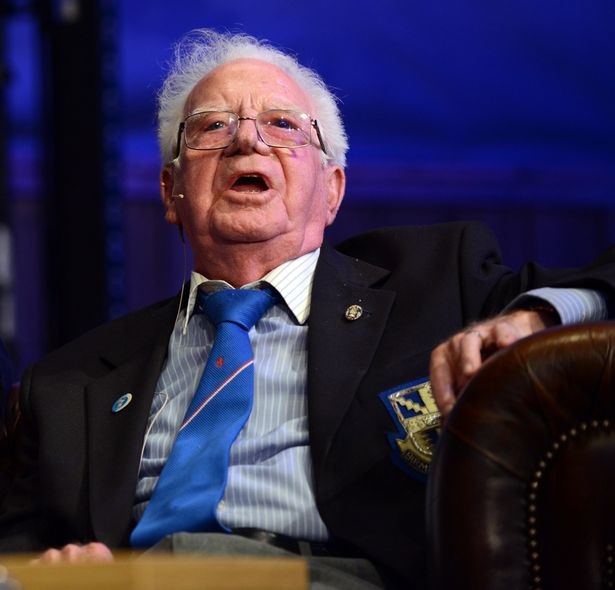
Birmingham City Legend Alex Govan.
As you go through life it’s a long, long road.
There’ll be joys and sorrows too.
As we journey on we will sing this song.
For the boys in royal blue.
We’re often partisan.
We will journey on.
Keep right on to the end of the road.
Keep right on to the end.
Though the way be long.
Let your heart beat strong.
Keep right on to the end.
Though you’re tired and weary.
Still journey on.
Till you come to your happy abode.
Where all the love you’ve been dreaming of will be there.
Where?
At the end of the road.
Birmingham.
Birmingham.
Birmingham.
Birmingham City fans singing Keep Right On To The End Of The Road before The Carling Cup Final Kick-Off.
Read more here.
Birmingham City was founded as Small Heath Alliance in 1875, and from 1877 we played our home games at Muntz Street in Small Heath, Birmingham. The club turned professional in 1885 and three years later became the first football club to become a limited company with a board of directors, under the name of Small Heath F.C. Ltd. From the 1889 – 90 season Blues played in the Football Alliance, which ran alongside the Football League. In 1892, Small Heath, along with the other Alliance teams, was invited to join the newly formed Football League Second Division. We finished as champions, but failed to win promotion via the test match system. The following season promotion to the First Division was secured after a second-place finish and test match victory over Darwen. The club adopted the name Birmingham Football Club in 1905 and moved into their new home, St Andrew’s, the following year. Matters on the field failed to live up to their surroundings. Birmingham was relegated in 1908, obliged to apply for re-election two years later, and remained in the Second Division until after the First World War.
Frank Womack’s captaincy and the creativity of Scottish international playmaker Johnny Crosbie contributed much to Birmingham winning Blues a second Division Two title in 1920–21. Womack went on to make 515 appearances, a club record for an outfielder, over a twenty-year career. 1920 also saw the debut of the 19-year-old Joe Bradford, who went on to score a club record 267 goals in 445 games and won 12 caps for England. In 1931, manager Leslie Knighton led the club to their first FA Cup Final, which they lost 2–1 to Second Division club West Bromwich Albion. Though Birmingham remained in the top flight for 18 seasons, we struggled in the league, with much reliance placed on England goalkeeper Harry Hibbs to make up for the lack of goals, Bradford excepted, at the other end. Blues were finally relegated in 1939, the last full season before the Football League was abandoned for the duration of the Second World War.
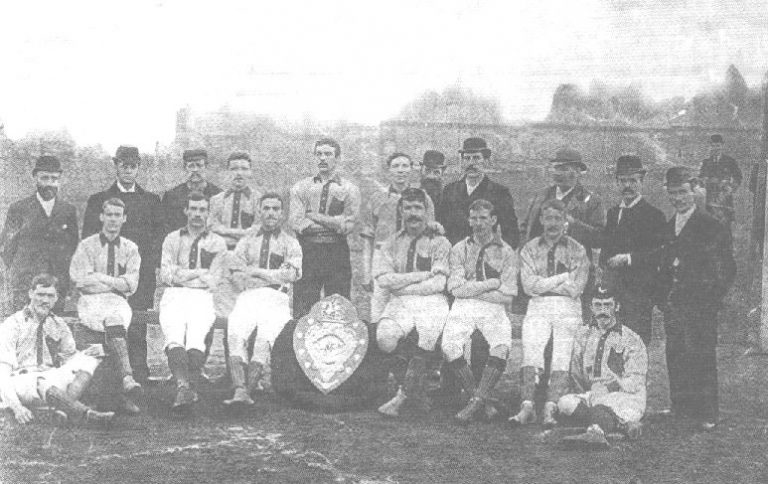
Second Division Champions Small Heath F.C. in 1893.
The name Birmingham City F.C. was adopted in 1943. Under Harry Storer, appointed manager in 1945, the club won the Football League South wartime league and reached the semifinal of the first post-war F.A. Cup. Two years later Blues won our third Second Division title, conceding only 24 goals in the 42-game season. Storer’s successor Bob Brocklebank, though unable to stave off relegation in 1950, brought in players who made a major contribution to the club’s successes of the next decade. When Arthur Turner took over as manager in November 1954, he made them play closer to their potential, and a 5 – 1 win on the last day of the 1954 – 55 season confirmed Birmingham City as champions. In our first season back in the First Division, Birmingham achieved our highest league finish of sixth place. We also reached the F.A. Cup final, losing 3 – 1 to Manchester City in the game notable for City’s goalkeeper Bert Trautmann playing the last 20 minutes with a broken bone in his neck. The following season the club lost in the F.A. Cup semi-final for the third time since the war, this time beaten 2 – 0 by Manchester United’s Busby Babes.
Birmingham became the first English club side to take part in European competition when they played their first group game in the inaugural Inter-Cities Fairs Cup competition on the 15th of May 1956. We went on to reach the semi-final where we drew 4 – 4 on aggregate with Barcelona, losing the replay 2 – 1. We were also the first English club side to reach a European final, losing 4 – 1 on aggregate to Barcelona in the 1960 Fairs Cup final and 4 -2 to A.S. Roma the following year. In the 1961 semi-final, Blues beat Internazionale home and away and no other English club won a competitive game in the San Siro until Arsenal managed it in 2003. Gil Merrick’s side saved their best form for cup competitions. Though opponents in the 1963 League Cup final, local rivals Aston Villa, were pre-match favourites, Birmingham raised their game and won 3 – 1 on aggregate to lift their first major trophy. In 1965, after ten years in the top flight, we returned to the Second Division.
Businessman Clifford Coombs took over as chairman in 1965, luring Stan Cullis out of retirement to manage the club. Cullis’s team played attractive football which took Blues to the semi-finals of the League Cup in 1967 and of the F.A. Cup in 1968, but league football needed a different approach. Successor Freddie Goodwin produced a team playing skilful, aggressive football that won promotion as well as reaching an F.A. Cup semi-final. Two years later, the club raised money by selling Bob Latchford to Everton for a British record fee of £350,000, but without his goals, the team struggled. Sir Alf Ramsey briefly managed the club before Jim Smith took over in 1978 (the year I started supporting them). With relegation a certainty, the club sold Trevor Francis to Nottingham Forest, making him the first player transferred for a fee of £1 million. Francis had scored 133 goals in 329 appearances over his nine years at Blues.
Smith took Birmingham City straight back to the First Division, but a poor start to the 1981 – 82 season saw him replaced by Ron Saunders, who had just resigned from Aston Villa. Saunders’ team struggled to score goals and was relegated in 1984. Blues bounced back up the following season. Saunders quit after F.A. Cup defeat to non-League team Altrincham, staff were laid off, the training ground was sold, and by 1989 Birmingham was in the Third Division for the first time in their history.
In April 1989 the Kumar brothers, owners of a clothing chain, bought the club. A rapid turnover of managers, the absence of promised investment, and a threatened mass refusal of players to renew contracts were relieved only by a victorious trip to Wembley in the Associate Members’ Cup. Terry Cooper delivered promotion, but the collapse of the Bank of Credit and Commerce International (B.C.C.I.) put the Kumars’ businesses into receivership. In November 1992 B.C..C.I.’s liquidator put up for sale their 84% holding in the football club.
The club continued in administration for four months, until Sport Newspapers’ proprietor David Sullivan bought it for £700,000, installed the then 23-year-old Karren Brady as managing director and allowed Cooper money for signings. On the last day of the season, the team avoided relegation back to the third tier, but after a poor start to the 1993–94 season, manager Terry Cooper was replaced by Barry Fry. The change did not prevent relegation, but Fry’s first full season brought promotion back to the second tier as champions, and victory over Carlisle United in the Football League Trophy via Paul Tait’s golden goal completed the lower-league Double. After one more year, Fry was dismissed to make way for the return of Trevor Francis.
Reinforced by players with top-level experience, including Manchester United captain Steve Bruce, Francis’s team narrowly missed out on a play-off position in 1998, and three years of play-off semi-final defeats followed. Blues reached the 2001 League Cup final against Liverpool at Cardiff’s Millennium Stadium. Birmingham equalised in the last minute of normal time, but the match went to a penalty shoot-out which Liverpool won. By October 2001, lack of progress had made Francis’s position untenable and after a 6–0 League Cup defeat to Manchester City, he left by mutual consent. Bruce’s return as manager shook up a stale team. He took them from mid-table to the play-offs and beat Norwich City on penalties in the final to secure promotion to the Premier League.
Motivated by the inspirational Christophe Dugarry, Birmingham’s first top-flight season for 16 years finished in mid-table. Loan signing Mikael Forssell’s 17 league goals helped Blues to a top-half finish in 2003 – 04, but when he was injured, the 2004 – 05 team struggled for goals. In July 2005, chairman David Gold said it was time to start talking about being as good as anyone outside the top three or four with the best squad of players for 25 years.
Injuries, loss of form, and lack of transfer window investment saw us get relegated in a season whose lowlight was a 7 – 0 F.A. Cup defeat to Liverpool. Jermaine Pennant and Emile Heskey left for record fees, and many others were released, but Bruce’s amended recruitment strategy, combining free-transfer experience with young hungry players and shrewd exploitation of the loan market, brought automatic promotion at the end of a season which had included calls for his head.

Manager Steve Bruce at a pre-season tournament at Weiden, Germany in 2004.
Bruce led Birmingham City to promotion to the Premier League in 2002 and 2007.
In July 2007, Hong Kong-based businessman Carson Yeung bought 29.9% of shares in the club, making him the biggest single shareholder, with a view to taking full control in the future. Uncertain as to his future under possible new owners, Bruce left in mid-season. His successor, Scotland national team manager Alex McLeish, was unable to stave off relegation but achieved promotion back to the Premier League at the first attempt. Yeung’s company completed the takeover in 2009, and the team finished in ninth place, our highest in 51 years. In 2011, we combined a second League Cup, defeating favourites Arsenal 2 – 1 with goals from Nikola Zigic and Obafemi Martins and securing qualification for the Europa League, with relegation back to the second-tier, after which McLeish resigned to join Aston Villa.
Birmingham narrowly failed to reach the knockout rounds of the Europa League and the play-off final. With the club in financial turmoil and under a transfer embargo, manager Chris Hughton left. Under Lee Clark, Blues twice retained our divisional status, albeit through Paul Caddis’s 93rd-minute goal in the last match of 2013 – 14 to avoid relegation on goal difference, but continued poor form saw him dismissed in October 2014. Gary Rowett stabilised the team and led us to two tenth-place finishes before being controversially dismissed by new owners Trillion Trophy Asia in favour of the pedigree of Gianfranco Zola, who would aid the club’s strategic, long-term view to take the club in a new direction.
Two wins from 24 matches under Zola left Birmingham needing two wins from the last three games to stay up, which they achieved under the managership of Harry Redknapp. Redknapp lasted another month, his former assistant Steve Cotterill five months, leaving successor Garry Monk another (ultimately successful) relegation battle. Despite budgetary restrictions and a nine-point deduction for breaches of the League’s Profitability and Sustainability (P&S) rules, Blues finished 17th in 2018 – 19. However, Monk was sacked in June after conflict with the board. He was succeeded by his assistant, Pep Clotet, initially as caretaker. In the 2019 – 20 season, a season that was suspended from March to June 2020 due to COVID, the club once again avoided relegation despite a 14-match winless run at the end of the season and the threat of a further points deduction. Academy product Jude Bellingham was sold to Borussia Dortmund in the summer for a club-record deal reported to be worth up to £30 million, after which Aitor Karanka lasted eight months as head coach before being replaced by former Birmingham player Lee Bowyer. After 16 months and yet another relegation struggle, amid rumours of an imminent takeover, Bowyer was replaced by John Eustace.
After two takeover attempts fell through, Shelby Companies Ltd, a subsidiary of US-based Knighthead Capital Management and fronted by that company’s co-founder Tom Wagner, purchased a controlling stake in the club and full ownership of the stadium on the 13th of July 2023. Former Manchester City C.E.O. Garry Cook was appointed to the corresponding role at Birmingham City, and the club gained considerable publicity from the arrival of American football player Tom Brady as minority owner.
In early October, with the team in the play-off places, John Eustace was sacked as manager. In a move that echoed Gary Rowett’s replacement by Gianfranco Zola seven years prior, the board stressed the need for a winning mentality and a culture of ambition across the club and a new appointment with responsibility for creating an identity and clear no-fear playing style. After former England international player Wayne Rooney‘s two wins from 15 matches left Birmingham in 20th place, Tony Mowbray was appointed manager. His need for medical leave brought the interim appointment of Gary Rowett, whose 11 points from the last eight games was not enough to prevent relegation to League One after 29 years at a higher level. On the 6th of June, 2024, Blues announced that our new manager would be Chris Davies who was previously at Tottenham Hotspur as their assistant manager.
Click here to read more about the start of the New Era of Birmingham City in 2023.
The Small Heath Alliance members decided among themselves that their colours would be blue. In the early days, they wore whatever blue shirt they had. The first uniform kit was a dark blue shirt with a white sash and white shorts. Several variations on a blue theme were tried and the one that stuck was the royal blue shirt with a white V, adopted during the First World War and retained until the late 1920’s. Though the design changed, royal blue remained. In 1971 Blues adopted the penguin strip (royal blue with a broad white central front panel) which lasted five years. This is probably most Blues fans, of a certain age’s favourite kit (it certainly is mine). Since then we have generally worn plain, nominally royal blue tops, though the actual shade used has varied. Shorts have been either blue or white, and socks usually blue, white or a combination. White, yellow, red and black, on their own or in combination, have been the most frequently used colours for the away kit.
There were aberrations: the 1992 kit, sponsored by Triton Showers, was made of a blue material covered with multicoloured splashes. The home shirt has only once featured stripes. In 1999, the blue shirt had a front central panel in narrow blue and white stripes.
You can view all of Birmingham City’s football kits past and present here.
When the club changed its name from Small Heath to Birmingham in 1905 it adopted the city’s coat of arms as its badge, although this was not always worn on the Blues tops. The 1970’s penguin top carried the letters B.C.F.C. intertwined at the centre of the chest. The Sports Argus newspaper ran a competition in 1972 to design a new badge for the club. The winning entry, a line-drawn globe and ball, with a ribbon carrying the club’s name and date of foundation, in plain blue and white, was adopted by the club but not worn on playing shirts until 1976, after the design was granted by the College of Arms in 1975. The design recorded at the College did not include the ribbon and was blazoned as a football ensigned by a terrestrial globe proper. This was granted as a heraldic badge to the English Football League and was licensed to Birmingham City. An experiment was made in the early 1990’s with colouring in the globe and ball, but was soon abandoned.
The first sponsor to have its name on the shirt was Birmingham-based brewery Ansell’s in 1983. They withdrew in mid-1985, and the shirts went unsponsored until January 1987, when Co-op Milk paid a five-figure sum to have its name displayed until the end of the season, which was a relief to the club not only financially; the vice-chairman claimed that as a “big club… people expect us to have a shirt sponsor and we have been lagging behind”. Later sponsors included car retailer P.J. Evans/Evans Halshaw (1988 – 1989), Mark One (1989 – 1992), Triton Showers (1992 – 1995), Auto Windscreens (1995 – 2001), Phones 4u (2001 – 2003), Flybe (2003 – 2007), F&C Investments (2007 – 2011), foreign exchange company RationalFX (2011 – 2012), lifestyle and leisure business EZE Group (2012 – 2013 and 2015 – 2016), e-cigarette company Nicolites (2013 – 2014), mobile payment enabler Zapaygo (2014 – 2015), 888sport (2016 – 2019) and Irish bookmaker BoyleSports (2019 – 2023). L.A.-based sports brand Undefeated is the current sponsor (2023 – ) which is supplied by Nike.
Click here to see the current Birmingham City kits.
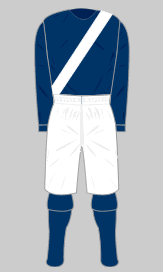
Small Heath Alliance’s first football kit from 1875.

Birmingham City’s club badge.
Small Heath Alliance played their first home games on waste ground off Arthur Street in Bordesley Green, Birmingham. As interest grew, we moved to a fenced-off field in Ladypool Road, Sparkbrook, where admission could be charged. A year later, we moved again, to a field adjoining Muntz Street, Small Heath, Birmingham, near the main Coventry Road, with a capacity of about 10,000. The Muntz Street ground was adequate for 1880’s friendly matches, and the capacity was gradually raised to around 30,000, but when several thousand spectators scaled walls and broke down turnstiles to get into a First Division match against Aston Villa, it became clear that it could no longer cope with the demand.
Director Harry Morris identified a site for a new ground in Small Heath, Bordesley Green, Birmingham, some three-quarters of a mile from Muntz Street towards the city centre. The site was where a brickworks once operated. The land sloped steeply down to stagnant pools, yet the stadium was constructed in under twelve months from land clearance to the opening ceremony on Boxing Day 1906. Heavy snow nearly prevented the opening; volunteers had to clear the pitch and terraces before the match, a goalless draw against Middlesbrough, could go ahead. The ground is reputed to have been cursed by gypsies evicted from the site; although gypsies are known to have camped nearby, there is no contemporary evidence for their eviction by the club.
The original capacity of St Andrew’s was reported as 75,000, with 4,000 seats in the Main Stand and space for 22,000 under cover. By 1938, the official capacity was 68,000, and February 1939 saw the attendance record set at the fifth round FA Cup tie against Everton, variously recorded as 66,844 or 67,341. On the outbreak of the Second World War, the Chief Constable ordered the ground’s closure because of the danger from air raids; it was the only ground to be thus closed and was only re-opened after the matter was raised in Parliament. It was badly damaged during the Birmingham Blitz: the Railway End and the Kop as a result of the bombing, while the Main Stand burnt down when a fireman mistook petrol for water.
The replacement Main Stand used a propped cantilever roof design, which meant fewer pillars to block spectators’ view of the pitch. Floodlights were installed in 1956 and officially switched on for a friendly match against Borussia Dortmund in 1957. By the early 1960’s a stand had been built at the Railway End to the same design as the Main Stand, roofs had been put on the Kop and Tilton Road End, and the ground capacity was down to about 55,000.
Resulting from the 1986 Popplewell Report into the safety of sports grounds and the later Taylor Report, the capacity of St Andrew’s was set at 28,235 for safety reasons, but it was accepted that the stadium had to be brought up to modern all-seated standards. After the last home game of the 1993 – 94 season, the Kop and Tilton Road terraces were demolished (fans took home a significant proportion as souvenirs) to be replaced at the start of the new season by a 7,000-seat Tilton Road Stand, continuing round the corner into the 9,500-seat Kop, which opened two months later. The 8,000-seat Railway Stand followed in 1999; ten years later, this was renamed the Gil Merrick Stand, in honour of the club’s appearance record-holder and former manager, but the Main Stand has still to be modernised. In 2019, the club website listed the stadium capacity as 29,409.
In 2004, a proposal was put forward to build a sports village comprising a 55,000-capacity City of Birmingham Stadium, other sports and leisure facilities, and a super casino, to be jointly financed by Birmingham City Council, Birmingham City F.C. (via the proceeds of the sale of St Andrew’s) and the casino group Las Vegas Sands. The feasibility of the plan depended on the government issuing a licence for a super casino and Birmingham being chosen as the venue, but this did not happen. The club have planning permission to redevelop the Main Stand, but the club and council continued to seek alternative sources of funding for the City of Birmingham Stadium project.
In 2013, the Birmingham City Supporters’ Trust’s application for listing St Andrew’s as an Asset of Community Value (A.C.V.). This is a building or other land whose main use furthers the social well-being or social interests of the local community and where it is realistic to believe it could do so in the future. The Localism Act 2011 was approved by Birmingham City Council. This requires any proposed sale to be notified to the Council and provides for a six-month moratorium on that sale to allow the Trust and other community groups to submit their own bid. In 2018, the club’s owners agreed to a three-year sponsorship deal under which the name became St Andrew’s Trillion Trophy Stadium. This would be changed back to St. Andrews in 2021. In 2024 Blues made an announcement that they had entered into a multi-million pound, multi-year naming rights agreement with Shelby Companies Limited, which is majority-owned by Knighthead and certain other minority investors, including seven-time Super Bowl champion and entrepreneur, Tom Brady. It is the largest commercial agreement in the Club’s history. Under the terms of the deal, the Club’s stadium was re-named St. Andrew’s @ Knighthead Park. The Club’s Wast Hills training ground was renamed The Knighthead Training and Academy Grounds, and a new fan entertainment zone @ Knighthead Park will be built, situated on Club-owned land close to the Tilton and Main Stand at the Stadium. These will be launched before the end of the 2023/24 Season.
On the 9th of April, 2024, Blues announced Knighthead’s acquisition of the 48-acre former Wheels site in Bordesley Park, East Birmingham, bringing their total land holding to more than 60 acres, excluding St. Andrew’s @ Knighthead Park. This is a key step toward creating a vibrant Sports Quarter and a new world-class stadium.
Read more about Muntz Street here.
Read more about St. Andrew’s here.
See more about the club’s plans for a new stadium here.
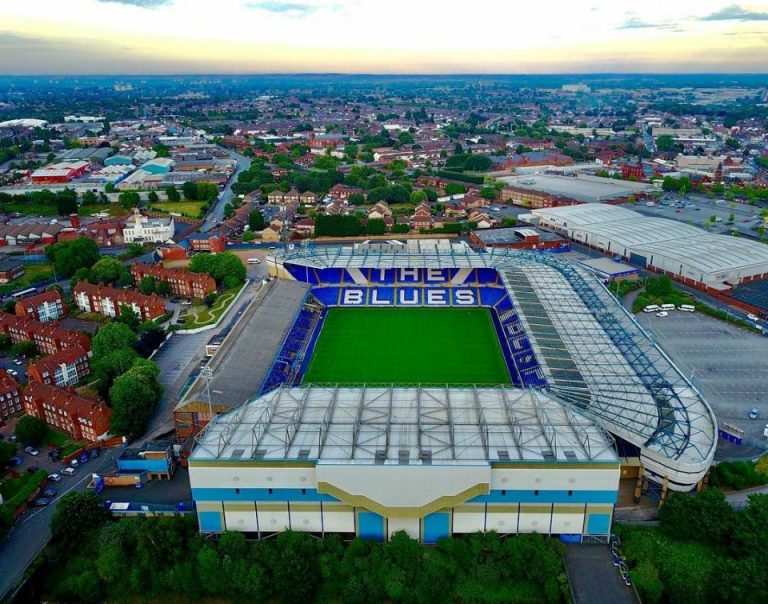
St. Andrews.
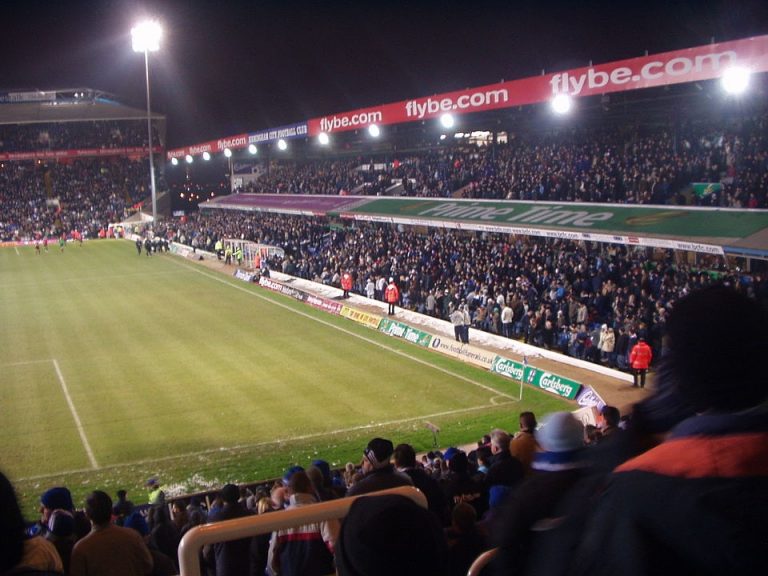
St. Andrews main stand in 2005.
In the first four weeks of owning Birmingham City, which included 100% of St. Andrew’s, Tom Wagner, Knighthead and Shelby Companies made it clear they were going to improve everything to do with Blues, on and off the pitch going forward. They did more for morale for Blues in the first four weeks since they took over than the previous Chinese owners ever did in sixteen years.
The stadium got a much-needed new look in that time that included a giant badge that lights up along with the new lettering and two large screens on either side of it. and what a fantastic improvement it turned out to be.
The following photos were taken before Blues first home game of the 2023/24 season against Leeds United.
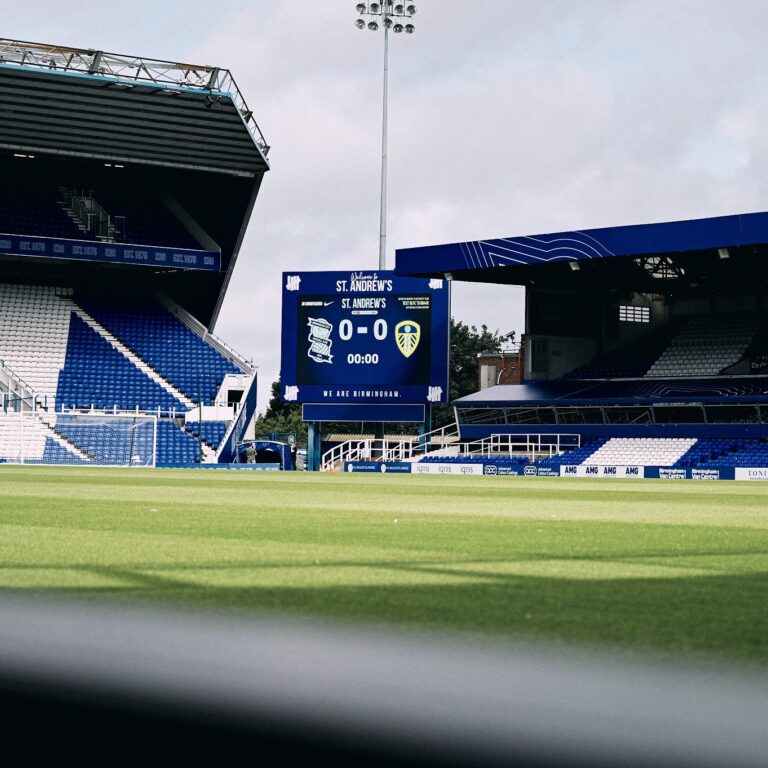
Inside the new look St. Andrews showing the improved giant screen.
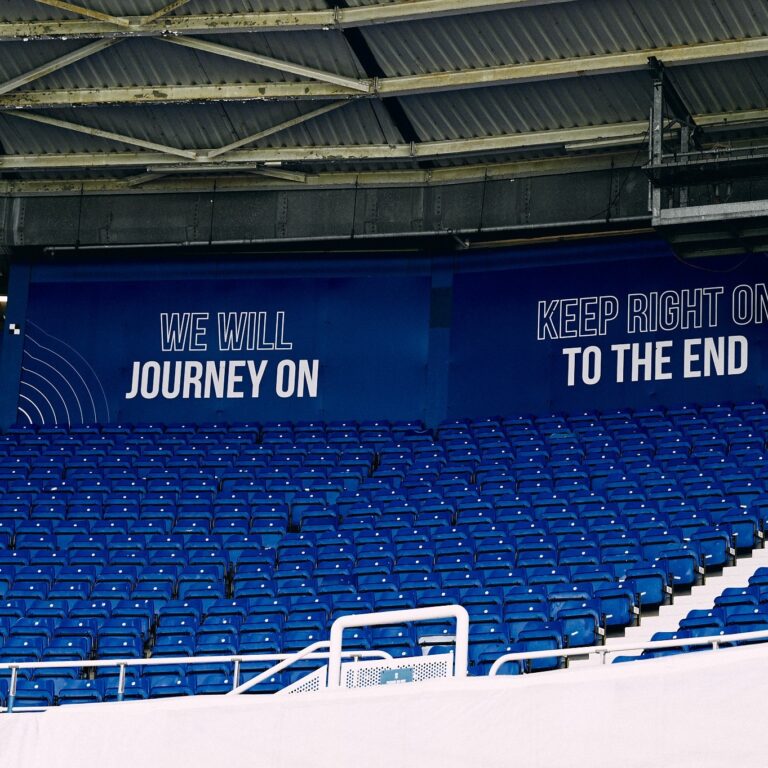
Inside the new look St. Andrews.
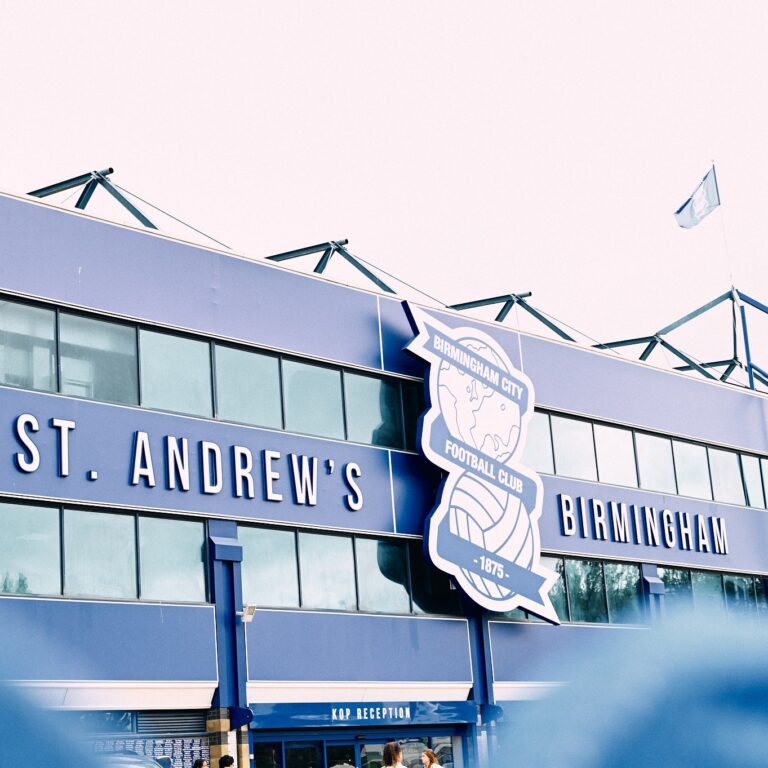
Outside the new look St. Andrews showing the new giant badge and lettering.
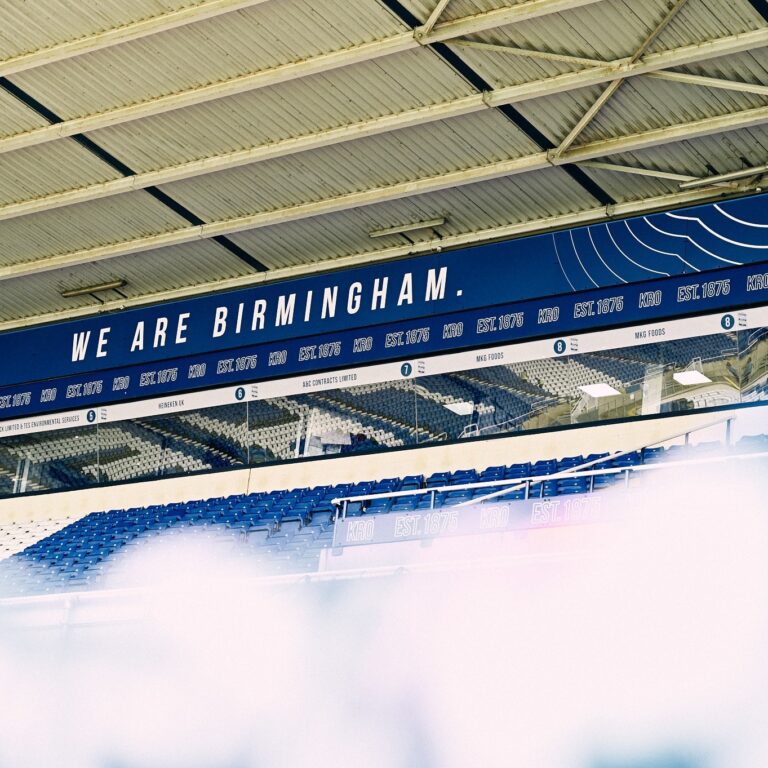
Inside the new look St. Andrews.
Inside the new look St. Andrews showing the improved dug-out seats.
Inside the new look St. Andrews showing the improved player’s tunnel.
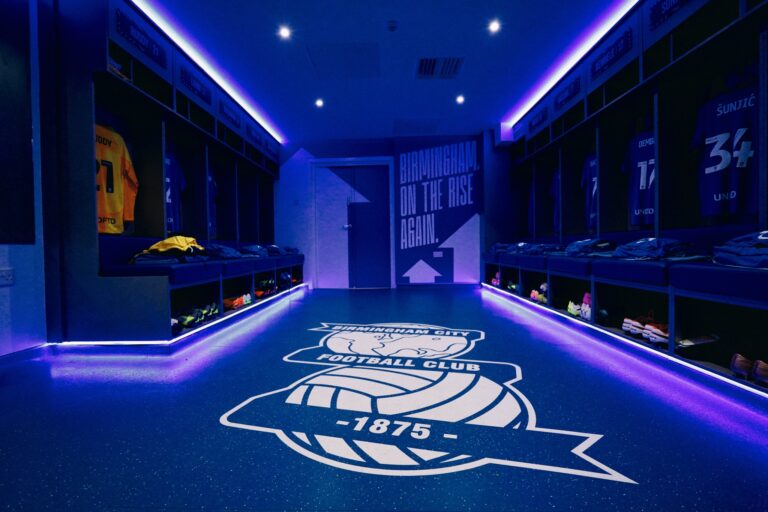
Inside the new look St. Andrews showing the improved player’s changing room.
Despite all the brilliant work that has been done above, the contractor, Buckingham Group, responsible for working on the lower tiers of the Tilton and Kop stands (which include safe standing) had gone into administration. It was announced by Blues on the 17th of August, 2023. You can read about it here.
Birmingham fans consider our main rivals to be Aston Villa, our nearest neighbours geographically, with whom we contest the Second City derby. Lesser rivalries include fellow West Midlands clubs Wolverhampton Wanderers and West Bromwich Albion.
Blues supporters are generally referred to as Blue Noses in the media and by the fans themselves. A piece of public sculpture in the form of a ten-times-life-size head lying on a mound near St Andrew’s, Ondré Nowakowski’s Sleeping Iron Giant, has been repeatedly painted with blue paint on its nose. Between 1994 and 1997, the club mascot took the form of a blue nose, though it is now a dog named Beau Brummie (which had first appeared on our football programmes back in the 1960’s) , a play on the name Beau Brummell and Brummie, the slang word for a person from Birmingham.
A number of supporters’ clubs are affiliated with the football club, both in England and abroad. An action group was formed in 1991 to protest against chairman Samesh Kumar, the club blamed an internet petition for the collapse of the purchase of player Lee Bowyer in 2005, and antipathy towards the board provoked hostile chanting and a pitch invasion after the last match of the 2007 – 2008 season, but when the club was in financial difficulties, supporters contributed to schemes which funded the purchase of players Brian Roberts in 1984 and Paul Peschisolido in 1992. A supporters’ trust was formed under the auspices of Supporters Direct in 2012.
There have been several fanzines published by supporters. Made in Brum, first issued in 2000, was the only one regularly on sale in 2013. The Zulu began some years earlier and ran for at least 16 seasons.
Our fans’ anthem is Keep Right On (as mentioned above).
Birmingham City’s mascot Beau Brummie.
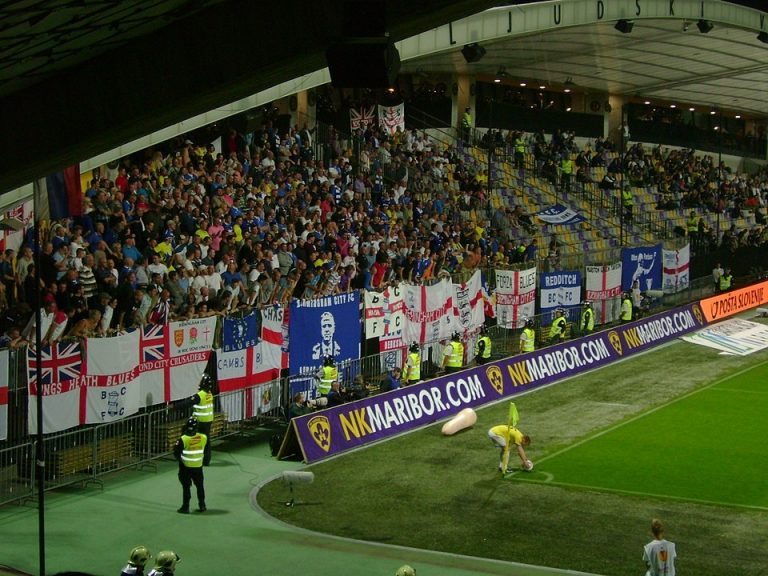
Birmingham City fans during the club’s first away appearance in the group stage of the U.E.F.A. Europa League in 2011.
Small Heath F.C. became a limited company in 1888. Its first share issue was to the value of £650. The board was made up of local businessmen and dignitaries until 1965, when the club was sold to Clifford Coombs. By the mid-1980’s the club was in financial trouble. Control passed from the Coombs family to former Walsall F.C. chairman Ken Wheldon, who cut costs, made redundancies, and sold off assets, including the club’s training ground. Still unable to make the club pay, Wheldon sold it to the Kumar brothers, owners of a clothing chain. Debt was still increasing when matters came to a head; the collapse of the Bank of Credit and Commerce International (BCCI) put the Kumars’ businesses into receivership. The club continued in administration for four months until Sport Newspapers’ proprietor David Sullivan bought the Kumars’ 84% holding for £700,000 from BCCI’s liquidator in March 1993. Birmingham City plc, of which the football club was a wholly owned subsidiary, was floated on the Alternative Investment Market (A.I.M.) in 1997 with an issue of 15 million new shares, raising £7.5 million of new investment. It made a pre-tax profit of £4.3M in the year ending on the 31st of August 2008.
In July 2007, Hong Kong businessman Carson Yeung, via the Hong Kong Stock Exchange (S.E.H.K.)-listed company Grandtop International Holdings Limited (G.I.H.), bought 29.9% of the plc from its directors. Although his intention to take full control of the club initially came to nothing, G.I.H. completed the purchase in October 2009 at a total cost of £81.5M, re-registered the club as a private company, and renamed the holding company Birmingham International Holdings (B.I.H.).
Trading in B.I.H. shares was suspended in June 2011 after Yeung’s arrest on charges of money laundering. Publication of financial results was repeatedly delayed, which led the Football League to impose a transfer embargo, and offers for the club were entertained from 2012 onwards. After Yeung resigned his positions with both club and company in early 2014, share trading resumed, and following his conviction, efforts intensified to dispose of the club, which had to be done piecemeal in order to retain B.I.H.’s share listing.
Going into 2015, the Football League made public their concerns over Yeung’s attempts to impose his choice of directors on the B.I.H.L. board despite his conviction disqualifying him from exerting influence over a club. Relationships became increasingly factional, as illustrated by the failure of three directors, including the club’s de facto chief executive Panos Pavlakis, to gain re-election, followed the next day by their reinstatement. On the 17th of February, 2015, the board voluntarily appointed receivers from accountants Ernst & Young to take over management of the company. Their statement stressed that no winding-up petition had been issued and the company was not in liquidation.
In June 2015, the receivers struck deals with the previous major shareholders such that legal action against them would be dropped in return for their agreement not to obstruct any transfer of ownership to their preferred bidder, the British Virgin Islands-registered investment vehicle Trillion Trophy Asia (T.T.A.), wholly owned by Chinese businessman Paul Suen Cho Hung, who in turn agreed that the company would not be sold on within two years. The process was completed in October 2016, leaving T.T.A. owning 50.64% of BIH’s share capital, a level of ownership that required them to make an offer for the remainder.
To keep the company running, T.T.A. arranged loans which it settled with discounted shares to the same value; the process of creating such shares diluted the percentage holding of all shareholders. Attempts to diversify the company’s holdings to make it less reliant on the football club were similarly funded. To reduce the club’s losses in light of breaches of the EFL’s Profitability and Sustainability Regulations, the stadium was sold for £22.8 million to Birmingham City Stadium Ltd, a new company wholly owned by the football club’s parent, and would be leased back to the club. In December 2020, 21.64% of the club and 25% of Birmingham City Stadium were sold to Vong Pech’s Oriental Rainbow, and in April 2021, the remaining 75% of the stadium was sold.
A June 2022 attempt to purchase the club by a group fronted by former Watford F.C. owner Laurence Bassini, involving financier Keith Harris and money loaned by David Sullivan, came to nothing. A consortium led by fashion industry businessman Paul Richardson and Argentine former footballer Maxi López announced in July that they were close to completing the purchase of a stake in the club, and later confirmed that they were providing operating funds, but pulled out in December citing a failure to agree revisions to the original terms of agreement. In April 2023, Richardson, López and their proposed chief executive, former Charlton Athletic chairman Matt Southall, were sanctioned by the EFL after admitting to breaching regulations by taking effective control of the club without approval.
In April 2023, Birmingham Sports Holdings confirmed letters of intent had been signed to sell 24% of Birmingham City plc shares held by themselves and the 21.64% owned by Oriental Rainbow, as well as the whole of Birmingham City Stadium Ltd, to a then-unnamed potential purchaser, definitive agreements to be reached within a two-month exclusivity period. The purchaser was named Shelby Companies Ltd, a subsidiary of asset management company Knighthead Capital Management fronted by Tom Wagner, Knighthead’s co-founder and co-C.E.O. The agreements were subject to approval by the English Football League (E.F.L.), which was forthcoming in early June, and by the Hong Kong Stock Exchange (H.K.S.E.), and an extraordinary general meeting (E.G.M.) on the 13th of July, 2023, voted overwhelmingly to accept. Although B.S.H. retains 51% of the shares, Wagner confirmed that Shelby was responsible for the operations of the club moving forward and that nothing about the way the transaction is structured would prevent them from obtaining the long-term goals they have for the club.
On the 14th of July, 2023, Wagner installed Garry Cook as C.E.O. of the club. A lifelong Birmingham City fan, Cook said, “The landscape of Birmingham is continuing to positively change. It’s young, multicultural and dynamic. It is time for the football club that bears its name, and shares its values, to add to this exciting story. With the support of Tom and the Knighthead team, and in partnership with the city of Birmingham, we aim to be world-class in everything that we do.”
On the 3rd of August, 2023, it was announced that N.F.L. legend Tom Brady would become a minority owner and chairman of a new advisory board at the club, in partnership with Knighthead Capital Management L.L.C.
Birmingham City’s honours include the following:
Second Division / First Division / The Championship (level 2):
Champions:
1892 – 1993, 1920 – 1921, 1947 – 1948, 1954 – 1955.
Runners-up:
1893 – 1994, 1900 – 1901, 1902 – 1903, 1971 – 1972, 1984 – 1985, 2006 – 2007, 2008 – 2009.
Play-off winners:
2001 – 2002.
Third Division / Second Division (level 3):
Champions:
1994 – 1995.
Runners-up:
1991 – 1992.
F.A. Cup:
Runners-up:
1930 – 1931, 1955 – 56.
Football League Cup:
Winners:
1962 – 1963, 2010 – 11.
Runners-up:
2000 – 2001.
Inter-Cities Fairs Cup:
Runners-up:
1958 – 1960, 1960 – 1961.
Associate Members’ Cup / Football League Trophy:
Winners:
1990 – 91, 1994 – 95.
Birmingham Senior Cup:
Winners:
1905.
Football League South (wartime):
Champions:
1945 – 1946.
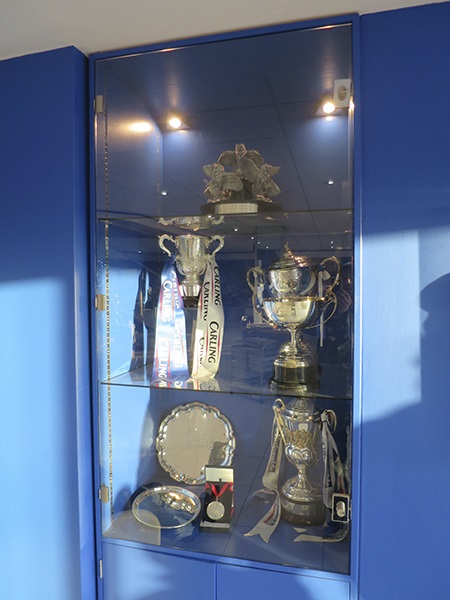
Birmingham City’s trophy cabinet showing the Carling Cup.
Read more about Records And Statistics here.
Blues achieved our highest finishing position, of sixth in the top flight, in the 1955 – 1956 First Division. Frank Womack holds the record for Birmingham league appearances, having played 491 matches between 1908 and 1928, closely followed by Gil Merrick with 485 between 1946 and 1959. If all senior competitions are included, Merrick has 551, less closely followed by Womack’s 515 which is the record for an outfield player. The player who won the most international caps while at the club is Maik Taylor with 58 for Northern Ireland.
The goalscoring record is held by Joe Bradford, with 249 league goals, 267 altogether, scored between 1920 and 1935; no other player comes close. Walter Abbott holds the records for the most goals scored in a season, in 1898 – 99, with 34 league goals in the Second Division and 42 goals in total.
The club’s widest victory margin in the league was 12 – 0, a scoreline which they achieved once in the Football Alliance, against Nottingham Forest in 1899, and twice in the Second Division, against Walsall Town Swifts in 1892 and Doncaster Rovers in 1903. They have lost a league match by an eight-goal margin on eight occasions: twice in the Football Alliance and five times in the First Division, all away from home, and once at home, beaten 8 – 0 by A.F.C. Bournemouth in the Championship in 2014. Our record F.A. Cup win was 10 – 0 against Druids in the fourth qualifying round of the 1899 competition; their record F.A. Cup defeat was 7 – 0 at home to Liverpool in the 2006 quarter-final.
Birmingham’s home attendance record was set at the fifth-round F.A. Cup tie against Everton on the 11th of February, 1939. It is variously recorded as 66,844 or 67,341. The highest transfer fee received for a Birmingham player is, according to the Sky Sports website, a guaranteed £25 million up front received in July 2020 from Borussia Dortmund for Jude Bellingham, which made him the most expensive 17-year-old in world football. The deal also included add-ons worth several millions more. The highest fee paid is £6.3m for Croatian midfielder Ivan Šunjić, who joined from Dinamo Zagreb in July 2019.
In appreciation of Jude Bellingham’s contribution in a short time with the first team. Bellingham was the club’s youngest debutant, at 16 years and 38 days, and the youngest goalscorer, he completed a full season before becoming Birmingham’s record transfer and the world’s most expensive 17-year-old, showing what can be achieved through talent, hard work and dedication while retaining a caring, humble and engaging off-the-field demeanour. The club retired his number 22 shirt to remember one of their own and to inspire others.
You can read about Birmingham City players’ past and present in-depth by clicking here.
Click here to see the current first team of Birmingham City and their squad numbers
Click here to see the current staff of Birmingham City.
For full information on Birmingham City’s Reserves and Academy players click here.
For full information on Birmingham City’s Women’s team click here.
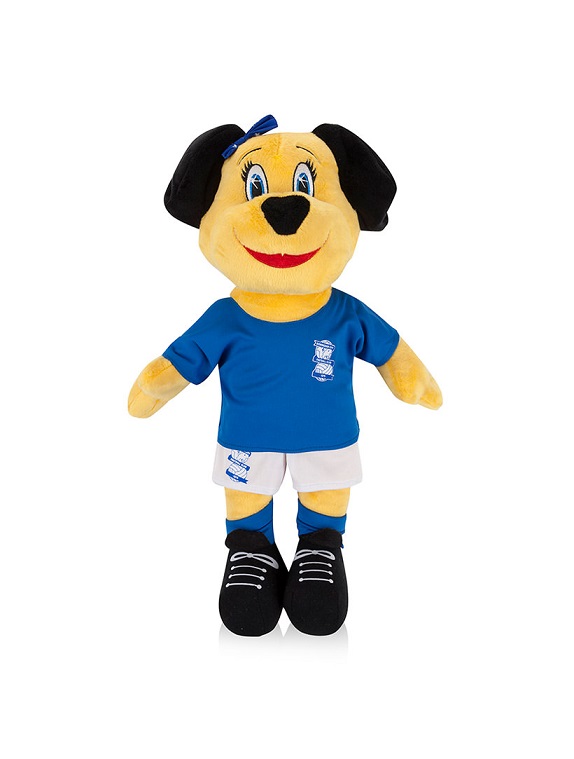
Birmingham City Ladies mascot Belle Brummie.
Shelby Companies Ltd – 45.96%
Chairman:
Tom Wagner.
C.E.O:
Directors:
Matthew Alvarez.
Andrew Shannahan.
Kyle Kneisly.
Wenqing Zhao.
Gannan Zheng.
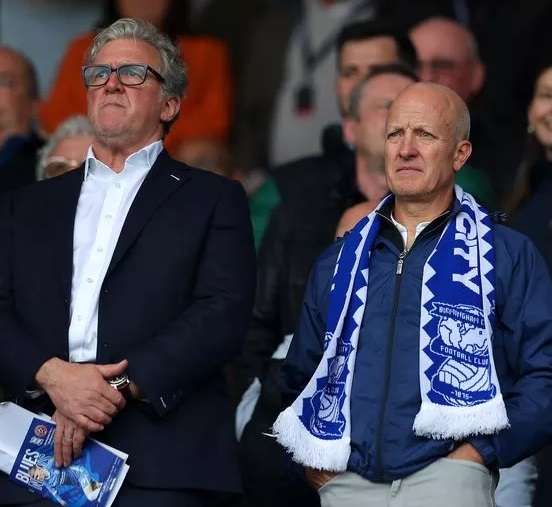
Chairman Of The Advisory Board: Tom Brady.
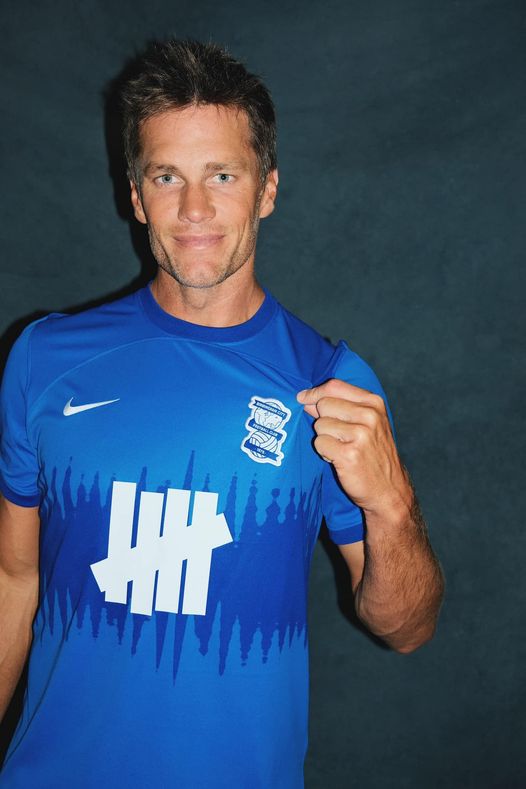
Directors: Matthew Alvarez, Andrew Shannahan, Kyle Kneisly, Laura Torrado, Wenqing Zhao and Gannan Zheng.
Read more from the Birmingham City page on Wikipedia here.
KEEP RIGHT ON.

The above information was sourced from the Birmingham City Wikipedia page except for “Birmingham City F.C. Anthem” which was sourced from the Birmingham Mail’s Birmingham City page.
Wikipedia content is subject to change.
The Birmingham City club logo shown at the top of this page and the 150th Year Anniversary Banner at the bottom is the copyright of Birmingham City F.C. and come from their website and social media pages.
The Home Kit photos are copyright of Birmingham City F.C. and came from their official website.
The Small Heath F.C. champions team photo from 1893 above is copyright unknown and came from Wikipedia.
The Steve Bruce photo from 2004 above is in the public domain and came from Wikipedia. It is copyright of Wikipedia user Struway.
The photo above of Beau Brummie is copyright of B.C.F.C and came from the Blues Store Online.
The photo above of Belle Brummie is copyright of B.C.F.C and came from the Blues Store.
The Small Heath F.C. original 1875 kit image from above is copyright of Historical Football Kits Birmingham City page.
The photo above of St. Andrews is copyright of photographer Slobozhansky and came from Wikimapia.
The photo above of St. Andrews in 2005 is copyright of photographer Struway and came from Wikipedia.
The photo above of Birmingham City away fans in 2011 is copyright of photographer Ratipok and came from Wikipedia.
The photo above of Birmingham City’s trophy cabinet is copyright of photographer Lokomotive74 and came from Wikipedia. You can view more of his or her great work here.
Birmingham City F.C. – Official website.
Birmingham City on Facebook – This is their official Facebook page.
Birmingham City on Twitter – This is their official Twitter page.
Birmingham City on YouTube – This is their official YouTube page.
Blues Store Online – Birmingham City’s official club store online.
List of Birmingham City F.C. seasons – List of seasons, including league division and statistics, cup results, top scorer and average league attendance from 1878 to the present day.
Birmingham Mail – Official website. The Birmingham Mail is a newspaper based in Birmingham, England but distributed around Birmingham, the Black Country, Solihull and parts of Warwickshire, Worcestershire and Staffordshire.
Historical Football Kits – Official website. They have a very detailed and comprehensive graphic archive of football kits available including every team from the English and Scottish Leagues.
Wikipedia – Official website. Its purpose is to benefit readers by acting as a widely accessible and free encyclopedia that contains information on all branches of knowledge. Funded and hosted by the Wikimedia Foundation, Wikipedia consists of freely editable content whose articles also provide numerous links to guide readers to related pages with more information.
Wikimapia – Official website. Wikimapia is a multilingual open-content collaborative map, where anyone can create place tags and share their knowledge. Their goal is to describe the whole world by compiling as much useful information about all geographical objects as possible, organising it, and providing free access to their data for the public domain.
Me and my family moved in 1970 to Hurst Lane, Shard End. I was 4 years and 7 months old and I can vaguely remember sitting on a cooker in the back of a removal van. It was about a week before Bonfire Night. My Mom managed to get some fireworks for the day and my Dad lit what was to become the first of many bonfires at home. I used to love family occasions like this.
I started Hillstone Infants and Juniors school, Hillstone Road, Shard End in 1971.
In 1977 I started my secondary school, Byng Kenrick Central School, Gressal Lane, Tile Cross.
I have fond memories of playing with my Action Man a lot, stamp collecting, drawing comics, reading lots of comics and books, watching lots of great family entertainment on the telly, going to The Red Welly Club at All Saints Church in Shard End going to Shard End Park or Arden Hall Park with my family and many more great memories that will be discussed in my blog.
The information below was sourced from Wikipedia and is subject to change.
You can read other articles related to the 1970’s via Blog Posts below as well.
In the 21st century, historians have increasingly portrayed the 1970’s as a pivot of change in world history, focusing especially on the economic upheavals that followed the end of the postwar economic boom. In the Western world, social progressive values that began in the 1960’s, such as increasing political awareness and economic liberty of women, continued to grow. In the United Kingdom, the 1979 election resulted in the victory of its Conservative leader Margaret Thatcher, the first female British Prime Minister. Industrialized countries experienced an economic recession due to an oil crisis caused by oil embargoes by the Organization of Arab Petroleum Exporting Countries. The crisis saw the first instance of stagflation which began a political and economic trend of the replacement of Keynesian economic theory with neoliberal economic theory, with the first neoliberal governments being created in Chile, where a military coup led by Augusto Pinochet took place in 1973.
The 1970’s was also an era of great technological and scientific advances; since the appearance of the first commercial microprocessor, the Intel 4004 in 1971, the decade was characterised by a profound transformation of computing units – by then rudimentary, spacious machines – into the realm of portability and home accessibility.
On the other hand, there were also great advances in fields such as physics, which saw the consolidation of Quantum Field Theory at the end of the decade, mainly thanks to the confirmation of the existence of quarks and the detection of the first gauge bosons in addition to the photon, the Z boson and the gluon, part of what was christened in 1975 as the Standard Model.
Novelist Tom Wolfe coined the term “ ’Me’ decade” in his essay “The ‘Me’ Decade and the Third Great Awakening”, published by New York Magazine in August 1976 referring to the 1970’s. The term describes a general new attitude of Americans towards atomized individualism and away from communitarianism, in clear contrast with the 1960’s.
In Asia, affairs regarding the People’s Republic of China changed significantly following the recognition of the PRC by the United Nations, the death of Mao Zedong and the beginning of market liberalization by Mao’s successors. Despite facing an oil crisis due to the OPEC embargo, the economy of Japan witnessed a large boom in this period, overtaking the economy of West Germany to become the second-largest in the world. The United States withdrew its military forces from their previous involvement in the Vietnam War, which had grown enormously unpopular. In 1979, the Soviet Union invaded Afghanistan, which led to an ongoing war for ten years.
The 1970’s saw an initial increase in violence in the Middle East as Egypt and Syria declared war on Israel, but in the late 1970’s, the situation in the Middle East was fundamentally altered when Egypt signed the Egyptian–Israeli Peace Treaty. Anwar Sadat, President of Egypt, was instrumental in the event and consequently became extremely unpopular in the Arab world and the wider Muslim world. Political tensions in Iran exploded with the Iranian Revolution in 1979, which overthrew the Pahlavi dynasty and established an authoritarian Islamic republic under the leadership of Ayatollah Khomeini.
Africa saw further decolonization in the decade, with Angola and Mozambique gaining their independence in 1975 from the Portuguese Empire after the restoration of democracy in Portugal. The continent was, however, plagued by endemic military coups, with the long-reigning Emperor of Ethiopia Haile Selassie being removed, civil wars and famine.
The economies of much of the developing world continued to make steady progress in the early 1970’s because of the Green Revolution. However, their economic growth was slowed by the oil crisis, although it boomed afterwards.
The most prominent events and trends in popular culture of the decade (particularly in the Anglosphere) include:
During the early 1970’s, popular music continued to be dominated by musicians who had achieved fame during the 1960’s such as The Rolling Stones, The Who, Elvis Presley, Bob Dylan, The Grateful Dead, and Eric Clapton. In addition, many newcomer rock groups such as Black Sabbath and Led Zeppelin appeared. The Beatles disbanded in 1970, but each member of the band immediately released a highly successful solo album, and Paul McCartney especially would remain extremely popular throughout the decade. Singer-songwriters such as Elton John, James Taylor and Jackson Browne also came into vogue during the early 1970’s.
The 1970’s saw the rapid commercialization of rock music, and by mid-decade, there was a spate of bands derisively dubbed corporate rock due to the notion that they had been created by record labels to produce simplistic, radio-friendly songs that offered clichés rather than meaningful lyrics. Such bands included The Doobie Brothers, Bread, Styx, Kansas, and REO Speedwagon.
Funk, an offshoot of soul music with a greater emphasis on beats, and influences from rhythm and blues, jazz, and psychedelic rock, was also very popular. The mid-1970s also saw the rise of disco music, which dominated during the last half of the decade with bands like the Bee Gees, Chic, ABBA, Village People, Boney M, Donna Summer, KC and the Sunshine Band, and others. In response to this, rock music became increasingly hard-edged, with early metal artists like Led Zeppelin, Jimi Hendrix, Black Sabbath, and Deep Purple. Minimalism also emerged, led by composers such as Philip Glass, Steve Reich and Michael Nyman. This was a break from the intellectual serial music in the tradition of Schoenberg, which lasted from the early 1900’s to 1960’s.
The 1970’s also saw artists from Motown records become popular across the globe. Artists like the Jackson 5, Stevie Wonder and Marvin Gaye dominated the record charts across the world and had a significant influence on pop culture, including breaking down racial barriers.
Experimental classical music influenced both art rock and progressive rock genres with bands such as Pink Floyd, Yes, Todd Rundgren’s Utopia, Supertramp, Rush, Genesis, King Crimson, Emerson, Lake & Palmer, Jethro Tull, The Moody Blues and Soft Machine. Hard rock and Heavy metal also emerged among British bands Led Zeppelin, Queen, The Who, Black Sabbath, UFO, Deep Purple, Uriah Heep, and Judas Priest. Australian band AC/DC also found its hard-rock origins in the early 1970’s and its breakthrough in 1979’s Highway to Hell, while popular American rock bands included Aerosmith, Lynyrd Skynyrd and shock rockers Alice Cooper, Blue Öyster Cult, and Kiss, and guitar-oriented Ted Nugent and Van Halen. In Europe, there was a surge of popularity in the early decade for glam rock.
After a successful return to live performing in the late 60’s with his TV special, Elvis Presley remained popular in Vegas and on concert tours throughout the United States until his death in 1977. His 1973 televised concert, Aloha from Hawaii Via Satellite, aired in over 40 countries in Europe and Asia, as well as the United States, making it one of the most popular concert events of the decade.
The second half of the decade saw the rise of punk rock when a spate of fresh, young rock groups playing stripped-down hard rock came to prominence at a time when most of the artists associated with the 1960’s to early 1970’s were in creative decline. Punk bands included The Sex Pistols, The Clash, The Ramones, The Talking Heads, and more.
The highest-selling album was Pink Floyd’s The Dark Side of the Moon (1973). It remained on the Billboard 200 albums chart for 741 weeks. Electronic instrumental progressive rock was particularly significant in continental Europe, allowing bands like Kraftwerk, Tangerine Dream, Can, and Faust to circumvent the language barrier. Their synthesiser-heavy krautrock, along with the work of Brian Eno (for a time the keyboard player with Roxy Music), would be a major influence on subsequent synth rock. The mid-1970’s saw the rise of electronic art music musicians such as Jean-Michel Jarre, Vangelis, and Tomita, who with Brian Eno were a significant influence on the development of new-age music. Japanese band Yellow Magic Orchestra helped to pioneer synthpop, with their self-titled album (in 1978) setting a template with less minimalism and with a strong emphasis on melody, and drawing from a wider range of influences than had been employed by Kraftwerk. YMO also introduced the microprocessor-based Roland MC-8 sequencer and TR-808 rhythm machine to popular music.
In the first half of the 1970’s, many jazz musicians from the Miles Davis school achieved cross-over success through jazz-rock fusion with bands like Weather Report, Return to Forever, The Headhunters and The Mahavishnu Orchestra who also influenced this genre and many others. In Germany, Manfred Eicher started the ECM label, which quickly made a name for chamber jazz. Towards the end of the decade, Jamaican reggae music, already popular in the Caribbean and Africa since the early 1970’s, became very popular in the U.S. and in Europe, mostly because of reggae superstar and legend Bob Marley. The mid-1970’s saw the reemergence of acoustic jazz with the return of artists like Dexter Gordon to the US music scene, who, along with a number of other artists, such as trumpet innovators like Don Ellis and Woody Shaw, who were among the last of the decade’s traditionally-oriented acoustic jazz musicians to be signed to major record labels, to receive critical and widespread commercial recognition and multiple Grammy nominations.
The late 1970’s also saw the beginning of hip hop music with disc jockeys like DJ Kool Herc and Afrika Bambaataa taking loops from funk and soul records and playing them repeatedly at block parties and dance clubs. At the end of the 1970’s, popular songs like Rapper’s Delight by Sugarhill Gang gave hip hop a wider audience. Hip hop was also influenced by the song The Revolution Will Not Be Televised by Gil Scott-Heron.
Country music also continued to increase in popularity in the 1970’s. Between 1977 and 1979, it became more mainstream, particularly with the outlaw movement, led by Waylon Jennings and Willie Nelson. The 70’s also saw the rise of a country music subgenre, southern rock, led by the Allman Brothers Band. Other artists; such as Conway Twitty, Loretta Lynn, Don Williams, Kenny Rogers, Dolly Parton, Ronnie Milsap, Crystal Gayle, and Barbara Mandrell; all scored hits throughout the 70’s which reached both country and pop charts. The genre also saw its golden age of vocal duos and groups in this decade; with Conway Twitty and Loretta Lynn, George Jones and Tammy Wynette, Jim Ed Brown and Helen Cornelius, the Bellamy Brothers, the Oak Ridge Boys, the Statler Brothers, Dave & Sugar, and The Kendalls. The genre also became more involved in Hollywood toward the end of the decade, with country-themed action films such as Smokey and the Bandit and Every Which Way But Loose, a trend that continued into the early 80’s with Urban Cowboy and BroncoBill.
A major event in music in the early 1970’s was the deaths of popular rock stars Jimi Hendrix, Janis Joplin, and Jim Morrison, all at the age of 27. Two of popular music’s most successful artists from other eras died within eight weeks of each other in 1977. Elvis Presley, the best-selling singer of all time, died on August 16th, 1977. Presley’s funeral was held at Graceland, on Thursday, August 18th, 1977. Bing Crosby, who sold about 50 million records, died on October 14th, 1977. His single, White Christmas, remains the best selling single of all time, confirmed by Guinness Records.
In addition to the deaths in the 1970’s, breakups of bands and duos; such as The Beatles, Simon and Garfunkel, Creedence Clearwater Revival, the Everly Brothers, and others; occurred over the course of the decade.
Statistically, Led Zeppelin and Elton John were the most successful musical acts of the 1970’s, both having sold more than 300 million records since 1969.
Oscar winners of the decade were Patton (1970), The French Connection (1971), The Godfather (1972), The Sting (1973), The Godfather Part II (1974), One Flew Over the Cuckoo’s Nest (1975), Rocky (1976), Annie Hall (1977), The Deer Hunter (1978), and Kramer vs. Kramer (1979).
The top ten highest-grossing films of the decade are (in order from highest to lowest grossing): Star Wars, Jaws, Grease, The Exorcist, Close Encounters of the Third Kind, Superman, The Godfather, Saturday Night Fever, Rocky, and Jaws 2. Two of these movies came out on the same day: June 16th, 1978.
In 1970’s European cinema, the failure of the Prague Spring brought about nostalgic motion pictures such as István Szabó’s Szerelmesfilm (1970). German New Wave and Rainer Fassbinder’s existential movies characterized film-making in Germany. The movies of the Swedish director Ingmar Bergman reached a new level of expression in motion pictures like Cries and Whispers (1973).
Car chase movies also became a popular film genre of the 1970’s with such films as Dirty Mary, Crazy Larry in 1974, and perhaps the genre’s most popular film Smokey and the Bandit in 1977.
Asian cinema of the 1970s catered to the rising middle-class fantasies and struggles. In the Bollywood cinema of India, this was epitomized by the movies of Bollywood superhero Amitabh Bachchan. Another Asian touchstone beginning in the early 1970’s was Hong Kong martial arts film which sparked a greater interest in Chinese martial arts around the world. Martial arts film reached the peak of its popularity largely in part due to its greatest icon, Bruce Lee. During the 1970’s, Hollywood continued the New Hollywood revolution of the late-1960’s with young filmmakers. Top-grossing Jaws (1975) ushered in the blockbuster era of filmmaking, though it was eclipsed two years later by the science-fiction film Star Wars (1977). Saturday Night Fever (1977) single-handedly touched off disco mania in the U.S. The Godfather (1972) was also one of the decade’s greatest successes and its first follow-up, The Godfather Part II (1974) was also successful for a sequel.
The Rocky Horror Picture Show flopped in its 1975 debut, only to reappear as a more-popular midnight show later in the decade. Still, in limited release decades after its premiere, it is the longest-running theatrical release in film history.
The Exorcist (1973) was a box office success for the horror genre, inspiring many other so-called devil (Satan) films like The Omen and both of their own sequels.
All That Jazz (1979) gained high critical praise, winning four Oscars and several other awards. It was an inductee of the 2001 National Film Registry list.
The decade of the 1970’s saw significant changes in television programming in both the United Kingdom and the United States. The trends included the decline of the family sitcoms and rural-oriented programs to more socially contemporary shows and young, hip and urban sitcoms in the United States and the permanent establishment of colour television in the United Kingdom.
The following is from A List Of Years In Television:
1970: The first broadcast of The Mary Tyler Moore Show, Josie and the Pussycats, Ashita no Joe, The Partridge Family, The Odd Couple, The Adventures of Hutch the Honeybee, The Adventures of Rupert Bear and All My Children. PBS is launched.
1971: The first broadcast of All in the Family, Kamen Rider, The Old Grey Whistle Test, Chespirito, The Two Ronnies, McDonaldland, Lupin the Third, Upstairs, Downstairs, La Linea, The Generation Game and Parkinson. DIC Enterprises is founded. Chesapeake Television Corporation is founded.
1972: The first broadcast of M*A*S*H, Emmerdale, Mastermind, Kamiondžije, El Chavo, Rainbow, Fat Albert and the Cosby Kids, The New Scooby-Doo Movies, El Chapulín Colorado, The Bob Newhart Show, Mazinger Z, Science Ninja Team Gatchaman, Great Performances and Maude. The first appearance of Little Mikey (Quaker’s Life Cereal). HBO is launched. Warner Communications is founded.
1973: The first broadcast of Boy on the Bike (Hovis), The Ascent of Man, Moonbase 3, The Wombles, Super Friends, The Young and the Restless, Cutie Honey, Super Friends, An American Family, Ein Herz und eine Seele, Schoolhouse Rock!, Speed Buggy, The Midnight Special, Star Trek: The Animated Series, Seventeen Moments of Spring, Tetley Tea Folk, Last of the Summer Wine and The World at War. The first appearances of Quicky the Nesquik Bunny and the Duracell Bunny.
1974: The first broadcast of Chico and the Man, Derrick, Happy Days, Little House on the Prairie, Mio Mao, Police Woman, Space Battleship Yamato, Heidi, Girl of the Alps, Land of the Lost, Porridge, Smash Martians, Rhoda, Good Times, The Rockford Files, and Tiswas. The first appearance of the Kool-Aid Man. The first Daytime Emmy Awards. Richard M. Nixon announces his resignation on live television.
1975: The first broadcast of Starsky & Hutch, Baretta, Barney Miller, Fawlty Towers, Good Morning America, One Day at a Time, Saturday Night Live, Sneak Previews, Space: 1999, The Jeffersons, The Naked Civil Servant, Welcome Back, Kotter, Wheel of Fortune and Wonder Woman; Sony introduces the Betamax home videotape recorder.
1976: The first broadcast of The Muppet Show, I, Claudius, Grlom u jagode, Honey Monster (Sugar Puffs), Loriot, SCTV, Austin City Limits, Andrex Puppy, Charlie’s Angels, Family Feud, The Gong Show, Laverne and Shirley and Nuts in May. The Cookie Jar Group is founded. Completion of CN Tower. The first VHS and videocassette recorders (VCRs) go on sale.
1977: The first broadcast of Abigail’s Party, CHiPs, Eight Is Enough, ¿Qué Pasa, USA?, Roots, Soap, It’ll Be Alright on the Night, Yatterman, Lou Grant, Hungarian Folktales, Three’s Company, Top Gear and Live from the Met. The first appearance of Cadbury’s Caramel Bunny. CBN Satellite Service is launched.
1978: The first broadcast of An Ordinary Miracle, Abarembo Shogun, Battlestar Galactica, Dallas, Diff’rent Strokes, WKRP in Cincinnati, Galaxy Express 999, Space Pirate Captain Harlock, Once Upon a Time…, The Incredible Hulk, The Dating Game, Ski Sunday, Fantasy Island, Grange Hill, Matador, Mork & Mindy, Jabberjaw, Pennies from Heaven, Taxi, Future Boy Conan and Deeply Regretted By…
1979: The first broadcast of Doraemon, Benson, Blue Remembered Hills, Buck Rogers in the 25th Century, Hart to Hart, Knots Landing, Seibu Keisatsu, Life on Earth, Anne of Green Gables, Antiques Roadshow, Los Ricos También Lloran, Mobile Suit Gundam, Real People, Worzel Gummidge, The Dukes of Hazzard, The Facts of Life, BuzzBee the Honey Nut Cheerios Bee, The Plastic Man Comedy/Adventure Show, The Rose of Versailles, You Can’t Do That on Television, The Meeting Place Cannot Be Changed, The Very Same Munchhausen and Tinker, Tailor, Soldier, Spy. ESPN and Nickelodeon are launched.
In 1967, BBC Two had started trials of their new colour service, and it was gradually rolled out over the next few years. BBC One and ITV followed suit in 1969, so by 1970, the viewer had three colour channels from which to choose: BBC1, BBC2 and ITV. Although U.S. imports occupied a significant proportion of airtime, there was a substantial amount of high-quality in-house production too.
The BBC, supported by its licence fee and with no advertisers to placate, continued fulfilling its brief to entertain and inform. The Play for Today was a continuation of the Wednesday Play which had run from the mid-1960’s. As the title implied, it presented TV drama that had relevance to current social and economic issues, done in a way calculated to intrigue or even shock the viewer. As well as using established writers, it was effectively an apprenticeship for new ones who were trying to make a name for themselves; Dennis Potter, John Mortimer, Arthur Hopcraft and Jack Rosenthal all served time on Play for Today before going on to write their own independent series. In style, the plays could go from almost documentary realism (of which Cathy Come Home is the best-known example) to the futuristic or surrealist (The Year of the Sex Olympics, House of Character).
Potter went on to write Pennies from Heaven, one of the landmarks of 1970’s television drama. It had the now-familiar elements of Potter’s style: sexual explicitness, nostalgia, fantasy song and dance scenes, all overlaying a dark and pessimistic view of human motivation. The series was a success, but the BBC was not yet ready for Brimstone and Treacle, a story of the rape of a physically and mentally handicapped young woman. After viewing it, the BBC’s Director Of Programs Alasdair Milne, pronouncing it to be “brilliantly written … but nauseating”, withdrew it, and it would not be shown on British television until 1987.
Things had begun to change in the 1960’s, with Till Death Us Do Part, and the series continued during 1972 – 75. The rantings of Alf Garnett on race, class, religion, education and anything else at all definitely touched a nerve. Although the show was in fact poking fun at right-wing bigotry, not everyone got the joke. Some — including, notably, Mary Whitehouse — complained about the language (although the level of profanity was quite light) and resented the racial epithets like wog and coon and the attitudes underlying them. Others, completely missing the point of the show, actually adopted Alf as their hero, thinking he was uttering truths that others didn’t dare to — apparently oblivious to the fact that he never got the best of any argument and was regularly shown up to be stupid and ill-informed. The series regularly provoked controversy in the media, and for millions, it became a common gossiping point at work or in the pub.
Many popular British situation comedies (sitcoms) were gentle, innocent, not challenging portrayals of middle-class life, avoiding or only hinting at controversial issues; typical examples were Happy Ever After (later succeeded by Terry and June), Sykes and The Good Life. Set in a hotel in Torquay, Fawlty Towers was a massive success for the BBC, despite only twelve episodes being made. More nostalgic in tone was Last of the Summer Wine, about the escapades of pensioners in a Yorkshire town, Dad’s Army, about a Home Guard unit during World War II and It Ain’t Half Hot Mum about a Royal Artillery Concert Party stationed in India/later Burma also during (and after) World War II.
A more diverse view of society was offered by series like Porridge, a comedy about prison life, and Rising Damp, set in a lodging house inhabited by two students, a lonely spinster and a lecherous landlord. Taking a softer approach to race than Till Death Us Do Part, ITV’s Mind Your Language (1977 – 79) represented several foreign nations personified as English language students attending an evening class. Despite LWT ending the show after its third series in objection to the undeniable stereotyping, Mind Your Language did later return for a fourth series in the 1980’s.
In police dramas, there was a move towards increasing realism. Dixon of Dock Green continued until 1976, but it was essentially a nostalgic look back to an earlier time when police officers were depicted as a mix of strict but fair law enforcers and kindly social workers. On the other hand, detective series such as Softly, Softly (a spin-off from the earlier Z-Cars) began to show police work done by fallible human beings with their own personal failings and weaknesses, constantly frustrated by the constraints under which they worked. Such series showed crime at the level of petty larceny and fraud, being tackled by ordinary coppers on the beat. Serious organised crime, on the other hand, was the province of various elite units, and one show in the 1970’s set a new standard. The Sweeney presented a hard, gritty picture of an armed police unit — members of Scotland Yard’s elite Flying Squad. Violence was routine, as were fast car chases; Regan and Carter were hard-hitting coppers, who when they weren’t catching villains were likely to be on a drunken binge or womanizing.
Although this was a truer picture of British policing, it was not always to the liking of senior police officers, who felt that the confidence of the public in the police force would be diminished as a result. In police dramas, through most of the 1970’s however, corruption was rare, the detection rate was unrealistically high, and the criminals arrested were always convicted on solid evidence. Although the officers in The Sweeney were no angels, and there were occasional hints that police who inhabited a world where informants were necessary could not completely avoid compromises, these never amounted to more than turning a blind eye to minor misdemeanours. It would not be until 1978 that a police drama (the miniseries Law and Order) would depict a police officer fabricating evidence to secure a conviction, with the collusion of his colleagues.
For the United States and more television click here and here.
The following is from A List Of Years In Literature:
1970: Muriel Spark’s The Driver’s Seat. Judith Kerr’s Mog the Forgetful Cat. J. G. Farrell’s Troubles. Toni Morrison’s The Bluest Eye. James Dickey’s Deliverance. Roald Dahl’s Fantastic Mr. Fox. Terry Southern’s Blue Movie. Jim Bouton’s Ball Four. Ted Hughes’s Crow. Nina Bawden’s The Birds on the Trees. Maurice Sendak’s In the Night Kitchen. Larry Niven’s Ringworld. Agatha Christie’s Passenger to Frankfurt. Deaths of Máirtín Ó Cadhain and Erich Maria Remarque.
1971: Frederick Forsyth’s The Day of the Jackal. Carlos Castaneda’s A Separate Reality: Further Conversations with Don Juan. Dr. Seuss’ The Lorax. Xaviera Hollander’s The Happy Hooker: My Own Story. Rosamunde Pilcher’s The End of Summer. Roger Hargreaves’s Mr. Men. Agatha Christie’s Nemesis and The Golden Ball and Other Stories.
1972: Richard Bach’s Jonathan Livingston Seagull. Hunter S. Thompson’s Fear and Loathing in Las Vegas. Ira Levin’s The Stepford Wives. Richard Adams’s Watership Down. Arkady and Boris Strugatsky’s Roadside Picnic. Isaac Asimov’s The Gods Themselves. Agatha Christie’s Elephants Can Remember. Deaths of Ezra Pound and L. P. Hartley.
1973: Thomas Pynchon’s Gravity’s Rainbow. J. G. Ballard’s Crash. J. G. Farrell’s The Siege of Krishnapur. Gore Vidal’s Burr. Peter Shaffer’s play Equus was first performed. Aleksandr Solzhenitsyn’s The Gulag Archipelago. John Bellairs’ The House with a Clock in Its Walls. Kurt Vonnegut’s Breakfast of Champions. Nina Bawden’s Carrie’s War. Arthur C. Clarke’s Rendezvous with Rama. Dean Koontz’s Demon Seed. Agatha Christie’s Postern of Fate. Deaths of W. H. Auden and J. R. R. Tolkien.
1974: Carl Bernstein & Bob Woodward’s All the President’s Men. Stephen King’s Carrie. Peter Benchley’s Jaws. Erica Jong’s Fear of Flying. Jill Murphy’s The Worst Witch. James Herbert’s The Rats. Agatha Christie’s Poirot’s Early Cases.
1975: James Clavell’s Shogun. Stephen King’s ‘Salem’s Lot. Jorge Luis Borges’s The Book of Sand. Samuel R. Delany’s Dhalgren. E. L. Doctorow’s Ragtime. Carlos Fuentes’ Terra Nostra. James Herbert’s The Fog. Diana Wynne Jones’ Cart and Cwidder. Agatha Christie’s Curtain. Death of P. G. Wodehouse.
1976: Anne Rice’s Interview with the Vampire. Richard Yates’s The Easter Parade. Mildred D. Taylor’s Roll of Thunder, Hear My Cry. Bob Woodward and Carl Bernstein’s The Final Days. Samuel R. Delany’s Triton. Alex Haley’s Roots: The Saga of an American Family. Agatha Christie’s Sleeping Murder. Death of Agatha Christie.
1977: Iris Murdoch’s The Sea, the Sea. Toni Morrison’s Song of Solomon. Stephen King’s The Shining. J. R. R. Tolkien’s The Silmarillion. Frederick Pohl’s Gateway. Diana Wynne Jones’s Charmed Life. Shirley Hughes’s Dogger. Patrick Leigh Fermor’s A Time of Gifts. Terry Brooks’ The Sword of Shannara. Death of Vladimir Nabokov.
1978: John Irving’s The World According to Garp. J. G. Farrell’s The Singapore Grip. Judi Barrett’s Cloudy with a Chance of Meatballs. John Cheever’s The Stories of John Cheever. Stephen King’s The Stand. Harold Pinter’s Betrayal. Ken Follett’s Eye of the Needle. Octavia Butler’s Kindred.
1979: Douglas Adams’s The Hitchhiker’s Guide to the Galaxy. Italo Calvino’s Se una notte d’inverno un viaggiatore (If on a winter’s night a traveler). V.S. Naipaul’s A Bend in the River. Milan Kundera’s Kniha smíchu a zapomnení (The Book of Laughter and Forgetting). Angela Sommer-Bodenburg’s Der kleine Vampir (The Little Vampire). William Styron’s Sophie’s Choice. Norman Mailer’s The Executioner’s Song. Jeffrey Archer’s Kane and Abel. Peter Shaffer’s play Amadeus was first performed. Flora Thompson’s Heatherley. Arthur C. Clarke’s The Fountains of Paradise. Ken Follett’s Triple. Agatha Christie’s Miss Marple’s Final Cases and Two Other Stories. Death of J. G. Farrell.
Popular and notable video games of the 1970’s include: Space Invaders, Asteroids, Pong, and Breakout.
Golden age of video arcade games.
Gun Fight was the first video game to contain a microprocessor.
The Oregon Trail was the first publicly available educational video game made available for widespread use in schools on December 3, 1971. The game is a cult classic and is still used today, in a wide variety of formats, through emulators and on smartphones.
The first commercially available video game console, entitled Magnavox Odyssey, was released in September 1972, created by Ralph H. Baer.
1974: Both Maze War (on the Imlac PDS-1 at the NASA Ames Research Center in California) and Spasim (on PLATO) appeared, pioneering examples of early multiplayer 3D first-person shooters.
In 1976, Mattel introduced the first handheld electronic game with the release of Mattel Auto Race.
Then, in 1976, William Crowther wrote the first modern text adventure game, Colossal Cave Adventure.
Apple, Inc. ushered in the modern personal computing age with its June 1, 1977, launch of the first mass-produced personal computer, the Apple II. Although many business-focused personal workstations were available to corporations years earlier, the Apple II has the distinction of being the first to produce personal computers specifically targeted to home users, beating the Commodore PET and Atari 400 to the market by five months. Its initial price tag was US$4999.99 for the CPU only.
The Atari 2600 was released in October 1977 and was a huge commercial success. It was challenged by the Magnavox Odyssey² and Intellivision.
Fairchild Channel F from 1976 becomes the first programmable ROM cartridge-based video game console.
The Microvision was the very first hand-held game console using interchangeable cartridges. It was released by the Milton Bradley Company in November 1979.
Read more about Computer And Video Games from the 1970’s here.
The Dallas Cowboys and the Pittsburgh Steelers dominated the decade in the NFL. Steelers were led by Terry Bradshaw and Chuck Noll, and the Cowboys were led by Roger Staubach and Tom Landry, while the Miami Dolphins became the only team in NFL history to go all the way, winning the Super Bowl with an undefeated record—a feat that remains unmatched to this day.
During the 1970’s, the Olympics took place four times, with Munich hosting the games in 1972 and Montreal playing host in 1976. The 1972 Summer games became a victim of both terrorism and international controversy with ties to the ongoing Cold War situation. During the games, Palestinian terrorists killed two Israeli athletes and took nine hostages. After a failed rescue attempt, all hostages and all but three terrorists were killed. The United States-Soviet Union basketball game was also embroiled in controversy. The U.S. basketball Olympic winning streak, which started in 1936, was ended by the Soviet Union team’s close victory game.
The U.S. complained about errors in officiating but the victory by the Soviet Union was upheld. Among the 1972 Summer Olympic highlights was the performance of swimmer Mark Spitz, who set seven World Records to win a record seven gold medals in one Olympics, bringing his total to nine. Other notable athletes at the 1972 games were sixteen-year-old Olga Korbut, whose success in women’s gymnastics earned three gold medals for the Soviet Union, and British athlete Mary Peters, who took home the gold in the women’s pentathlon.
The 1976 Summer games in Montreal marked the first time the Olympic games were held in Canada. Mindful of the tragedy during the 1972 games, security was high during the Montreal games. Due to its policy on apartheid, South Africa was banned from the games. Even so, twenty-two other African countries sat out to protest. The 1976 Summer Olympics were highlighted by the legendary performance of 14-year-old Romanian female gymnast Nadia Comăneci, who scored seven perfect 10s and won 3 gold medals, including the prestigious All-Around in women’s gymnastics. The performance by Comăneci also marked the rise of legendary women’s gymnastics coach Béla Károlyi, who went on to coach the U.S. team in both the 1988 and 1992 summer Olympic games. The 1976 Summer games also featured the strong U.S. boxing team, which consisted of Sugar Ray Leonard, Leon Spinks, Michael Spinks, Leo Randolph and Howard Davis Jr. The team won five gold medals and was arguably the greatest Olympic boxing team ever. In wrestling, Dan Gable won the gold medal in the 149-pound weight class without having a single point scored against him. Amazingly, this was done with a painful shoulder injury.
The Winter Olympics were held in Sapporo, Japan, in 1972 and Innsbruck, Austria, in 1976. Originally, Denver, Colorado, was supposed to host the ’76 Games, but voters rejected a plan to finance the venues needed and the IOC chose Innsbruck instead; the city had already had venues from hosting the 1964 Winter Olympics.
The Oakland Athletics three-peated at the World Series in 1972 – 1974.
The Cincinnati Reds go to the World Series in 1970, 1972, 1975, and 1976, led by the Big Red Machine winning two out of four.
The New York Yankees won the World Series in 1977 and 1978 after losing in 1976.
The Philadelphia Flyers won the Stanley Cup in 1974 and 1975, a team-best remembered as The Broad Street Bullies.
As numbers of young people became alienated from social norms, they resisted and looked for alternatives. They would form what would become known as the counterculture. The forms of escape and resistance would manifest in many ways including social activism, alternative lifestyles, experimental living through foods, dress, music and alternative recreational activities, including that of throwing a frisbee. What started with a few players like Victor Malafronte, Z Weyand and Ken Westerfield experimenting with new ways of throwing and catching a frisbee later would become known as playing freestyle. Organized disc sports, in the 1970’s, began with promotional efforts from Wham-O and Irwin Toy (Canada), a few tournaments and professionals using frisbee show tours to perform at universities, fairs and sporting events. Disc sports such as freestyle, double disc court, guts, disc ultimate and disc golf became this sports first events.
For more 1970’s Sports click here.
The 1970’s witnessed an explosion in the understanding of solid-state physics, driven by the development of the integrated circuit, and the laser. Stephen Hawking developed his theories of black holes and the boundary condition of the universe at this period with his theory called Hawking radiation. The biological sciences greatly advanced, with molecular biology, bacteriology, virology, and genetics achieving their modern forms in this decade. Biodiversity became a cause of major concern as habitat destruction, and Stephen Jay Gould’s theory of punctuated equilibrium revolutionized evolutionary thought.
As the 1960’s ended, the United States had made two successful crewed lunar landings. Many Americans lost interest afterwards, feeling that since the country had accomplished President John F. Kennedy’s goal of landing on the Moon by the end of the 1960’s, there was no need for further missions. There was also a growing sentiment that the billions of dollars spent on the space program should be put to other uses. The Moon landings continued through 1972, but the near loss of the Apollo 13 mission in April 1970 served to further anti-NASA feelings. Plans for missions up to Apollo 20 were cancelled, and the remaining Apollo and Saturn hardware was used for the Skylab space station program in 1973 – 1974, and for the Apollo–Soyuz Test Project (ASTP), which was carried out in July 1975. Many of the ambitious projects NASA had planned for the 1970s were cancelled amid heavy budget cutbacks, and instead, it would devote most of the decade to the development of the Space Shuttle. ASTP was the last crewed American space flight for the next five years. The year 1979 witnessed the spectacular reentry of Skylab over Australia. NASA had planned for a Shuttle mission to the space station, but the shuttles were not ready to fly until 1981, too late to save it.
Meanwhile, the Soviets, having failed in their attempt at crewed lunar landings, cancelled the program in 1972. By then, however, they had already begun Salyut, the world’s first space station program, which began in 1971. This would have problems of its own, especially the tragic loss of the Soyuz 11 crew in July 1971 and the near-loss of the Soyuz 18a crew during launch in April 1975. It eventually proved a success, with missions as long as six months being conducted by the end of the decade.
In terms of unmanned missions, a variety of lunar and planetary probes were launched by the US and Soviet programs during the decade. The most successful of these include the Soviet Lunokhod program, a series of robotic lunar missions which included the first unmanned sample return from another world, and the American Voyagers, which took advantage of a rare alignment of the outer planets to visit all of them except Pluto by the end of the 1980’s.
China entered the space race in 1970 with the launching of its first satellite, but technological backwardness and limited funds would prevent the country from becoming a significant force in space exploration. Japan launched a satellite for the first time in 1972. The European Space Agency was founded during the decade as well.
The second generation of facelifts was first attempted in the 1970’s, popularizing the procedure for millions.
The first MRI image was published in 1973.
César Milstein and Georges Köhler reported their discovery of how to use hybridoma cells to isolate monoclonal antibodies, effectively beginning the history of monoclonal antibody use in science.
Carl Woese and George E. Fox classified archaea as a new, separate domain of life.
Lucy, a fossilized hominid of the species Australopithecus afarensis, was discovered in the Afar region of Ethiopia by Donald Johanson in 1974, providing evidence for bipedalism as an early occurrence in human evolution.
After successful vaccination campaigns throughout the 19th and 20th centuries, the WHO certified the eradication of smallpox in December 1979 after the last smallpox case in 1977.
The first organisms genetically engineered were bacteria in 1973 and then mice in 1974.
1977 The first complete DNA genome to be sequenced is that of bacteriophage φX174.
In 1978, Louise Brown became the first child to be born via in vitro fertilisation or IVF.
Social science intersected with hard science in the works in natural language processing by Terry Winograd (1973) and the establishment of the first cognitive sciences department in the world at MIT in 1979. The fields of generative linguistics and cognitive psychology went through a renewed vigour with symbolic modelling of semantic knowledge while the final devastation of the long-standing tradition of behaviourism came about through the severe criticism of B. F. Skinner’s work in 1971 by the cognitive scientist Noam Chomsky.
Concorde makes the world’s first commercial passenger-carrying supersonic flight.
British Rail introduced high-speed trains on InterCity services. The trains consisted of British Rail Class 43 diesel-electric locomotives at either end with British Rail Mark 3 carriages. The trains were built in the United Kingdom by British Rail Engineering Limited. The high-speed trains ran at 125 miles per hour (201 km/h) speeding up journeys between towns and cities and are still known as the InterCity 125.
Amtrak was formed in the United States in 1971, assuming responsibility for intercity passenger operations throughout the country. In 1976, Conrail was formed to take over assets of six bankrupt freight railroads in the northeastern US.
The 1970’s was an era of fuel price increases, rising insurance rates, safety concerns, and emissions controls. The 1973 oil crisis caused a move towards smaller, fuel-efficient vehicles. Attempts were made to produce electric cars, but they were largely unsuccessful. In the United States, imported cars became a significant factor for the first time, and several domestic-built subcompact models entered the market. American-made cars such as the quirky AMC Gremlin, the jelly bean shaped AMC Pacer, and Pontiac Firebird’s powerful Trans Am sum up the decade. Muscle cars and convertible models faded from favour during the early-1970’s. It was believed that the 1976 Cadillac Eldorado would be the last American-built convertible; ending the open body style that once dominated the auto industry.
Cars in the U.S. from the early 1970’s are noted more for their power than their styling, but they even lost their power by the Malaise era of the late 1970s Styling on American cars became progressively more boxy and rectilinear during the 1970’s, with coupes being the most popular body style. Wood panelling and shag carpets dominated the interiors. Many automobiles began to lose their character and looked the same across brands and automakers, as well as featuring luxury enhancements such as vinyl roofs and opera windows. Only a few had real personalities such as the AMC Gremlin, which was America’s first modern subcompact, and the AMC Pacer. Thomas Hine said (in his book, The Great Funk: Styles of the Shaggy, Sexy, Shameless 1970s), “These two cars embody a sense of artful desperation that made them stand out from the crowd and epitomize at once the best and worst of the seventies.”
Automobiles in the U.S. reached the largest sizes they would ever attain, but by 1977, General Motors managed to downsize its full-size models to more manageable dimensions. Ford followed suit two years later, with Chrysler offering new small front-wheel-drive models, but was suffering from a worsening financial situation caused by various factors. By 1979, the company was near bankruptcy, and under its new president Lee Iacocca (who had been fired from Ford the year before), asked for a government bailout. American Motors beat out the U.S. Big Three to subcompact sized model (the Gremlin) in 1970, but its fortunes declined throughout the decade, forcing it into a partnership with the French automaker Renault in 1979.
European car design underwent major changes during the 1970’s due to the need for performance with high fuel efficiency—designs such as the Volkswagen Golf and Passat, BMW 3, 5, and 7 series, and Mercedes-Benz S-Class appeared at the latter half of the decade. Ford Europe, specifically Ford Germany, also eclipsed the profits of its American parent company. The designs of Giorgetto Giugiaro became dominant, along with those of Marcello Gandini in Italy. The 1970’s also saw the decline and practical failure of the British car industry—a combination of militant strikes and poor quality control effectively halted development at British Leyland, owner of all other British car companies during the 1970’s.
The Japanese automobile industry flourished during the 1970’s, compared to other major auto markets. Japanese vehicles became internationally renowned for their affordability, reliability, and fuel efficiency, which was very important to many customers after the oil crisis of 1973. Japanese car manufacturing focused on computerized robotic manufacturing techniques and lean manufacturing, contributing to high efficiency and low production costs. The Honda Civic was introduced in 1973, and sold well due to its high fuel efficiency. By 1975 Toyota overtook Volkswagen as the top-selling imported automobile brand in the U.S., with over a million cars sold per year by this point. Other popular compact cars included the Toyota Corolla and the Datsun Sunny, in addition to other cars from those companies and others such as Subaru, Mitsubishi, and Mazda.
The birth of modern computing was in the 1970’s, which saw the development of:
Intel 4004, the world’s first general microprocessor.
The C programming language.
Rudimentary personal computers, with the launch of the Datapoint 2200.
Pocket calculators.
The Magnavox Odyssey, the first home video game console.
The Sony Walkman, built in 1978 by Japanese audio-division engineer Nobutoshi Kihara.
Consumer video games, after the release of Computer Space.
The earliest floppy disks, invented at IBM, which were 8 inches wide and long, commercially available by 1971.
Email, with the first transmission in 1971.
Electronic paper, developed by Nick Sheridon at Xerox’s Palo Alto Research Center (PARC).
The Xerox Alto of 1973, the first computer to use the desktop metaphor and mouse-driven graphical user interface (GUI).
The 1970’s were also the start of:
Fiber optics, which transformed the communications industry.
Microwave ovens, which became commercially available.
The VCR and Betamax became commercially available.
The first voicemail system, known as the Speech Filing System (SFS), invented by Stephen J. Boies in 1973.
E-commerce, invented in 1979 by Michael Aldrich.
DiscoVision in 1978, the first commercial optical disc storage medium.
Positron emission tomography, invented in 1972 by Edward J. Hoffman and fellow scientist Michael Phelps.
Mobile phones. The first call was transmitted in 1973 by Martin Cooper of Motorola.
Car phone services, first available in Finland in 1971 in form of the zero-generation ARP (Autoradiopuhelin, or Car Radiophone) service.
Apple Computer Company, founded in 1976.
For a list of 1970’s Musicians and information about them click here.
For a list of 1970’s Bands and information about them click here.
For a list of 1970’s Filmmakers and information about them click here.
For a list of 1970’s Actors / Entertainers and information about them click here.
For a list of 1970’s Writers and information about them click here.
For a list of 1970’s Sports Figures and information about them click here.
Clothing styles during the 1970’s were influenced by outfits seen in popular music groups and in Hollywood films. In clothing, prints, especially from India and other parts of the world, were fashionable.
Much of the 1970’s fashion styles were influenced by the hippie movement. As well as the hippie look, the 70’s also gave way to glam rock styles, started off by David Bowie who was named the King of Glam Rock. Glam was a gender-bent and outlandish style.
Significant fashion trends of the 1970’s include:
Bell-bottomed pants remained popular throughout the decade. These combined with turtle necked shirts and flower-prints to form the characteristic 1970’s look. In the later part of the decade, this gave way to three-piece suits, in large part because of the movie Saturday Night Fever.
Sideburns were popular for men, as were beards and moustaches which had been out of fashion since the 19th and early 20th centuries.
Women’s hairstyles went from long and straight in the first half of the decade to the feathery cut of Farrah Fawcett.
Miniskirts and minidresses were still fashionable in the first half of the decade but were quickly phased out by the mid-70s in favour of hot pants. However, miniskirts and minidresses never totally went away, and they made a return to mainstream fashion in the mid-1980’s and has remained a fashion staple in the decades since.
Platform shoes.
Leisure suits.
Mohawk hairstyle, associated with the punk subculture.
Flokati rugs.
Lava lamps.
Papasan chairs.
Read more about 1970’s Fashion here.
The 1970’s were perhaps the worst decade of most industrialized countries economic performance since the Great Depression. Although there was no severe economic depression as witnessed in the 1930’s, economic growth rates were considerably lower than in previous decades. As a result, the 1970’s adversely distinguished itself from the prosperous postwar period between 1945 and 1973. The oil shocks of 1973 and 1979 added to the existing ailments and conjured high inflation throughout much of the world for the rest of the decade. U.S. manufacturing industries began to decline as a result, with the United States running its last trade surplus (as of 2009) in 1975. In contrast, Japan and West Germany experienced economic booms and started overtaking the U.S. as the world’s leading manufacturers. In 1970, Japan overtook West Germany to become the world’s second-largest economy. Japan would rank as the world’s second-largest economy until 1994 when the European Economic Area (18 countries under a single market) came into effect.
In the US, the average annual inflation rate from 1900 to 1970 was approximately 2.5%. From 1970 to 1979, however, the average rate was 7.06% and topped out at 13.29% in December 1979. This period is also known for stagflation, a phenomenon in which inflation and unemployment steadily increased. It led to double-digit interest rates that rose to unprecedented levels (above 12% per year). The prime rate hit 21.5 in December 1980, the highest in history. A rising cost of housing was reflected in the average price of a new home in the U.S. The average price of a new home in the U.S. was $23,450 in 1970 up to $68,700 by 1980. By the time of 1980, when U.S. President Jimmy Carter was running for re-election against Ronald Reagan, the misery index (the sum of the unemployment rate and the inflation rate) had reached an all-time high of 21.98%. The economic problems of the 1970’s would result in a sluggish cynicism replacing the optimistic attitudes of the 1950’s and 1960’s and a distrust of government and technology. Faith in government was at an all-time low in the aftermath of Vietnam and Watergate, as exemplified by the low voter turnout in the 1976 United States presidential election. There was also the 1973 – 74 stock market crash.
Great Britain also experienced considerable economic turmoil during the decade as outdated industries proved unable to compete with Japanese and German wares. Labour strikes happened with such frequency as to almost paralyze the country’s infrastructure. Following the Winter of Discontent, Margaret Thatcher was elected prime minister in 1979 with the purpose of implementing extreme economic reforms.
In Eastern Europe, Soviet-style command economies began showing signs of stagnation, in which successes were persistently dogged by setbacks. The oil shock increased East European, particularly Soviet, exports, but a growing inability to increase agricultural output caused growing concern to the governments of the COMECON block, and a growing dependence on food imported from democratic nations.
On the other hand, export-driven economic development in Asia, especially by the Four Asian Tigers (Hong Kong, South Korea, Singapore, and Taiwan), resulted in rapid economic transformation and industrialization. Their abundance of cheap labour, combined with educational and other policy reforms, set the foundation for development in the region during the 1970’s and beyond.
Economically, the 1970’s were marked by the energy crisis which peaked in 1973 and 1979. After the first oil shock in 1973, petrol was rationed in many countries. Europe particularly depended on the Middle East for oil; the United States was also affected even though it had its own oil reserves. Many European countries introduced car-free days and weekends. In the United States, customers with a license plate ending in an odd number were only allowed to buy petrol on odd-numbered days, while even-numbered plate-holders could only purchase petrol on even-numbered days. The realization that oil reserves were not endless and technological development was not sustainable without potentially harming the environment ended the belief in limitless progress that had existed since the 19th century. As a result, ecological awareness rose substantially, which had a major effect on the economy.
On January 5th, 1970, the 7.1 Mw Tonghai earthquake shakes Tonghai County, Yunnan province, China, with a maximum Mercalli intensity of X (Extreme). Between 10,000 and 14,621 were killed and 26,783 were injured.
On May 31st, 1970, the 1970 Ancash earthquake caused a landslide that buried the town of Yungay, Peru; more than 47,000 people were killed.
On October 29th 1999, a super cyclonic storm hit the coastal districts of Orissa like Kendrapara, Jagatsinghpur, Jajpur, Bhadrak, some parts of Puri and Khurda and adjacent areas along the Bay of Bengal with a velocity of more than 300 kmph.
The 1970 Bhola cyclone, a 120-mph (193 km/h) tropical cyclone, hit the densely populated Ganges Delta region of East Pakistan (now Bangladesh) on November 12th and 13th, 1970, killing an estimated 500,000 people. The storm remains to date the deadliest tropical cyclone in world history.
On October 29th, 1971, the 1971 Odisha cyclone in the Bay of Bengal, in the Indian state of Odisha, killed 10,000 people.
June, 1972, Hurricane Agnes hit the east coast of the United States, resulting in 128 deaths and causing over $2.1 Billion in damage.
On April 3rd, 1974, the 1974 Super Outbreak occurred in the U.S. producing 148 tornadoes and killing a total of 330 people.
On December 24th, 1974, Cyclone Tracy devastated the Australian city of Darwin.
Bangladesh famine of 1974 — Official records claim a death toll of 26,000. However, various sources claim about 1,000,000.
On August 8th, 1975, the Banqiao Dam, in China’s Henan Province, failed after a freak typhoon; over 200,000 people perished.
On February 4th, 1976, a major earthquake in Guatemala and Honduras killed more than 22,000.
On July 28th, 1976, a 7.5 earthquake flattened Tangshan, China, killing 242,769 people and injuring 164,851.
On August 17th, 1976, a magnitude 8 earthquake struck Moro Gulf near the island of Sulu in Mindanao, the Philippines causing a tsunami killing 5,000 to 8,000 people.
Super Typhoon Tip affected areas in the southwestern Pacific Ocean from October 4–19, 1979. Off the coast of Guam, Tip became the largest and most powerful tropical cyclone ever recorded, with a gale diameter of almost 1,400 miles, 190-mph winds, and a record intensity of 870 millibars.
October 2nd, 1970, Plane Crash involving the Wichita State University Football Team.
On November 14th, 1970, Southern Airways Flight 932 carrying the entire Marshall (West Virginia) football team and boosters crashed into a mountainside near Ceredo, West Virginia, on approach to Tri-State Airport in heavy rain and fog. They were returning from a road game loss at East Carolina University in Greenville, North Carolina. There were no survivors.
On July 30th, 1971, All Nippon Airways Flight 58 collided with a JASDF fighter plane, killing all 162 onboard. The JASDF pilot survived.
On December 29th, 1972, Eastern Air Lines Flight 401 crashed in the Florida Everglades while its crew was distracted. 101 people died in the accident while 75 survived.
On January 22nd, 1973, an Alia Boeing 707, chartered by Nigeria Airways, crashed upon landing at Nigeria’s Kano Airport after one of its landing gear struts collapsed. 176 of the 202 people on board perished, leaving 26 survivors.
On March 3rd, 1974, Turkish Airlines Flight 981 crashed in northern France after a cargo hatch blowout, killing all 346 people aboard.
On April 4th, 1975, the rear loading ramp on a USAF Lockheed C-5 Galaxy blew open mid-flight, causing explosive decompression that crippled the aircraft. 153 were killed in the incident while 175 survived.
On November 10th, 1975, the U.S. Great Lakes bulk freighter SS Edmund Fitzgerald foundered on Lake Superior with the loss of all 29 crewmen.
On September 10th, 1976, in the Zagreb mid-air collision, a British Airways Hawker Siddeley Trident and an Inex-Adria Aviopromet Douglas DC-9 collided near Zagreb, Yugoslavia (now Croatia), killing all 176 aboard both planes and another person on the ground.
On March 27th, 1977, two Boeing 747s (a KLM and a Pan Am) collided on the runway in heavy fog at Los Rodeos Airport in Tenerife, Canary Islands, Spain, killing 583 people – the worst aviation disaster on record.
On January 1st, 1978, Air India Flight 855 crashed into the sea off the coast of India, killing all 213 aboard.
On September 25th, 1978, PSA Flight 182 collided with a private Cessna 172 over San Diego, California, and crashed into a local neighbourhood. All 135 on the PSA aircraft, both pilots of the Cessna, and 7 people on the ground (144 total) were killed.
On May 25th, 1979, American Airlines Flight 191, outbound from O’Hare International Airport in Chicago, Illinois, lost an engine during take-off and crashed, killing all 271 onboard and 2 others on the ground. It was and remains the deadliest single-plane crash on American soil.
On November 28th, 1979, Air New Zealand Flight 901 crashed on the flanks of Mount Erebus in Antarctica, killing all 257 people on board.
On March 28th, 1979, a Three Mile Island accident occurred.
The role of women in society was profoundly altered with growing feminism across the world and with the presence and rise of a significant number of women as heads of state outside monarchies and heads of government in a number of countries across the world during the 1970’s, many being the first women to hold such positions. Non-monarch women heads of state and heads of government in this period included Isabel Perón as the first woman President in Argentina and the first woman non-monarch head of state in the Western hemisphere in 1974 until being deposed in 1976, Elisabeth Domitien becomes the first woman Prime Minister of the Central African Republic, Indira Gandhi continuing as Prime Minister of India until 1977 (and taking office again in 1980), Sirimavo Bandaranaike, Prime minister of Sri Lanka (Former Ceylon) and first female head of government in the world, re-elected in 1970, Prime Minister Golda Meir of Israel and acting Chairman Soong Ching-ling of the People’s Republic of China continuing their leadership from the sixties, Lidia Gueiler Tejada becoming the interim President of Bolivia beginning from 1979 to 1980, Maria de Lourdes Pintasilgo becoming the first woman Prime Minister of Portugal in 1979, and Margaret Thatcher becoming the first woman Prime Minister of the United Kingdom in 1979. Both Indira Gandhi and Margaret Thatcher would remain important political figures in the following decade in the 1980’s.
The opposition to the War in Vietnam that began in the 1960’s grew exponentially during the early 1970’s. One of the best-known anti-war demonstrations was the Kent State shootings. In 1970, university students were protesting the war and the draft. Riots ensued during the weekend and the National Guard was called in to maintain the peace. However, by 4th May 1970, tensions arose again, and as the crowd grew larger, the National Guard started shooting. Four students were killed and nine injured. This event caused disbelief and shock throughout the country and became a staple of anti-Vietnam demonstrations.
The 1970’s started a mainstream affirmation of the environmental issues early activists from the 1960’s, such as Rachel Carson and Murray Bookchin, had warned of. The Apollo 11 mission, which had occurred at the end of the previous decade, had transmitted back concrete images of the Earth as an integrated, life-supporting system and shaped a public willingness to preserve nature. On April 22nd, 1970, the United States celebrated its first Earth Day, in which over two thousand colleges and universities and roughly ten thousand primary and secondary schools participated.
The 1960’s counterculture movement had rapidly undone many existing social taboos, and divorce, extramarital sex, and homosexuality were increasingly accepted in the Western world. The event of legalized abortion and over-the-counter birth control pills also played a major factor. Western Europe was in some ways more progressive on sexual liberation than the United States, as nudity in film and on TV had been gradually accepted there from the mid-1960’s, and many European countries during this time began allowing women to go topless in public places. The nudist culture was also popular during the decade, especially in Germany and Scandinavia. Child erotica found a niche market, but would eventually be banned under child pornography laws in the 1980’s to 1990’s.
The market for adult entertainment in the 1970’s was large, and driven in part by the sizable baby boomer population, and the 1972 movie Behind the Green Door, an X-rated feature, became one of the top-grossing films of the year. Playboy Magazine appeared increasingly dull and old-fashioned next to new, more explicit sex-themed magazines such as Penthouse Magazine and Hustler Magazine.
By the end of the decade, there was an increasing backlash against libertine sexual attitudes, and the event of the AIDS epidemic helped bring about an end to the Sexual Revolution. Adult movie theatres, which had exploded in numbers during the 1970’s and were widely seen as a symptom of urban decay in the US, declined as pornographic movies would largely shift to VHS tapes during the succeeding decade.
Crime rates in the US had been low from the 1940’s until the mid-1960’s, but began to escalate after 1965 due to a complex of social, economic, and demographic factors. By the 1970’s, crime and blighted urban areas were a serious cause of concern, New York City being particularly affected. In 1972, the US Supreme Court ruled capital punishment unconstitutional, then reversed the ruling only four years later.
The Second-Wave Feminist Movement in the United States, which had begun in the 1960’s, carried over to the 1970’s, and took a prominent role within society. The fiftieth anniversary of the passage of the Nineteenth Amendment to the United States Constitution (which legalized female suffrage) in 1970 was commemorated by the Women’s Strike for Equality and other protests.
1971 saw Erin Pizzey establish the world’s first domestic violence shelter in Chiswick, London and Pizzey and her colleagues opened further facilities throughout the next few years. This work inspired similar networks of safe houses for female victims of abuse in other countries, with the first shelter in continental Europe opening in Amsterdam in 1974.
With the anthology Sisterhood is Powerful and other works, such as Sexual Politics, being published at the start of the decade, feminism started to reach a larger audience than ever before. In addition, the Supreme Court’s 1973 decision of Roe v. Wade, which constitutionalized the right to an abortion, brought the women’s rights movement into the national political spotlight.
Gloria Steinem, Betty Friedan, Betty Ford, Shirley Chisholm, Bella Abzug, Robin Morgan, Kate Millet and Elizabeth Holtzman, among many others, led the movement for women’s equality.
Even musically, the women’s movement had its shining moment. Australian-American singer Helen Reddy, recorded the song I Am Woman, which became an anthem for the women’s liberation movement. I Am Woman reached No. 1 on the Billboard Hot 100 chart and even won Helen her one and only Grammy Award.
Another movement to arise was the 1970’s Goddess movement, which took place to combat patriarchal ideas of religion.
Most efforts of the movement especially aims at social equality and repeal of the remaining oppressive, sexist laws, were successful. Doors of opportunity were more numerous and much further open than before as women gained unheard-of success in business, politics, education, science, the law, and even the home. Although most aims of the movement were successful, however, there were some significant failures, most notably the failure to ratify the Equal Rights Amendment to the U.S. Constitution with only three more states needed to ratify it (efforts to ratify ERA in the unratified states continues to this day and twenty-two states have adopted state ERAs). Also, the wage gap failed to close, but it did become smaller.
The second-wave feminist movement in the United States largely ended in 1982 with the failure of the Equal Rights Amendment, and with new conservative leadership in Washington, D.C. American women created a brief, but powerful, third-wave in the early 1990’s which addressed sexual harassment (inspired by the Anita Hill–Clarence Thomas Senate Judiciary Committee hearings of 1991). The results of the movement included a new awareness of such issues among women, and unprecedented numbers of women elected to public office, particularly the United States Senate.
The Civil Rights Movement of the 1960’s began to fracture in the 1970’s, as social groups began defining themselves more by their differences than by their universalities. The Black Nationalist movement grew out of frustrations with the non-violent strategies of earlier Civil Rights Activists. With the April 1968 assassination of Martin Luther King Jr. and June 1968 assassination of Robert F. Kennedy, many Black people were compelled to reject ideas of negotiation and instead embrace isolation. The feminist movement also splintered from a larger push for Civil Rights in the 1970’s. The seventies were seen as the woman’s turn, though many feminists incorporated civil rights ideals into their movement. A feminist who had inherited the leadership position of the civil rights movement from her husband, Coretta Scott King, as leader of the black movement, called for an end to all discrimination, helping and encouraging the Woman’s Liberation Movement, and other movements as well. At the National Women’s Conference in 1977 a minority women’s resolution, promoted by King and others, passed to ensure racial equality in the movement’s goals. Similarly, the gay movement made a huge step forward in the 1970’s with the election of political figures such as Harvey Milk to public office and the advocating of anti-gay discrimination legislation passed and not passed during the decade. Many celebrities, including Freddie Mercury and Andy Warhol, also came out during this decade, bringing gay culture further into the limelight.
The Twenty-sixth Amendment to the United States Constitution was ratified on July 1st, 1971, lowering the voting age for all federal and state elections from 21 years to 18 years. The primary impetus for this change was the fact that young men were being drafted to fight in the Vietnam War before they were old enough to vote.
Prominent assassinations, targeted killings, and assassination attempts include:
King of Saudi Arabia Faisal bin Abdulaziz Al Saud is assassinated on March 25th, 1975, by his half-brother’s son, Faisal bin Musaid.
Arthur Bremer plotted to assassinate Governor of Alabama, George Wallace on May 15th, 1972, while Wallace was making a campaign trip in Laurel, Maryland. Wallace would later be paralyzed from the waist down. Arthur Bremer was sentenced to the Maryland Correctional Institute, and would later be released in 2007.
Sheikh Mujibur Rahman, President of Bangladesh, and almost his entire family was assassinated in the early hours of August 15th, 1975, when a group of Bangladesh Army personnel went to his residence and killed him, during a coup d’état.
U.S. President Gerald Ford was nearly assassinated twice in September 1975 in Sacramento and San Francisco, California.
Christian Democratic leader and former Prime Minister of Italy Aldo Moro was kidnapped and later killed by the Red Brigades on May 9th, 1978.
Raymond Lee Harvey and his confidant Osvaldo Ortiz plotted to assassinate President Jimmy Carter while Carter was to give a speech at the Civic Center Mall in Los Angeles, California, on May 5th, 1979.
The most notable wars and / or other conflicts of the decade include:
The Cold War (1945 – 1991)
The Vietnam War came to a close in 1975 with the fall of Saigon and the unconditional surrender of South Vietnam on April 30th, 1975. The following year, Vietnam was officially declared reunited.
Soviet–Afghan War (1979 – 1989). Although taking place almost entirely throughout the 1980’s, the war officially started on December 27th, 1979.
Angolan Civil War (1975 – 2002). Resulting in intervention by multiple countries on the Marxist and anti-Marxist sides, with Cuba and Mozambique supporting the Marxist faction while South Africa and Zaire support the anti-Marxists.
Ethiopian Civil War (1974 – 1991).
The Portuguese Colonial War (1961 – 1974).
The Bangladesh Liberation War of 1971 in South Asia, engaging East Pakistan, West Pakistan, and India.
1971 Bangladesh genocide.
Indo-Pakistani War of 1971.
Arab–Israeli conflict (Early 20th century – present).
Yom Kippur War (1973) – the war was launched by Egypt and Syria against Israel in October 1973 to recover territories lost by the Arabs in the 1967 conflict. The Israelis were taken by surprise and suffered heavy losses before they rallied. In the end, they managed to repel the Egyptians (and a simultaneous attack by Syria in the Golan Heights) and crossed the Suez Canal into Egypt proper. In 1978, Egypt signed a peace treaty with Israel at Camp David in the United States, ending outstanding disputes between the two countries. Sadat’s actions would lead to his assassination in 1981.
Indian emergency (1975 – 1977).
Lebanese Civil War (1975 – 1990). A civil war in the Middle East at times also involved the PLO and Israel during the early 1980’s.
Western Sahara War (1975 – 1991). A regional war pinning the rebel Polisario Front against Morocco and Mauritania.
Ugandan–Tanzanian War (1978 – 1979). This war which was fought between Uganda and Tanzania was based on an expansionist agenda to annex territory from Tanzania. The war resulted in the overthrow of Idi Amin’s regime.
The Ogaden War (1977 – 1978) was another African conflict between Somalia and Ethiopia over control of the Ogaden region.
The Rhodesian Bush War (1964 – 1979).
The most notable international conflicts of the decade include:
A major conflict between capitalist and communist forces in multiple countries, while attempts are made by the Soviet Union and the United States to lessen the chance for conflict, such as both countries endorsing nuclear nonproliferation.
In 1976, peaceful student protests in the Soweto township of South Africa led to the Soweto Uprising when more than 700 black school children were killed by South Africa’s Security Police.
Rise of separatism in the province of Quebec in Canada. In 1970, radical Quebec nationalist and Marxist militants of the Front de libération du Québec (FLQ) kidnapped the Quebec labour minister Pierre Laporte and British Trade Commissioner James Cross during the October Crisis, resulting in Laporte being killed, and the enactment of martial law in Canada under the War Measures Act, resulting in a campaign by the Canadian government which arrests suspected FLQ supporters. The election of the Parti Québécois led by René Lévesque in the province of Quebec in Canada brings the first political party committed to Quebec independence into power in Quebec. Lévesque’s government pursues an agenda to secede Quebec from Canada by democratic means and strengthen Francophone Québécois culture in the late 1970’s, such as the controversial Charter of the French Language more commonly known in Quebec and Canada as Bill 101.
Martial law was declared in the Philippines on September 21, 1972, by dictator Ferdinand Marcos.
In Cambodia, the communist leader Pol Pot led a revolution against the American-backed government of Lon Nol. On April 17th, 1975, Pot’s forces captured Phnom Penh, the capital, two years after America had halted the bombings of their positions. His communist government, the Khmer Rouge, forced people out of the cities to clear jungles and establish a radical, Marxist agrarian society. Buddhist priests and monks, along with anyone who spoke foreign languages, had any sort of education, or even wore glasses were tortured or killed. As many as 3 million people may have died. Vietnam invaded the country at the start of 1979, overthrowing the Khmer Rouge and installing a satellite government. This provoked a brief, but furious border war with China in February of that year.
The Iranian Revolution of 1979 transformed Iran from an autocratic pro-Western monarchy under Shah Mohammad Reza Pahlavi to a theocratic Islamist government under the leadership of Ayatollah Ruhollah Khomeini. Distrust between the revolutionaries and Western powers led to the Iran hostage crisis on November 4th, 1979, where 66 diplomats, mainly from the United States, were held captive for 444 days.
Growing internal tensions take place in Yugoslavia beginning with the Croatian Spring movement in 1971 which demands greater decentralization of power to the constituent republics of Yugoslavia. Yugoslavia’s communist ruler Joseph Broz Tito subdues the Croatian Spring movement and arrests its leaders, but does initiate major constitutional reform resulting in the 1974 Constitution which decentralized powers to the republics, gave them the official right to separate from Yugoslavia, and weakened the influence of Serbia (Yugoslavia’s largest and most populous constituent republic) in the federation by granting significant powers to the Serbian autonomous provinces of Kosovo and Vojvodina. In addition, the 1974 Constitution consolidated Tito’s dictatorship by proclaiming him president-for-life. The 1974 Constitution would become resented by Serbs and began a gradual escalation of ethnic tensions.
To read more about 1970’s Politics And Wars click here.
Superpower tensions had cooled by the 1970’s, with the bellicose US-Soviet confrontations of the 1950’s – 60’s giving way to the policy of détente, which promoted the idea that the world’s problems could be resolved at the negotiating table. Détente was partially a reaction against the policies of the previous 25 years, which had brought the world dangerously close to nuclear war on several occasions, and because the US was in a weakened position following the failure of the Vietnam War. As part of détente, the US also restored ties with the People’s Republic of China, partially as a counterweight against Soviet expansionism.
The US-Soviet geopolitical rivalry nonetheless continued through the decade, although in a more indirect faction as the two superpowers jockeyed relentlessly for control of smaller countries. American and Soviet intelligence agencies gave funding, training, and material support to insurgent groups, governments, and armies across the globe, each seeking to gain a geopolitical advantage and install friendly governments. Coups, civil wars, and terrorism went on across Asia, Africa, and Latin America, and also in Europe where a spate of Soviet-backed Marxist terrorist groups was active throughout the decade. Over half the world’s population in the 1970’s lived under a repressive dictatorship. In 1979, a new wrinkle appeared in the form of Islamic fundamentalism, as the Shia theocracy of Ayatollah Khomeini overthrew the Shah of Iran and declared itself hostile to both Western democracy and godless communism.
People were deeply influenced by the rapid pace of societal change and the aspiration for a more egalitarian society in cultures that were long colonized and have an even longer history of hierarchical social structure.
The Green Revolution of the late 1960’s brought about self-sufficiency in food in many developing economies. At the same time, an increasing number of people began to seek urban prosperity over agrarian life. This consequently saw the duality of transition of diverse interaction across social communities amid increasing information blockade across social class.
Other common global ethos of the 1970’s world included increasingly flexible and varied gender roles for women in industrialized societies. More women could enter the workforce. However, the gender role of men remained as that of a breadwinner. The period also saw the socioeconomic effect of an ever-increasing number of women entering the non-agrarian economic workforce. The Iranian revolution also affected global attitudes to and among those of the Muslim faith toward the end of the 1970’s.
The global experience of the cultural transition of the 1970’s and an experience of a global zeitgeist revealed the interdependence of economies since World War II, in a world increasingly polarized between the United States and the Soviet Union.
Read more about 1970’s here.